Key takeaways
ICT’s Post CPI NQ Futures Commentary \ Monday Analysis Delivered – 07/15/2026 is an 18-minute NQ review recorded the morning after an 8:30 a.m.
Read the full summary
ICT’s Post CPI NQ Futures Commentary \ Monday Analysis Delivered – 07/15/2026 is an 18-minute NQ review recorded the morning after an 8:30 a.m. ET CPI print and shortly before that day’s PPI release. This article works from the episode’s own automatic transcript rather than a third-party summary. It records what the speaker says he had outlined on Monday — a sweep of relative equal lows and a return to the new week opening gap — what he reports doing (going short after buy-side liquidity was taken, taking partials, then being stopped out on his final single contract), and how he re-classified delivery as price action changed. The transcript cannot verify chart markings, fills, contract month or results, one dollar figure he cites is ambiguous in the automatic transcription, and the scenarios he offers for the coming PPI release are explicitly conditional rather than predictive.
How we researched this article
BestProps used document-based research from primary firm sources, checked September 14, 2026. The complete source list, scope, limitations, and commercial-state record appear near the end of this article.
The keyword phrase ICT post CPI NQ futures commentary Monday analysis delivered 07/15/2026 points at one specific recording: Post CPI NQ Futures Commentary \ Monday Analysis Delivered – 07/15/2026 on The Inner Circle Trader, YouTube video ID IF7dEkgWoO0. This page is an independent, transcript-based review of that recording. It is not a transcript of the episode, not an official lesson, and not a claim about the channel’s or anyone else’s profitability.
What the recording is
- Title: Post CPI NQ Futures Commentary \ Monday Analysis Delivered – 07/15/2026
- Channel: The Inner Circle Trader
- Length: about 18 minutes (18:08 on the watch page; audio duration 1,088 seconds in this review’s cached source)
- Market named: NQ, the Nasdaq-100 futures contract
- Watch page read: 2026-09-13, which returned that exact title, a stated 2.22M subscribers, 28K views and a listed age of about one month
The speaker’s own words place the recording the morning after the CPI release and shortly before PPI. At 1:30 he refers to consolidation “overnight on Monday into Tuesday morning Eastern Time” followed by a move higher “on the CPI number”, and at 17:17 he says the PPI number is due “in about a little less than an hour” after he publishes. That internal timeline is consistent with the 07/15/2026 date in the title and with a CPI release the previous morning; the calendar date shown on a platform can still differ from the session a speaker is describing, so this article treats the timing as the speaker’s own description rather than as an independently verified publication timestamp.
Source basis for this review. The recording was transcribed from its full original audio by local automatic speech recognition (whisper-large-v3-turbo) on 2026-09-14, giving 199 timestamped segments covering the complete audio. That is machine transcription, not human-verified captions: it contains no flagged low-confidence spans but it does garble specialist terms and numbers. No chart, price scale or annotation was viewed during this review, so nothing below is presented as chart-verified.
What he says the earlier Monday analysis called for
At the 0:16 mark he recaps guidance he says he had already given, including a level the transcript renders as $29,395, the relative equal lows below price, and a return to the new week opening gap. At 0:35 he points viewers to “Monday’s commentary and analysis”, and at 0:39 he identifies a yellow line on the daily chart as the lower imbalance he had been referring to.
He then describes what price did: at 1:06 he says price traded down below those relative equal lows and rallied, and at 1:21 he describes liquidity resting after long overnight consolidation followed by the CPI-driven move, noting at 1:40 that there were two forms of liquidity in play right before the 8:30 a.m. ET news driver. In his framework that sequence — reaching beneath relative equal lows and then reversing — is read as a sweep of sell-side liquidity, and the return toward the new week opening gap is the objective he had named in advance.
Two caveats belong on that recap. The $29,395 figure is what automatic transcription produced for the level he repeats; it is a reported level, not an exchange-verified print, and the contract month and chart feed he was using are not established anywhere in the transcript. And a sweep-and-reverse pattern is his interpretation of price delivery, not a demonstrated cause of what followed.
The short he reports, and how he says it ended
The trade discussion is short and specific. At 2:01 he points to what the transcript renders as the “first presented value gap from Tuesday”, which he also calls a suspension block, and at 2:13 he says buy-side liquidity had been taken there after several attempts higher. Then, at 2:26, he states plainly: “And I went short.”

What followed, in his account:
- At 2:34 he says a candle body closed outside the gap area, which is why he began treating it as an inversion fair value gap.
- At 3:04 he says he was looking for lower prices to take out the low that formed around the 8:30 a.m. release, and at 3:22 that he took some partials.
- At 3:24 he describes measuring from one low to an older low and expecting the algorithm to reach roughly halfway between them, adding at 3:47 that he wanted a close below the wick there and that failing that close would favour the higher side instead.
- At 4:13 he names the lowest low he had outlined the day before, which the transcript renders as $29,545.
- At 4:18 he says price came back and stopped him out on the final single contract, and that this was fine.
Immediately after that, at 4:24, he cites a dollar figure that the automatic transcript renders as “$16,080”. That number cannot be checked from the audio as transcribed, its unit and meaning are not clear from the surrounding sentences, and it should not be read as a verified profit, account balance or performance result. The same applies to the whole trade recap: these are the speaker’s own reported actions, not brokerage records, audited statements or fills that another trader could assume they would have obtained.
Why he says the delivery changed
Most of the recording is spent re-labelling the same price action as its character changes, which is the part of the session a developing trader can study without accepting any result claim.
- At 4:32 he notes that a body was left above the wick, which he treats as a sign of a change in delivery; at 5:08 he says price could not close below half of that wick, after which the area acted as an inversion fair value gap.
- At 5:37 he places this inside what he calls the “chain of custody”, meaning price moving from one PD array to the next, with a failure at one array warning that the prior directional read is weakening.
- At 6:21 he says buy-side relative equal highs were taken and price dropped back in; at 7:02 he describes bodies failing to stay below the reference area, calling it a shift in market structure, and at 7:30 he identifies a breaker.
- At 7:54 he says price returned to respecting the first-presented fair value gap he had called the suspension block, and at 8:32 he reclassifies it as a bullish reclaimed fair value gap.
- At 8:57 he describes what the transcript renders as an institutional order flow entry drill — a partial entry, explicitly not even a consequent encroachment — and says price could not reach it before reacting higher.
- At 9:47 he calls the move a complete closure and return to the opening range gap; at 9:58 he says price traded back into Tuesday’s first-presented fair value gap and he recapitalised it.
- At 10:41 he notes the level being utilised in the Asia session, and at 10:49 he repeats that the draw was the new week opening gap he had given on Monday, adding at 10:58 that he had tweeted the previous night that the new week opening gap for NQ had been hit.
- At 11:12 he describes price returning higher to the consequent encroachment of that opening gap and closing a small portion of the gap, and at 11:29 he says price then broke lower, failed to reach the consequent encroachment, and traded into sell-side liquidity.
These labels — inversion fair value gap, breaker, suspension block, reclaimed fair value gap, consequent encroachment — are ICT methodology terms, and the automatic transcript renders several of them loosely (for example “first presented value gap” and “consequence of encouragement”). They are reported as the speaker’s own reading of a chart this review could not see. Nothing here shows that these formations predict future movement.
The scenarios he framed before PPI
After zooming out at 13:04, he says he does not think a move higher can be avoided and that some unfinished business remains above, while drawing attention at 13:20 to sell-side liquidity resting below a large block of price action and to what he calls a single “toothpick” holding that block up. He says at 13:35 that he suspects that area may be traded to before the week closes.
He then gives two conditional paths at 13:50: NQ could drop into the area with the PPI release and then work higher, which he calls a two-stage delivery; or it could rally above the new week opening gap first, fail to go higher and then break down, which he says would be his draw for the day. At 14:46 he adds a condition for the bullish reading: if price drops there and remains bullish, he expects the upper half with the candle bodies to be respected and something to be left open on the downside.
He is explicit that this is not a forecast. At 15:06 he says he does not know which path will occur before PPI, and at 15:27 he describes periods when volatility is “scripted against you”, grouping PPI, CPI, FOMC announcements and non-farm payrolls as events when, in his framing, the probabilities are not stacked in a trader’s favour. At 16:37 he removes the lines he had drawn for the previous day’s CPI liquidity, saying they are no longer salient, and at 16:59 he notes a large pool of sell-side liquidity still resting below.
The process point he repeats
About two thirds of the way through, the recording turns into a coaching point rather than a trade review. At 11:44 he addresses viewers who keep asking what happens next, and at 11:59 he asks them instead to build an expectation from their own model and then compare it with what he later shares, so they can grade their own progress rather than compete with him. His closing version of the same idea, at 15:53, is a sniper analogy: position somewhere specific, wait for price to come into the setup, and manage from there instead of chasing. At 17:46 he asks viewers whether their own chart did what the Monday analysis anticipated, and says being content with that is what he is trying to foster.
That is a statement about process and self-assessment. It is not evidence that the Monday call was correct, and it is not a recommendation to copy any position.
How to read a reported session like this one
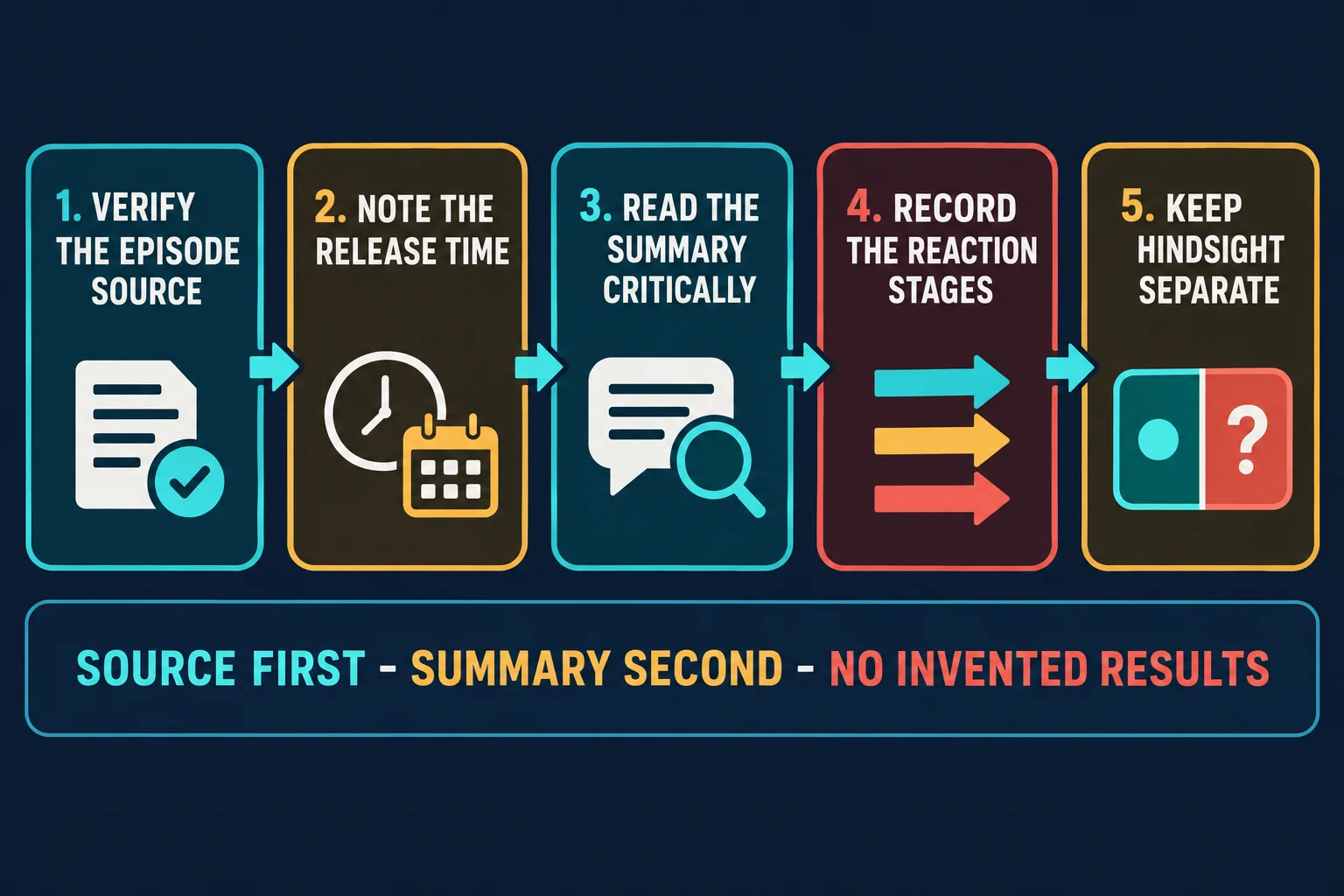
- Separate the source from the story. The primary source here is one 18-minute recording and its automatic transcript. A summary written by someone else is a secondary account, and this article does not rely on one.
- Treat machine transcription as imperfect. Specialised terms and numbers are the most likely casualties. Verify them against the audio before reusing any level, and expect genuine ambiguity to remain.
- Do not promote reported trades to verified results. A speaker’s description of entries, partials and a stop-out is not an account statement.
- Keep conditional language conditional. “If price does this, then that” is not a prediction that the first part will happen.
- Attribute causation carefully. A CPI or PPI release is a scheduled, published event, but the link between a release and a particular index move is an interpretation, not a measurement.
- Check your own constraints. Funded traders should verify current news-trading, maximum-loss, trailing-drawdown, position-size and prohibited-conduct rules before taking on scheduled-release volatility.
Watch the original recording on YouTube
This recording cannot be played inside another website. An embedded player test run on 2026-09-13 from a BestProps page origin returned, from the player itself, “Playback on other websites has been disabled by the video owner”, so no player area is reserved here and no blank embed is left behind. The recording remains available directly on YouTube.
Sources for CPI timing, definitions and this episode
Three pages on the U.S. Bureau of Labor Statistics site were read directly on 2026-09-13. None of them reports a market reaction, an NQ price or anything about the recording reviewed above.
The bureau’s home page for the series defines it as a measure of the average change over time in the prices paid by urban consumers for a market basket of consumer goods and services.[1] That is the release referenced in the episode title: a measure of consumer prices, not a statement about equity-index futures direction or about any session’s outcome. Each published release also carries its own transmission line — the page read for this article states that transmission of material was embargoed until 8:30 a.m. ET on its publication date[2] — which is why a CPI or PPI session can be planned around a published clock time rather than guessed. The figures on that cited release are not the July 2026 figures and are used only as evidence of how the release and its timing are presented. Because the episode discussed here is dated, the bureau’s own schedule of releases for the index[3] is the reference to check before treating a stated release date, or a description of what followed it, as verified.
For completeness, an independent third-party archive page for this episode is listed below[4]. It is unofficial, it was not written by this site or by the channel, it was not used as the source for this review, and its summary of the session is not relied on anywhere above.
Sources
- [1] U.S. Bureau of Labor Statistics: CPI Home (definition of the Consumer Price Index, read 2026-09-13)
- [2] U.S. Bureau of Labor Statistics: Consumer Price Index Summary (published release showing the 8:30 a.m. ET embargo convention, read 2026-09-13)
- [3] U.S. Bureau of Labor Statistics: Schedule of Releases for the Consumer Price Index (official publication calendar for the series, read 2026-09-13)
- [4] ICT Archivist: episode page for Post CPI NQ Futures Commentary (unofficial third-party archive, reachable 2026-09-14, not used as a source for this article)
The primary source for everything attributed to the speaker above is the recording itself, Post CPI NQ Futures Commentary \ Monday Analysis Delivered – 07/15/2026, reviewed through its own timestamped transcript. BestProps is not affiliated with the U.S. Bureau of Labor Statistics or with The Inner Circle Trader, and no source listed here endorses this article, this site or any setup. No result described in the episode is verified here, nothing on this page demonstrates a tested or repeatable edge, and the reported levels and dollar figures carry the uncertainty of automatic transcription.