Key takeaways
Maverick Trading and Vanquish Trader offer two different routes to options prop trading.
Read the full summary
Maverick Trading and Vanquish Trader offer two different routes to options prop trading. Maverick advertises an application-based equity-and-options contractor role, firm capital and a 65% to 90% profit split. Vanquish offers a monthly paid simulated program; its terms say no orders reach live markets and rewards depend on simulated performance. Maverick is the more relevant starting point for traders seeking a contractor capital-allocation arrangement; Vanquish is relevant to traders specifically seeking a simulated options evaluation. Neither is a universal winner. Confirm listed contracts, permitted spreads, position valuation, assignment handling and the complete fee schedule before joining.
How we researched this article
BestProps used document-based research from primary firm sources, checked September 12, 2026. The complete source list, scope, limitations, and commercial-state record appear near the end of this article.
Finding the best prop firms for options trading is harder than comparing headline funding amounts or profit splits. Many retail prop firms focus on futures, forex, contracts for difference, or crypto perpetuals, not exchange-listed options. Even when a company uses the word “options,” access may depend on the account stage, contract type, platform, jurisdiction, or strategy.
The strongest distinction between these candidates is the account model, not the headline split. Maverick explicitly describes options as a core market in its contractor role. Vanquish explicitly discloses simulation in its program terms. That makes them a useful shortlist, but not interchangeable products or a ranking of payout reliability.
Quick answer: Do not pay or apply until the firm confirms (in current official documents) that your account can trade the exact equity, index, or futures options you want. Verify multi-leg order support, buying-power rules, drawdown calculations, assignment procedures, fees, and whether the funded account is live or simulated.
Why Options Prop Firms Are Hard to Compare
Options accounts create issues that do not appear in a simple futures or forex comparison. A position’s value can change because of the underlying price, implied volatility, time decay, liquidity, and the pricing method used by the platform. Short options can also create assignment and margin exposure that is difficult to capture with a basic daily loss limit.
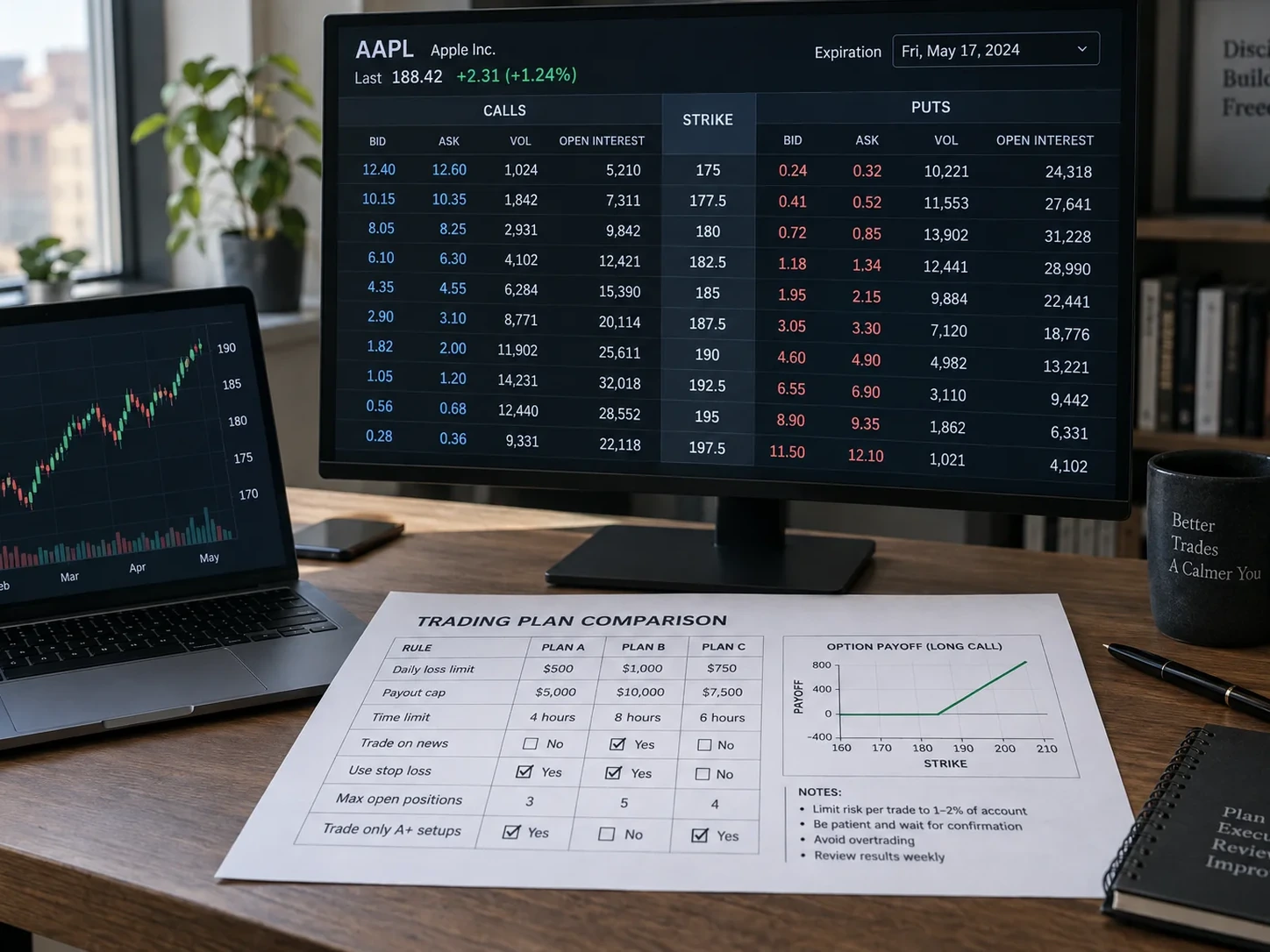
This helps explain why search results often blur several different products. A firm offering futures is not automatically offering options on futures. A CFD that tracks an index is not an index option. A crypto perpetual contract has no conventional option premium, strike, or expiration date. These products should not appear in the same options ranking unless they are clearly separated.
Options Trading Products to Compare Separately
| Product | What it is |
|---|---|
| Equity options | Exchange-listed contracts linked to individual stocks. |
| Index options | Contracts linked to an index, with settlement and exercise terms determined by the specific product. |
| Options on futures | Options whose underlying instrument is a futures contract. |
| Futures | Standardized derivatives, but not options themselves. |
| CFDs | Broker-issued contracts that may track an asset without providing ownership of a listed option. |
| Crypto perpetuals | Derivatives without a conventional expiration date; they are not options. |
If a firm only supports one of the last three categories, it may be an options-adjacent alternative, but it should not be described as a funded options trading account.
Options Prop Firms Worth Investigating
The comparison below uses Maverick’s published contractor role and Vanquish’s program terms. Their descriptions establish the advertised structure; the individual agreement still determines access, costs and risk limits.

| What to compare | Maverick Trading | Vanquish Trader |
|---|---|---|
| Account model | Application-based equity-and-options contractor program; the role page says the program uses firm capital and is not a challenge or demo evaluation | Simulated program; current terms say trades are hypothetical, no real funds are traded and no orders reach live markets |
| Payout terms | 65% to 90% profit split stated on its role page | Performance payouts are rewards tied to simulated results, not proceeds from live trading |
| Cost | Request the current program agreement and confirm capital access, trader costs, profit-sharing terms and platform support | Monthly subscribers only; plans use program-specific targets, drawdown, trade-count, subscription and position-holding rules |
| Eligibility | Application-based; confirm capital allocation and eligibility requirements directly | Eligible U.S. residents aged 18 or older who remain monthly subscribers and pass the applicable evaluation |
| Evidence status | First-party promotional claim requiring contract-level confirmation | First-party terms claim requiring contract-level confirmation |
Maverick Trading Options Prop Firm
Maverick Trading markets an application-based equity-and-options contractor program. An official Maverick role page says the program uses firm capital, is not a challenge or demo evaluation, and offers a 65% to 90% profit split. These remain first-party promotional claims, so applicants should confirm the applicable agreement, capital allocation, costs, payout terms, and eligibility before joining.
A prospective applicant should request the current program agreement and determine whether participation is an employment-style, membership, educational, evaluation, live-capital, or simulated arrangement. Other essential questions include which option exchanges and underlyings are available, whether approval tiers apply, and whether the firm permits spreads or uncovered short options.
Maverick may be relevant to experienced traders who are comfortable with an application-based model rather than a quick online challenge. However, current capital access, trader costs, profit-sharing terms, platform support, and eligibility requirements should be confirmed directly.
Vanquish Trader Options Prop Firm
Vanquish Trader markets options and advanced-options evaluations, but its current terms identify the program as simulated. The terms say trades are hypothetical, no real funds are traded, and no orders reach live markets. Performance payouts are rewards tied to simulated results, not proceeds from live trading.
Vanquish’s current terms limit participation to eligible U.S. residents aged 18 or older who remain monthly subscribers and pass the applicable evaluation. Its options plans use program-specific targets, drawdown, trade-count, subscription, and position-holding rules that can change. Confirm the exact plan table and performance-account rules before paying.
Other Options Prop Firms and Comparison Sites
Velotrade and Audacity Capital publish options-related material, but an educational article is not an instrument list. Futures, forex CFDs and crypto perpetuals do not become listed options simply because a firm discusses options strategies. Compare those alternatives separately unless the provider explicitly documents the contracts available in the account.
Prop Firm Match and Myfxbook can help identify candidates. Use the provider’s instrument list, agreement and platform documentation to decide whether an account supports the options strategy you actually trade.
How to Compare Options Prop Firms
A useful comparison begins with product eligibility and account structure. Profit split is important only after confirming that the trader can execute and manage the intended strategy.
Confirm Which Options Contracts You Can Trade
Ask for a written instrument list. “Options available” is too broad. Confirm whether access covers equity options, index options, or options on futures, along with eligible exchanges, expiration cycles, and underlyings. Determine whether the list changes between evaluation and funded stages.
Check Which Options Strategies Are Allowed
A platform displaying an options chain does not mean every strategy is permitted. Verify long calls and puts, covered calls, debit spreads, credit spreads, calendars, butterflies, iron condors, and uncovered short options separately. Ask whether all legs can be submitted as one order and whether positions may be adjusted without temporarily violating exposure limits.
Understand Prop Firm Drawdown Rules
Options can show wide bid-ask spreads or abrupt mark changes. BestProps’ prop firm drawdown rules guide explains common static, daily, maximum, and trailing mechanics. Options traders also need to know whether drawdown uses bid, ask, midpoint, last trade, or another valuation. Confirm whether unrealized losses count, whether the threshold is static or trailing, and whether it is measured intraday or at the end of the session.
A static threshold is not automatically better. Its suitability depends on its size, valuation method, buying-power rules, and the trader’s strategy. Review the firm’s complete risk framework rather than choosing based on one label.
Verify Options Assignment Exercise and Expiration Rules
Ask what happens when a short option is assigned or a long option finishes in the money. Determine whether the account can hold the resulting shares or futures position, whether the firm closes contracts before expiration, and who bears exercise or assignment charges. Also check for restrictions around expiration day, earnings announcements, and market close.
Identify the Prop Firm Account Model
“Funded” can describe different arrangements. Trading may occur in a live brokerage account, a simulated setting with performance-based rewards, an educational program, or a professional application model. Each can have different execution, counterparty, and payout implications.
Read the agreement rather than relying on homepage language. The document should explain who provides the account, whether orders reach a live market, how rewards are calculated, and what happens when rules change.
Calculate the Full Cost of Options Trading
Look beyond an initial evaluation fee. Potential costs can include recurring subscriptions, resets, activation, market data, platform access, commissions, exchange fees, exercise or assignment charges, and withdrawal-related conditions. None should be assumed unless they appear in current official documentation.
Options Prop Firm Verification Checklist
Before paying or submitting an application, obtain written answers to the following:
- Which listed option contracts are available in each account stage?
- Is trading live, simulated, or switched between the two?
- Which single-leg and multi-leg strategies are permitted?
- How are option positions marked for drawdown purposes?
- Do unrealized gains increase a trailing loss threshold?
- How is buying power calculated for spreads and short options?
- Are positions allowed through expiration, earnings, or overnight sessions?
- How are exercise, assignment, and resulting underlying positions handled?
- What are all mandatory and conditional costs?
- What payout conditions apply, and can the firm change them?
- Which countries and trader types are eligible?
- Where are the current rules, pricing, and account agreement published?
Save dated copies of the terms used in your decision. Prop-firm programs can change, and an older review or search snippet may no longer describe the available account.
What Options Traders on Reddit Say
A Reddit discussion about options prop firms reflects frustration about limited choice, costs, and qualification requirements. These comments are useful as qualitative audience evidence: they show the questions and concerns real traders raise.
Community posts are not proof that a firm is reliable, expensive, or unsuitable. Users may discuss different account versions, jurisdictions, or time periods, and their experiences cannot verify current rules. Use forum discussions to create questions for the firm, not as substitutes for official documentation.
Which Options Prop Firm Is Best?
For an application-based route, Maverick is the stronger fit of these two candidates: its role description explicitly offers equity-and-options trading with firm capital and performance-based scaling. For a simulated evaluation, Vanquish is the closer match, provided its subscription and reward conditions suit you. The difference is a product-fit judgment, not an endorsement of either firm’s execution or payout record.
The best match is the firm that verifies your exact contracts and strategies, clearly documents its account model, and provides risk rules compatible with options pricing and expiration mechanics. If those facts are unavailable, the prudent choice is to keep researching rather than treating an options-adjacent program as a true options prop firm.
Options and leveraged derivatives involve substantial risk. Prop-firm limits can reduce or terminate account access even when a strategy may have recovered later. This guide is general educational information and does not promise trading results or provide individualized financial advice.