
Key takeaways
We checked 32 prop firm listings for Zimbabwean traders and ranked the 10 products a Zimbabwean resident can buy with no stage bar or sanctions question, by cost per $1,000 of loss room at $50K: list price plus any activation fee, divided by the overall loss limit in dollars.
Read the full summary
We checked 32 prop firm listings for Zimbabwean traders and ranked the 10 products a Zimbabwean resident can buy with no stage bar or sanctions question, by cost per $1,000 of loss room at $50K: list price plus any activation fee, divided by the overall loss limit in dollars. Blue Guardian 2 Step Nano is cheapest at $25.40 on the fee alone ($127, $5,000 static floor), then AquaFunded 2 Step Elite at $44.32, E8 Markets E8 Pro 10% at $49.80, Alpha Capital Group Alpha Pro 10% at $53.40 and Maven Trading Standard 2-Step at $55.00. Only Alpha Capital Group and FundedNext Futures name Zimbabwe outright. Eighteen listings name Zimbabwe as restricted, including Goat Funded Trader and Tradeify 247, which leave Kenya, Ghana and Uganda off their lists. Topstep allows Express Funded Accounts but no live account, and The5ers and FundingPips carry sanctions clauses that could be read against Zimbabwe. FundedNext rules out bank and card payouts to Zimbabwe, E8 Markets’ wire partner lists Zimbabwe in US dollars, and no firm names EcoCash, InnBucks, OneMoney or ZIPIT. Prices are in US dollars, with ZiG at the October 2, 2026 interbank rate of 26.7653.

Checked: October 2, 2026, with country lists, payout pages and sanctions sources read again on October 4, 2026, and prices on October 3 and 4, 2026. Firms change prices, codes and country lists without notice, so confirm on the firm’s own page before paying. Each Trustpilot figure shows its own read date.
Editorial disclosure. BestProps has no affiliate or sponsor relationship with any firm in this guide and has received no money from any of them. Codes shown are published by the firms and are uncompensated. No firm reviewed this guide before publication. Full policy: affiliate disclosure.
Quick answer and the top five prop firms for traders in Zimbabwe
Ten of the 32 prop firm listings we checked sell at least one product a Zimbabwean resident can buy on their published terms with no stage bar and no sanctions question. Eighteen name Zimbabwe as restricted. Ranked on what you pay for each $1,000 the account can lose, these five come first:
- Blue Guardian 2 Step Nano: $25.40 per $1,000 (ZiG 680). List price $127 (ZiG 3,399); overall floor $5,000, static.
- AquaFunded 2 Step Elite: $44.32 per $1,000 (ZiG 1,186). List price $221.60 (ZiG 5,931); overall floor $5,000, static.
- E8 Markets E8 Pro 10%: $49.80 per $1,000 (ZiG 1,333). List price $249 (ZiG 6,665); overall floor $5,000, static.
- Alpha Capital Group Alpha Pro 10%: $53.40 per $1,000 (ZiG 1,429). List price $267 (ZiG 7,146); overall floor $5,000, static.
- Maven Trading Standard 2-Step: $55.00 per $1,000 (ZiG 1,472). List price $220 (ZiG 5,888); overall floor $4,000, static.
Blue Guardian is far ahead on the measure, but its payouts are capped at $1,000 per cycle on the Nano account and its country list is not called complete. Blue Guardian, AquaFunded and Maven Trading do not say whether an activation fee applies. For a payout route that names Zimbabwe, E8 Markets is third at $49.80; for a firm that names Zimbabwe in writing, Alpha Capital Group is fourth at $53.40.
What prop firms are and why traders in Zimbabwe use them
A proprietary trading firm, or prop firm, sells you an evaluation: a practice account with a profit target and loss limits. Pass it and the firm gives you a funded account and pays you a share of the profit you make on it, 80% to 95% at the firms in this guide. Every firm ranked here says the funded account is simulated, so the money you receive comes from the firm under its rules, not from trades placed in the market in your name.
The appeal for a Zimbabwean trader is the size of the account against the size of the fee. A $50,000 Blue Guardian 2 Step Nano costs $127, about ZiG 3,399, while trading $50,000 of your own money would mean finding the whole balance in US dollars. The trade-off is that the fee is spent if you break a rule, and the rules are strict: an overall loss limit, usually a daily loss limit, and sometimes limits on news trading, weekend holds or open losses.
Prop firms are also a way to trade global markets without moving a large balance abroad. The fee is a single card or crypto payment, and the risk is capped at that fee. Whether the profit then reaches you depends on the payout route, which is where Zimbabwe differs most from its neighbours.
A prop firm is not a ZSE stockbroker in Zimbabwe
Search for prop firms in Zimbabwe and most of the results are about something else: ZSE Direct, C-Trade, stockbrokers licensed by the Securities and Exchange Commission of Zimbabwe, and questions about buying Econet shares. Those are routes for buying shares listed in Zimbabwe through licensed local firms. Your money buys the shares, and they are yours.
A prop firm works the other way round. It is based abroad, sells a simulated evaluation priced in dollars or euros, and pays a share of profits under its own contract. It holds nothing for you and is not a broker. None of the firms in this guide claims a Zimbabwean licence. If you want to buy local shares, check the dealer on the Securities and Exchange Commission of Zimbabwe site; if you want a funded evaluation, read on.
How the prop firm funding process works for traders in Zimbabwe
Most products follow the same steps. You pay a one-time fee (Topstep bills monthly), trade the evaluation until you hit the profit target without touching a loss limit, pass a KYC check with your ID and often proof of address, sign the funded agreement, then trade the funded account and request payouts on the firm’s schedule. Two-step products add a second, easier target; one-step products have a single phase.
A worked example shows why the loss limit matters as much as the price. FundedNext Futures’ Flex costs $133.99, about ZiG 3,586, and ends at a $1,500 fall. E8 Pro 10% costs $249 and ends at a $5,000 fall. Per $1,000 of room, E8 costs $49.80 and FundedNext Futures $89.33, so the dearer account is the cheaper one if you need room to recover from a bad week.
Payouts come with deductions. At For Traders, a $1,000 profit at its 80% split is $800, and a Rise payout of $400 or more costs $50, leaving $750 before your bank’s own charges. At Blue Guardian and AquaFunded every payout loses 3%; at FundedNext up to 3.5%. E8 Markets’ WorkMarket wire to Zimbabwe costs 2%, between $10 and $30.
Profit split headlines hide caps. FTMO’s 1-Step and AquaFunded start at 90% and FundedNext Futures Flex at 95%, while most others start at 80%. E8 Pro lets you withdraw only half of your profit per request, Blue Guardian’s Nano caps each cycle at 2% of the balance, and Maven Trading caps every trader at $10,000 in 30 days, so the split alone does not tell you what reaches your account.
Can traders in Zimbabwe use prop firms
Yes, but fewer than in most African countries. Ten listings sell to Zimbabwean residents on their published terms with no stage bar and no sanctions question. Only two name Zimbabwe as a place they serve: Alpha Capital Group lists it in its country guide and checkout, and FundedNext Futures lists it as able to buy, trade and earn simulated rewards. The other eight publish a list of countries they will not serve and leave Zimbabwe off it.
Two firms present their lists as complete, so leaving Zimbabwe off is close to a yes: BrightFunded and FTMO. The rest use wording such as “include” or keep an open right to refuse, and the test differs from firm to firm: residence, citizenship, the country on your ID document, or where you log in from. Read lists to the end; Zimbabwe sorts last alphabetically and is the entry most often cut off in summaries.
Three more listings sit between yes and no. Topstep sells its Trading Combine to Zimbabwe but lists it among countries with “No Live Funded Account access”. The5ers and FundingPips leave Zimbabwe off their own country lists but have sanctions clauses that could be read against it. Each has its own section below.
Zimbabwe is on more prop firm restricted lists than Kenya, Ghana or Uganda
Zimbabwe is the most restricted African country in our series. Eighteen of the 32 listings we checked name Zimbabwe, and several of them leave Kenya, Ghana and Uganda off the same lists. So a list of firms that accept African traders tells a Zimbabwean very little.
The table compares the same firms’ answers for Zimbabwe and for the three countries in our earlier African guides. Goat Funded Trader and Tradeify 247 are the clearest cases: both name Zimbabwe and leave Kenya, Ghana and Uganda off. FundedNext’s card payout exclusion names Zimbabwe and none of the other three.
| Firm or listing | Zimbabwe | Kenya | Ghana | Uganda |
|---|---|---|---|---|
| Goat Funded Trader (forex) | Named | Not named | Not named | Not named |
| Tradeify 247 (crypto) | Named | Not named | Not named | Not named |
| FXIFY (forex) | Named | Named | Named | Not named |
| Tradeify (futures) | Named | Not named | Named | Named |
| Funded Trading Plus (forex) | Named | Not checked | Not checked | Not named |
| Instant Funding (forex) | Named | Not checked | Not checked | Not named |
| FundedNext card payouts | Excluded | Not excluded | Not excluded | Not excluded |
| FundedNext bank payouts | Excluded | Not excluded | Excluded | Excluded |
Neighbours are mixed. South Africa, Botswana and Mozambique are on none of the ranked firms’ sign-up lists, Zambia is on E8 Markets’ forex list and FundedNext’s card list, and Malawi and Lesotho are on FundedNext Futures’ purchase list. Topstep’s live-stage bar covers Ghana and Namibia as well as Zimbabwe.
Sanctions and Zimbabwe at prop firms, what the clauses point to
A few firms tie their country rules to sanctions lists, and one, OneUp Trader, still lists Zimbabwe under OFAC’s sanctioned countries. The lists those clauses point to say something narrower, and we read each one on October 4, 2026.
- United States: the Treasury’s sanctions office “is removing from the Code of Federal Regulations the Zimbabwe Sanctions Regulations as a result of the termination of the national emergency on which the regulations were based.” That took effect on April 17, 2024.
- European Union: Council Decision (CFSP) 2026/383 of February 17, 2026 deleted the travel ban and asset freeze, so “the framework only includes an arms embargo”, renewed until February 20, 2027.
- United Kingdom: its Zimbabwe regime targets designated persons and military goods and services.
- United Nations: the Security Council runs no Zimbabwe sanctions regime.
- FATF: Zimbabwe is on neither the call-for-action list nor the increased-monitoring list dated June 19, 2026.
So most clauses do not reach an ordinary Zimbabwean resident: Maven Trading’s UN clause, Topstep’s OFAC wording, and the person-level clauses at FTMO, BrightFunded and For Traders. Two do not settle so easily. The5ers asks you to declare you do not live in a place “subject to sanctions,” and FundingPips bars “countries on the FATF and EU/UN sanctions lists.” Because the EU’s arms embargo is still a regime named for Zimbabwe, both can be read either way. That is a question about the firm’s wording, not about you, and it is covered in the serious warning section below.
RBZ, SECZ and forex rules for prop traders in Zimbabwe
No Zimbabwean regulator licenses prop firm evaluations, and no firm in this guide claims to be licensed in Zimbabwe. Two bodies set the rules a Zimbabwean trader should read for themselves. The Reserve Bank of Zimbabwe sets exchange control, including how foreign currency can leave and enter the country, and publishes the official exchange rates. The Securities and Exchange Commission of Zimbabwe licenses securities dealers and advisers.
We do not say whether trading through a foreign prop firm is legal in Zimbabwe; that is a question for those regulators and a lawyer. The Reserve Bank’s website blocked our automated read on October 4, 2026, so this guide quotes nothing from it. Before paying, read the Reserve Bank’s current exchange control directives on paying for services abroad and receiving foreign income, and check anyone offering to trade for you against the SECZ’s licensed list. For which firms block Zimbabwe outright, see our Zimbabwe restricted country page, and for other countries our country tools.
Paying a prop firm from Zimbabwe in US dollars or ZiG
Every firm in this guide charges in US dollars except BrightFunded and FTMO, which charge in euros. A card drawn on a US-dollar account pays a dollar price with no conversion at your end; a ZiG card is converted at your bank’s own rate, plus any card fee. As a guide, the interbank rate of October 2, 2026 was ZiG 26.7653 per dollar, while First Capital Bank’s selling rate that day was 28.1036. Cash and street rates differ again, and we do not use them. Ask your bank which rate and fees apply before you pay.
If a card payment is declined, most firms here also take crypto (Blue Guardian through Confirmo, FTMO in several coins), and some take Skrill or PayPal, so keep a second route ready. Several firms insist the card is in your own name, and none names EcoCash, InnBucks, OneMoney or ZIPIT as a way to pay.
How prop firm payouts reach traders in Zimbabwe

No firm pays in ZiG. Payouts leave in US dollars, euros or crypto, and any conversion happens at your bank, the payout provider or a crypto exchange. The payout route is where Zimbabwe most often falls short: FundedNext and FundedNext Futures rule out bank transfer for Zimbabwe, FundedNext rules out card payouts too, and Maven Trading names bank transfer only for South Africa, Nigeria, Kenya and Ghana.
E8 Markets goes furthest. It pays through WorkMarket, whose Hyperwallet table lists Zimbabwe for wire transfers in US dollars with no limit and a 2% fee, at least $10 and at most $30. FTMO’s bank wire is not excluded for Zimbabwe either. Rise is the most common route, used by 8 of the 10 ranked firms; Rise’s own list of countries it does not serve, which E8 links, leaves Zimbabwe off, but the firms themselves rarely say whether Rise reaches you.
EcoCash is everywhere in Zimbabwe, yet no firm in this guide names it, InnBucks, OneMoney or ZIPIT for payouts. If the only working route is crypto, you need a way to turn USDT or USDC into dollars you can spend, at a rate you have checked.
| Payout route | Ranked firms using it | Pays in | Found for Zimbabwe |
|---|---|---|---|
| WorkMarket (Hyperwallet) wire | E8 Markets | USD | Zimbabwe listed; 2% fee, $10 to $30; no ZiG |
| Bank wire or transfer | FTMO, Alpha Capital Group | Not stated per country | No Zimbabwe exclusion and no Zimbabwe route named |
| EUR bank transfer | BrightFunded | EUR | Reach to Zimbabwean banks not stated; $5 to $50 bank fees |
| Bank transfer that leaves Zimbabwe out | FundedNext, FundedNext Futures, Maven Trading | Not available | Each firm’s own list for it skips Zimbabwe |
| Card payout | FTMO (card push), FundedNext | Not published | FundedNext’s card list names Zimbabwe; FTMO is silent |
| Rise (Riseworks) | 8 of the 10 ranked firms | USD or crypto | Not on Rise’s own unserved list; no ZiG option |
| Crypto (USDT or USDC) | Most ranked forex firms | Crypto | No Zimbabwe limit published; you convert yourself |
| Wise or Skrill | Alpha Capital Group (Wise), FTMO (Skrill) | Not published | No Zimbabwe-specific terms published |
| EcoCash, InnBucks, OneMoney or ZIPIT | None | Not offered | No firm in this guide names any of them |
KYC and verification for prop traders in Zimbabwe
KYC decides more than the checkout does. E8 Markets reads your country from the ID you upload, Alpha Capital Group wants a government photo ID and a selfie and compares login locations, Topstep checks citizenship and permanent residence together, and Tradeify 247 and FundingPips go by residence. At firms that test residence, a Zimbabwean living in South Africa is judged as a South African resident, and a foreign national living in Zimbabwe may be judged by passport.
Have a valid national ID or passport and a recent proof of address in your own name. Do not use a VPN, a borrowed card or someone else’s documents to get past a list: Apex Trader Funding warns that paying with a card from a restricted country is grounds for termination, FXIFY Futures warns that misrepresenting your residence can cost you the account, and Take Profit Trader blocks activity from listed countries by location. Verification problems are a recurring topic in the videos and posts Zimbabwean traders publish about prop firms, and a mismatch between ID, address and login country is the easiest one to avoid.
How we checked prop firms for Zimbabwe
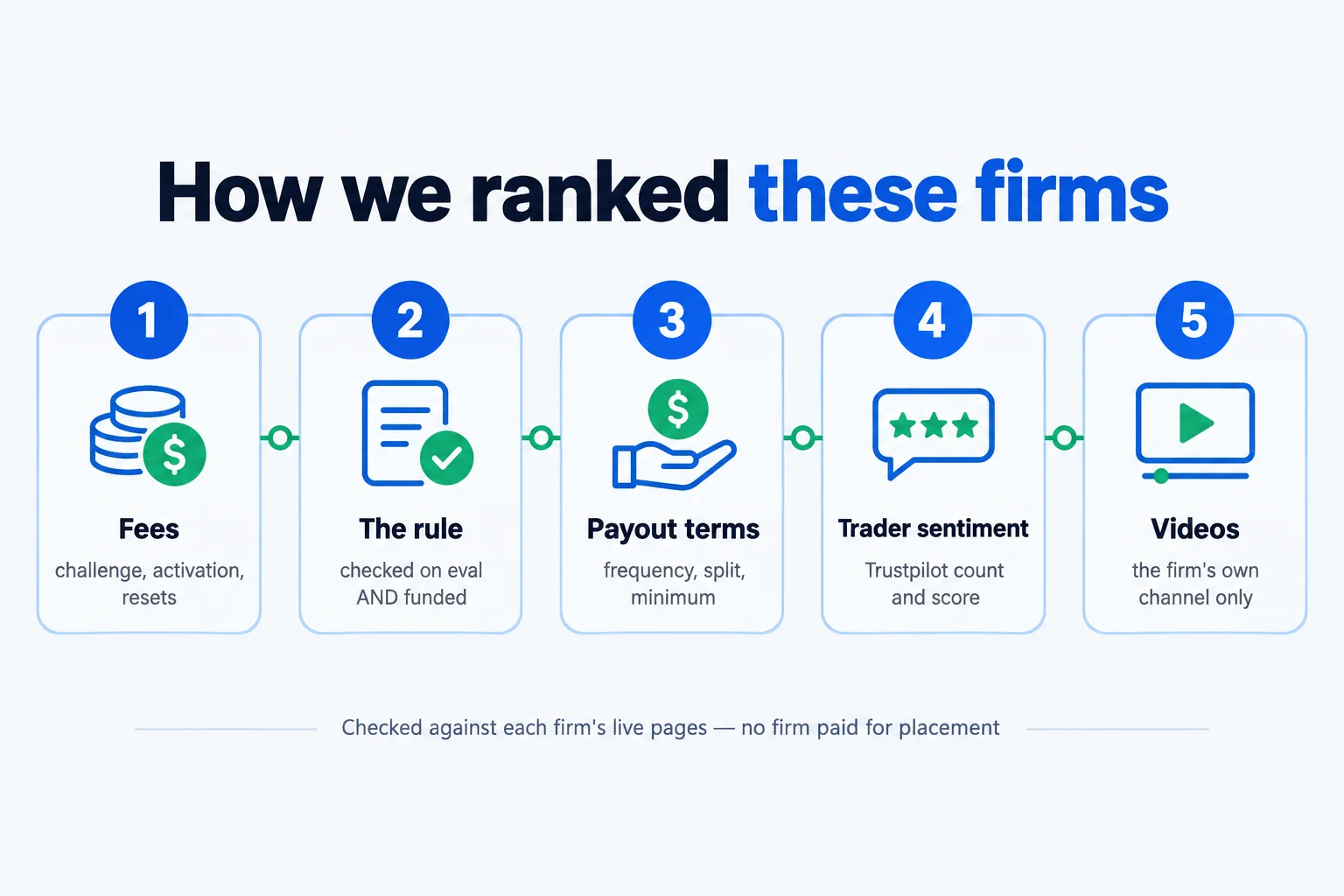
- Read each firm’s own restricted countries page, terms, help article or checkout for Zimbabwe, product by product, to the end of the list.
- Treat forex, futures and crypto arms of one brand as separate listings.
- Price every $50K variant at list price and add any activation fee; codes go in the firm notes only.
- Divide by the smallest overall loss limit in dollars at any stage, never a daily limit, and multiply by 1,000.
- Skip any product whose floor trails open profit, then rank each firm on its cheapest remaining product.
- Check every sanctions clause against the list it names, then note payout routes, live stage terms and Trustpilot.
A simulated funded account is how every ranked firm works, for every country, so it is a fact we state for each firm rather than a reason to drop one. Only a rule that names Zimbabwe, a stage bar for Zimbabwe, or a sanctions clause that can be read against Zimbabwe moves a firm out of the ranking. Where a firm does not publish an activation fee we rank on the fee alone and mark it.
Prop firms in Zimbabwe ranked by cost per $1,000 of loss room
Lower is better. The figure tells you what you pay for each $1,000 the account is allowed to lose, which is the comparison that matters if you expect to buy more than once. Every price is in US dollars, with ZiG in brackets.
| Rank, firm, product | Zimbabwe status | Price at $50K | Max-loss floor | Cost per $1,000 | Payout route |
|---|---|---|---|---|---|
| 1. Blue Guardian 2 Step Nano (forex) | Not on its published list; list not called complete | $127 (ZiG 3,399) | $5,000, static | $25.40 (ZiG 680)a | Rise from $500 or crypto under $5,000; 3% fee |
| 2. AquaFunded 2 Step Elite (forex) | Not on its published list; checkout menu is not proof | $221.60 (ZiG 5,931) | $5,000, static | $44.32 (ZiG 1,186)b | Crypto under $5,000 or Rise from $500; 3% fee |
| 3. E8 Markets E8 Pro 10% (forex) | Not on its forex list; its futures list names it | $249 (ZiG 6,665) | $5,000, static | $49.80 (ZiG 1,333) | WorkMarket wire lists Zimbabwe (USD); or Rise |
| 4. Alpha Capital Group Alpha Pro 10% (forex) | Named in its country guide and checkout | $267 (ZiG 7,146) | $5,000, static | $53.40 (ZiG 1,429) | Rise, Wise or bank wire in USD; crypto via Rise |
| 5. Maven Trading Standard 2-Step (forex) | Not on its list; no payout route named for it | $220 (ZiG 5,888) | $4,000, static | $55.00 (ZiG 1,472)c | Rise ($20 fee) or unnamed options |
| 6. FundedNext Stellar Lite (forex) | Not on its list; bank and card payouts exclude it | $229.99 (ZiG 6,156) | $4,000, static | $57.50 (ZiG 1,539)d | Crypto, Confirmo or RiseWorks; no bank or card |
| 7. BrightFunded 2-Step Classic (forex) | Not on its six-country list, called complete | €297, about $333.38 (ZiG 8,923) | $5,000, static | $66.68 (ZiG 1,785)e | EUR bank transfer or USDC |
| 8. For Traders Classic 2-Step (forex) | Not on any of its three lists | $343 (ZiG 9,180) | $5,000, static | $68.60 (ZiG 1,836) | Rise ($50 fee) or USDC ($25 fee) |
| 9. FTMO 1-Step Challenge (forex) | Not on its list of exceptions | €319, about $358.08 (ZiG 9,584) | $5,000, end-of-day trailing | $71.62 (ZiG 1,917)f | Bank wire, card push, Skrill or crypto |
| 10. FundedNext Futures Flex (futures) | Named: may buy and earn simulated rewards | $133.99 (ZiG 3,586) | $1,500, end-of-day trailing | $89.33 (ZiG 2,391) | RiseWorks or crypto; no bank transfer |
ZiG at the October 2, 2026 interbank rate of 26.7653 per US dollar (published by First Capital Bank Zimbabwe); your bank, card or bureau rate will differ.
Notes on this ranking: Cost per $1,000 is the list price of the firm’s cheapest $50,000 product that a Zimbabwean resident can buy and that has no floor trailing open profit, plus any activation fee, divided by the smallest overall loss limit in dollars at any stage, times 1,000. Daily loss limits, per-symbol rules and per-position rules are not used. Euro prices convert at the European Central Bank reference rate of October 2, 2026 (EUR/USD 1.1225). ZiG figures use the interbank rate of October 2, 2026 (1 USD = ZiG 26.7653) published by First Capital Bank Zimbabwe, rounded to the nearest ZiG 1; your bank, card or bureau rate will differ, and no firm here charges or pays in ZiG. a Blue Guardian names no activation fee for the 2 Step Nano and does not say there is none, so $25.40 is the evaluation fee alone. It would take a fee of about $94.60 to lose first place to AquaFunded. Its list of banned countries says “include,” so leaving Zimbabwe off it is not a written promise. b AquaFunded calls the fee “One-time fee • 100% refundable” and shows no activation step, but never states a $0 activation fee in words. A fee above about $27.40 would drop it below E8 Markets. Its 2 Step Pro is cheaper on paper ($28.64) but its floor trails open profit, so it is not ranked. c Maven Trading shows no activation line at checkout and does not state a $0 fee. A fee above about $10.00 would drop it below FundedNext. Its paid add-on that raises the floor to 10% ($275 for $5,000 of room) gives the same $55.00. d FundedNext does not name an activation fee for Stellar Lite either way. A fee above about $36.72 would drop it below BrightFunded. The price is for MT5; cTrader or Match-Trader adds $25 ($63.75). e BrightFunded prices in euros: €297 x 1.1225 = $333.38, so $333.38 / $5,000 x 1,000 = $66.68. For Traders is 2.9% dearer, so a euro rise of that size would swap them. f FTMO prices in euros: €319 x 1.1225 = $358.08. Its 1-Step floor trails the end-of-day balance and the fee is never refunded; the 2-Step Challenge (€345, about $387.26, static floor, fee refunded with the first reward) works out at $77.45.
Profit splits, platforms and live stage at prop firms for Zimbabwean traders
Same order as the ranking. The funded account column quotes how each firm describes it; the local rail column shows whether the firm names EcoCash, InnBucks, OneMoney or ZIPIT anywhere.
| Firm and product | Funded account | Platforms | Trader’s split | First payout | Local rail named | Live stage |
|---|---|---|---|---|---|---|
| Blue Guardian 2 Step Nano | Demo accounts, per its help centre | MT5, Match-Trader, TradeLocker | 80% | 14 days; capped at 2% of the balance per cycle | Not named | No live stage; all accounts are demo |
| AquaFunded 2 Step Elite | Simulated; the firm says payouts are real | MT5, TradeLocker, Match-Trader, cTrader (+$15) | 90%, 100% with a paid add-on | 14 days after the first funded trade; $100 minimum | Not named | No live stage; every account is simulated |
| E8 Markets E8 Pro 10% | Demo accounts at every stage | MT5, cTrader, TradeLocker, Match-Trader | 80%, 100% option at a higher price | 1% profit ($500); half the profit per request | Not named | No live stage; every account is demo |
| Alpha Capital Group Alpha Pro 10% | Simulated; Alpha Prime live accounts later | MT5, cTrader, DXtrade, TradeLocker | 80%, 90% with a paid add-on | 5 trading days and $100 realised profit | Not named | Alpha Prime move; decliners get a final payout |
| Maven Trading Standard 2-Step | Simulated with virtual funds | Match-Trader, MT5 | 80%, 90% with a $33 add-on | 3 profitable days per stage; every 10 business days | Not named | No live stage; all trading is simulated |
| FundedNext Stellar Lite | Simulated funded stage, per its terms | MT5; cTrader or Match-Trader (+$25) | 80% on the standard payout plan | 21 days, then every 14 days | Not named | Not published; the funded stage is simulated |
| BrightFunded 2-Step Classic | Demo accounts only, per its terms | MT5, cTrader, DXtrade | 80%, 90% with a paid add-on | 30 days after the first funded trade | Not named | No call-up; demo accounts only |
| For Traders Classic 2-Step | Demo trading with fictitious funds | TradeLocker, cTrader, MT5 | 80% | Every 14 days; 3 profitable days, $100 minimum | Not named | No call-up; all trading is demo |
| FTMO 1-Step Challenge | Fully fictitious funds | MT4, MT5, cTrader, TradingView | 90% | Day 14 after the first trade; 50% best-day rule | Not named | No live stage; accounts |