Key takeaways
Current official sources checked August 26, 2026 confirm that FundedNext prohibits HFT.
Read the full summary
Current official sources checked August 26, 2026 confirm that FundedNext prohibits HFT. FTMO permits algorithmic trading and EAs only within its current strategy and server-use limits, so neither source supports labeling FTMO or FundedNext HFT-friendly. FTUK, Optimal Traders, FundwayPlus, FunderPro, Bulenox, OneUp Trader, Hola Prime, Sabio Trade, QT Funded, E8 Markets, TradingFunds, Blue Guardian, Nova Funding, and Next Step Funded remain research leads only, with conflicting evidence noted for FunderPro. Classify each firm as Allowed, Conditionally allowed, Unclear, or Prohibited, defaulting to Unclear until official documentation explicitly covers the exact evaluation, simulated-funded, and live-funded phases. EA, bot, scalping, VPS, or platform permission does not prove HFT permission. Verify minimum and average holding times, orders, modifications and cancellations per minute, simultaneous-position limits, APIs, copiers, third-party EAs, duplicated strategies, static or trailing drawdown, balance or equity measurement, daily resets, commissions, spreads, slippage, payout reviews, and restrictions on latency arbitrage, reverse arbitrage, tick scalping, order flooding, server spamming, delayed-feed exploitation, cross-firm hedging, and account mirroring. Send support measurable strategy details, obtain written phase-specific approval, and save the response, official rules URL, product name, and verification date before purchasing or changing a bot.
How we researched this article
BestProps used document-based research from primary firm sources, checked September 12, 2026. The complete source list, scope, limitations, and commercial-state record appear near the end of this article.
Finding prop firms that allow HFT is more complicated than locating a list of firms that permit expert advisors. In retail prop trading, terms such as HFT, algorithmic trading, automated trading, and scalping are often used interchangeably, even though they can describe very different strategies.
A firm may allow an EA while prohibiting latency arbitrage, tick scalping, order flooding, or trades held for only a few seconds. Its rules may also differ between an evaluation, a simulated funded account, and any live-funded setting. That makes an unqualified list of “HFT-friendly” firms potentially misleading.
Policy warning Prop-firm rules, products, platforms, and account phases can change without notice. The firms mentioned in search results for this topic have not been classified as HFT-friendly here because the supplied evidence does not include current official rules or written support confirmations. Verify your exact strategy directly with each firm before purchasing an evaluation.
Prop Firms That Allow HFT Comparison
Search results and third-party articles associate several firms with high-frequency or automated trading. However, those references are not enough to verify whether HFT is currently allowed, which account types qualify, or which execution methods remain prohibited.
For example, competitor content makes uncertain claims about FTUK, Optimal Traders, FundwayPlus, FunderPro, Bulenox, OneUp Trader, FTMO, Hola Prime, Sabio Trade, QT Funded, E8 Markets, TradingFunds, Blue Guardian, FundedNext, Nova Funding, and Next Step Funded. These names should be treated as a research shortlist, not as confirmed recommendations.
The evidence is especially unclear for FunderPro: the supplied research reports conflicting language about bots and HFT. Other claims appear in comparison pages, snippets, or community discussions without enough official documentation to establish the applicable account phase, minimum trade duration, order limits, or prohibited techniques.
Current official-source checks (August 26, 2026): FundedNext states that it does not allow HFT. FTMO says algorithmic trading and EAs may be used when they follow its rules, while its forbidden-practices policy bars ultra-high-speed tools or mass data entry used for manipulation, abuse, or unfair advantage and bars automated activity exceeding 2,000 server requests per day. These findings are narrow provider-policy checks, not proof that either firm permits a trader’s specific rapid strategy.
A responsible comparison should assign each firm one of four statuses:
| Status | What it means |
|---|---|
| Allowed | Current official rules explicitly permit HFT and define what the firm means by it. |
| Conditionally allowed | Rapid or automated trading is permitted subject to restrictions on trade duration, order volume, strategy type, platform, or account phase. |
| Unclear | The firm permits EAs, bots, or scalping but does not explicitly address HFT. |
| Prohibited | Current official rules expressly prohibit HFT or the execution method used by the trader. |
Until an official rule page or written support response answers the relevant questions, unclear is the appropriate classification. The absence of an explicit ban is not the same as permission.
What Prop Firms Mean by HFT
Institutional high-frequency trading generally involves highly automated systems, substantial message volume, specialized infrastructure, and extremely short execution timeframes. Most retail traders using prop evaluations do not have that infrastructure. In the retail-prop market, “HFT” may instead refer to an EA that opens many positions, a rapid scalping system, or a bot that holds trades for seconds.
This loose terminology creates a compliance problem. A trader may describe a strategy as ordinary automated scalping while a firm’s risk system classifies the same activity as prohibited high-frequency trading.
Important strategy characteristics include:
- The number of orders and modifications submitted per minute.
- Average and minimum position duration.
- Whether entries depend on price-feed delays or execution latency.
- Whether the system sends and cancels orders without intending to trade.
- Whether identical trades run across multiple accounts.
- Whether the EA was developed by the trader or purchased from a third party.
- Whether the strategy depends on a VPS, API, copier, or external signal service.
Permission to use an EA answers only one question: whether software can place or manage trades. It does not automatically authorize every strategy that the software can execute.
Prop Firm HFT Rules to Verify Before Buying
HFT Rules by Account Phase
Ask whether the policy applies separately to the evaluation, simulated funded, and live-funded phases. A technique accepted during an assessment may face different review standards later. Obtain an answer for the exact product you intend to use rather than relying on a general FAQ.

HFT Minimum Trade Duration Rules
Check whether positions must remain open for a minimum number of seconds or minutes. Also ask how the firm treats partial closes, stop orders triggered and closed quickly, and positions closed automatically by risk controls. A strategy with a longer average holding time can still violate a rule if some trades close too quickly.
HFT Order Frequency Rules
Look for limits on new orders, modifications, cancellations, simultaneous positions, or requests sent over a defined period. If no public limit exists, ask support whether the firm uses an unpublished threshold or “excessive activity” standard.
HFT Execution Tactics Firms Prohibit
Review the definitions of latency arbitrage, reverse arbitrage, tick scalping, order flooding, server spamming, delayed-feed exploitation, hedging across firms, and account mirroring. These labels are not always defined consistently. Ask how each restriction applies to your execution logic rather than assuming that your terminology matches the firm’s.
HFT Automation VPS and Platform Rules
Confirm that the relevant platform supports your EA or bot and that the firm permits the required integration. Platform availability does not prove that APIs, plugins, trade copiers, or every automated strategy are allowed. VPS permission likewise does not establish HFT permission; a VPS is simply infrastructure.
HFT Drawdown and Trading Cost Rules
High-turnover systems can be sensitive to commissions, spread, slippage, and the timing of equity-based drawdown calculations. Understand whether drawdown is static or trailing, whether it is measured using balance or equity, and when any daily threshold resets. Do not rely on a backtest that omits the firm’s execution conditions or applicable trading costs.
HFT Software and Copy Trading Rules
Some firms may distinguish between a personally developed EA, a commercially distributed bot, and a copier that reproduces trades from another account. Ask whether multiple traders using the same software could trigger a duplicated-strategy review. Never assume that buying an EA includes permission to use it under a prop firm’s rules.
HFT Review and Payout Rules
Request the rules governing compliance reviews before any payout request. Avoid relying on promotional summaries for payout timing, profit splits, or eligibility because those commercial terms are time-sensitive and were not verified in the supplied evidence.
Why Prop Firms Restrict HFT
Third-party articles commonly attribute HFT restrictions to simulation differences, infrastructure load, latency exploitation, execution risk, and monitoring limitations. These are plausible explanations, but they should not be treated as a verified statement about any particular firm unless that firm provides the explanation itself.
Prop evaluation systems may not reproduce every feature of live-market execution. A strategy that depends on tiny price differences or exceptionally fast fills may produce results that the firm considers non-replicable. High order and cancellation volumes can also create operational concerns. Firms may therefore restrict broad categories of activity rather than assess every algorithm individually.
These restrictions do not necessarily mean that all scalping or automated trading is banned. They mean traders need a precise, written interpretation of the rules before deploying a rapid strategy.
How to Verify HFT Rules With Prop Firm Support
Send support a concise description containing measurable details. Avoid asking only, “Do you allow HFT?” because the firm’s definition may differ from yours.
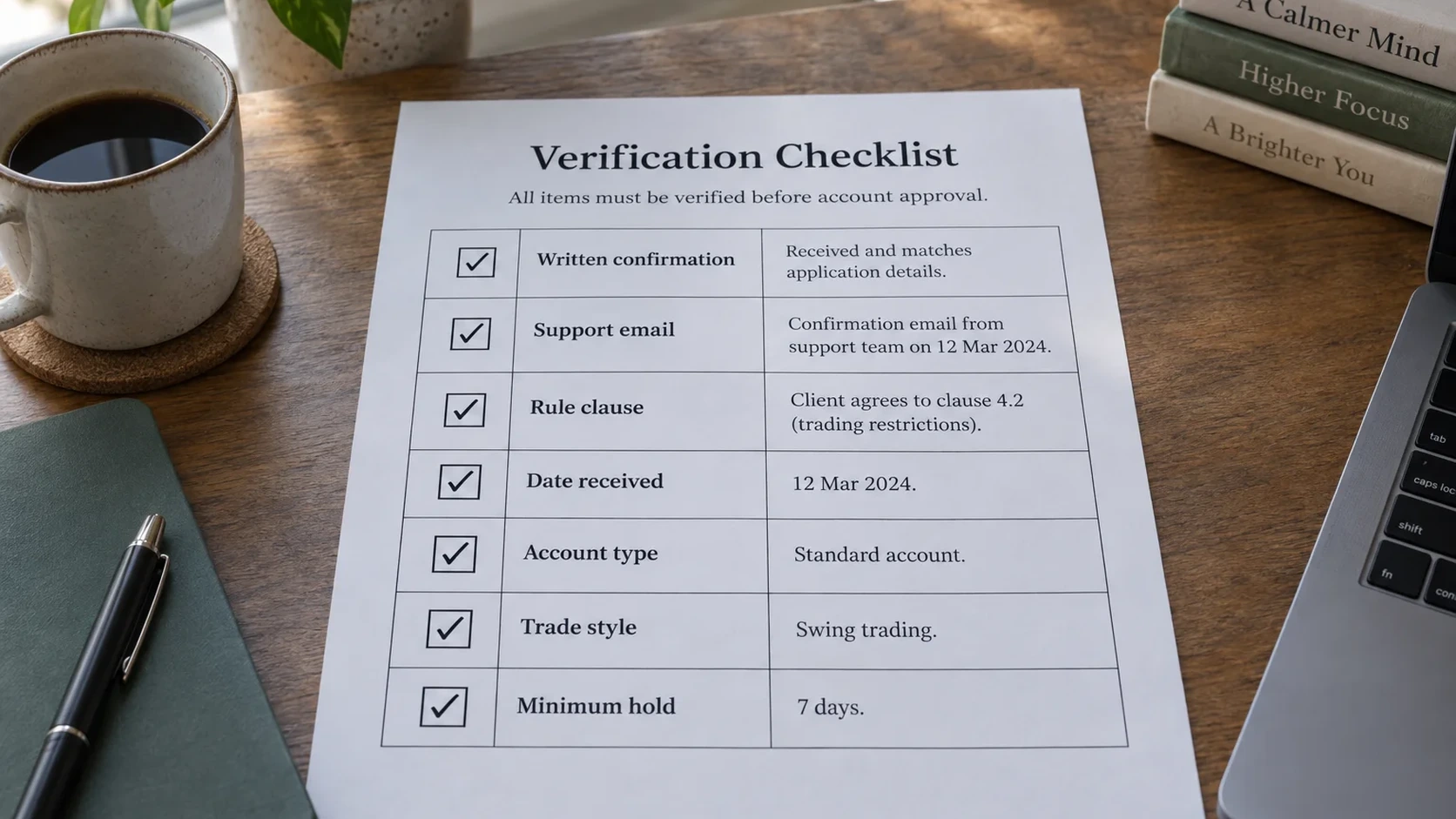
I plan to use an automated strategy on [account product and phase]. It submits approximately [number] new orders and [number] modifications or cancellations per minute. Its shortest expected holding time is [duration], and its average holding time is [duration]. It uses [platform, EA, API, VPS, or copier] and does not intentionally exploit delayed price feeds or execution latency. Is this strategy permitted during the evaluation and every funded phase? Are there minimum holding times, order-frequency limits, third-party EA restrictions, or other rules that apply?
Save the response, the URL of the applicable rules, the product name, and the verification date. Ask whether the answer remains valid if your order frequency increases or market volatility causes trades to close faster than expected. Written approval may clarify the policy, but it does not replace reading the complete agreement.
Prop Firm HFT Rules FAQ
Does Allowing EAs Mean a Prop Firm Allows HFT?
No. EA permission means automated software may be used under the applicable rules. The firm may still prohibit rapid order activity, short-duration trades, latency-based strategies, third-party bots, or other techniques.
Can HFT Rules Differ Between Evaluation and Funded Accounts?
They can. Always request confirmation for each account phase and the exact product under consideration. Do not assume that a general automation policy covers every phase.
Does Using a VPS Count as HFT?
Not by itself. A VPS hosts trading software closer to the platform’s infrastructure or keeps it running continuously. Compliance depends on what the software does, not merely where it runs.
Is Latency Arbitrage the Same as Rapid Scalping?
Not necessarily. Rapid scalping describes short-duration trading, while latency arbitrage generally refers to exploiting timing differences between price feeds or execution venues. A firm may restrict either or both, using definitions found in its own rules.
What Happens if a Firm Changes Its Rules After Purchase?
Contact support and request written clarification about which terms apply to the account. Keep dated copies of relevant rules and communications. Because policy-change procedures vary, no universal outcome should be assumed.
Choose Prop Firms That Allow HFT Carefully
The best prop firm for an automated trader is not simply one advertised as bot-friendly. It is one whose current rules explicitly accommodate the strategy’s real order frequency, holding time, software, and execution method across every relevant account phase.
Use third-party lists and Reddit discussions to find firms and questions worth researching, not as proof of permission. Verify the official rules, obtain a strategy-specific support response, and recheck the policy before purchasing or changing your bot. This verification-first process is more useful than a static ranking in a market where trading rules can change quickly.