Key takeaways
Prop firm trading limits personal cash exposure mainly to evaluation, reset, activation, subscription, platform, data and withdrawal fees, but imposes maximum drawdown, daily loss, position, holding, news, automation, copying and instrument rules, while self-funded brokerage trading exposes deposited capital directly but generally provides greater strategy freedom, account continuity and retention of gains after trading costs…
Read the full summary
Prop firm trading limits personal cash exposure mainly to evaluation, reset, activation, subscription, platform, data and withdrawal fees, but imposes maximum drawdown, daily loss, position, holding, news, automation, copying and instrument rules, while self-funded brokerage trading exposes deposited capital directly but generally provides greater strategy freedom, account continuity and retention of gains after trading costs and taxes. A prop account’s advertised balance B is less meaningful than its permitted loss D, especially when drawdown trails or includes open profits, and funded stages may be simulated rather than live. Compare total fees F with the simplified expected receipt P × S × G, where P is the documented probability of an eligible payout, S is the payout share and G is the eligible gain, then stress-test repeat fees, delayed eligibility and no payout. Prop programs may fit traders with limited risk capital and tested rule-compatible strategies, while personal accounts may better suit overnight positions, swing trades, news trading and automation. Verify simulated versus live status, static versus trailing drawdown, payout timing, refunds, termination terms, operator jurisdiction and aggregate exposure across accounts, and keep dated terms because rules can change. Neither model creates a profitable edge, both carry counterparty and loss risk, and simulation may be preferable if neither survives conservative cost analysis.
Prop firm trading vs trading your own capital is not simply a choice between a large account and a small one. The practical comparison involves usable risk, total costs, trading restrictions, profit retention, payout conditions and counterparty risk.
A funded-trader program may appeal to someone who has limited personal risk capital and can trade within strict rules. A personal brokerage account may suit someone who values flexibility, controls enough risk capital and accepts direct exposure to losses. Neither route makes a strategy profitable, and both can result in financial loss.
Educational notice: This comparison is general information, not individualized financial, legal or tax advice. Trading is risky. Verify every firm’s current rules and assess whether you can afford the applicable fees or losses.
Prop Firm Trading vs Your Own Capital
Consider a prop program when its loss limits, holding rules, permitted instruments and payout terms match a strategy you have already tested. The main attraction is limiting the personal cash committed to trading, although evaluation fees and other charges may accumulate.
Consider a personal account when strategy freedom, account continuity and retaining all trading gains before brokerage costs matter more than access to a nominally larger balance. The trade-off is straightforward: losses come directly from your capital.
Beginners should not assume a prop challenge is automatically safer or easier. Strict breach limits can stop account losses, but they can also lead to repeated evaluation purchases. Practising in simulation and keeping a trading journal may be more informative than immediately choosing either route.
How Prop Firm and Own Capital Trading Work
How Retail Prop Firm Programs Work
In a typical retail program, a trader pays to enter an evaluation or access an account under specified rules. If the trader satisfies the applicable conditions, the program may offer a funded-stage account and a share of eligible payouts. The exact structure varies substantially.
Importantly, a displayed account balance does not prove that the trader is placing orders with live firm capital. Some programs use simulated trading during evaluations, funded stages or both. Read the firm’s disclosures rather than assuming that “funded” means a live brokerage account.
How Traditional Prop Firms Trade Capital
Traditional proprietary trading can refer to a business employing or contracting traders to trade the firm’s capital. Recruitment, compensation, supervision and risk controls may differ from online evaluation programs. The two models should not be treated as interchangeable merely because both use the term “prop trading.”
How You Trade Your Own Capital
A self-funded trader deposits personal money with a broker and bears the resulting gains and losses. There is no third-party challenge to pass, but the broker’s margin requirements, product terms, commissions and other account conditions still apply. Broker and custody risks also deserve review.
Prop Firm vs Own Capital Comparison
- Upfront cost: A prop program may charge an evaluation fee and potentially reset, subscription, platform, data or other charges. A personal account requires a deposit and may involve brokerage or data costs.
- Loss exposure: Personal-account losses reduce the trader’s money. With a retail prop program, direct cash exposure may be centered on fees, but this depends on the contract and any recurring costs.
- Usable risk: Prop accounts are constrained by maximum drawdown, daily loss limits, position limits and related rules. Personal usable risk depends on deposited capital, leverage, broker requirements and the trader’s own limits.
- Profit retention: A self-funded trader generally keeps trading gains after applicable trading costs and taxes. Prop payouts are governed by the program’s sharing formula, eligibility rules and contract.
- Restrictions: Programs may regulate holding periods, news trading, automation, copying, instruments or position size. A personal account generally offers more discretion, subject to broker and market rules.
- Continuity: A rule breach may end a prop evaluation or account. A personal account remains open while it meets broker requirements, although losses can still make continued trading impractical.
- Counterparty exposure: Prop traders depend on the program honoring its terms and remaining operational. Self-funded traders depend on their broker and relevant service providers.
Why Prop Firm Capital Can Look Misleadingly Large
The headline balance is not the same as spendable money or an allowable loss budget. For decision-making, maximum permitted drawdown may be more relevant than nominal account size.

Suppose a hypothetical program displays a balance of B and permits a maximum loss of D. The practical risk envelope is closer to D than B. It may be smaller still when daily loss limits, trailing calculations or open-profit treatment apply. These mechanics can affect position sizing and strategy viability.
Compare that risk envelope with the amount you would genuinely be prepared to lose in a personal account, not with your savings, emergency fund or money required for living expenses. A larger displayed balance does not automatically create better returns or a better risk-adjusted opportunity.
When Prop Firm Trading Fits You
A funded program may be worth evaluating when:
- You want to limit the personal cash allocated to trading and can afford to lose the fees.
- Your tested strategy fits every relevant loss, holding and execution rule.
- You can follow mechanical limits without increasing risk to meet a target or deadline.
- You understand whether the account is simulated or live.
- You accept the payout process, profit-sharing arrangement and counterparty risk.
Rule discipline can provide structure, but it should not be confused with an edge. Traders may take poor-quality setups, oversize positions or abandon their plans when focused on passing an evaluation. A challenge target does not change market uncertainty.
When Trading Your Own Capital Fits You
A self-funded account may be more suitable when:
- You need flexibility for overnight positions, swing trades, news events or automation.
- You prefer to set your own drawdown and position limits.
- You want account continuity without evaluation targets or payout approvals.
- You have risk capital separate from essential savings and near-term obligations.
- You are willing to accept direct losses in exchange for retaining control of the account.
Freedom can also be a disadvantage. Without enforced limits, a trader can add to losing positions, overtrade or deposit more money after losses. Written risk limits, conservative position sizing and independent performance records remain important.
Prop Firm and Own Capital Costs and Break Even
A useful comparison should include more than the first evaluation fee. List all costs that could apply over a realistic review period:
- Initial evaluations and likely repeat attempts
- Reset, activation or subscription charges
- Platform, market-data and withdrawal-related charges
- Spreads, commissions and financing costs
- The portion of eligible profits retained by the program
- Personal-account brokerage costs and expected loss budget
For an illustrative framework, let F represent total prop fees, P the probability of reaching an eligible payout based on your own documented history, S your payout share under the current terms and G the hypothetical eligible gain. A simplified expected receipt is P × S × G, before taxes and other costs. Compare that figure with F and the opportunity cost of your time.
This is not a return forecast. If you lack enough records to estimate P, using an optimistic assumption can make the calculation misleading. Stress-test repeat fees, delayed eligibility and no payout rather than relying on the best case.
Can You Trade With a Prop Firm and Own Capital?
Some traders separate purposes: a personal account for flexible or longer-duration trades and a prop account for a rules-compatible strategy. This can diversify account structures, but it does not necessarily diversify market risk.
Mirroring correlated positions may multiply exposure. Copy trading or coordinated execution may also be prohibited by a program or restricted in certain circumstances. Review all applicable terms before trading accounts together, and calculate aggregate exposure across them.
Prop Firm Trading Due Diligence Checklist
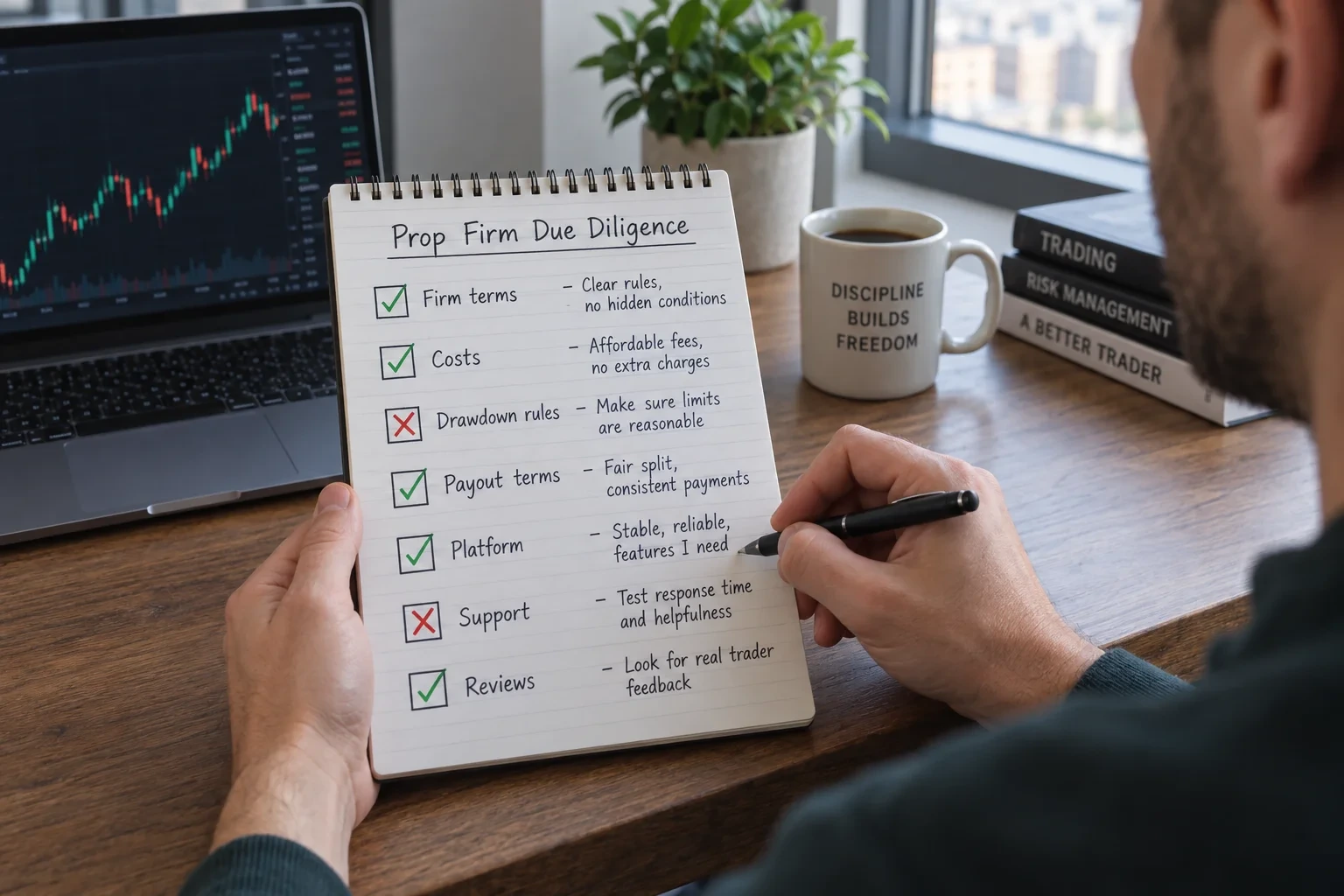
- Identify the account model. Determine whether evaluation and funded stages are simulated or live.
- Map every cost. Check evaluations, resets, subscriptions, activation, platforms, data and withdrawal-related charges.
- Study drawdown calculations. Confirm whether limits are static or trailing and how open positions, commissions and time zones affect them.
- Check strategy compatibility. Review news, overnight, weekend, scalping, automation and copying provisions.
- Read payout conditions. Examine eligibility timing, calculation methods, documentation requirements and circumstances that may invalidate a payout.
- Review refunds and termination. Understand when fees are refundable and what happens after a breach or account closure.
- Assess the operator. Review current legal disclosures, contracting entity, jurisdiction, operating history and support channels without relying solely on affiliate reviews.
- Save the terms. Keep a dated copy because rules and offers can change.
Prop Firm vs Own Capital Decision Checklist
Before deciding, answer these questions honestly:
- What is my maximum affordable cash loss, including repeat fees?
- Does my documented strategy fit the account’s exact rules?
- Am I comparing allowable drawdown rather than advertised balance?
- How would a trailing limit affect my position sizing?
- Do I need overnight, news, automation or copying flexibility?
- Can I tolerate losing personal capital, or would that distort my decisions?
- Have I considered firm, broker and operational risks?
- Have I verified the current tax and legal treatment where I live?
The better model is the one whose risks, costs and constraints you understand and can follow consistently. If neither survives a conservative cost analysis, continued simulation may be the more useful next step.
Prop Firm and Own Capital Trading FAQs
Is a Prop Firm Safer Than Using Your Own Capital?
It may limit direct trading-capital exposure, but fees can accumulate and firm-related risks remain. “Safer” depends on the contract, trader behavior and comparison being made.
Do Prop Traders Always Trade Real Capital?
No. Retail programs may use simulated accounts at one or more stages. Verify the firm’s current disclosures.
What Happens After a Prop Firm Rule Breach?
Consequences vary and may include account closure or loss of eligibility. Review the applicable terms before paying.
Which Option Fits Swing Traders Better?
A personal account often provides greater holding flexibility. A prop program may still fit if it expressly permits the strategy and its drawdown mechanics are compatible.
How Are Prop Firm Payouts Taxed?
Treatment depends on jurisdiction, contract and personal circumstances. Consult a qualified local tax professional rather than applying a universal classification.