Key takeaways
A prop firm scaling plan increases permitted contracts, lots, or nominal account allocation after performance milestones, with futures programs typically unlocking contract limits and forex or CFD programs typically enlarging allocations after reviews.
Read the full summary
A prop firm scaling plan increases permitted contracts, lots, or nominal account allocation after performance milestones, with futures programs typically unlocking contract limits and forex or CFD programs typically enlarging allocations after reviews. Core rules include the starting limit, qualifying metric, review timing, size increase, reversal policy, maximum ceiling, drawdown method, daily loss limit, minimum trading days, consistency conditions, payout effects, contract equivalence, and breach consequences. Illustrative examples move from 2 to 4 to 6 futures contracts at balance milestones or begin at 50,000 allocation units before later reviews, but these are fictional rather than current firm terms. Traders should distinguish evaluation from funded-stage rules, calculate usable risk in currency rather than relying on account labels, verify whether tiers are upward-only or reversible, and model how losses, withdrawals, inactivity, commissions, fees, and trailing or static drawdowns affect eligibility. Apex Trader Funding, FunderPro, Take Profit Trader, and Reddit’s Daytrading community offer explanatory or experiential material, but all provider claims and community comments should be checked against current official documentation because rules can change.
How we researched this article
BestProps used document-based research from primary firm sources, checked September 12, 2026. The complete source list, scope, limitations, and commercial-state record appear near the end of this article.
A prop firm scaling plan is a framework for increasing a trader’s permitted position size or account allocation after specified performance conditions are met. The phrase sounds straightforward, but it commonly describes two different systems: increasing contract limits in futures programs and increasing nominal account allocation in forex or CFD-style programs.
That distinction matters. A plan that unlocks more contracts as an account balance rises operates differently from one that reviews performance periodically and assigns a larger account. Traders should therefore compare the underlying rules rather than relying on a headline such as “scale to a larger account.”
Important: Scaling rules, drawdown calculations, payout conditions and account limits can change. Always confirm the current terms in a firm’s official documentation before purchasing an evaluation or changing position size. Prop trading involves substantial risk, and scaling does not improve the probability of profitable results.
What Is a Prop Firm Scaling Plan?
A prop firm scaling plan provides staged access to trading size. Instead of making the program’s maximum size available immediately, the firm sets milestones that may make additional contracts, lots or nominal account allocation available.
Milestones can involve net profit, end-of-day balance, minimum trading days, consistency requirements or a scheduled review. Depending on the program, scaling may be automatic, require manual approval or remain subject to a risk review.
Firms may use staged access to control exposure and observe how traders perform before permitting larger positions. For traders, scaling can create a defined route to more capacity. However, a larger limit also increases the potential dollar impact of mistakes. The permission to trade more is not an instruction to do so.
Prop Firm Scaling Plan Types
Contract Size Scaling
Contract scaling is common in futures-oriented programs. The account begins with a maximum number of contracts. Additional contracts become available after the balance or profit reaches defined tiers.
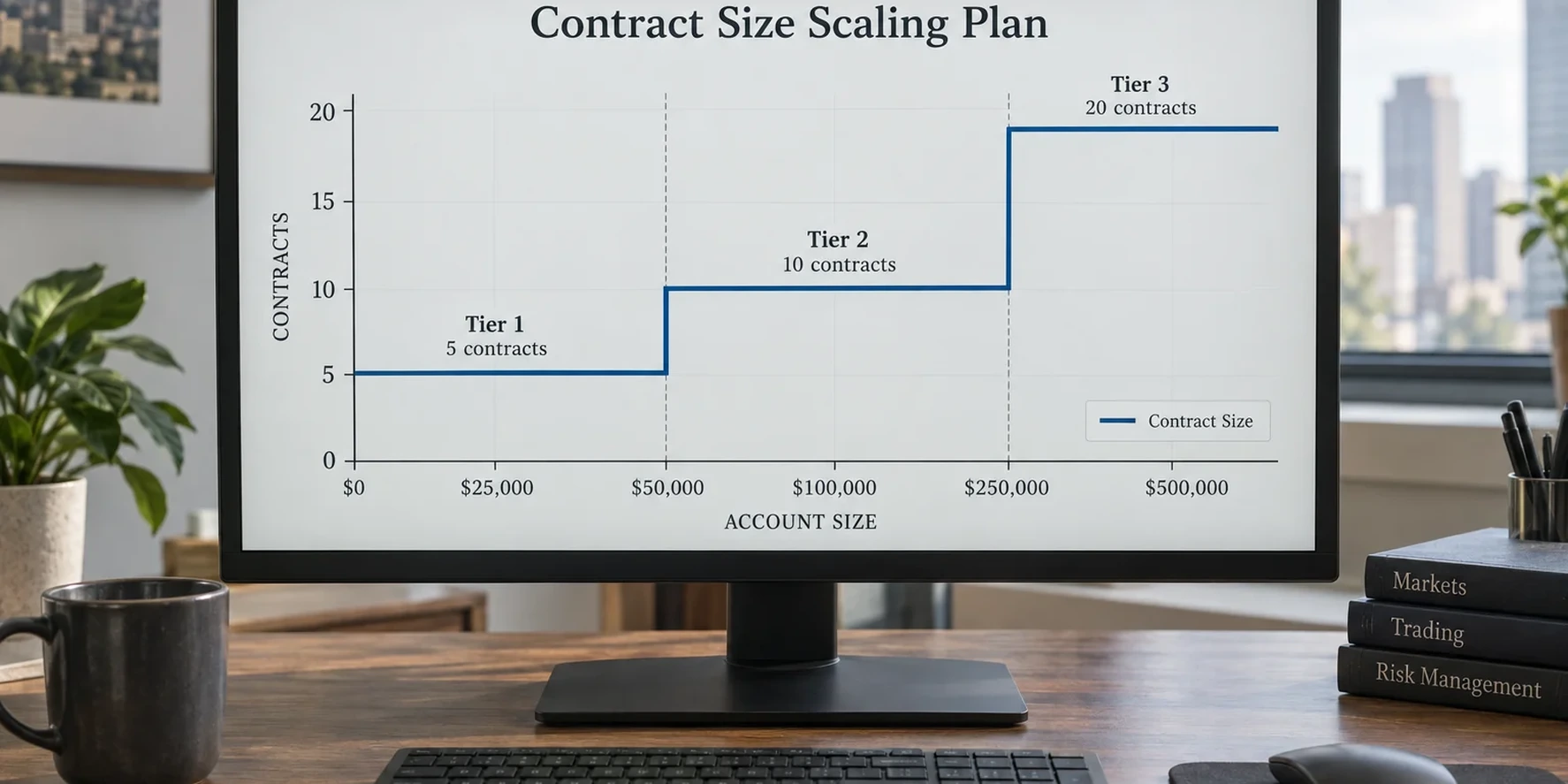
For example, a hypothetical plan might allow two contracts at its starting tier, four after the account reaches one milestone and six after another. These figures are illustrative only and do not represent any firm’s current rules.
Contract plans also need to explain how smaller contracts are counted. A firm may apply a conversion ratio between standard and micro contracts, but that ratio varies and must be checked in the official rules. Traders should also determine whether a tier is measured using intraday equity, realized balance or an end-of-day figure.
Account Allocation Scaling
Allocation scaling is often associated with forex or CFD-style funded programs. A trader starts with a stated account allocation and may become eligible for a larger allocation after meeting performance and time-based conditions.
An allocation increase might occur after a review period rather than as soon as a balance crosses a threshold. Eligibility may depend on profitability, rule compliance, trading-day requirements or payout history. The increased number displayed as account size does not, by itself, explain actual risk capacity. Drawdown limits and loss calculations determine how much room the trader has.
Neither model is inherently better. Contract scaling emphasizes position limits, while allocation scaling emphasizes the nominal size assigned to an account. Both must be evaluated alongside drawdown and breach rules.
How a Prop Firm Scaling Plan Works
Although details differ, many plans can be understood through six components:
- Starting limit: The initial number of contracts, lots or amount of account allocation available.
- Qualifying metric: The balance, realized profit, trading period or other condition used to determine eligibility.
- Review timing: Whether scaling occurs immediately, at the end of a session or after a scheduled review.
- Size increase: The additional capacity unlocked at each stage.
- Reversal policy: Whether a higher tier remains available or can decrease after losses or withdrawals.
- Maximum ceiling: The largest position limit or allocation permitted under the current program.
The stage at which scaling applies is also important. Some programs may use position limits during an evaluation, while others reserve account growth for traders who have completed the evaluation. Do not assume evaluation-stage and funded-stage rules are identical.
Prop Firm Scaling Plan Examples
Contract Scaling Tier Example
Assume a fictional futures program starts a trader at two contracts. After the qualifying balance reaches Milestone A, the limit increases to four. Reaching Milestone B increases it to six.
If tiers are upward-only, falling below Milestone B might not reduce the six-contract limit. Under a reversible system, the limit could return to four. If a payout lowers the qualifying balance, it might also affect the tier. The plan’s exact balance definition decides the result.
Allocation Scaling Growth Example
Now assume a fictional allocation program begins at 50,000 units. Following a review period, a trader who satisfies every stated condition becomes eligible for a larger allocation. A later review may permit another increase.
The headline allocation is not enough to compare this plan with another. If the drawdown remains fixed, trails the account or resets under specified circumstances, usable risk can differ substantially. Traders should calculate the permitted loss in currency terms rather than comparing account labels alone.
As a current provider-specific example, the official My Funded Futures Pro Plan table checked August 23, 2026 lists a maximum of 15 mini contracts and, separately, 15 micro contracts for its $150,000 simulated-funded account. This is one program-stage limit, not an industrywide scaling rule, and it may change.
These examples demonstrate mechanics, not expected outcomes. Actual programs may calculate tiers, losses and eligibility differently.
Prop Firm Scaling Plan Rules to Compare
A useful comparison goes beyond the maximum advertised size. Review the following items in the current official terms:
| Rule to compare | What to check |
|---|---|
| Threshold definition | Is progress based on closed profit, account balance, equity or end-of-day balance? |
| Drawdown method | Is the limit static, trailing or calculated another way? When does it stop moving, if ever? |
| Daily loss limit | Does a separate daily restriction apply, and what activity is included? |
| Review frequency | Is scaling automatic, scheduled or discretionary? |
| Minimum activity | Are minimum trading days or qualifying days required? |
| Consistency conditions | Can one unusually large day prevent or delay eligibility? |
| Payout interaction | Can a withdrawal lower the balance used for a contract tier or delay an allocation review? |
| Tier reversals | Can permitted size decrease after losses, inactivity or payouts? |
| Contract equivalence | How are standard, mini and micro contracts counted? |
| Maximum exposure | Are limits applied per account, per trader or across linked accounts? |
| Breach consequences | Does exceeding a scaling limit close positions, invalidate the account or lead to another outcome? |
| Trading conditions | Does the program describe the account as simulated or live, and can that status change? |
Provider-authored explainers can help identify questions to ask. For example, articles from Apex Trader Funding, FunderPro and Take Profit Trader discuss scaling concepts. Because these sources describe or market providers’ own services, any program-specific detail should be cross-checked against current official rule pages.
Prop Firm Scaling Tiers and Full Contract Access
A tiered plan limits initial size and unlocks capacity over time. This can discourage immediate oversizing and make progression easier to define. The trade-off is that a trader may have less flexibility at the start, even when a strategy occasionally requires multiple entries or instruments.
Full contract access permits the program’s broader position allowance from the outset. It offers flexibility but places more responsibility on the trader to choose a suitable size. Access to the maximum does not mean that using the maximum is prudent.
The relevant question is not simply which model provides more contracts. Consider whether the allowed size supports the strategy at its intended risk per trade, including stop distance, instrument volatility and the account’s drawdown structure.
Prop Firm Scaling Plan Risks and Mistakes
Forcing Trades Near a Scaling Threshold
A trader who is close to the next tier may take low-quality setups merely to cross the line. The milestone can become a psychological target rather than an administrative rule. No tier is worth abandoning a tested process.

Increasing Scaling Size Too Quickly
Unlocking additional capacity does not require an immediate jump to the maximum. Position size changes the dollar value of normal variance, slippage and execution errors. A gradual adjustment may make it easier to evaluate whether the strategy behaves as expected at a different size.
Ignoring How Payouts Affect Scaling
A withdrawal may interact with balance-based scaling or drawdown. The precise effect is program-specific. Before requesting a payout, check the current rules and model the post-withdrawal balance, loss limit and contract tier.
Using Outdated Prop Firm Rules
Comparison lists can become stale when firms revise programs. Search results also mix futures contract scaling with forex or CFD allocation scaling. Record the source URL and verification date for every threshold, limit and payout-related condition you use in a decision.
How to Evaluate a Prop Firm Scaling Plan
- Identify whether “scaling” means more contracts, more lots, a larger nominal allocation or a combination.
- Download or save the official rules that apply to the exact program and account type.
- Separate evaluation rules from funded-stage rules.
- Translate every percentage and account label into currency-based risk.
- Test how losses, payouts and inactivity affect the tier.
- Confirm how open positions, commissions and fees are treated in balance calculations.
- Check whether scaling is automatic or requires a review.
- Verify the rules again before purchasing or requesting a change.
Community discussions, including threads on Reddit’s Daytrading community, can reveal the questions and frustrations traders encounter. Treat those comments as qualitative experiences, not verification of current terms or evidence that another trader’s result will be repeatable.
Prop Firm Scaling Plan FAQs
Do All Prop Firms Have Scaling Plans?
No universal model applies across the industry. Some programs use staged contract limits, some offer allocation reviews, and others may provide broader access without a conventional scaling ladder. Availability must be confirmed for the specific program.
Can a Scaling Tier Decrease?
It depends on the rules. A plan may be upward-only, reversible when balance falls or affected by withdrawals. Look for explicit language covering tier retention and recalculation.
Does Scaling Apply During Evaluation or After Funding?
Either is possible. Contract restrictions may operate during an evaluation, while account-allocation growth may apply only after qualification. Compare both stages separately.
How Are Micro Contracts Counted?
Each futures program can set its own contract-equivalence rules. Never infer a micro-to-standard ratio from another firm or account type.
Is the Plan With the Highest Ceiling Best?
Not necessarily. A high ceiling may be irrelevant if the drawdown method, review conditions or position limits do not fit the trader’s process. Usable risk and rule clarity are generally more informative than the largest advertised account label.
This article is educational and does not provide individualized financial advice or guarantee access to funding, payouts or profitable trading.