Key takeaways
ICT presents daily bias as a probabilistic framework for anticipating whether meaningful range expansion will occur above or below the midnight New York opening price, not as a daily close prediction, guaranteed edge, or automatic trade signal.
Read the full summary
ICT presents daily bias as a probabilistic framework for anticipating whether meaningful range expansion will occur above or below the midnight New York opening price, not as a daily close prediction, guaranteed edge, or automatic trade signal. The method combines the Power of Three model of accumulation, manipulation, and distribution with weekly direction, a higher-time-frame draw on liquidity such as old or approximately equal highs or lows, scheduled medium- and high-impact events, and ICT’s interpretation of institutional order flow. Bullish study focuses on purchases near or below the midnight open, bearish study reverses that logic, and the midnight open plus the noon 15-minute candle opening form bookends for a custom midnight-to-noon New York range. Traders are advised to begin with the weekly chart, wait for Monday when direction is unclear, treat FOMC and similar announcements cautiously, and recognize that bias can be invalidated, reversed, or abandoned. Down-close candles qualify as bullish order blocks only when the broader bullish narrative, target, stop run, and other filters already align. ICT recommends journaling expected weekly expansion, the midnight open, daily high and low with formation times, behavior around the open, the predetermined liquidity objective, relevant news, invalidation conditions, and annotated 15-minute charts, followed by repeated manual review without hindsight. A correct bias does not guarantee a valid entry or profit, a losing trade does not necessarily invalidate the bias, and the framework does not remove leveraged forex risk.
How we researched this article
BestProps used document-based research from primary firm sources, checked September 25, 2026. The complete source list, scope, limitations, and commercial-state record appear near the end of this article.
In ICT Forex Lesson (Keys To Daily Bias In The Forex Market), ICT presents daily bias as a probabilistic framework for anticipating whether a market’s meaningful range expansion is more likely to occur upward or downward. It is not, in his explanation, a prediction of where the daily candle will close or a signal to trade every day.
The lesson connects four broad elements: the architecture of the daily range, a higher-time-frame objective, the economic calendar, and what ICT calls institutional order flow. These are ICT’s interpretations of market behavior, not independently established facts or a guaranteed trading edge.
Watch the full lesson: ICT Forex Lesson: Keys to Daily Bias in the Forex Market on YouTube (approximately 104 minutes). The video covers the Power of Three model, midnight New York open, draw on liquidity, FOMC behavior, and a detailed journaling exercise.
ICT Daily Bias and Expected Market Range Expansion
ICT begins with his “Power of Three” model: accumulation, manipulation, and distribution. He says the pattern can be studied not only on daily candles but also within session ranges. He gives London and New York time windows as examples of smaller ranges to examine (00:45).
His central definition arrives early: a bullish bias does not require the market to open, establish the low, rally to the high, and finish with an up-close. Instead, the question is whether price is more likely to expand farther above or below the opening price (03:43). A market could therefore produce upward intraday opportunity and still close at or below its opening price.
ICT repeatedly qualifies the concept. He says his initial view can be invalidated, reversed, or set aside as new information appears. In his framework, flexibility is essential because daily bias is not certain and does not automatically produce a valid entry (04:53).

ICT Daily Bias Using the Midnight Market Open
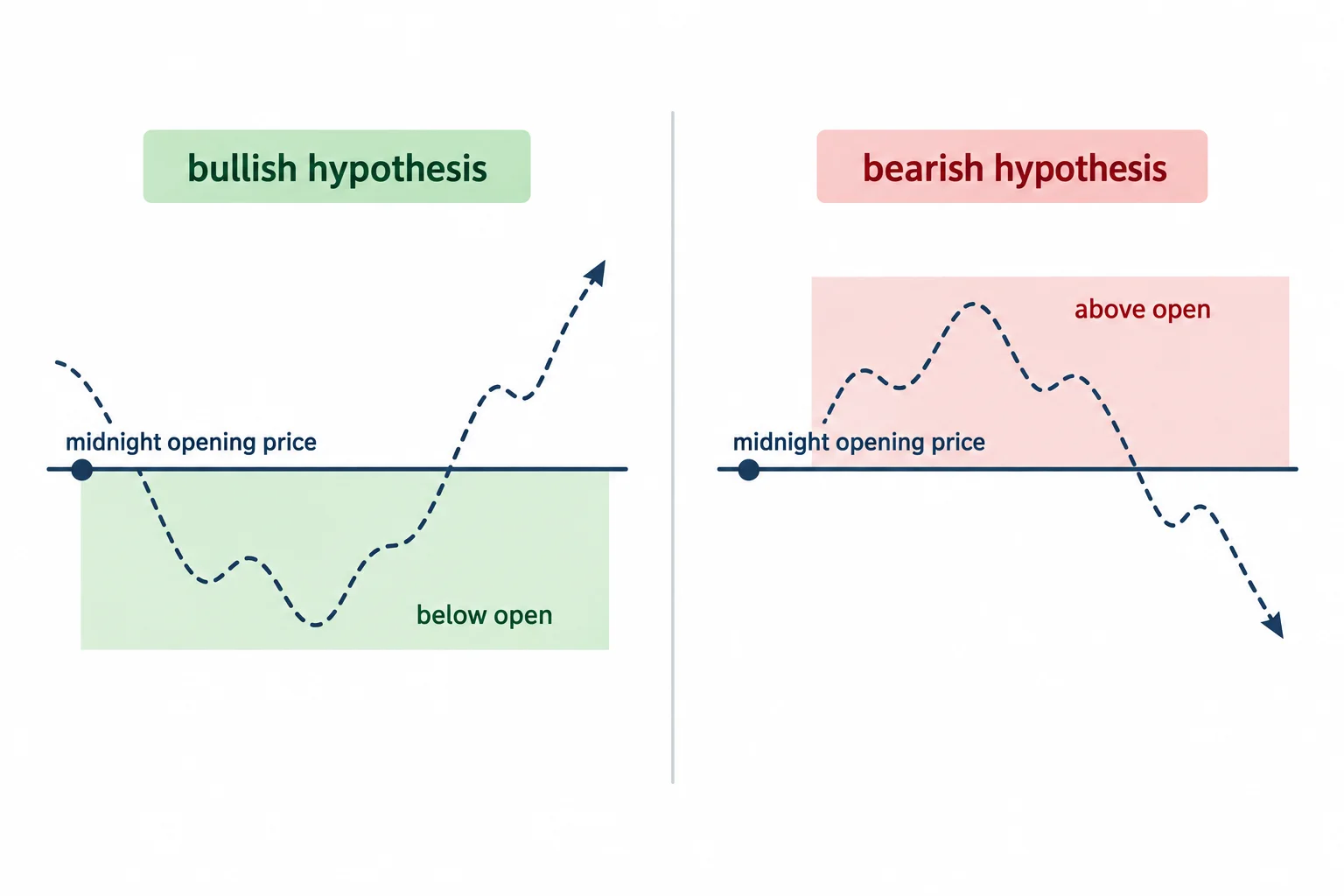
For this lesson, ICT defines the operative opening price as the price at midnight New York time. Under a bullish hypothesis, he prefers studying potential purchases near or below that reference; under a bearish hypothesis, he reverses the logic and looks near or above it (06:46).
This is presented as a study framework rather than an everyday signal. ICT explicitly notes that price does not always return to the preferred side of the opening price. He recommends extending the midnight-open reference on an intraday chart and examining how price behaves around it through the morning.
He also proposes studying a custom midnight-to-noon New York window rather than relying only on a broker platform’s standard daily separator. In his terminology, the midnight opening and the noon 15-minute candle’s opening act as “bookends” for examining the most relevant part of the range (17:46). This convention is specific to ICT’s methodology; it should not be confused with a universal definition of a forex trading day.
Daily Forex Bias Starts With Higher Time Frame Targets
The opening price supplies a reference, but ICT says bias should be rooted in something beyond one daily candle. He calls the anticipated destination a “draw on liquidity.” In a bullish scenario, that might be an earlier high or a group of approximately equal highs where he expects orders to be concentrated (22:34).
ICT’s explanation is that protective buy-stop orders may rest above old highs, making those areas potential upside objectives. Conversely, old lows may serve as downside objectives in a bearish framework. This description reflects ICT’s market model; the transcript does not provide order-book evidence proving the location or motivation of actual participants.
He recommends beginning with a weekly chart and asking whether the next weekly candle is more likely to expand upward or downward. If the answer is unclear before the week begins, he suggests waiting for Monday’s price action to provide more information (30:30). The practical lesson is that uncertainty can justify doing nothing.
Forex Daily Bias Around Events and Market Structure
Using a euro-dollar example from the period discussed in the recording, ICT describes a higher-time-frame bullish view alongside consolidation before an FOMC event. He interprets a sharp move around the announcement as a liquidity event rather than immediate proof that the larger bias has failed (49:00).
Later, he describes a sequence in which price first moves above a consolidation and then below nearby lows. Under his bullish narrative, that sequence removes nearby orders before an upside repricing (56:58). Because the transcript cannot show the referenced chart, exact levels, fills, and subsequent trade results cannot be verified from captions alone.
ICT also says scheduled medium- or high-impact events can help identify which day may matter most, but he cautions that major announcements can produce erratic behavior. More broadly, he acknowledges that unexpected events and abrupt repricing create risk whenever a live position is open.
ICT Daily Bias and Institutional Forex Order Flow
Once a bullish narrative, a target, and a perceived stop run are in place, ICT treats pullbacks and down-close candles as potentially constructive rather than automatically bearish. In the example, he labels certain down-close candles “bullish order blocks” and looks for renewed upside expansion afterward (01:03:30).
Crucially, this is conditional. Near the end of the video, ICT warns that simply buying every down-close candle is not the lesson; surrounding filters and context must already be present. The terminology is part of ICT’s proprietary-style analytical vocabulary and should be evaluated as a hypothesis rather than assumed to describe institutional activity directly.
Practice the ICT Forex Daily Bias Lesson
The most broadly applicable part of the presentation is its emphasis on structured observation. ICT recommends keeping a journal and recording:
- whether the expected weekly expansion is upward or downward;
- the midnight New York opening price;
- the day’s high and low and the times at which they formed;
- how price behaved relative to the opening price;
- the predetermined objective or “draw on liquidity”;
- relevant scheduled news and whether the original premise remained valid.
He outlines this exercise directly near 02:20:45, recommending annotated 15-minute charts and repeated manual review. His point is not to force a directional call each day, but to learn when the ingredients of the framework align and when they do not.
ICT Forex Daily Bias Lesson Takeaways
The lesson’s main message is narrower than “predict every daily candle.” ICT defines bias as a working expectation for directional expansion, supported by higher-time-frame context, a proposed destination, timing, economic events, and intraday structure. He also stresses that a losing trade does not by itself prove the broader bias wrong, while a valid bias does not guarantee a sound entry or outcome.
For study purposes, this can be treated as a testable chart-annotation framework: document the forecast before the session, specify what would negate it, and compare it with what occurred without rewriting the premise afterward. That approach may help separate a market hypothesis from hindsight, but it does not establish profitability or remove the substantial risks of leveraged forex trading.
Further Reading and Resources
- CFTC: Eight Things You Should Know Before Trading Forex — Official U.S. regulator guidance on over-the-counter forex trading, leverage, and retail protections. Relevant because ICT’s lesson involves leveraged forex and does not address regulatory risk.