Key takeaways
ICT’s three minutes 4.24 seconds YouTube clip is discretionary live execution commentary on a five-second chart, not an algorithmic or high-frequency trading system.
Read the full summary
ICT’s three minutes 4.24 seconds YouTube clip is discretionary live execution commentary on a five-second chart, not an algorithmic or high-frequency trading system. He wanted to short at one second but says screen recording prevented the entry, then watched price approach a bearish order block or "main threshold," stated an intended risk of 150 to make 1,500 with no currency specified, added as the bearish move resumed, identified a transcript-rendered "reclaimed bearish fairway gap" at one minute 53 seconds, and expected a low to break with acceleration. After adding again at two minutes 6 seconds, he reduced exposure by "five" when the low broke, said costs were covered, and left one position open for a possible breakaway. The clip provides no instrument, prices, contract size, commissions, verified fills, account details, final result, coded execution, latency data, win rate, or drawdown, and its automated transcript and unexamined chart do not support reconstructing the trade.
How we researched this article
BestProps used document-based research from primary firm sources, checked September 24, 2026. The complete source list, scope, limitations, and commercial-state record appear near the end of this article.
In the short video “Algorithmic High Frequency Trading The Opposite Direction | January 25, 2024”, ICT narrates a rapidly developing bearish trade idea while watching a five-second chart. The recording was uploaded on January 25, 2024; neither the transcript nor the title independently establishes when the shown market activity occurred.
The clip is closer to live execution commentary than a complete lesson. ICT names several concepts from his trading vocabulary, discusses adding to a position, and describes reducing exposure after a low breaks. Because the source transcript was generated by automated speech recognition and the chart is not available for verification here, the video does not support reconstructing exact prices, order quantities, fills, or the final result.
ICT Trade Setup in the Opposite Direction
At 0:01, ICT opens by saying he wanted to be short at that moment but his screen recorder did not let him act on it, a reminder that his own commentary here is retrospective narration of a move already underway, not a pre-planned alert.
At 0:08, he says he will try to get an order block if price can trade up into it. He soon remarks at 0:26 that the move looks like “it’s running without me,” illustrating a common execution problem: an anticipated entry area is not useful if price never reaches it.
At approximately 0:43, he identifies what the transcript renders as a “main threshold” associated with a bearish order block. That phrase may be a recognition error, and the unseen chart prevents confirmation of the precise level or annotation. The supported point is that ICT is using a bearish reference area to frame a possible move lower.
He also mentions drawing extensions at 1:05, then says something is “good enough” at 1:13. The transcript does not disclose the anchors or numerical targets, so these extensions should not be treated as reproducible levels.
ICT Trade Risk and the Expected Direction
At 1:25, ICT states that he is risking 150 while trying to make 1,500. No currency, account context, or verified order record is supplied, so the units are unstated in the clip. This is therefore a statement of his intended risk-and-reward objective, not evidence that the target was reached.
As the sequence develops he says at 1:45 that he will add more because it is “too good to pass up.” At 1:53, the automated transcript records “reclaimed bearish fairway gap.” In ICT terminology this almost certainly refers to a bearish fair value gap, but this review only had the automatic audio transcript, so the exact wording is left as transcribed rather than silently corrected.
ICT then says he should be breaking a low, accelerating pretty hard, and at 2:02 calls it his “final trade for today.” Around 2:06, he announces another addition, followed at 2:09 by a prediction that price will rip through the area quickly and an assertion that he knows he is onside.
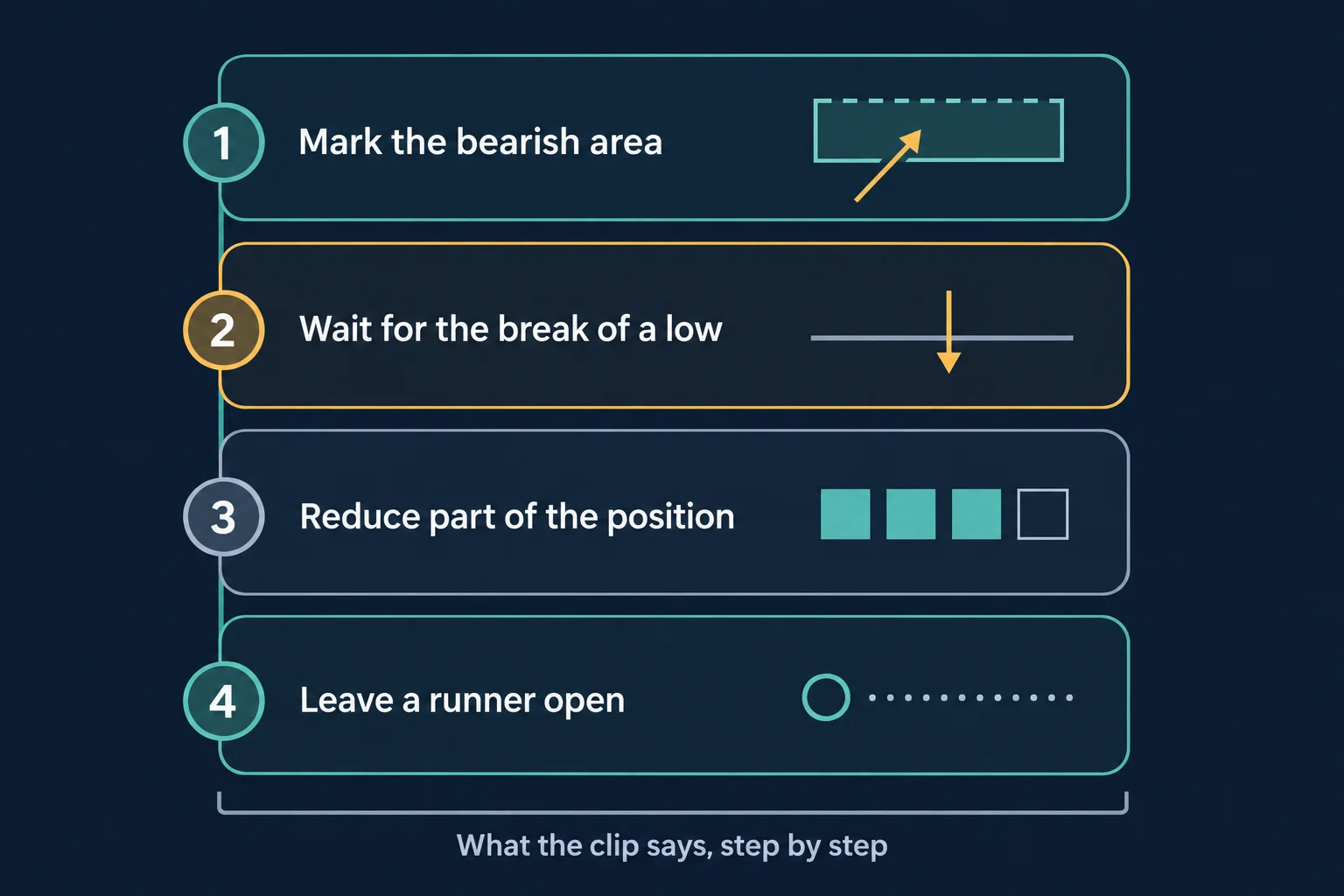
ICT Trade Management on a Five-Second Chart
At 2:20, ICT points to a small chart area, and at 2:26 stresses that he is working from a five-second timeframe. His remark that such detail is “supposed to be just noise” reflects his interpretation that very short-term price action can still contain meaningful structure. The clip itself does not test that proposition or demonstrate that it provides a repeatable edge.
After saying a low has broken, ICT states at 2:32 that he will “take off five” and that costs are covered. This appears to describe a partial reduction, but the transcript does not identify the instrument, contract size, execution price, commissions, or actual fill, so the phrase is reported rather than interpreted. At 2:44 he says he wants one position to stay open because that would represent a breakaway condition.
What the ICT Trade Commentary Teaches
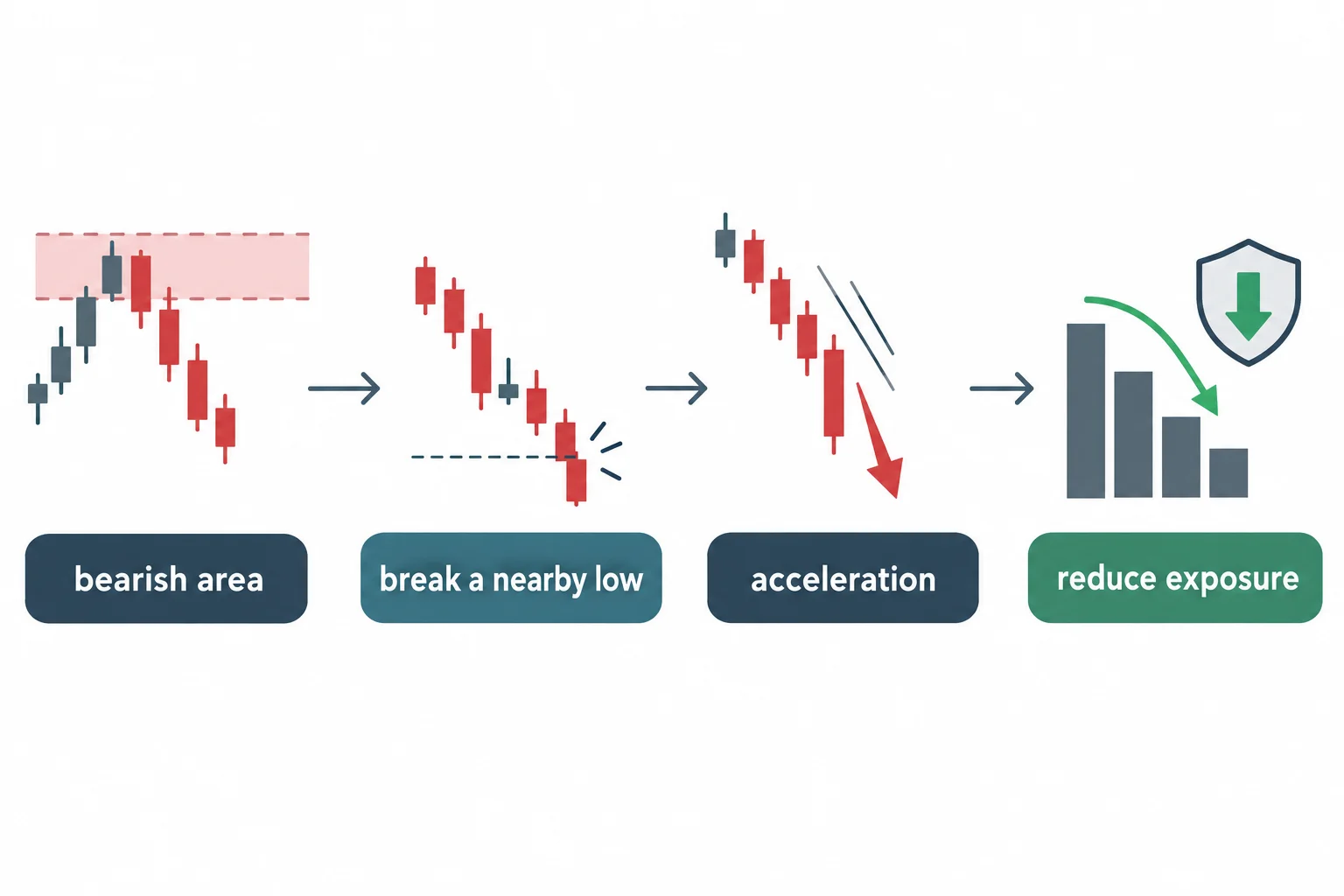
As an educational interpretation, the sequence can be organized into four steps:
- Define a bearish area from which a short idea may be considered.
- Look for price to move away from that area and break a nearby low.
- Use the perceived acceleration as confirmation for ICT’s bearish thesis.
- Reduce some exposure after the low breaks while monitoring whether the move continues.
Those steps summarize ICT’s narration; they do not establish how the setup would perform across other markets or periods. Despite “algorithmic high frequency trading” appearing in the title, the transcript does not explain exchange algorithms, automated order execution, latency, or a coded high-frequency strategy. What it directly documents is ICT’s discretionary interpretation and trade-management commentary on a five-second chart.
The recording ends shortly after ICT reacts to the move at 3:00. It does not provide enough subsequent footage to verify the ultimate outcome of every position he describes.
Watch the Original ICT Trade Commentary
The embed above is the upload’s own YouTube player and it is left in place because it plays. This same iframe markup was loaded from a BestProps origin on 15 September 2026 and clicked: playback advanced to 5.9 seconds of the recording’s own 184.24-second duration with no error notice and no owner restriction reported by the player. YouTube’s help documentation states that a video or playlist can be added to a website or blog by embedding it[3]. All timestamp links above point into the same recording.
How the ICT Trade Commentary Used Its Source
The primary source is “Algorithmic High Frequency Trading The Opposite Direction | January 25, 2024”, a public upload on the channel The Inner Circle Trader dated 25 January 2024 and running 184.24 seconds[1]. Its transcript was produced by local automatic speech recognition of the complete original audio rather than from YouTube captions, so the wording is automated, not human-verified; where the audio was ambiguous it is flagged above rather than smoothed over. The recording’s charts and annotations were not examined by this review, so the timestamps are pointers into the audio rather than descriptions of what is on screen. Everything attributed to ICT is his stated observation or intent, not a verified market outcome.
ICT Trade Commentary Sources and Further Reading
Two regulator references frame the risk language above. The CFTC advises that no technology can consistently predict the future (a direct counterweight to reading an “algorithmic high frequency trading” title as predictive technology) and that anyone trading foreign exchange should trade with a registered dealer[2]. Separately, the CFTC’s investor advisories recommend that investors be more careful about who they trust online and learn all they can about trading risks[4]. Neither reference is a statement about this recording or channel, and this article is independent commentary rather than ICT material.
- [1] Algorithmic High Frequency Trading The Opposite Direction \\ January 25, 2024 (The Inner Circle Trader) (the primary source; use the timestamp links above to compare the narration with its recording).
- [2] CFTC Learn & Protect: Forex Frauds (regulator guidance on predictive-technology claims and unregistered dealers).
- [3] YouTube Help: embed videos and playlists (platform guidance behind the player embedded above).
- [4] CFTC Learn & Protect: Advisories and articles (investor alerts on online trading approaches and risk awareness).
Note that the video’s title appears to have been assigned by the publishing channel rather than describing a disclosed system. Any ICT, smart-money-concept or third-party indicator, script, transcript, note set or social summary circulating outside the channel’s own upload page is unofficial and untested here. Bearish order block, fair value gap, breakaway, “onside” and “main threshold” are the speaker’s own framework and terminology. No win rate, drawdown figure, fill, position size, pip distance or account result is claimed anywhere in this article; the 150-to-1,500 figure is reported exactly as the speaker stated it, without currency.
Leveraged futures and foreign-exchange trading carries substantial risk. Executing on a five-second chart, adding into a move already underway, and judging a position “onside” from the speaker’s own commentary all change the distribution of outcomes, and none of them removes slippage or the possibility of loss. This article is independent educational commentary, does not provide individualised financial advice, and reports no outcome from any session or account.