Key takeaways
ICT Forex Scout Sniper Basic Field Guide Volume 8, Escape and Evasion, is the final installment and a study checklist rather than verified evidence of a trading edge, consolidating prior lessons into a daily, four-hour, hourly, and lower-timeframe workflow.
Read the full summary
ICT Forex Scout Sniper Basic Field Guide Volume 8, Escape and Evasion, is the final installment and a study checklist rather than verified evidence of a trading edge, consolidating prior lessons into a daily, four-hour, hourly, and lower-timeframe workflow. Establish the daily premise using yield relationships, seasonal context, several years of support and resistance, market structure, swing points, potential order blocks, and 9-period and 18-period exponential moving averages, then seek aligned four-hour order flow and liquidity near conspicuous highs or lows, use roughly two or three weeks of hourly swings to define location and reward relative to risk, and time entries on fifteen-minute and five-minute charts. Execution tools include liquidity sweeps, rejection and order-block revisits, Fibonacci retracements, OTE pullback entries, Asian-session ranges, London open from seven to ten GMT, New York open from twelve to fourteen GMT, and London close around fifteen to sixteen GMT. ICT proposes that bullish weekly lows often form Monday through Wednesday, with the inverse under a bearish premise, and promotes one carefully selected weekly setup, demo practice, small exposure, reduced risk after losses, patience, and avoiding excessive leverage or stagnant markets. The transcript provides no visible charts, setup verification, performance statistics, or proof that its institutional footprint, liquidity, seasonality, and timing interpretations are predictive or profitable.
How we researched this article
BestProps used document-based research from primary firm sources, checked September 25, 2026. The complete source list, scope, limitations, and commercial-state record appear near the end of this article.
ICT Forex Scout Sniper Basic Field Guide – Vol. 8 is the final installment in ICT’s series. Titled “Escape and Evasion,” it introduces no major new technical concept. Instead, ICT condenses the earlier modules into a top-down process spanning daily, four-hour, hourly, and execution charts.
The lesson is best understood as a study checklist rather than evidence that the methods produce a trading edge. ICT repeatedly emphasizes patience, practice, selective participation, and controlled exposure. The transcript alone does not show the referenced charts, verify any setup, or establish subsequent trading results.
ICT Field Guide Context Before Execution
At 00:31, ICT explains that the episode reviews what viewers were expected to learn from the preceding installments. His broader argument is that each component (time of day, market structure, order flow, liquidity, retracements, and risk) must first be studied separately. Only then should the components be assembled into a repeatable process.
ICT frames price movement through his interpretation of institutional participation. Beginning around 05:12, he says he prefers to wait for an initial, forceful move rather than predict one in advance. In his terminology, rapid movement away from a level may represent an institutional “footprint.” This is ICT’s market interpretation, not something independently demonstrated by the transcript.
He also argues that traders should avoid forcing activity in stagnant conditions. His practical teaching is less about trading constantly and more about waiting for volatility, alignment, and a predefined setup. Around 14:54, he returns to the series’ “one shot, one kill” theme: concentrate on one carefully selected weekly setup instead of pursuing every short-term fluctuation.
ICT Field Guide Trading Concepts
- Higher-timeframe direction: ICT starts with daily and four-hour structure rather than allowing a five-minute pattern to define the entire idea.
- Time-of-day windows: He focuses on London open, New York open, and London close as recurring periods of interest.
- Liquidity near obvious highs and lows: Equal or closely grouped highs and lows are treated as possible locations for clustered stop orders.
- Reaction after a liquidity sweep: ICT describes waiting for price to move through an obvious level, reject it, and potentially revisit an “order block.”
- Retracement entries: His optimal trade entry, or OTE, concept seeks entries during a pullback rather than after price has already extended.
- Selective risk: He recommends simulated practice and small exposure while learning, while warning against overtrading and excessive leverage.
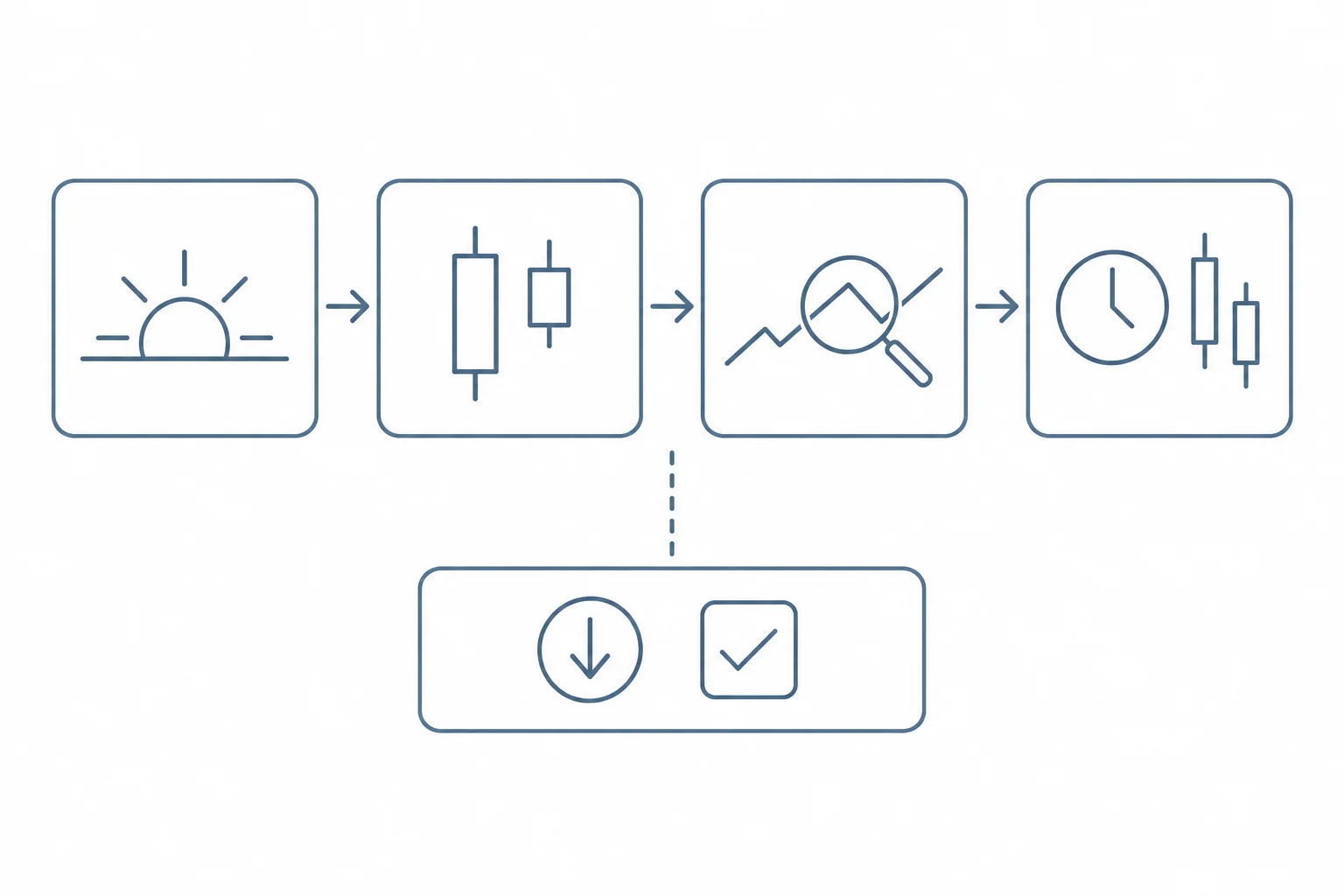
At 15:59, ICT explains the counterintuitive logic of buying during a decline within a bullish premise or selling during a rally within a bearish premise. The intention is to enter closer to the proposed invalidation level instead of chasing apparent confirmation. This remains a conceptual framework; a retracement can continue rather than reverse.
ICT Forex Daily Chart Checklist
The formal top-down workflow begins at 24:42. On the daily chart, ICT discusses:
- reviewing yield relationships as part of a directional narrative;
- using seasonal tendencies as context, not as a standalone signal;
- marking major support and resistance using several years of data;
- occasionally consulting weekly and monthly levels;
- classifying market structure and the active price swing;
- marking significant reactions, swing points, and potential order blocks; and
- using the 9- and 18-period exponential moving averages as a simplified directional filter.
ICT explicitly says seasonal tendencies are not guarantees. He treats them as a roadmap for periods when larger directional movement may be more likely, while still requiring other price-based conditions.
ICT Forex Higher Timeframe Refinement
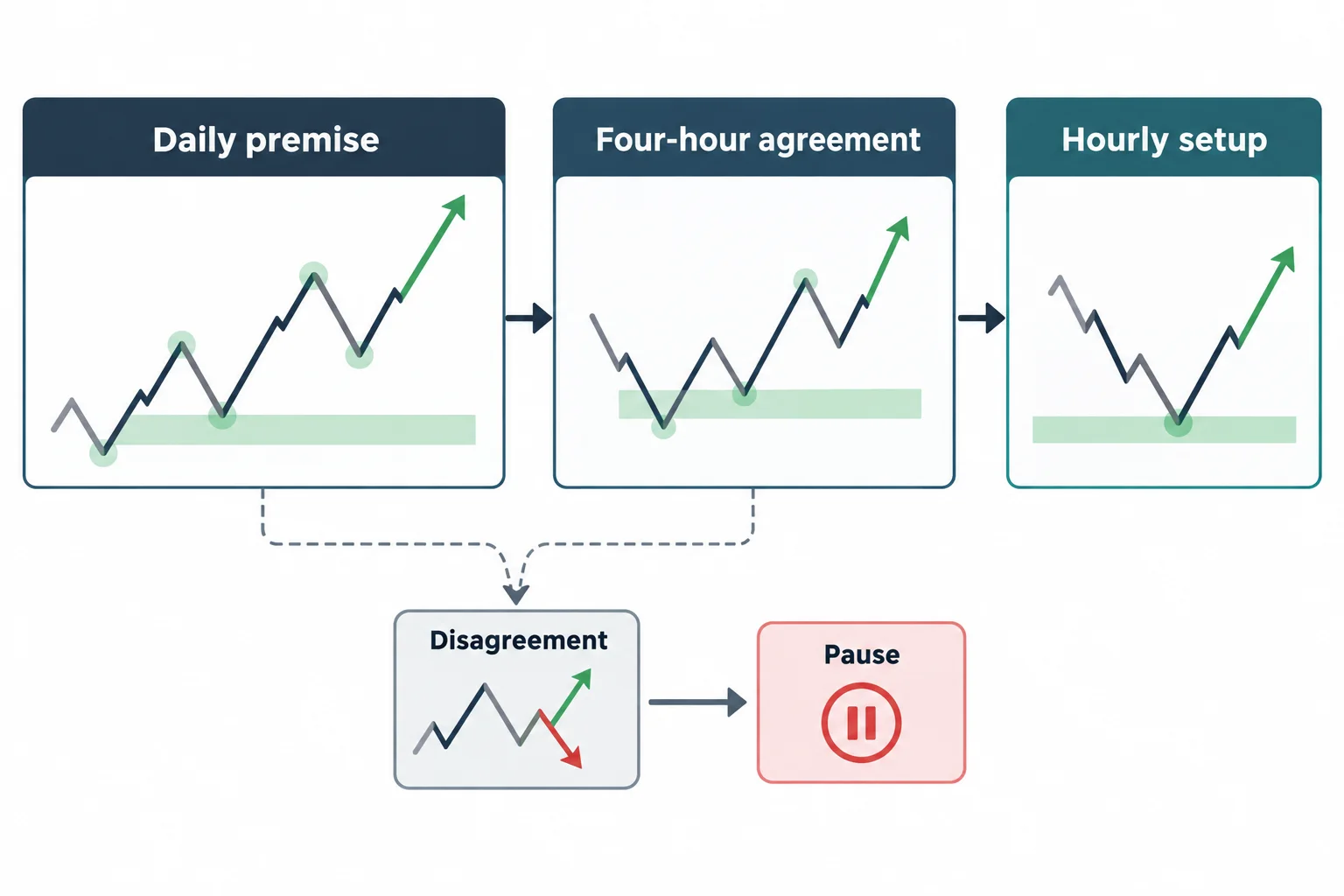
At 34:07, the four-hour chart becomes the intermediate view. The daily premise remains the foundation: under a bullish daily interpretation, ICT looks for four-hour support and bullish order flow; under a bearish interpretation, he looks for resistance and bearish order flow. He also marks conspicuous highs and lows as possible liquidity areas.
The hourly checklist starts at 38:38. ICT uses this chart to study approximately two or three weeks of swings, refine reaction levels, and evaluate whether a proposed setup offers acceptable reward relative to risk. He says the daily and four-hour perspectives should ideally agree before the hourly chart is used to locate a setup.
His day-of-week model suggests that, within a bullish weekly premise, a weekly low often forms from Monday through Wednesday; the inverse is proposed for a bearish premise. This is presented as ICT’s recurring observation, not a certainty or a verified statistical rule.
ICT Forex Execution and Session Timing
The 15- and five-minute execution checklist begins at 43:19. ICT carries the higher-timeframe analysis onto these charts, separates trading days visually, and marks the Asian-session range. He discusses the 07:00–10:00 GMT London window and the 12:00–14:00 GMT New York window, with London close around 15:00–16:00 GMT.
Under his model, London may establish one side of the daily range through an initial counter-directional move, while New York may provide a retracement or continuation. He cautions that New York can instead reverse when a larger swing is reaching important support or resistance. Session labels and daylight-saving changes require care when translating GMT windows to local time.
ICT Forex Risk Checklist
At 48:50, ICT recommends keeping risk small, especially during learning, reducing exposure after a loss, and practicing in a demo account. These are the speaker’s stated parameters, not personalized recommendations or guarantees against loss.
His final summary appears around 55:35: establish a daily premise, seek four-hour agreement, use the hourly chart to define the setup, and only then use lower timeframes for entry timing. Fibonacci retracements, order blocks, prior highs or lows, session windows, and day-of-week ideas serve as supporting tools rather than substitutes for higher-timeframe context.
ICT Field Guide Learning Takeaways
The most transferable lesson is procedural: analysis should move from broad context to narrow execution, with explicit conditions for doing nothing. A useful study exercise would be to document the daily premise, four-hour confirmation, hourly location, session window, invalidation point, and planned exposure before reviewing a lower-timeframe pattern. That can improve consistency of observation, but it does not establish that ICT’s institutional, liquidity, or timing interpretations are predictive or profitable.
Watch the original ICT lesson
This article is grounded in the timestamped English captions of ICT Forex Scout Sniper Basic Field Guide – Vol. 8. Captions capture the speaker’s words; they are not independent proof of any reported trading performance. Keep the recording’s charts in view when following the annotations.
Watch the original lesson on YouTube
This video cannot be played inside another website: when its embedded player was opened and clicked on 23 September 2026, the player itself reported “Playback on other websites has been disabled by the video owner” and settled on a “Watch on YouTube” prompt with no duration or playback progress. That is why no embed is left here; the recording is available directly on YouTube.
Watch ICT Forex Scout Sniper Basic Field Guide Vol. 8 on YouTube ↗
Primary source and further reading
- The original Inner Circle Trader lesson: use the timestamp links in this article to compare each explanation with its source.
- InnerCircleTrader.net: an independent third-party tutorial site explaining the ICT concepts referenced throughout this series (unofficial and untested, not affiliated with ICT or a claim of trading success).
- YouTube’s embedding documentation: platform guidance relevant to the external watch link above.
This is independent educational commentary. It is not official ICT material, a tested trading system, or a claim that the reported methods can be reproduced profitably. Trading risk is real; nothing here is personalized financial advice.