How we researched this article
BestProps used document-based research from primary firm sources, checked September 25, 2026. The complete source list, scope, limitations, and commercial-state record appear near the end of this article.
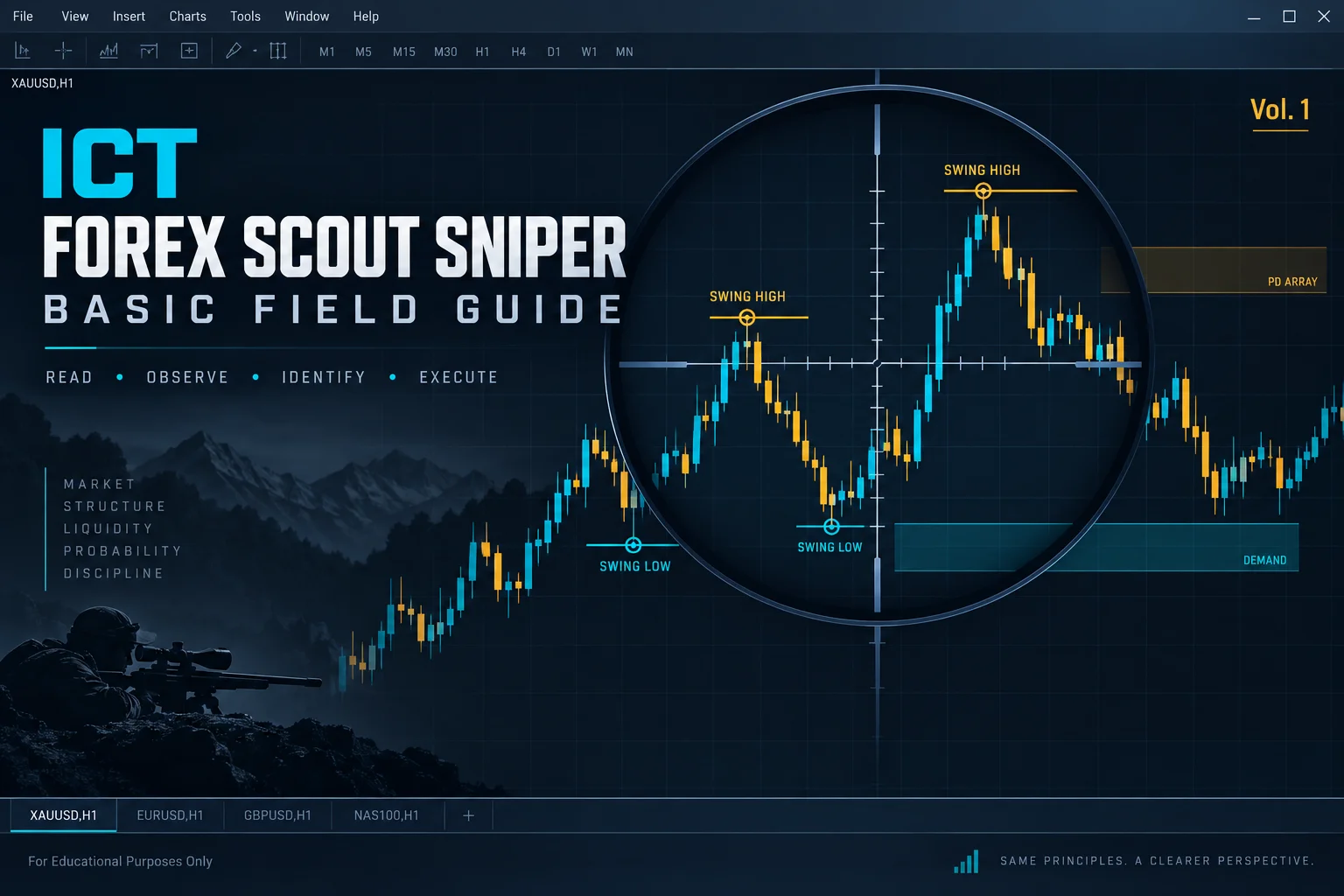
ICT Forex Scout Sniper Basic Field Guide – Vol. 1, uploaded on December 25, 2017, introduces the first part of an eight-part educational series. Rather than presenting a complete trade setup, ICT uses this opening module to establish a practice environment, define what he calls a “sniper setup,” set expectations, and assign a chart-observation exercise.
The primary source is ICT Forex Scout Sniper Basic Field Guide – Vol. 1. The available captions are automatically generated, so some names, dates, and platform terms may have been transcribed imperfectly.
Purpose of the opening module
At 0:19, ICT describes the series as a broad introduction for viewers unfamiliar with his concepts. His stated goal is to move beyond isolated conceptual lessons and toward a modular, hands-on process. He argues that learners should repeatedly observe price action and practice in a demo environment rather than expect one viewing of a lesson to produce mastery.
This first volume is intentionally foundational. ICT previews platform setup, practice drills, the characteristics of the trades the series will examine, realistic expectations, target selection, and homework. He compares the preliminary theory to preparation undertaken before practical fieldwork: learners first need terminology and observation skills before applying more detailed methods.
Platform and demo-account framework
Beginning around 3:47, ICT identifies the version of MetaTrader 4 he was using for the presentation. His reason for placing students on a common platform is practical: later tools and indicators in the course were intended to work with MT4.
Importantly, ICT repeatedly frames the platform as a demo resource. At 4:44, he says the concepts should be employed in a demo-account setting and does not advocate committing live funds. He also states that viewers are not locked into the platform he demonstrates and that he is not giving signals or making a brokerage recommendation.
For the simulated account balance, his practical suggestion is to select an amount resembling what the learner could realistically use. The educational purpose is to make practice decisions less detached from personal constraints, not to imply that demo execution reproduces live-market conditions.
What ICT means by a “sniper setup”
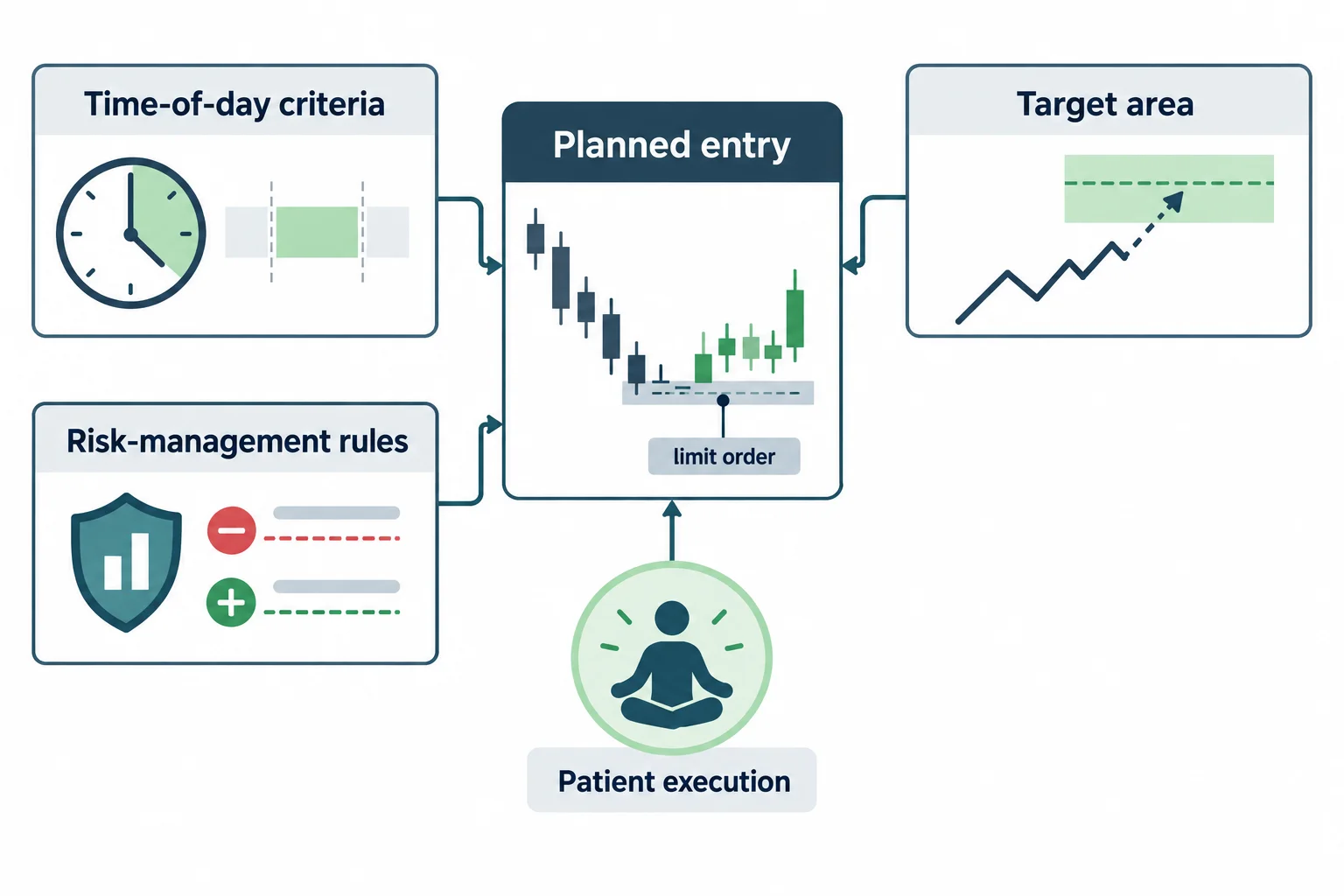
At 7:13, ICT lists the features he associates with a sniper-style setup:
- A planned entry price that may be approached with a limit order.
- Specific time-of-day criteria.
- An anticipated target area for a possible exit.
- Defined risk-management rules.
- Patient, disciplined execution rather than impulsive participation.
ICT presents precision as advance planning, not certainty. A limit order may define an intended entry more narrowly than an immediate market order, but he explicitly says this does not eliminate risk. Likewise, anticipating a target does not establish that price must reach it.
He also notes that a learner must determine a suitable style and time horizon. Intraday scalping, short-term trading, swing trading, and position trading impose different demands. The video does not provide a validated method for deciding among them; it only says later concepts are intended to help viewers explore that question.
Realistic expectations and sustained study
The clearest caution begins at 10:07. ICT says losses can occur in both live and simulated trading, no setup wins every time, apparently textbook conditions can fail, and opportunities will inevitably be missed. He rejects a promise of effortless wealth and warns students against expecting identical results from the same material.
ICT measures progress primarily as increased familiarity with price behavior. At 14:08, he recommends evaluating development in small increments and says learners should be prepared to spend at least six months studying the concepts. That duration is ICT’s instructional expectation, not evidence that a particular amount of study produces profitability.
Multiple-timeframe influence
Around 15:10, ICT attributes part of his framework to the “triple screen” principle from Alexander Elder’s Trading for a Living. He summarizes the premise as first determining a likely market direction and then considering entries only in that direction. He also credits Elder’s discussion of trading psychology and mentions Larry Williams as another influence on his broader work.
This is background on how ICT characterizes the lineage of his approach. Volume 1 does not test the triple-screen principle, define a complete directional model, or demonstrate a finished strategy.
The chart-reading assignment
The practical section starts at 19:26. ICT opens an EUR/USD chart in MT4, switches to candlesticks, removes the grid, changes the color scheme, and leaves space at the right edge. These are viewing preferences rather than trade signals.
He then introduces swing points. In the demonstrated fractal convention, a swing high has lower highs on both sides, while a swing low has higher lows on both sides. At 23:57, he shows MT4’s Bill Williams Fractals indicator as a temporary aid for locating these structures. He later removes it and asks learners to identify the same reference points visually. ICT cautions that a swing pattern alone is insufficient to justify a trade.
Suggested observation routine
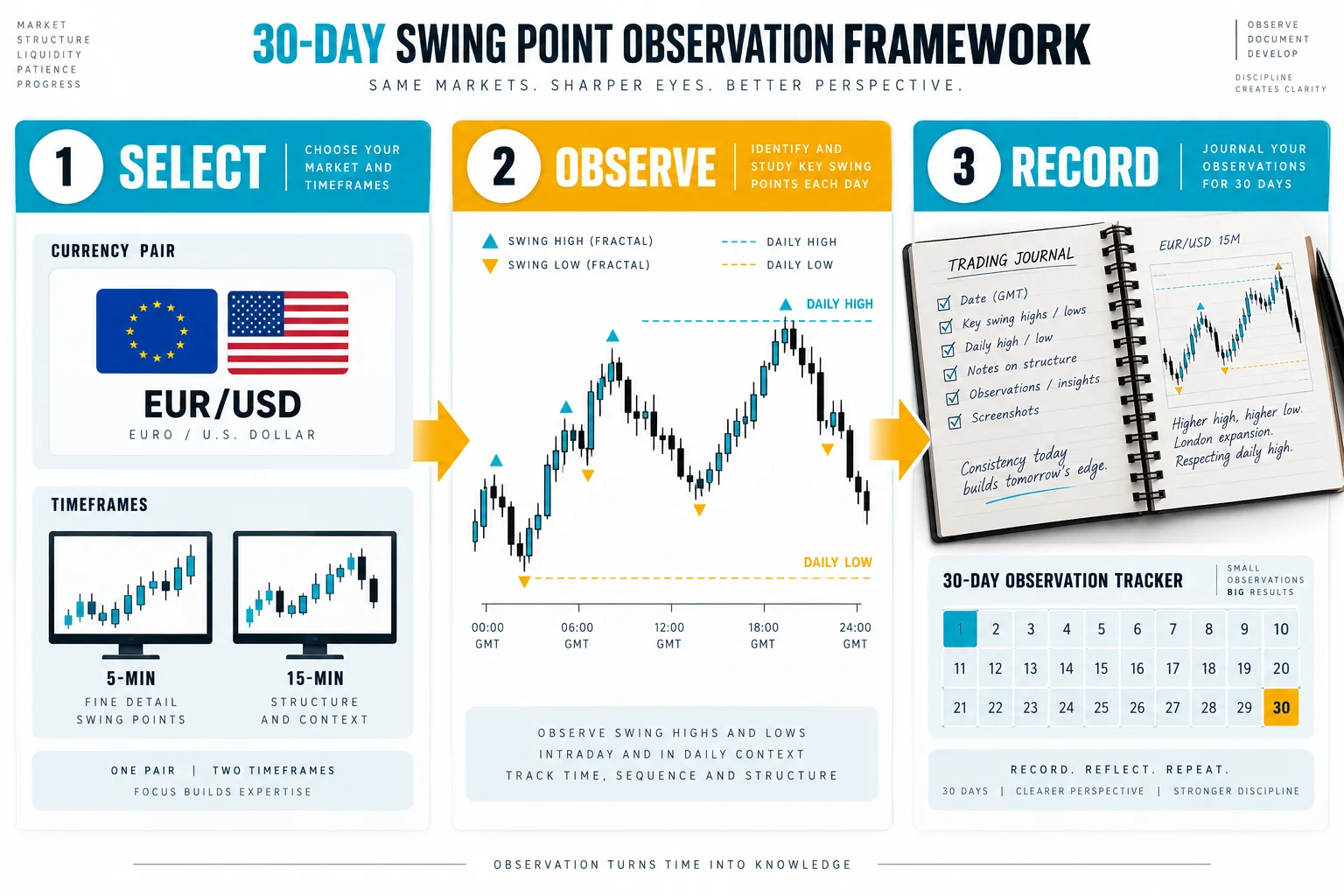
From approximately 30:06, the assignment can be summarized as follows:
- Select one currency pair or another market available on the chosen charting platform.
- Review five-minute and 15-minute charts for at least 30 trading days.
- Mark significant intraday swing points and turning points.
- Record when the daily high and low formed, using the chart’s displayed time zone.
- Note the price levels and compare recurring time-and-price characteristics.
- Save or print charts and annotate them by hand or digitally.
The general educational value of this exercise is deliberate observation and consistent recordkeeping. It may help a learner describe recurring chart structures without assuming those structures are predictive. The transcript does not reveal unseen chart prices, completed trades, fills, or subsequent results, so no performance conclusion can be drawn from this lesson.
Video lesson
Alternative if embedding is unavailable: Watch ICT Forex Scout Sniper Basic Field Guide – Vol. 1 on YouTube
Further resources
- Alexander Elder – Trading for a Living (triple screen principle and trading psychology)
- Larry Williams – official website and published works (cited by ICT as a broader influence)
- Forex.com MT4 demo platform (the specific platform used in the 2017 recording; verify current availability and terms independently)
- MetaTrader 4 official site (for the current MT4 download and documentation)