Key takeaways
The ICT Judas Swing is an educational London-session forex pattern in which price initially moves against a higher-time-frame bullish or bearish premise, attracts breakout traders or runs stops, then reverses toward the anticipated daily direction.
Read the full summary
The ICT Judas Swing is an educational London-session forex pattern in which price initially moves against a higher-time-frame bullish or bearish premise, attracts breakout traders or runs stops, then reverses toward the anticipated daily direction. ICT observes midnight through 5 a.m. New York time and uses the Asian range high and low plus the midnight New York opening price as reference levels. In the bullish EUR/USD example, price rises above the Asian high, falls through the midnight open and preferably below the Asian low to form or support a London low, then reverses higher. In the bearish USD/CAD example, price falls below the Asian low, rallies through the midnight open and Asian high, then reverses lower. ICT says the higher-time-frame premise and complete sequence are essential, recommends historical chart review and a study log, and advises no participation when the expected setup is absent because it does not occur daily. The article presents this as conditional pattern recognition rather than a proven edge, noting that validation requires explicit rules, representative data, transaction costs, time-zone handling, and failed examples, while leveraged forex trading remains high risk with no guaranteed outcome.
How we researched this article
BestProps used document-based research from primary firm sources, checked September 25, 2026. The complete source list, scope, limitations, and commercial-state record appear near the end of this article.
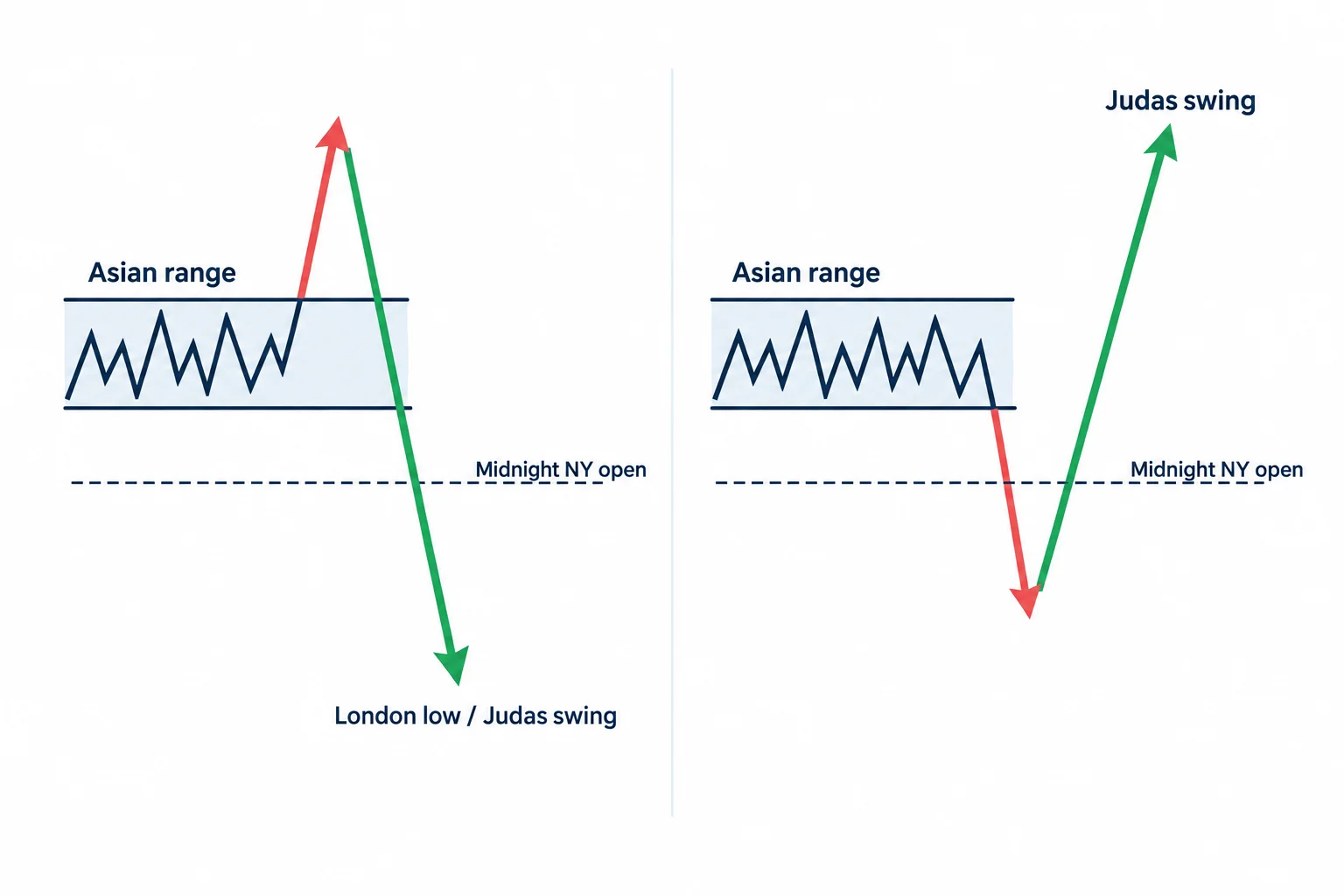
The ICT Judas Swing is presented in this lesson as a deceptive intraday price move associated with the London session. ICT explains it as a move that appears to encourage trading in one direction before price turns in the direction suggested by his higher-time-frame analysis.
This article summarizes ICT’s framework from the video ICT Forex – Understanding The ICT Judas Swing. It describes the speaker’s market interpretation, not a proven trading edge or a guarantee that a particular pattern will produce a profitable outcome.
Understanding the ICT Judas Swing
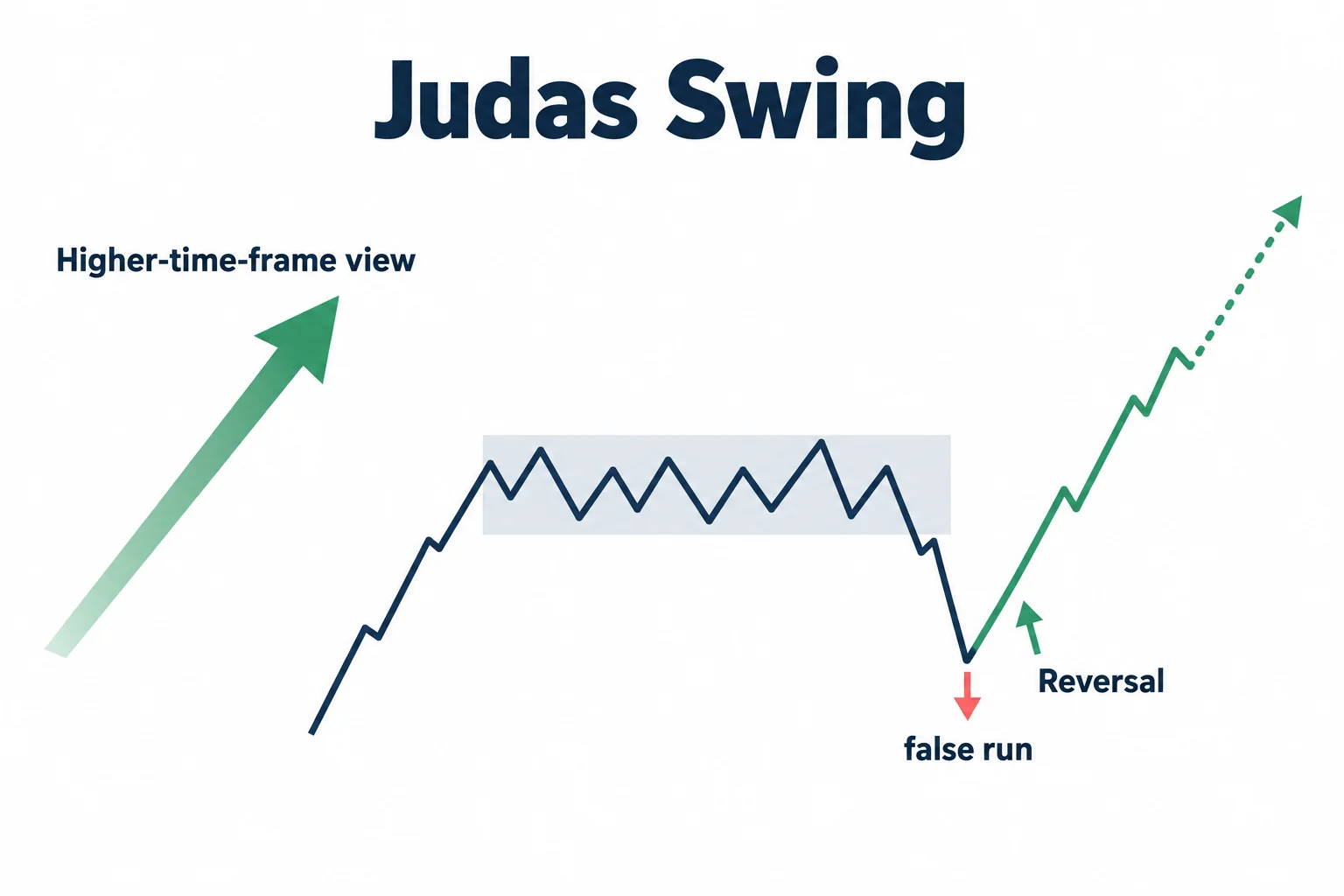
ICT introduces the concept at 0:47. In his terminology, the price swing that establishes a London-session high or low can be an energetic move caused by a run on stops or a return to a significant price level. He argues that traders must first form a higher-time-frame directional view because the same intraday movement can have different implications in bullish and bearish conditions.
At 2:08, ICT defines the observation window as midnight through 5:00 a.m. New York time. Within his model, a high or low of the daily range will often develop during this period. He calls the Judas Swing a “false run” that draws traders toward what his analysis treats as the wrong direction for the day.
The name is an analogy. ICT explains at 7:11 that a “Judas goat” leads a group in one direction and then turns away. Applied to price, the initial move attracts breakout participation before price reverses. This is ICT’s explanatory model; the transcript does not independently demonstrate why any specific market movement occurred.
ICT Judas Swing Reference Points
The examples rely on several intraday reference points:
- Higher-time-frame premise: A bullish or bearish expectation formed from a daily or weekly perspective.
- Asian range: The high and low of the earlier consolidation marked on ICT’s chart.
- Midnight opening price: The price at midnight New York time, which ICT extends across the chart as a reference level.
- London-session window: The period in which ICT looks for the deceptive swing and a potential daily high or low.
The higher-time-frame premise comes first in this framework. A movement through the Asian range or midnight open is not automatically a Judas Swing. ICT stresses that the sequence and directional context must align.
Bullish ICT Judas Swing Sequence
The bullish example begins at 3:21 with a EUR/USD chart. ICT assumes that higher-time-frame analysis has already produced a bullish outlook for the day. He then looks for a relatively tight Asian-session consolidation.
His bullish sequence is:
- Price initially moves above the Asian range high, attracting breakout buyers or reaching buy stops.
- Price reverses and falls below the midnight New York opening price.
- Preferably, the decline also moves beneath the Asian range low.
- Under ICT’s bullish premise, that downward move is expected to establish or contribute to the London low before price turns higher.
ICT gives a concise restatement at 8:13: a bullish example includes a move above the Asian high, followed by a drop through the midnight open and below the Asian low. He does not classify every small dip below the opening price as a Judas Swing. The prior move that draws traders toward the opposite side is an essential part of his definition.
Bearish ICT Judas Swing Sequence
The bearish example starts at 8:53 with USD/CAD. Here, ICT begins with a bearish higher-time-frame premise and anticipates lower prices rather than a higher daily close.
The sequence is the inverse of the bullish case:
- Price first drops below the Asian range low, encouraging bearish breakout participation.
- It subsequently rallies above the midnight New York opening price.
- The rally also moves through the Asian range high.
- ICT interprets that rally as the Judas Swing when it conflicts with his pre-existing bearish outlook.
At 10:28, ICT emphasizes waiting for the initial move below the Asian range and then watching for a run above both the Asian high and the midnight open. He describes a fast move away from the resulting high as a characteristic that, in his interpretation, indicates traders were caught on the wrong side. Captions alone do not establish actual entries, fills, exact chart prices, or what happened beyond the displayed example.
What ICT Judas Swing Lessons Actually Claim
ICT recommends reviewing historical charts and maintaining a study log at 9:58. Near the conclusion, he also cautions that the setup does not form every day. His stated takeaway at 13:32 is that, within his London-session methodology, the absence of the expected sequence is a reason not to participate.
As a general educational interpretation, the lesson is primarily about conditional pattern recognition: define the directional premise, mark consistent session references, require a specific sequence, and distinguish a complete setup from an isolated breakout. That structure may help prevent vague hindsight labeling, but it does not validate the causal language used in the presentation or establish profitability. Any testing would need clear rules, representative data, transaction costs, time-zone handling, and treatment of failed examples.
This summary is educational only and is not investment advice. Leveraged foreign-exchange trading involves substantial risk, and no chart pattern guarantees an outcome.
Watch the ICT Judas Swing Lesson
ICT Judas Swing Forex Resources
- ICT Forex – Understanding The ICT Judas Swing (primary video, first-party YouTube)
- Inner Circle Trader – official ICT education portal (first-party site)
- BabyPips – School of Pipsology (third-party forex education; unofficial, untested)