Key takeaways
ICT Forex Considerations in Risk Management, available through the first-party Inner Circle Trader YouTube channel and official ICT education portal, teaches drawdown control through percentage-based position sizing rather than promising profitable entries.
Read the full summary
ICT Forex Considerations in Risk Management, available through the first-party Inner Circle Trader YouTube channel and official ICT education portal, teaches drawdown control through percentage-based position sizing rather than promising profitable entries. Using a hypothetical $10,000 account, ICT considers 10% and 5% risk per trade excessive and proposes a step-down model that starts at a predefined 2% maximum, falls to 1% after one loss, then to 0.5% after another loss, with 0.25% as a possible lower tier if losses continue. Traders remain at 0.5% until roughly half of the relevant equity dip is recovered, then return to 1% and recover more of the larger drawdown before restoring 2%, stepping down again after any further loss. The framework distinguishes financial equity from mental capital, warns against doubling exposure or chasing losses, and requires predefined sizing, stops, transaction-cost assumptions, and pause rules. It does not establish a tested win rate, guarantee longevity, or validate a strategy, and the transcript contains numerical inconsistencies that should be checked against the original audio and visuals.
How we researched this article
BestProps used document-based research from primary firm sources, checked September 25, 2026. The complete source list, scope, limitations, and commercial-state record appear near the end of this article.
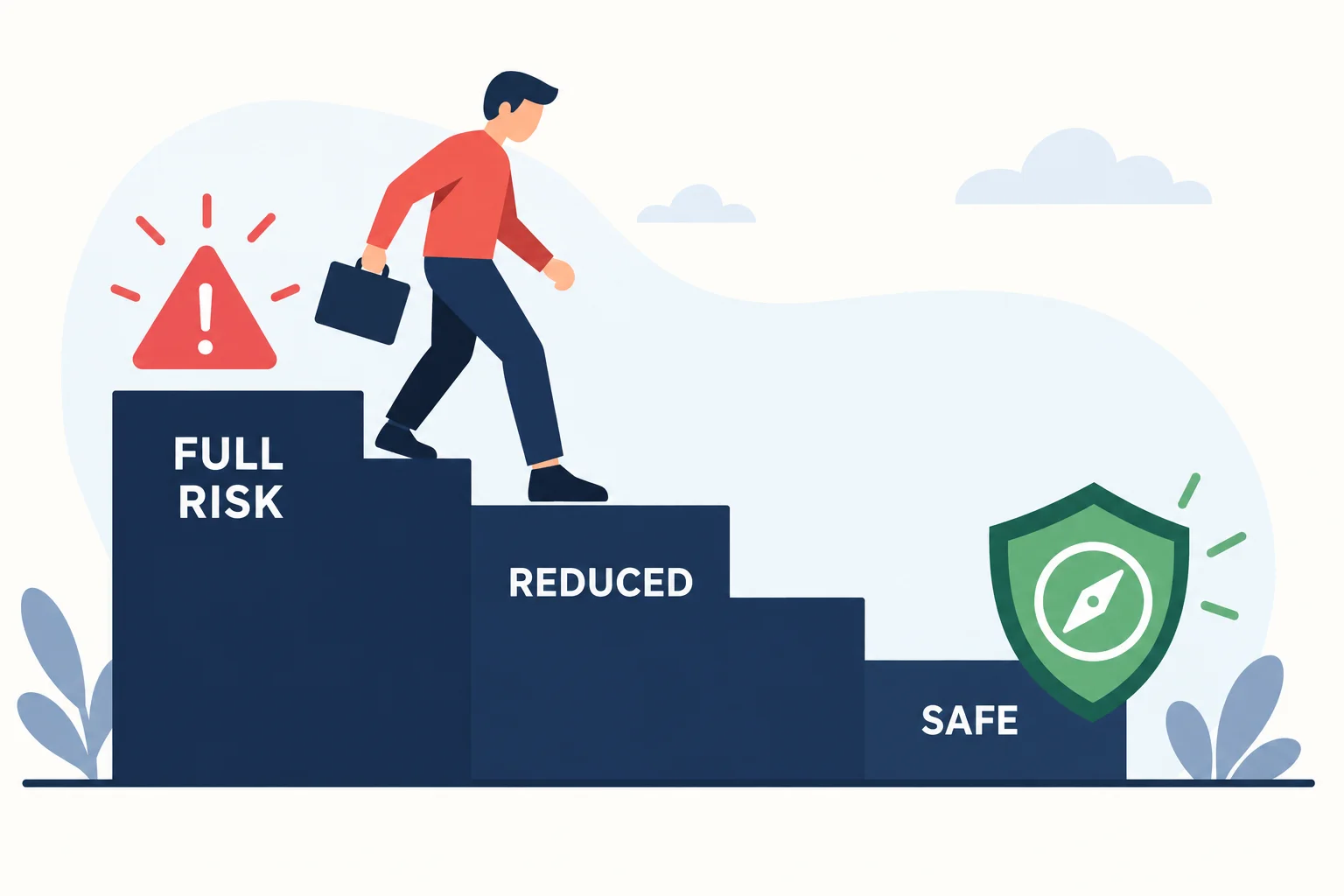
In ICT Forex – Considerations In Risk Management, ICT argues that longevity depends less on finding a flawless entry and more on limiting the damage caused by inevitable losing periods. The lesson focuses on percentage-based risk, the psychological effects of drawdown, and a step-down process for reducing exposure after losses.
This is an educational summary of ICT’s stated approach, not evidence that the method is profitable or suitable for every trader. The transcript also contains numerical inconsistencies, so its account examples should be checked independently rather than treated as audited calculations.
Why ICT Forex Risk Stays Low
ICT opens by describing risk management as a matter of survival and longevity. At 0:40, he considers a hypothetical $10,000 account risking 10% of its current equity on each trade. His broader point is that repeated percentage losses compound and can quickly create a severe drawdown.
He also emphasizes the behavioral consequences. After a loss, a trader may become determined to recover the money immediately, ignore evidence against the position, or try to impose a preferred outcome on the market. Around 1:28, ICT characterizes this as “arm wrestling” with the market: the trader shifts from following a plan to seeking emotional vindication.
The lesson next considers 5% risk per trade. ICT regards that level as excessive as well, particularly when several losses occur close together. His examples are intended to show that a risk percentage that feels manageable on one trade may become difficult both financially and emotionally when applied repeatedly.
Forex Risk Management for Financial and Mental Capital
At 3:21, ICT distinguishes account equity from what he calls mental capital. A trader might deposit $10,000 while discovering that they are emotionally unwilling to tolerate a $4,000 decline. In that case, the nominal account balance overstates the amount of loss the person can realistically handle without abandoning the plan or making impulsive decisions.
As a general educational interpretation, this distinction can be framed as risk capacity versus risk tolerance:
- Risk capacity concerns how much loss the account and the trader’s wider finances can withstand.
- Risk tolerance concerns how much uncertainty and drawdown the trader can experience without departing from the process.
The video does not provide a formal assessment tool for either concept. Its practical message is simply that position sizing should reflect more than the account’s headline balance.
The ICT Forex Risk Step-Down Model
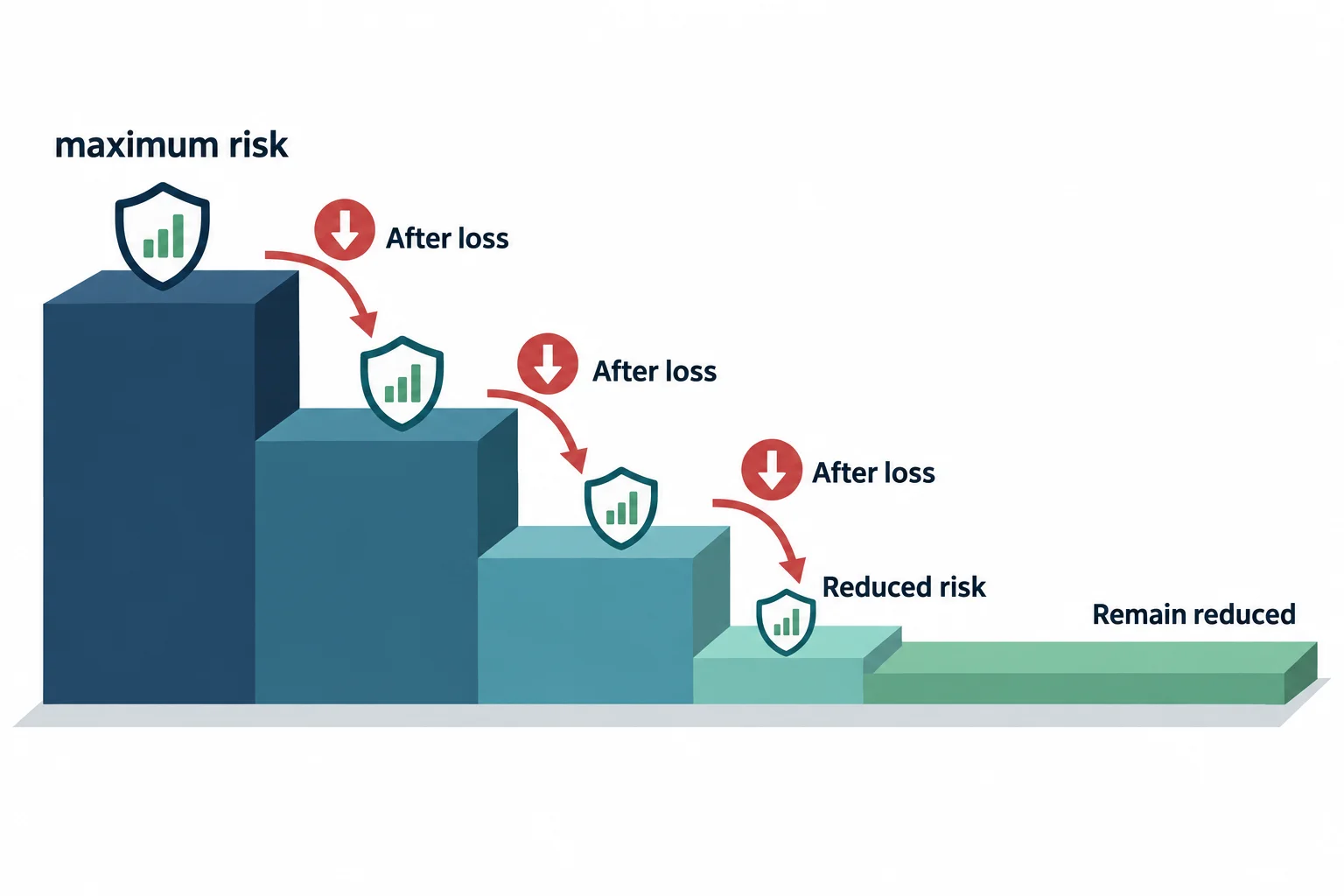
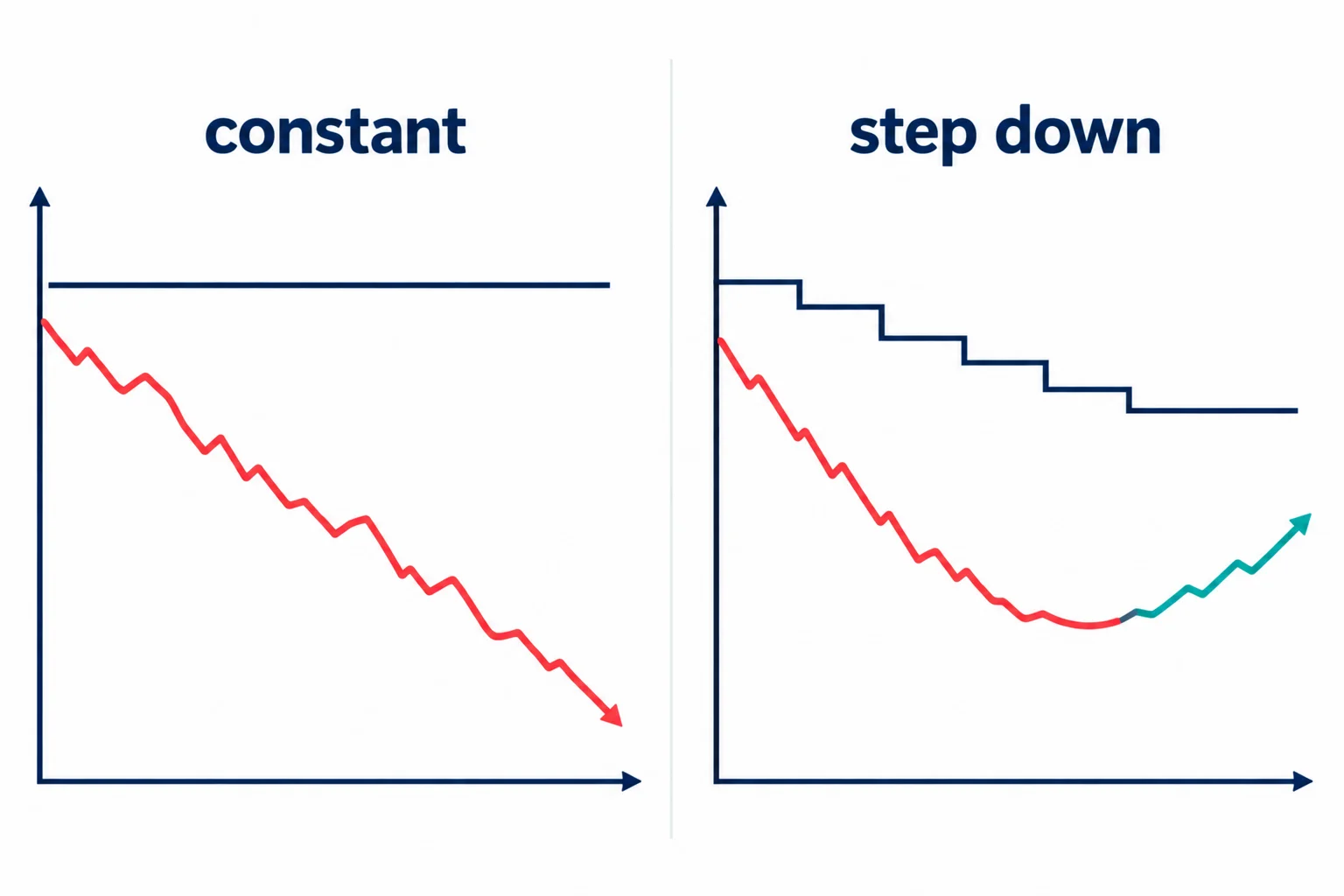
The central example begins at 6:44. ICT contrasts a trader who keeps risking 2% after every loss with one who reduces risk as soon as a loss occurs.
The proposed sequence is:
- Begin with a predefined maximum risk, illustrated as 2% of equity per trade.
- After one loss, reduce the next trade’s risk to 1%.
- After another loss, reduce risk again to 0.5%.
- Remain at the reduced tier during the drawdown rather than increasing size to recover losses faster.
- If losses continue, consider a still smaller tier, such as 0.25%, according to the trader’s plan and tolerance.
ICT explains the first reductions at 9:16 and reiterates the broader rule at 11:33: after a loss, cut risk rather than raise it. He explicitly warns against doubling exposure or otherwise increasing size because the next trade is expected to recover the previous loss.
This is the opposite of loss-chasing. The purpose is not to predict when the losing sequence will end. It is to reduce the amount at stake while performance, discipline, or market understanding may be impaired.
How Forex Risk Management Supports Staying Power
At 13:00, ICT extends the example to a much longer losing sequence. He argues that a trader who quickly moves to 0.5% risk can absorb substantially more losing trades than someone who continues risking 2% each time.
The transcript does not establish that a particular losing streak is statistically inevitable, and it provides no tested win rate or distribution of outcomes. The supported takeaway is narrower: smaller exposure slows the rate at which repeated losses consume equity. That can also create space to investigate whether the problem is execution, lack of discipline, unsuitable market conditions, personal stress, or an ineffective strategy.
How ICT Restores Forex Risk After Drawdowns
Risk is not restored immediately after one winning trade. Beginning at 17:13, ICT describes a gradual recovery process:
- Following a loss at the 2% tier, move to 1%.
- If another loss follows, move to 0.5%.
- Stay at 0.5% until approximately half of the relevant equity dip has been recovered.
- Then return to 1% and recover part of the larger drawdown before considering a return to the original maximum.
- If another loss occurs, step down through the tiers again.
The automated transcript renders one phrase near 18:14 as “1.5 of 1%.” In context, ICT appears to mean one-half of one percent, or 0.5%, because that is the tier used throughout the surrounding explanation. The audio and original visuals should be reviewed before relying on the wording.
Practical ICT Forex Risk Management Lessons
ICT closes by ranking risk control above entries and exits. Stripped of the video’s emphatic language, the framework has three parts: define a maximum exposure before trading, automatically reduce it after losses, and require an equity recovery before restoring size.
This does not remove market risk, validate a trading system, or guarantee longevity. It is a drawdown-control rule that must still be paired with clear position-sizing calculations, stop placement, transaction-cost assumptions, and a decision about when trading should pause entirely. The complete primary lesson is available on YouTube.
Watch the ICT Forex Risk Management Lesson
ICT Forex Risk Management Resources
- ICT Forex – Considerations In Risk Management (primary video, first-party YouTube)
- Inner Circle Trader – official ICT education portal (first-party site)
- BabyPips – School of Pipsology (third-party forex education; unofficial, untested)