Key takeaways
ICT’s February 25, 2025 Nasdaq review teaches that forecasts require confirmation and should be abandoned when price violates the plan.
Read the full summary
ICT’s February 25, 2025 Nasdaq review teaches that forecasts require confirmation and should be abandoned when price violates the plan. His modest bullish bias called only for an initial move toward smooth or relative equal highs before a bearish move toward a downside reference. After the 9 thirty open, price needed to trade above a marked inefficiency, return while holding its upper half, and displace upward to create a fair value gap long entry, but that sequence never formed. ICT instead aligned with weakness and considered shorts using failed inversion fair value gaps, volume imbalances, and consequent encroachment, then reported taking partial profits, reducing risk, and ultimately being stopped out after the position had been profitable, though the transcript provides no verifiable entry, size, fills, stop, or net result. For the next session he conditionally considered a return toward the prior session’s first fair value gap and smooth highs without abandoning his broader bearish interpretation. The article recommends timestamped chart review with TradingView Bar Replay at https://www.tradingview.com/support/solutions/43000474024-how-do-i-turn-bar-replay-on, notes NinjaTrader’s warning at https://support.ninjatrader.com/s/article/How-Market-Conditions-Affect-Orders-Fills that limited depth can cause slippage and partial fills, and stresses that the automatic transcript, Telegram messages, trade execution, profits, and claimed edge were not independently verified.
How we researched this article
BestProps used document-based research from primary firm sources, checked September 24, 2026. The complete source list, scope, limitations, and commercial-state record appear near the end of this article.
In 2025 Lecture Series – Telegram Commentary Market Review 02/25/2025, ICT reviews his Nasdaq analysis for the February 25 session. The central lesson is not that his opening scenario unfolded perfectly. It is that the market failed to confirm the scenario, requiring him to abandon the anticipated long setup and align with the observed weakness.[1]
At 5:26, ICT explicitly identifies the prior Telegram broadcast as February 25, 2025; he opens by explaining that the review was delayed from the previous night. This guide follows an automatic transcription of the original video audio, not a visual chart audit. It does not independently authenticate the original Telegram messages or verify trade fills and results.[1]
ICT Market Review Summary
- ICT’s initial bullish idea concerned a limited first move toward highs, followed by a bearish objective, not a bullish forecast for the whole session.[1]
- The intended long required specific post-open behavior around an inefficiency. ICT says that behavior never developed.[1]
- He describes switching to shorts, reducing exposure, taking partials and later being stopped out. That account does not establish the trade’s net result.[1]
- The practical distinction is between an anticipated path and a confirmed opportunity; his subsequent outlook also remained conditional.[1]
ICT Market Bias Was Deliberately Limited
ICT describes beginning with what he calls a “very modest bullish bias”. This was not presented as a broad call for a sustained Nasdaq rally. He wanted price first to move upward toward a group of smooth highs, then turn lower toward a downside reference level.[1]
His explanation relies on several concepts from his own framework:[1]
- Smooth or relative equal highs: ICT interprets these as an area where buy-side liquidity may rest.
- Inefficiency and fair value gaps: He watches how price trades through or reacts to these chart areas.
- Inversion fair value gap: He wanted a previously breached area to provide support before considering a long.
- Liquidity objectives: Rather than requiring a complete directional forecast, he looks for nearby highs or lows that price might reach.
At 3:38, he clarifies that the proposed daily-range sequence was an initial rise followed by movement toward that downside reference. The distinction matters: “bullish” referred only to the expected first leg, not the full-session expectation.[1]
ICT Market Long Lacked Confirmation
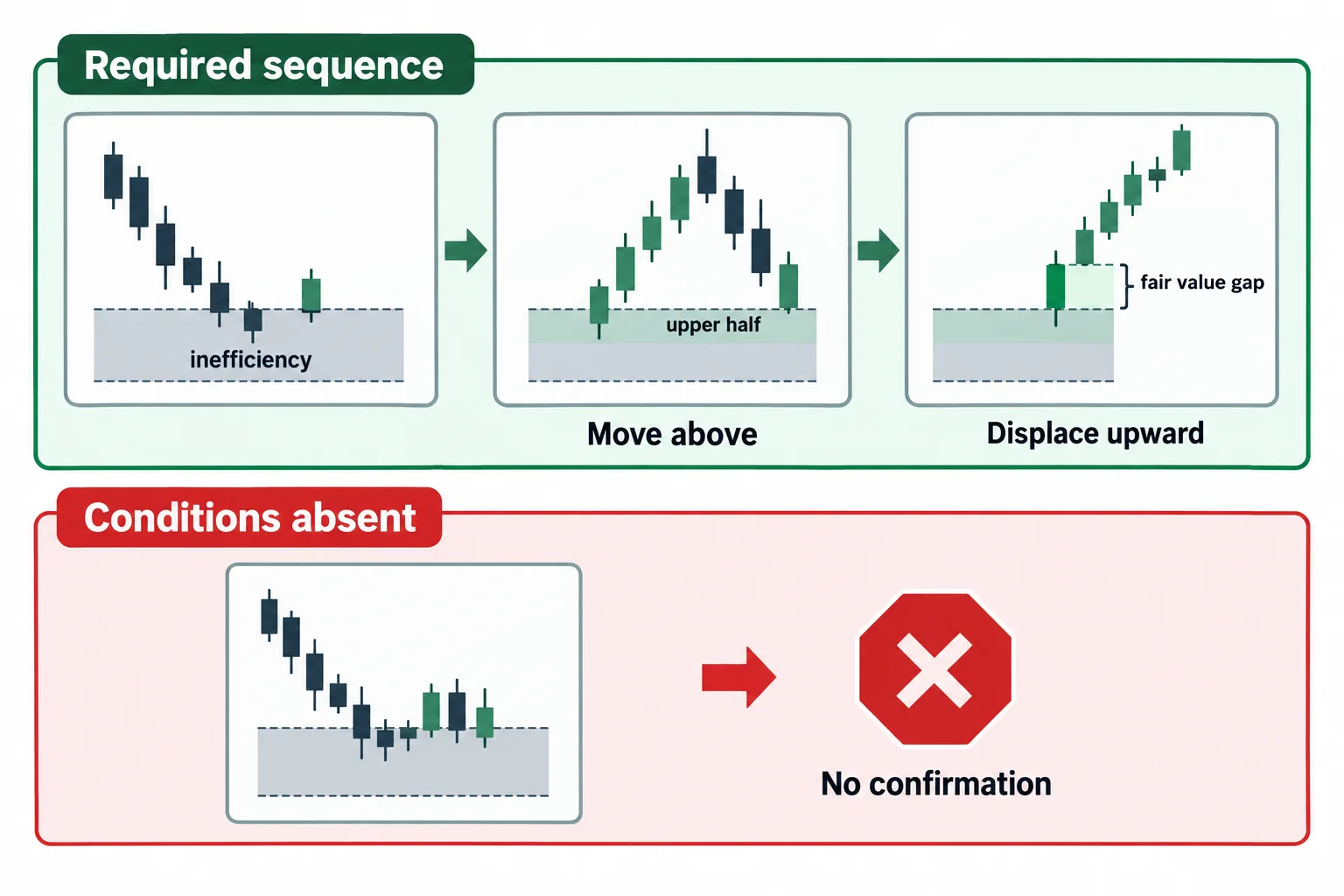
ICT then moves through the five-minute and one-minute views. In the sequence at 4:15, repeated at 6:10, after the 9:30 opening price he wanted price to trade above a marked inefficiency, return to it while holding the upper half, and then displace upward. A subsequent fair value gap could, in his model, have supplied a possible long entry toward the smooth highs. He planned to exit that hypothetical long near the buy-side objective and then look for a short.[1]
That sequence did not occur. At 4:52, he says the market showed no interest in moving higher and instead continued lower. Later, he emphasizes that the anticipated run above the inefficiency had to happen after 9:30; without that behavior, the modest bullish premise lacked confirmation.[1]
This is the most transferable educational point in the review: a directional idea is not the same as an entry signal. Within ICT’s interpretation, the idea supplied a conditional path. When price did not produce the required support and displacement, there was no basis for taking the planned long merely because it had been considered beforehand.[1]
ICT Market Commentary Shifts to Observation
Once the market remained heavy, ICT says he “had to eventually just get in line” with it and consider shorts. He describes price returning into portions of fair value gaps or volume imbalances, failing to launch higher, and then breaking lower. In his terminology, a failed inversion fair value gap and a barrier at what he calls consequent encroachment helped frame a short (8:58).[1]
From 10:19, ICT also recounts managing a position by taking partial profits and reducing exposure because he was uncomfortable with the risk. He says the position ultimately stopped out after having been in profit. The transcript does not provide enough independently verifiable information to reconstruct the entry, contract count, partial exits, stop price, or net outcome, so these remarks are best understood as his own account of the management process.[1]
ICT Market Risk Control in Difficult Conditions
From 11:11, the discussion broadens into risk and expectations. ICT characterizes the 2025 market up to that point as unusually difficult and volatile. He urges traders to be nimble, cautious with position risk, and willing to accept that an analysis can be wrong.[1]
His broader message is that the existence of an open market does not itself create a valid opportunity. In his closing remarks at 17:01, he cautions against trading merely because the market is open. That caution is separate from a claim that any setup is guaranteed.[1]
What ICT Watched Next in the Market
Near 13:18, ICT turns to the next session. After lower smooth lows had been disturbed, he considers the possibility of a return toward the prior session’s first fair value gap and possibly the smooth highs he identifies as an upside liquidity reference. He stresses that even a rally to that area would not necessarily overturn his broader bearish interpretation.[1]
At 14:46, he summarizes the intended benefit of his approach: focus on relatively clear liquidity objectives rather than requiring perfect directional bias. At 15:29, he says he is prepared to look for higher prices but change course if a contrary setup appears, just as he says he had done the day before. These are conditional expectations voiced in the recording, not a report of what happened afterward.[1]
ICT Market Review Takeaways
This review illustrates a conditional workflow: establish an objective, specify the price behavior needed for entry, and withdraw the idea when that behavior does not appear. ICT’s market terminology and interpretations are his own; the recording does not establish that these concepts provide a proven edge. The sound general lesson is simpler: do not confuse a forecast with confirmation, and do not force a trade when the market fails to meet the conditions of the plan.[1]
ICT Market Review Timeline and Worksheet
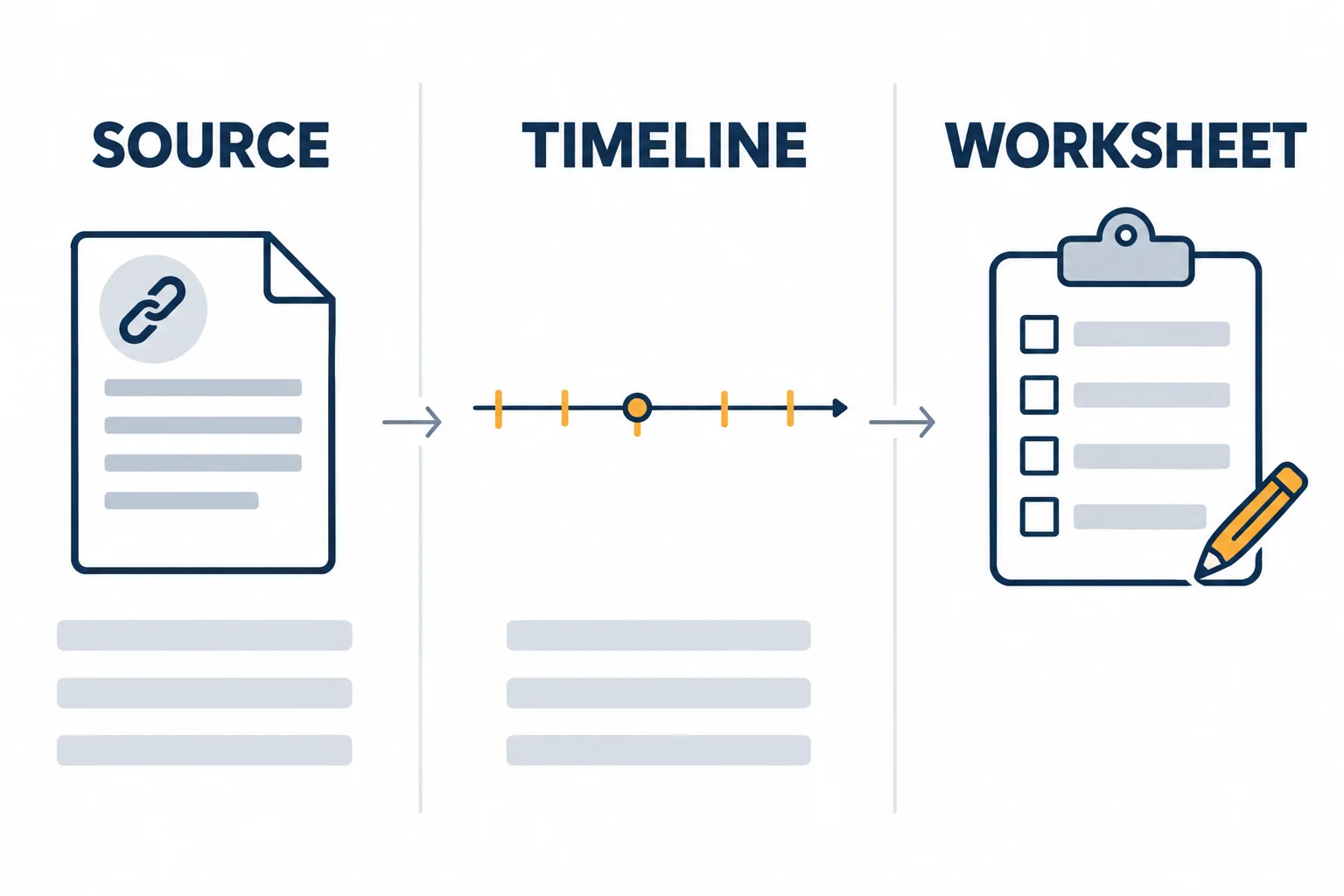
For your own study, first link the original recording. Then separate the February 25 retrospective from the forward-looking portion beginning around 13:18. On a worksheet, give the planned long, the missing confirmation, the reported short management and the next-session hypothesis their own rows. Add timestamps and distinguish speaker claims from observations you have actually checked. This is an editorial review method, not an official ICT entry model.
TradingView’s Bar Replay instructions explain how to select a historical starting point and step forward manually. Use that only as labelled historical practice, not evidence that a trade was executed live.[3]
NinjaTrader’s order documentation explains that limited depth can lead to slippage and partial fills. A chart-study result does not establish an identical executable fill; this is supplementary execution context, not verification of ICT’s trade.[2]
Watch the ICT February 25 Market Review
The previously tested embedded player reported that playback on other websites was disabled by the video owner. The original recording remains linked here.
Watch ICT’s 2025 Lecture Series (Telegram Commentary Market Review 02/25/2025) on YouTube
Risk and evidence: This article is educational, not a trade recommendation. The automatic transcript does not independently establish profits, exact chart coordinates or what happened after the recording. The CFTC’s Learn & Protect resource warns that there is no risk-free trade or investment.[4]
ICT Market Review Sources and Resources
The video supports the lesson summary. The three additional first-party resources provide execution, study and investor-protection context, not validation of a trading edge.