Key takeaways
ICT’s 2025 GBP/USD London Open lesson demonstrates a bearish scalp on a demo account, not verified real-money trading, using five-minute context and one-minute execution.
Read the full summary
ICT’s 2025 GBP/USD London Open lesson demonstrates a bearish scalp on a demo account, not verified real-money trading, using five-minute context and one-minute execution. ICT treats an earlier buy-side liquidity run as a Judas swing, marks the five-minute bearish order block’s opening price, identifies lower sell-side liquidity and imbalance objectives, and waits for either a return to the marked reference or entry near a nearby imbalance. Around seven minutes 53 seconds he narrates opening a small short with invalidation above consequent encroachment, considers adding only on a revisit consistent with the premise, and keeps the stop unchanged until a one-minute close through a lower-wick confirmation threshold. After that close around 24 minutes 7 seconds, he reduces risk, takes a partial near 28 minutes 20 seconds, and says the remaining stop should cover costs. When a reported limit order misses its fill, he brings the stop closer rather than forcing an all-or-nothing outcome and warns against frustration, revenge trading, and impulsive re-entry. ICT explicitly calls the account demo at 31 minutes 29 seconds and says at 47 minutes 15 seconds that he does not trade forex with real money. The automatic transcript does not independently verify chart coordinates, platform behavior, exact entry, stop distance, notional size, fills, account calculations, or the final result, and the lesson does not establish a repeatable trading edge.
How we researched this article
BestProps used document-based research from primary firm sources, checked September 24, 2026. The complete source list, scope, limitations, and commercial-state record appear near the end of this article.
In this 2025 Lecture Series video, ICT walks through a GBP/USD London-session short on a demo account while moving between five-minute and one-minute charts. The lesson is less about copying an entry than about following his narrated decision process: forming a directional premise, waiting for a specific setup, defining invalidation, reducing risk and managing the emotions created by an open position.[1]
Watch the full primary video on YouTube. The transcript is generated by automatic speech recognition, and the chart was not independently reviewed visually for this guide. The February 21, 2025 label comes from the original video title; the transcript is not an independent audit of the chart date.[1]
ICT 2025 GBPUSD Lecture Summary
- The title says live execution, but ICT explicitly identifies the account as demo at 31:29 and 47:15. It is not proof of real-money profits.[1]
- He begins with five-minute GBP/USD context and uses one-minute detail to refine a bearish scalp.[1]
- His teaching separates waiting for the setup, initial risk, confirmation before stop adjustment, partials and the response to a reported missed fill.[1]
- The entry, stop, notional size, final fill and net result are not independently reconstructed from the automatic transcript.
ICT GBPUSD London Short Setup
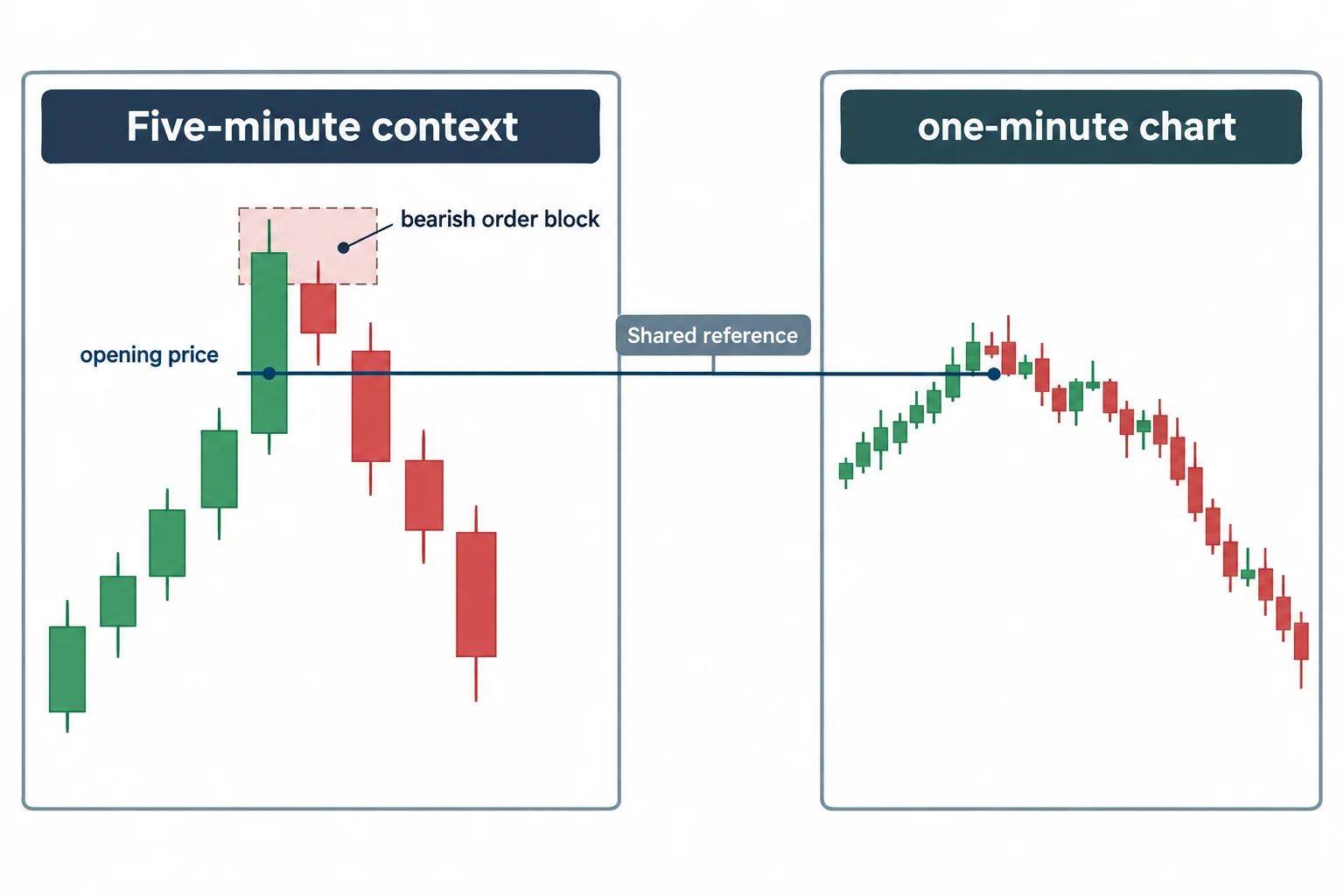
ICT begins on a five-minute GBP/USD chart. He interprets an earlier move above buy-side liquidity as a “Judas swing” and identifies several lows below price as potential sell-side objectives. At 16:26, he explicitly calls the idea a bearish scalp toward lower references, not a prediction of a lasting GBP/USD top or a very large decline.[1]
At 0:30, he identifies GBP/USD and the five-minute chart. From 1:11, he focuses on the last up-close candle in that move, then carries its opening-price reference onto the one-minute chart. At 3:19, he explicitly calls the line the five-minute bearish order block’s opening price.[1]
The early distinction is between that five-minute reference and the higher one-minute candle another viewer might select. At 1:25–2:17, ICT says he does not require a rally to the latter candle; he describes a break and return to his marked reference as a possible setup. Later, at 6:55–7:40, he also allows for an entry around the nearby imbalance if price leaves without touching the order-block line. These are narrated chart references, not independently reconstructed candle coordinates. At 04:03, he also cites the Friday context and the preceding run higher as parts of his bearish interpretation.[1]
Waiting for the GBPUSD London Open Setup
The most transferable teaching appears around 05:00. ICT says newer traders often anticipate an entry because they fear missing the move. His response is that intraday markets offer other opportunities, so there is no need to force a position before the stated conditions appear.[1]
He waits for price to interact with what he describes as the lower portion of a buy-side imbalance/sell-side inefficiency and narrates putting on a small short position around 07:53. At 8:00, he describes a stop above what he calls consequent encroachment of the referenced imbalance. No precise stop price or distance is reconstructed here. At 9:47, he discusses adding only if price revisits the area within his premise; that is his demonstration, not a recommendation to increase exposure.[1]
The large leveraged amounts he mentions belong to the demonstration; they are not a sizing recommendation. At 31:29, ICT expressly calls this a demo. He repeats at 47:15 that he does not trade forex with real money. The transcript alone cannot verify the platform display, exact fills, prices or account calculations.[1]
GBPUSD Execution Confirmation and Stop Management
From 11:11, ICT watches a lower wick’s consequent encroachment as a confirmation threshold. At 17:38, he says he will keep the stop where it is until price trades through that threshold on a closing basis. His expectation is that a close through this level would indicate continued weakness toward the relative equal lows and the lower five-minute imbalance.[1]
At 24:07, he says the one-minute chart has closed below that threshold. He then says he can lower the stop to reduce risk. Importantly, he does not present this as certainty: throughout the session, he repeatedly acknowledges that price need not move directly to the objective and that no trade is guaranteed.[1]
ICT Execution Sequence and Key Caveats
The following summarizes his process in this recording, not a universal entry or risk rule.[1]
- Establish a higher-time-frame premise and identify the intended liquidity draw.
- Move to a lower time frame only to refine a setup already grounded in that premise.
- Wait for price to reach the predefined entry area instead of chasing movement.
- Place invalidation where the underlying interpretation would no longer be acceptable.
- Require a specified confirmation before reducing risk.
- Take a partial if doing so supports disciplined management, then move the stop to cover costs.
GBPUSD Execution Partials Missed Fills and Emotional Control
Near 28:20, ICT narrates taking a partial near an area he had identified. He explains that partial profit-taking can help a developing trader satisfy the urge to realize a gain. Under his stated process, once the first partial is taken, the remaining stop should cover costs, while the trader accepts that the rest may be stopped out.[1]
Later, ICT reports that price reached the area he expected without the limit order filling as he wanted. That is his account of the platform behavior, not an independently verified market fill. At 42:18, he explains that he brings the stop closer rather than demanding an all-or-nothing result. He uses the episode to discuss missed fills, frustration and revenge trading, particularly from 45:54. The transcript does not establish a final closed result for the remainder of the position.[1]
At 48:18, his broader message is that a trader should remain committed to the original logic until either the stop or target resolves the position. Anger about execution cannot change a missed fill and may distract from the still-open trade. He strongly cautions against acting on the impulse to re-enter merely because an outcome felt unsatisfactory.[1]
ICT GBPUSD Lecture Limits and Learning Points
Concepts such as order blocks, fair value gaps, liquidity pools and an algorithm controlling price reflect ICT’s own market framework. This video does not independently establish that these interpretations predict markets or provide a profitable edge. It also contains extended personal, marketing, religious and prop-firm commentary; those claims are not necessary to understand the demonstrated trade-management lesson and are not independently substantiated by the transcript.[1]
GBPUSD Execution Review Without Unsupported Chart Evidence
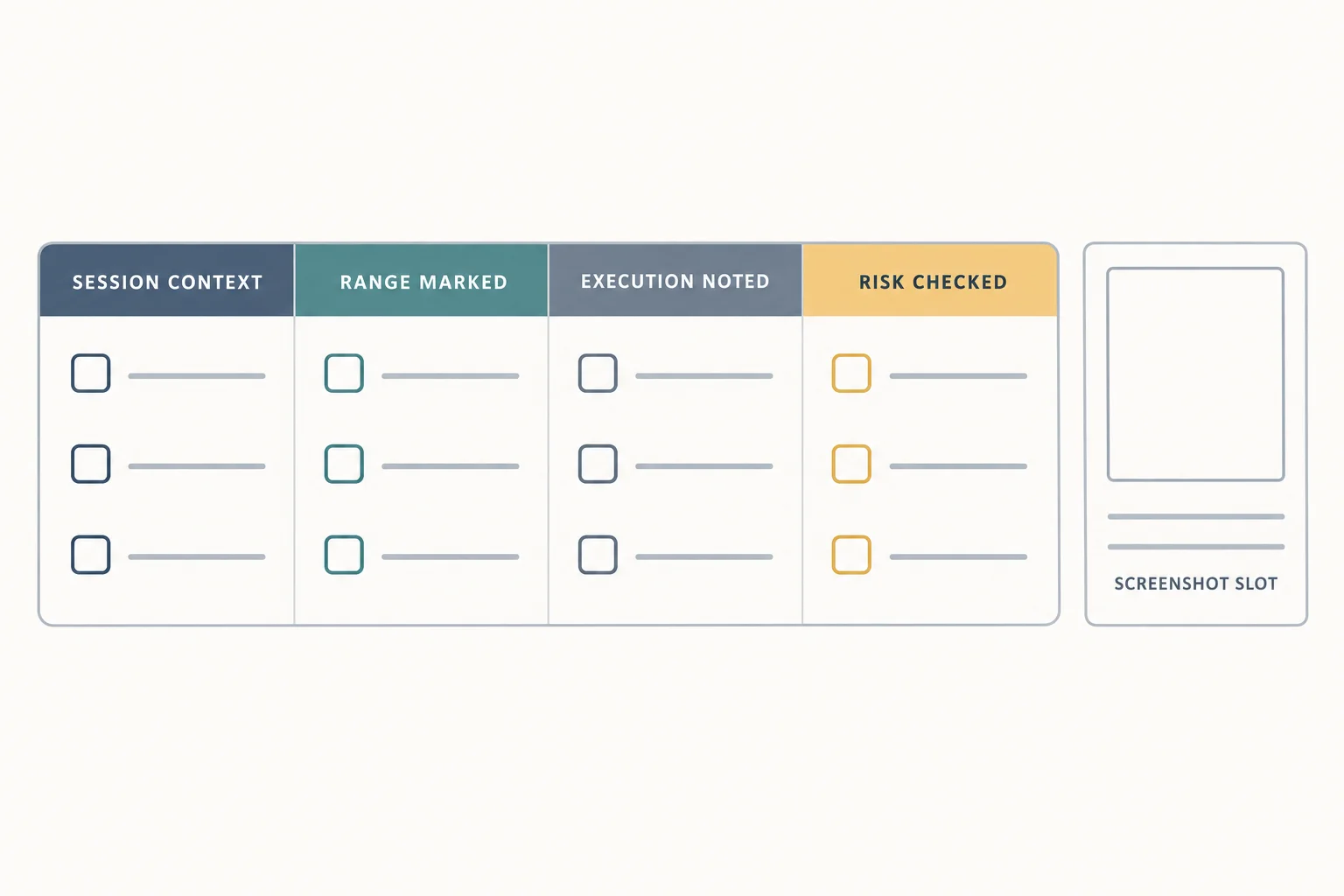
As an editorial study exercise, work through the four columns below: session context, the range or reference you actually marked, the execution evidence you actually checked, and the risk question still open. Keep the screenshot slot empty unless you have inspected and captured the relevant chart. A transcript passage is evidence of what was said, not a substitute for that visual check.
Record the platform’s displayed time zone alongside any chart timestamp. IANA’s Time Zone Database tracks historical local-time rules, UTC offsets and daylight-saving changes; use the recording date rather than assuming today’s London–New York offset applies. This supporting resource does not define ICT’s killzone boundaries, and the featured schematic clock is not a precise schedule.[2]
Watch the ICT GBPUSD London Open Lecture
The previously tested embedded player reported that playback on other websites was disabled by the video owner. Use the original recording and the timestamp links above.
Watch ICT’s 2025 Forex GBP/USD Live Execution London Open Killzone (02/21/2025) on YouTube
Risk and evidence: This guide is educational, not a trade recommendation. A narrated demo account does not establish real-money returns or a repeatable trading edge. The CFTC’s forex advisory warns that this market is volatile, carries substantial risk and is not a place for money you cannot afford to lose. That general warning is not an allegation about the speaker or this recording.[3]
ICT GBPUSD Lecture Sources and Resources
The original video is the source for the lesson summary. IANA and the CFTC provide separate time-zone and risk references, not evidence of trading performance.