Key takeaways
In Drawdown Mitigation – March 09, 2023 Homework Assignment the speaker walks through a deliberately self-inflicted loss sequence in about two and a quarter minutes: he takes shorts and adds after a stop, says he is building drawdown against the parameters of a well-known funded-account challenge (0:17), describes two five-handle runs he chooses not to…
Read the full summary
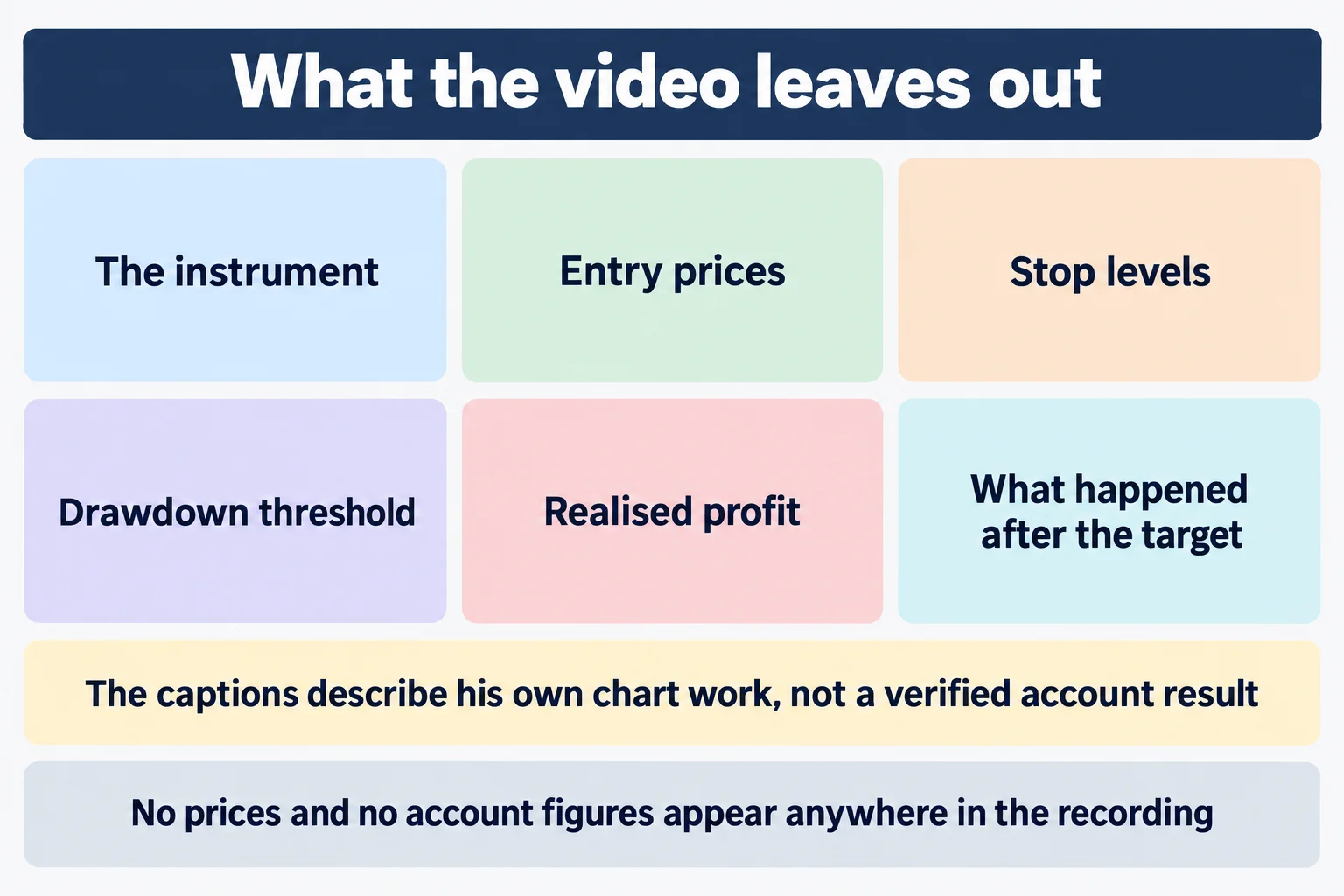
In Drawdown Mitigation – March 09, 2023 Homework Assignment the speaker walks through a deliberately self-inflicted loss sequence in about two and a quarter minutes: he takes shorts and adds after a stop, says he is building drawdown against the parameters of a well-known funded-account challenge (0:17), describes two five-handle runs he chooses not to close (0:39 and 1:03), steps aside for an unemployment release he says will railroad the position (1:17), then reads the daily chart, goes long, sets a target with a swing projection, adds at an order block and says he is at the 15-contract maximum he ties to the $150,000 challenge option (1:56). The captions name no instrument, no entry price, no stop level, no drawdown threshold, no fill and no account result, so this is a narrated chart exercise rather than a verified performance record.
How we researched this article
BestProps used document-based research from primary firm sources, checked September 24, 2026. The complete source list, scope, limitations, and commercial-state record appear near the end of this article.
The clip is short and informal: a screen recording of the speaker working on his own charts while he talks. What makes it useful is not a setup but the sequence of decisions he narrates — deliberately using up risk capacity, then flipping direction and building a position to a hard contract cap.
Deliberate drawdown, on purpose
He starts by saying out loud that he is going to create drawdown and paint some shorts on the chart (0:00 and 0:05). He says he wants to build the position up so that when it stops him, it will take a little equity away (0:09).
The purpose is stated a moment later: the homework for that week was to draw down against the parameters of one of the well-known funded-account challenges (0:17). That framing matters. A challenge account usually constrains the trader in two ways at once — a maximum loss before the account fails, and a cap on how large a position may be held — so any live exercise has to be planned inside both. He does not name the firm or restate its numbers on this recording.
Read as an instruction, the exercise would be poor practice: losing money on purpose burns the loss allowance an account needs in order to keep trading. The useful content here is the accounting, not the direction — under those rules each entry, each add and each stop changes how much room is left.
Two five-handle runs he does not close
After one stop-out he adds another short, again describing it as drawing down further (0:30). He then says the move will be an example of a five-handle run, and that he is not going to close it but will let it come back against him (0:39). A little later he repeats the point and says he would be content with that move and will step to the sidelines (1:03).
“Handle” is a market-specific term: it refers to a whole number or a set increment of the quoted price depending on the instrument and how the trader counts. The captions never identify the market being traded, and they show no price scale, so the phrase cannot be converted into a verified point or dollar figure from this recording.
Standing aside for the unemployment release
He ties the decision to exit to a scheduled event: he says he is moving to the sidelines for unemployment data (1:12) and expects the release to come out and railroad the position (1:17). He then notes the run is over (1:28).
That is the general lesson worth taking from the clip: an economic release can reprice quickly and unpredictably enough that carrying a position into it is a separate decision from whether the trade idea is right. The recording does not say which release, which market, or what the actual impact on the account was.
The flip to long, and a position cap
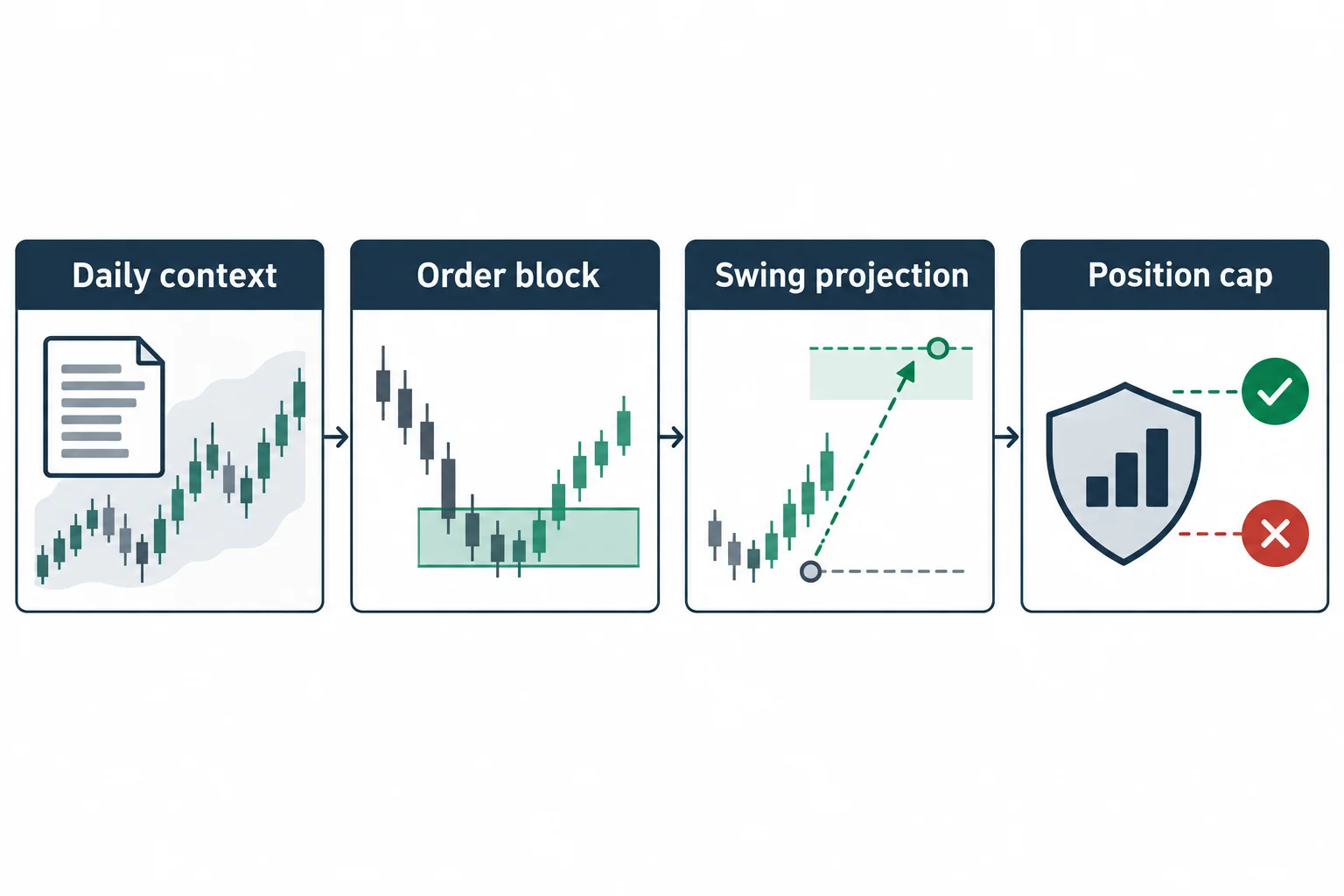
He then says he is going to go in and look at the daily chart (1:35), finds a reason to expect higher prices and goes long (1:38), and uses a swing projection to give himself a target (1:43). He describes adding to the position at what he calls an order block (1:51).
Those are his own analytical labels for what he was drawing. Order block and swing projection are parts of the speaker’s vocabulary rather than standardised measurements, and a two-minute clip supplies neither the bars nor the levels needed to check the designations independently.
He then says he is at the maximum parameter he mentioned earlier — 15 contracts — which he says is what the funded-account challenge allows and is the limit he ties to the $150,000 option (1:56). He says the market is about to run up and hit the target, and notes when it does (2:08 and 2:16).
That contract figure is his statement about a third-party firm’s rule set, not something this article can confirm; challenge rules differ by firm, by account size and over time. The same caveat applies to the target: “there it is” is the speaker acknowledging his own mark, and the captions record no fill, no realised profit and no account balance.
What the clip is useful for, and what it is not
Taken as a demonstration of process, the sequence illustrates four things a constrained account has to hold together at once:
- Know the governing limits before entering: the loss allowance and the contract or position cap constrain the plan itself, not just its outcome.
- Track cumulative exposure: each add changes total risk even when it is placed at a different price.
- Treat scheduled releases as their own decision: the speaker steps aside for the unemployment data instead of assuming the prior conditions persist.
- Keep bias and execution apart: he narrates a shift from short to long after reading the daily chart.
What it does not do is show a result. There is no instrument, no price, no stop, no threshold and no ending balance anywhere in the captions, so nothing here establishes that the approach works or that the target was reached in a live account. It is also not a recommendation to spend risk capacity on purpose; that behaviour is the exercise, not the lesson.
Watch the original recording
Drawdown Mitigation – March 09, 2023 Homework Assignment
The Inner Circle Trader · published 9 March 2023 · about two minutes. This is the primary source for this article; every timestamp link above points into it.
The video is not embedded here because the owner has disabled playback on other websites. That was checked directly on 15 September 2026 from a BestProps page origin: the embedded player loads and returns “Playback on other websites has been disabled by the video owner” instead of playing, so no empty player is left on this page.
The watch page was read on 15 September 2026 and rendered as a public video: title “Drawdown Mitigation – March 09, 2023 Homework Assignment”, listed at 2 minutes 17 seconds, with an upload timestamp of 9 March 2023 at 6:25 a.m. Pacific. The scheduling inventory used for this article lists the same upload under the date 9 March 2023, so the two agree, and the inventory title matches the watch-page title. The channel is The Inner Circle Trader on YouTube, which is the first-party record of what it publishes.
Resources
These are the sources checked for this article. The drawdown-rules page relates to the account constraints the exercise is built around; the regulator and investor-education pages are general material about futures and about trading systems sold to the public. None of them assesses the speaker or verifies a statement made in the recording. Any ICT, smart-money or third-party indicator, script, note set or re-upload circulating outside the publishing channel’s own page is unofficial and untested here.
- [1] Drawdown Mitigation – March 09, 2023 Homework Assignment — The Inner Circle Trader (primary source; watch page read 15 September 2026, 2M17S)
- [2] The Inner Circle Trader — official YouTube channel (read 15 September 2026)
- [3] BestProps drawdown rules (read 15 September 2026) — the kind of loss limit a challenge exercise has to stay inside. Check the firm’s current rulebook before relying on any figure.
- [4] CFTC — Fraud Advisory: Commodity Trading Systems Sold on the Internet (read 15 September 2026)
- [5] Investor.gov — Glossary: Futures (read 15 September 2026)
This is independent educational commentary on one speaker’s own chart work. It is not official ICT material, it is not a tested trading system and it is not investment advice. The recording contains no profit or loss figure and none is reported here. Leveraged futures trading carries substantial risk.