Key takeaways
ICT Mentorship Episode 20 is a retrospective London-session lesson, not a documented live trade, combining DXY context with a hypothetical EUR short setup.
Read the full summary
ICT Mentorship Episode 20 is a retrospective London-session lesson, not a documented live trade, combining DXY context with a hypothetical EUR short setup. ICT expected DXY to move below 100 toward roughly 99.92 to 99.95, defines the London open kill zone as two o'clock a.m. to five o'clock a.m. New York time, and interprets aligned prior highs as liquidity targets. Around nine minutes 6 seconds, he compares DXY weakness near projected support with EUR trading above the previous week's high, treating their inverse relationship as context for a possible euro reversal. On the two-minute EUR chart from 12 minutes 21 seconds, the sequence requires a sweep above the weekly high, sharp bearish displacement creating a fair value gap, a break below a short-term low confirming a bearish market-structure shift, and a retracement into the gap before a hypothetical short entry with invalidation above the referenced high. ICT stresses that displacement must precede the retracement setup, uses the five-minute chart only to display broader targets such as the parent price leg midpoint and a lower imbalance, and suggests risking no more than 1 percent of account equity, with smaller fractions for learners. He states at 11 minutes 1 second that he neither bought DXY nor shorted EUR, so the example does not verify fills, profitability, chart markings, or subsequent price action.
How we researched this article
BestProps used document-based research from primary firm sources, checked September 25, 2026. The complete source list, scope, limitations, and commercial-state record appear near the end of this article.
In 2022 ICT Mentorship Episode 20, ICT reviews a London-session example involving the U.S. Dollar Index and the euro. He uses the session to explain his interpretation of intermarket relationships, liquidity around prior highs, displacement, fair value gaps and hypothetical risk management.
This is a retrospective teaching example rather than a documented live trade. ICT explicitly says that he did not take either side of the move, and the transcript alone cannot verify chart markings, order fills or what happened after the period shown.
ICT Episode 20 Dollar Index Review
ICT begins by referring viewers to Episode 19, where he says he had anticipated a move in the Dollar Index below the 100 level and toward an area around 99.92–99.95. In Episode 20, he describes the subsequent action as broadly consistent with that premise, although he acknowledges that it did not reach precisely the level he had outlined.
At 4:18, he explains that the projected area came from extending an earlier price movement and aligning it with the high of a referenced candle. He characterizes this as an approximate visual projection rather than presenting a complete mechanical rule.
His broader lesson is that students should investigate repeatable conditions independently instead of expecting live calls. ICT frames the example as an answer to questions about whether his concepts could be studied during the London forex session, not as an expansion of the mentorship’s core model.
ICT Episode 20 London Session Window
ICT defines his London open “kill zone” as 2:00 a.m. to 5:00 a.m. New York local time. At 8:04, he says the Dollar Index formed its low during this window and then rallied toward a group of similar prior highs.
Under ICT’s interpretation, closely aligned highs can represent liquidity rather than dependable resistance. He argues that price may move through those highs as an intraday objective. This is ICT’s market framework and should not be treated as an independently established rule based on this single example.
ICT Episode 20 Dollar and Euro Comparison
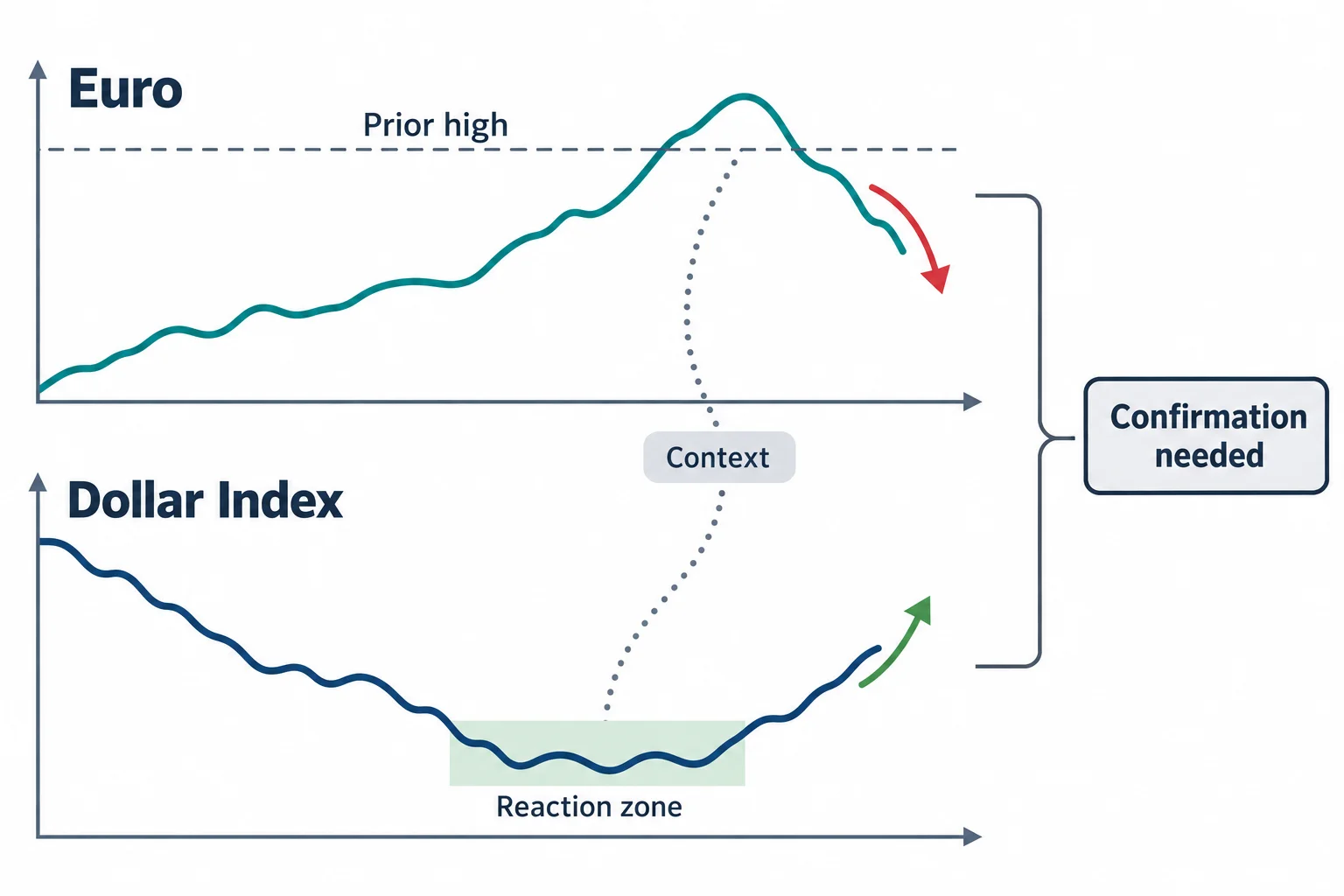
The central teaching begins around 9:06. ICT compares the Dollar Index with the euro and treats their movement as inversely related for this analysis:
- The Dollar Index moved down toward the area ICT had identified as potentially supportive.
- At approximately the same time, the euro rallied toward and above the previous week’s high.
- ICT interpreted the euro’s move above that high as a potential false breakout because his Dollar Index premise anticipated a reversal higher.
- If the dollar strengthened from that area, his expectation was that the euro would face downward pressure.
ICT therefore presents the Dollar Index as a contextual “barometer” for a euro setup. The lesson is not simply to trade one market because another has turned. Rather, his analysis combines a higher-timeframe objective, a prior liquidity level, session timing and lower-timeframe confirmation.
He also states at 11:01 that he neither bought the Dollar Index move nor shorted the euro example. That distinction matters: the video explains a hypothetical setup after the described movement, not a verified fill or trading result.
ICT Episode 20 Two-Minute Trade Confirmation
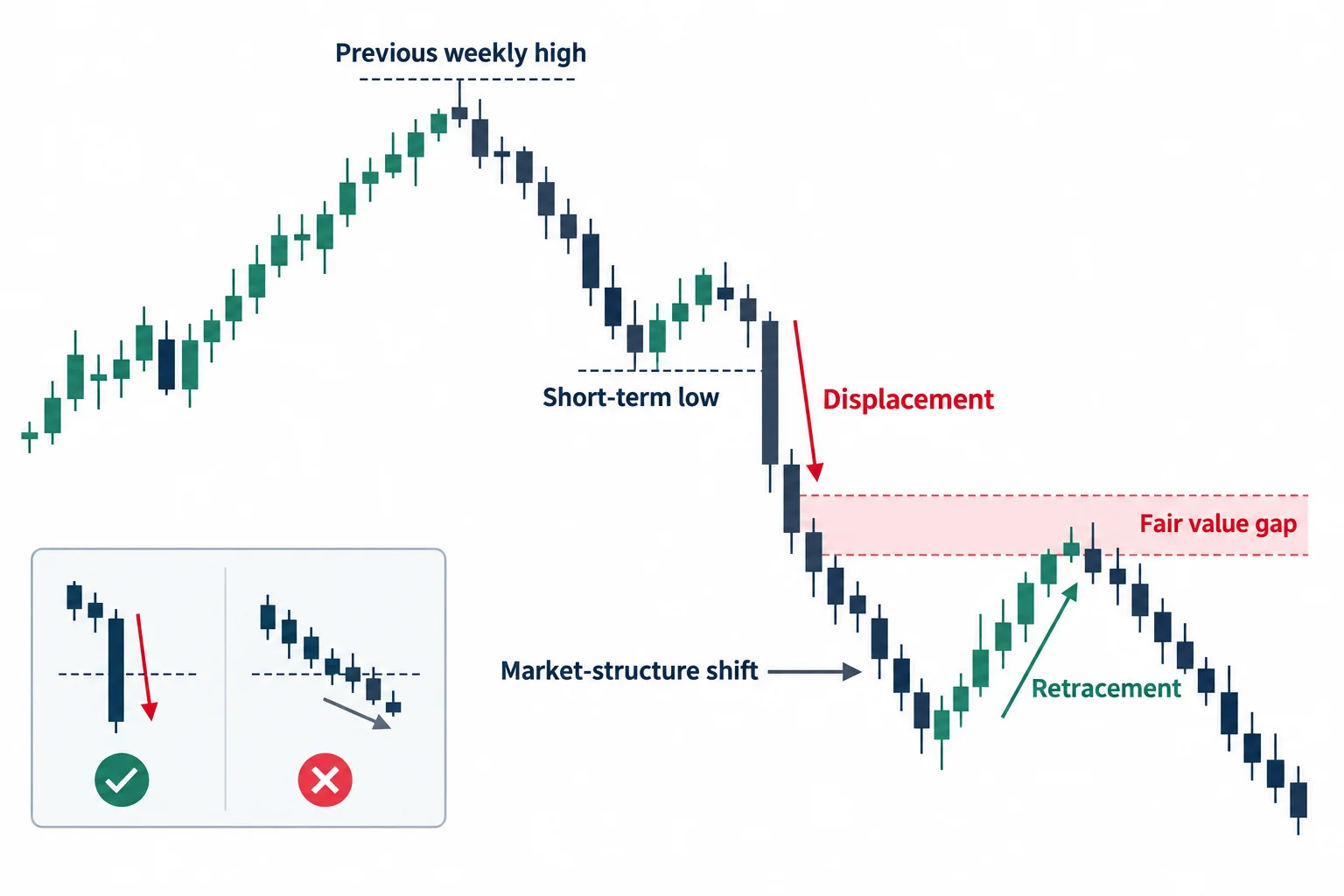
ICT then reduces the euro chart to a two-minute timeframe. Beginning at 12:21, he identifies a fair value gap after price moved above the previous week’s high and then traded lower through a short-term low.
For ICT, the key condition is displacement: an energetic move away from the fair value gap. He rejects the first nearby low as meaningful confirmation because price had not yet moved decisively away from the gap. Once a stronger decline passed through a short-term low, he labels it a market-structure shift.
His hypothetical sequence is:
- Price trades above the previous week’s high.
- A sharp decline creates a lower-timeframe fair value gap.
- The decline breaks a short-term low, which ICT treats as a bearish structure shift.
- Price retraces into the fair value gap while the London window remains open.
- The retracement becomes the hypothetical short-entry area, with invalidation above the referenced high.
At 13:41, ICT zooms in and discusses a hypothetical limit entry. Although the captions include precise quoted prices and estimated drawdown, those values depend on an unseen chart and cannot be independently confirmed from the transcript. The more transferable educational point is that ICT waits for displacement before considering a retracement, rather than chasing the initial move.
ICT Episode 20 Risk and Target Lessons
Around 15:27, ICT advises thinking in terms of a fixed percentage of account equity rather than a fixed dollar amount. He mentions 1% as a maximum and suggests that learners consider smaller hypothetical fractions. These are the speaker’s educational risk examples, not personalized investment advice or a guarantee that losses would remain within the intended amount.
For possible objectives, ICT discusses the midpoint of what he calls the “parent price leg” and a lower imbalance visible on his chart. He switches to a five-minute view only to fit the larger movement onto one display; he does not present the timeframe change as an additional signal.
ICT Episode 20 Educational Takeaways
Episode 20 illustrates how ICT combines several parts of his framework: a projected Dollar Index reaction area, the London session window, the euro’s move through a previous weekly high, an assumed inverse intermarket relationship, lower-timeframe displacement and a retracement into a fair value gap.
The clearest study exercise is to separate context from execution. In ICT’s presentation, the Dollar Index supplies directional context, while the euro’s two-minute price action supplies the hypothetical trigger. A single retrospective example does not establish reliability or profitability, so any independent study would need to account for failed signals, timing differences, spreads and alternative interpretations.
2022 ICT Mentorship Episode 20 Video
2022 ICT Mentorship Episode 20 Resources
- ICT Mentorship Episode 20 (YouTube) Primary source video with full transcript.
- U.S. Dollar Index (DXY) Definition (Investopedia) General reference for the Dollar Index instrument referenced in the episode. Unofficial, not affiliated with ICT.
- Fair Value Gap Explained (BabyPips) Independent educational reference for the FVG concept discussed in the episode. Unofficial, not affiliated with ICT.
- Liquidity Definition (Investopedia) General reference for liquidity terminology used in the lesson. Unofficial, not affiliated with ICT.