Key takeaways
2022 ICT Mentorship Episode 18 presents a EUR/USD top-down workflow using daily, hourly, 15-minute, and 5-minute charts, with TradingView linked annotations preserving marked levels across time frames.
Read the full summary
2022 ICT Mentorship Episode 18 presents a EUR/USD top-down workflow using daily, hourly, 15-minute, and 5-minute charts, with TradingView linked annotations preserving marked levels across time frames. The daily chart establishes a bearish bias and higher-time-frame fair value gap, the hourly chart identifies relatively equal highs as buy-side liquidity, the 15-minute chart tracks midnight New York open, structure, and the 7:00 a.m. to 10:00 a.m. New York window, and the 5-minute chart refines entries. The setup waits for price to trade above equal highs, then show bearish displacement that breaks a swing low and leaves a fair value gap, followed by a retracement into that imbalance for a candidate short. The 15-minute imbalance is the parent context and 5-minute imbalances are subordinate refinements, while a bearish order block can comprise a three-candle sequence and must include an imbalance under ICT’s definition. Stops may sit above the relevant swing high or wider imbalance, with actual monetary risk determined by position size and leverage rather than pip distance alone. Unfilled limit orders are canceled by 11:30 a.m., traders maintain one working directional bias instead of switching repeatedly, and screenshots, annotations, journaling, weekly range review, realistic costs, risk limits, and out-of-sample observation are recommended because no setup wins every time and chart review alone does not establish profitability.
How we researched this article
BestProps used document-based research from primary firm sources, checked September 25, 2026. The complete source list, scope, limitations, and commercial-state record appear near the end of this article.
What ICT Covers in Episode 18
In 2022 ICT Mentorship Episode 18, ICT presents a top-down process for analyzing EUR/USD, organizing charts and studying an intraday setup after the fact. The lesson moves from a daily directional idea to hourly context, then to 15-minute and 5-minute execution concepts.
The central message is not that a setup must work every time. ICT explicitly says that no method wins on every occasion and that directional bias can be wrong. His proposed solution is to define one working bias, wait for a setup aligned with it and avoid repeatedly switching direction in response to intraday fluctuations.
ICT Episode 18 Top-Down Forex Workflow
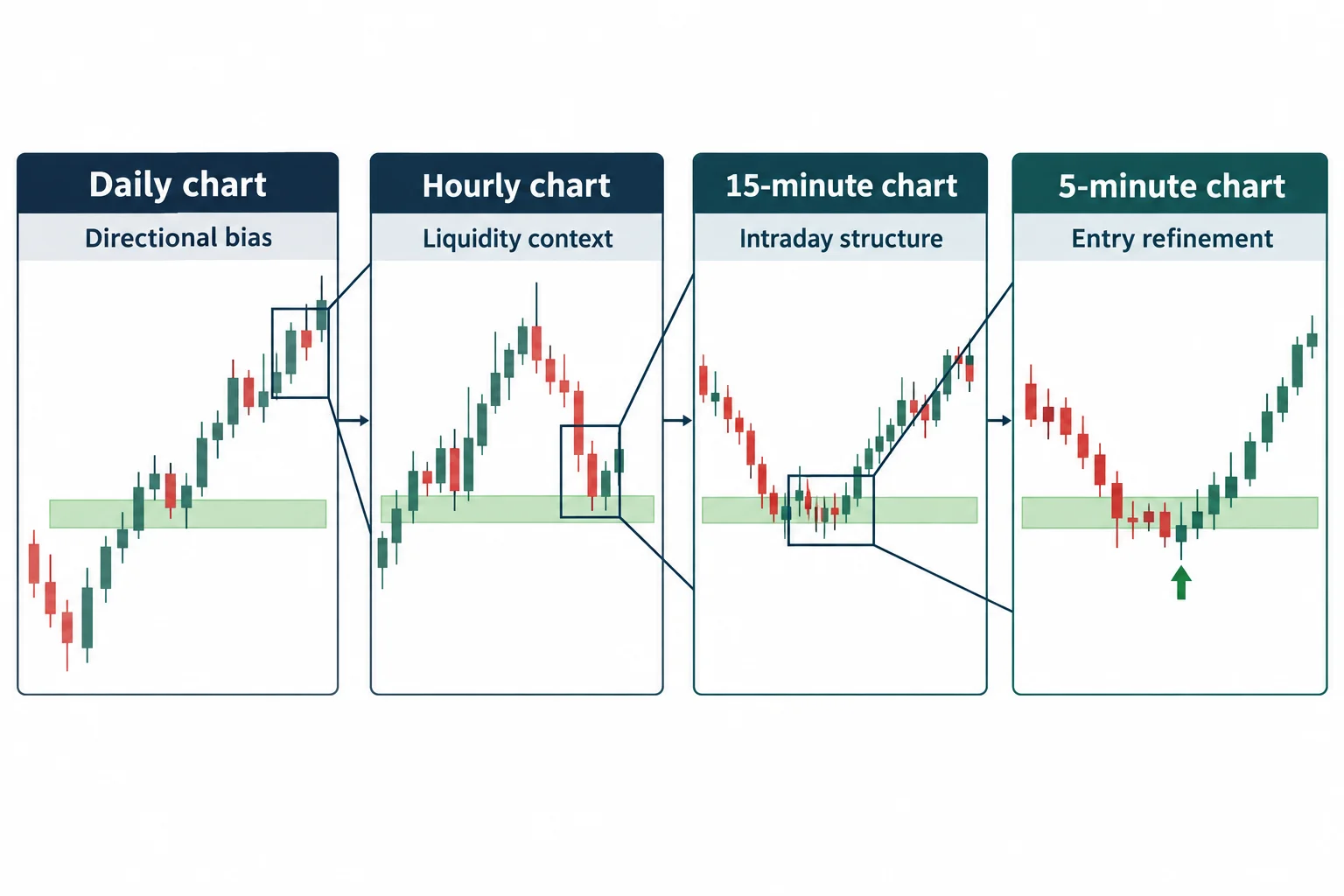
ICT introduces his multi-time-frame layout at 1:42. He places the daily chart in the upper-left, the hourly chart in the lower-left and a larger 15-minute chart on the right. For someone using one monitor, he says the same sequence can be followed by changing time frames on a single chart rather than displaying all three simultaneously.
- Daily chart: Establish directional bias and identify higher-time-frame areas of interest.
- Hourly chart: Refine the context and mark features such as relatively equal highs or lows.
- 15-minute chart: Monitor intraday structure, time-of-day behavior and potential setups.
- 5-minute chart: Refine a possible entry area after the higher-time-frame conditions have appeared.
At 23:00, ICT explains that the annotations made on one linked TradingView chart can appear on the other time frames. The platform discussion is incidental to the analytical method; the main practical point is to preserve the same marked levels while moving from higher to lower time frames.
ICT Episode 18 Bearish Daily Bias
For the EUR/USD example, ICT states a bearish bias at 8:02. Within his framework, this means looking only for short-sale scenarios unless price action clearly invalidates the premise. He cautions against chasing both bullish and bearish moves during the same session.
He identifies what he calls a daily fair value gap and describes a possible rally into that area before a continuation lower. After several declining daily candles, he interprets a short-term rebound as plausible even though his broader directional expectation remains bearish. He then marks prior daily highs and lows as reference points rather than assuming that the more distant daily liquidity objective must be reached in one session.
This distinction matters: a higher-time-frame objective supplies context, while a nearer previous-day low can serve as the intraday reference. These are ICT’s interpretations of the displayed price action, not independently established properties of markets.
ICT Episode 18 Hourly Liquidity Setup
On the hourly chart, ICT highlights relatively equal highs inside the broader daily area. He treats those highs as a pool of buy-side liquidity and looks for price to trade above them before turning lower. His 15-minute workflow begins around 26:50.
He marks each new trading day at midnight New York time and plots the midnight opening price. For this forex lesson, he defines the New York window as 7:00 a.m. to 10:00 a.m. New York local time at 32:00. Viewers should note that the transcript does not discuss daylight-saving conversion rules for other regions.
After price moves above the relatively equal highs, ICT looks for bearish displacement: a forceful move down that breaks a prior swing low and leaves what he labels a fair value gap. In his terminology, that combination signals an internal bearish market-structure shift. A subsequent retracement into the imbalance becomes the candidate short-entry area.
ICT Episode 18 Five-Minute Forex Entry
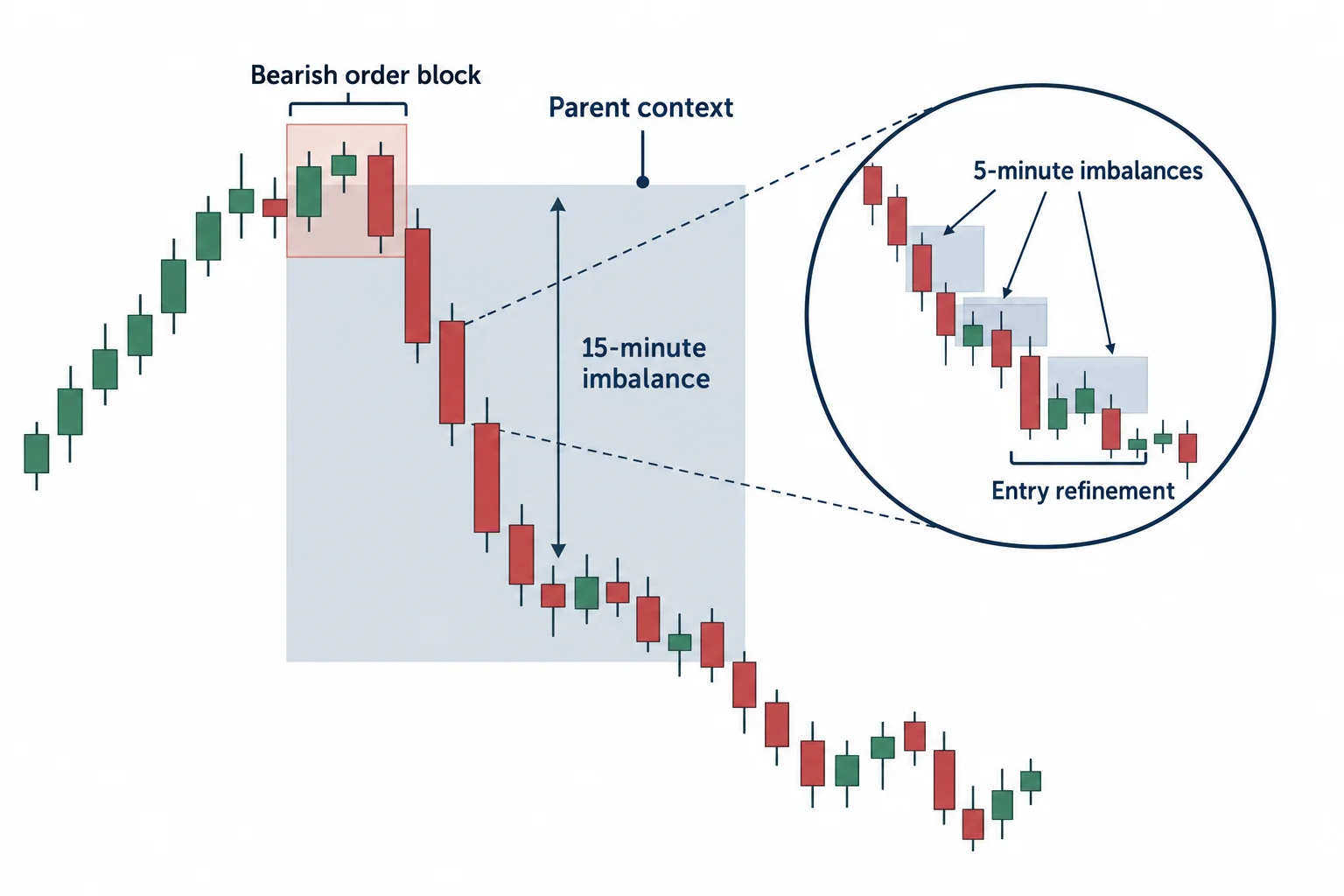
At 33:41, ICT divides the 15-minute move into 5-minute intervals. His principle is that the 15-minute imbalance is the “parent” context, while 5-minute imbalances are subordinate refinements. He warns that seeking a deeper, more favorable entry can result in no fill; using the first acceptable threshold may increase the stop distance instead.
ICT also connects the retracement area with his definition of a bearish order block. In this example, he does not limit the order block to the final bullish candle before the decline. He describes it as a sequence of three candles associated with an imbalance and the subsequent change in delivery. At 39:50, he emphasizes that, within his framework, an order block requires an imbalance.
For risk placement, he discusses positioning a stop above the relevant swing high or above the wider imbalance. He also stresses that monetary exposure comes from position sizing and leverage, not merely the number of pips between entry and stop. The transcript describes a chart example and proposed orders; it does not provide independently verifiable fills or account records for this specific sequence.
ICT Mentorship Episode 18 Study Workflow
ICT adds an important timing rule at 48:11: if the limit order has not filled by 11:30 a.m., he would cancel it rather than leave it active indefinitely. In his explanation, the setup is tied to the day’s New York-session conditions, and a later fill may no longer represent the original idea.
The closing section shifts from setup mechanics to deliberate review. ICT recommends taking screenshots, annotating observed structure and keeping a study journal. At the end of each week, the student can compare intraday charts with the daily and weekly ranges, asking when the week’s high and low formed, which day moved most and where the reviewed setups appeared.
How to Interpret ICT Episode 18
The broadly useful lesson is procedural: begin with a written hypothesis, retain the same reference levels across time frames, define what confirms or invalidates the idea, and review historical examples consistently. Journaling can help expose hindsight bias and inconsistent rule application, but reviewing past charts alone does not demonstrate that a method is predictive or profitable. Any trading framework should be evaluated cautiously with realistic costs, risk limits and out-of-sample observation before risking capital.
Video
Resources
- ICT Mentorship Episode 18 (YouTube) — Primary source video with full transcript.
- Fair Value Gap Explained (BabyPips) — Independent educational reference for the FVG concept discussed in the episode. Unofficial, not affiliated with ICT.
- Liquidity Definition (Investopedia) — General reference for liquidity terminology used in the lesson. Unofficial, not affiliated with ICT.
- Order Block Definition (Investopedia) — Independent reference for the order block concept. Unofficial, not affiliated with ICT.