Key takeaways
In Weekend US Holiday Volume Protocol, ICT works through an index-futures session on the Monday after a U.S.
Read the full summary
In Weekend US Holiday Volume Protocol, ICT works through an index-futures session on the Monday after a U.S. holiday weekend and argues the conditions are unusually hard to trade. His stated reasons: the holiday fell on a Saturday, so the following Monday tends to be “trashy” with false signals; a rally off the 9:30 open is not by itself a reason to participate; the index contracts were not moving together; price sat near the middle of a 15-minute range; and the expansion he wanted never arrived. He describes taking a short, closing it when price refused to go lower, reversing his read, cutting risk in stages, and closing the session with the point that on a day like this “enough” can mean taking no trade at all. Everything below paraphrases an automatically generated speech-recognition transcript of the recording. The chart itself was not available for verification, and nothing here is a recommendation to trade futures.
How we researched this article
BestProps used document-based research from primary firm sources, checked September 14, 2026. The complete source list, scope, limitations, and commercial-state record appear near the end of this article.
The recording is not a presentation of a mechanical holiday strategy. It is a live-style discussion of difficult conditions, including an attempted short, a reversal in directional expectation, active risk reduction, and repeated acknowledgement that not trading would generally be the better decision. The speaker refers to continuous index futures, rendered in the automatic transcript as NQU 2026, and mentions a September delivery month for the ES contract and a YM contract at 6:42; those contract labels are transcribed automatically and should be treated as approximate.
The main protocol: expect degraded conditions
ICT introduces the key idea at 1:02. Because the U.S. holiday fell on a Saturday, he expects the following Monday to produce what he calls “trashy” trading: a lot of false signals and a lot of what the viewer is already seeing on the chart. He adds that just because price moved higher from the 9:30 area does not by itself warrant participation.

He compares the Dow, Nasdaq and S&P-related futures and reports a lack of agreement between them, a condition the automatic transcript renders as “discoupling” and which in context reads as decoupling. In his interpretation, if all three were rising in the same way the bullish read would be straightforward; mixed behaviour instead supports caution.
He later states that he has personally lost more money trading after holidays than in any other circumstance and identifies holiday volume as the recurring factor, at 5:53. That is his own reported experience, not a measured result presented in the recording.
Waiting for scheduled news
Another part of the session concerns the 10:00 news release. Before it, he says several of the things he might have done would have produced a loss, and although he sees a possible short setup he declines to treat it as settled while the announcement is still pending. The discussion begins at 2:18.
After the release, price does not react with the precision he wanted. He points out at 5:03 that price took one nearby low without touching the first fair value gap he was watching, and he treats that as further evidence the session is not delivering cleanly. The educational point is not that news supplies a predictable direction; it is that acting immediately before a known catalyst can invalidate an otherwise plausible intraday idea.
Why the middle of a range is problematic
At 8:23, ICT describes the price action as ugly and locates it near the centre of a 15-minute range, where either the upper or the lower boundary could be explored. From that position a trader lacks the clearer location that exists near one extreme of the range.
He also studies the midpoint of a wick, using his term “consequent encroachment”, and treats a close below that midpoint as a tip-off that price is more likely to come back for the associated low. He qualifies that reading immediately: because the session follows a holiday, the usual inference may not hold today. The transcript renders the term inconsistently as “consequent correction” and similar variants; the context indicates consequent encroachment.
He summarises his own advice for the day at 13:23 by saying that on a day like today you generally do not want to be taking trades at all.
Changing the trade idea when price fails to confirm
The short thesis weakens as price does not move lower with the urgency he expected. At 11:26 he notes that the market is failing to go lower, so he closes the trade, saves the stop, reverses, and treats the reclaimed gap as an initial bullish reference.
His management of the new position is conditional. He wants price to hold above specific candle and gap references, to open above a defined area, and to avoid leaving candle bodies beneath an area he regards as support. When momentum stays hesitant, he takes part of the position off, moves the stop below the wick low, and leaves one contract managed by a stop rather than assuming the bullish scenario must eventually work.
He calls one upside reference an “event horizon”: in this session the halfway point between an old high and the midpoint, or consequent encroachment level, of a 15-minute fair value gap, as he describes at 16:19. This appears to be his own terminology rather than a standard market term, and the chart itself was not available here, so the exact placement cannot be independently checked.
Failure to launch as a warning
Once price reaches the upper part of the session, he repeatedly asks for decisive bullish candles. Instead he sees small advances, reluctance at his measured level, and only a limited run above the reference high. At 21:05 he connects these warning signs to the holiday weekend and the first day back, noting that price can be fickle, lethargic, and prone to failures to launch.
He contrasts the session with what he calls a low-resistance liquidity run, when price moves freely and technical reactions look cleaner. Here, movement is slow, overlapping and prone to rolling over. The lesson is observational: learn to recognise when current delivery differs from an orderly session, rather than assuming any one chart concept predicts the next move.
What the speaker reports about his own results
From about 23:42, ICT says he had posted on X that viewers should not be trading that day with live funds, and he frames the session as an answer to viewers who asked to see him handle a losing sequence. He then reads figures from his own trading display. The automatic transcript records an initial loss of about $1,800 that he says was later mitigated, then roughly $220, a further $1,000, and his own comment that he was wrong about one level but right so far with the turn (24:30). These amounts come from automatic speech recognition of the commentary rather than from a verified account statement or any other source document, so the digits should be treated as approximate. The recording does not establish a verified net result for the session, and the chart, order tickets and fills were not available for inspection.
Near the end he re-measures one level on a one-minute chart and reads it as 30,037.5, saying that is where the candle body stopped and rolled over (25:52, 26:12). He describes the measurement as done by hand and loosely determined, the digits come from an automatic transcript, and the chart was not available for verification, so the level is his reported reading rather than an independently confirmed market fact.
ICT’s explanation for lighter participation
From 26:25, ICT says the lecture is chiefly about recognising the difficulty in advance. He argues that participation can stay subdued on the first session after a U.S. holiday, particularly in the summer months, because some market participants are still away, and he associates that reduced interest with smaller ranges and less precise price behaviour. This is his market interpretation; the recording supplies no volume statistics and no external study establishing the claim.
His closing guidance at 27:45 is more conservative than the intraday examples might suggest: knowing these conditions in advance helps preserve capital, keeps a trader in control of themselves rather than going on tilt, and makes it acceptable to be content with enough — where enough can mean not trading at all.
General educational takeaway
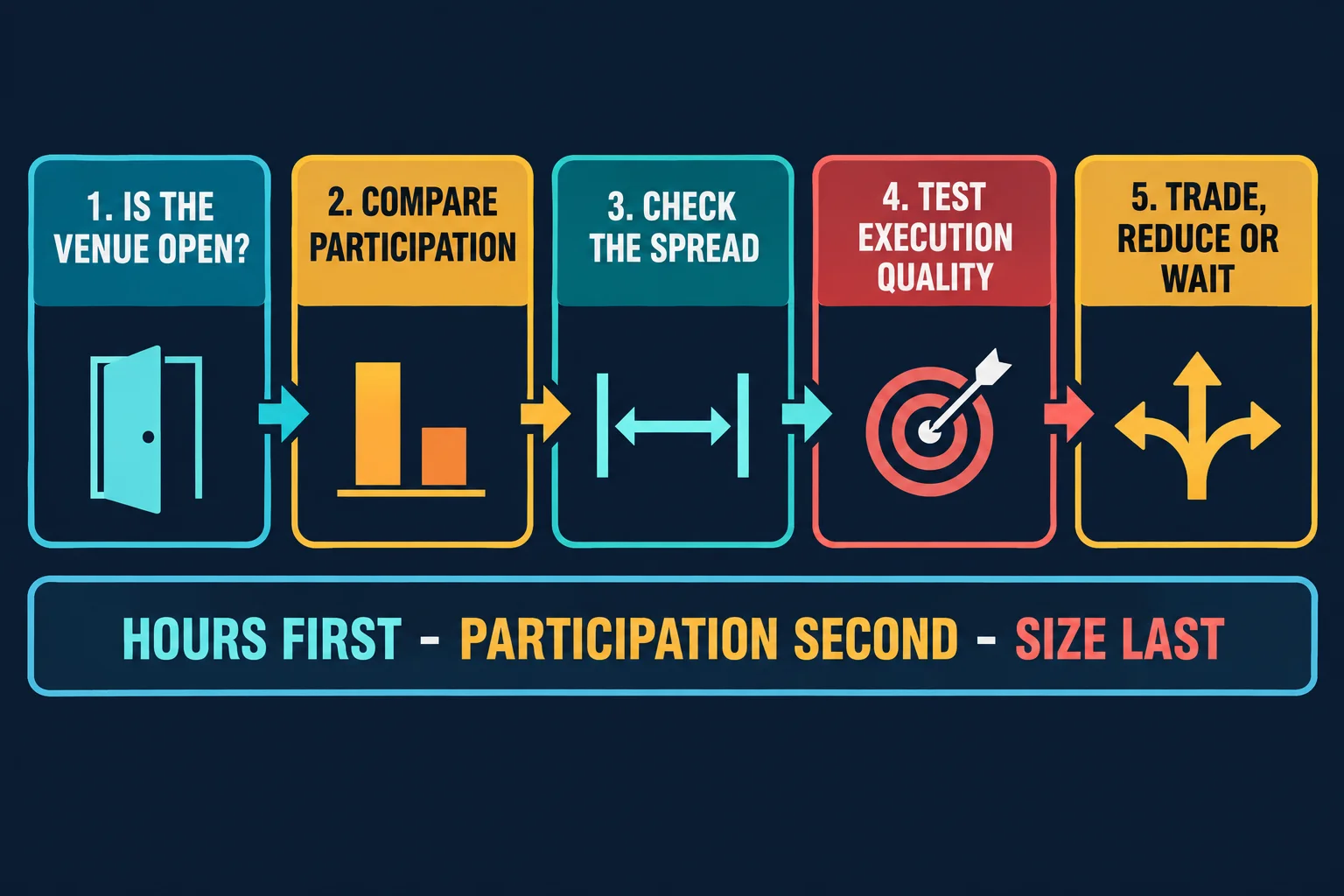
- Treat the first session after a major holiday as a possible low-participation environment, not as an automatic trading opportunity.
- Look for agreement or disagreement among related markets, while recognising that correlation alone does not determine direction.
- Avoid giving normal technical signals full confidence when price is overlapping near the centre of a broader range.
- Require follow-through. If the expected expansion does not occur, reassess rather than defend the original idea.
- Reducing risk or remaining flat is a valid response to unclear conditions.
These are educational observations drawn from ICT’s commentary, not evidence of a proven edge and not a recommendation to trade futures. This page paraphrases an automatically generated speech-recognition transcript of the recording; specialised terms and numbers may contain recognition errors, and no visual chart verification was performed. The transcript cannot verify the unseen chart, order execution, fills, account figures, or what happened after the recording ended.
Related source video: Weekend US Holiday Volume Protocol
The recording discussed above is Weekend US Holiday Volume Protocol on the channel The Inner Circle Trader. Its watch page was read on 2026-09-13 and returned that title, a publication timestamp of 2026-07-06 08:03 (UTC−07:00), a stated length of 1690 seconds, and the flag public with 37,538 views at the time of reading. The upload date is a separate fact from the date of the session shown inside the recording; the transcript does not independently establish the calendar date of the session depicted, although the speaker says the holiday fell on a Saturday.
Everything attributed to the speaker on this page comes from the automatic transcript of that recording and is presented as his commentary and interpretation. BestProps is not affiliated with the channel, and this page is independent educational commentary rather than an official ICT lesson or a transcript republication.
Watch the original recording on YouTube
This recording cannot be played inside another website. A playback test of the embed markup used on this page, run on 2026-09-13 from a BestProps page origin, returned the player’s own message “Playback on other websites has been disabled by the video owner”, so no player area is reserved here and no empty embed is left behind. The recording remains available directly on YouTube.
Exchange calendars and hours pages to check first
The holiday status of a date does not determine whether a venue is open, shortened, or closed. These four calendars are published by the venues and agencies themselves, and they are the fastest way to separate a calendar label from an operating schedule. Read the schedule for the exact contract and venue you trade rather than a general market summary.
U.S. equity market hours and early closes
The NYSE page states that “All NYSE markets observe U.S. holidays as listed below for 2026, 2027, and 2028” and adds early-close notes for individual dates, including that each market will close early at 1:00 in the afternoon on listed half days.[1] That is the difference between a holiday closure and a shortened session, and it is why the exact close time matters more than the label.
Holiday hours that are announced late
ICE publishes holiday trading hours for its markets, administrators and clearing houses, and warns that “for some markets, holiday trading hours for specific contracts or benchmarks are announced close to the holiday itself”.[2] A protocol built only on a date on a calendar will therefore miss the sessions whose hours are only settled in the days before the holiday.
Published hours for futures products
Cboe publishes trading hours for its futures exchange directly, headed “CFE Trading Hours (all times are Central Time)”.[3] Note the time zone in that heading: an exchange calendar quoted in a different clock than the one on your chart is a common source of mistaken session assumptions.
Bank holidays that affect cash-market participation
The Federal Reserve Board’s holiday schedule explains that “for holidays falling on Saturday, Federal Reserve Banks and Branches will be open the preceding Friday; however, the Board of Governors will be closed”.[4] Banking availability is not futures trading hours, but it does bear on participation in related cash and currency markets around a long weekend.
These organisations publish market operations and calendar information, not trading advice. BestProps does not operate any of these venues, has no affiliation with them, and cannot confirm that a specific broker, platform or prop firm will follow the exchange schedules above; confirm availability in your own platform notices and account rules. Holiday schedules also change between years, so re-read the page for the year you are trading.