Key takeaways
In ICT’s Turning Loss Into Gain – Market Alchemy, he takes a long from what he calls an inversion fair value gap, is stopped out, and re-enters on the same directional premise with a new invalidation level after stating the contingency in advance.
Read the full summary
In ICT’s Turning Loss Into Gain – Market Alchemy, he takes a long from what he calls an inversion fair value gap, is stopped out, and re-enters on the same directional premise with a new invalidation level after stating the contingency in advance. He then reduces the position as the move develops and ends the recording willing to be stopped on the remainder, treating the loss as a completed transaction to review rather than a debt to recover. The session demonstrates a process; it is not verified performance, and nothing here is investment advice.
How we researched this article
BestProps used document-based research from primary firm sources, checked September 14, 2026. The complete source list, scope, limitations, and commercial-state record appear near the end of this article.
In Turning Loss Into Gain – Market Alchemy, published by the channel The Inner Circle Trader on 13 May 2026 and running about 94 minutes, ICT narrates one session almost candle by candle. He goes long from a level he treats as an inversion fair value gap, is stopped out, re-enters on the same premise with a new invalidation level, clears partial objectives as price works higher, and finishes the recording with the remaining position stopped out while saying he still expects his original target to be reached.
The lesson is not that a loss can be recovered on demand. His stated position is that the things which stopped him out did not change where he believed price was drawn to, and that the practical question afterwards was whether the following candles still supported that view. This article is written from the timestamped transcript of the recording: his words are the source, and the reported trade is not treated as verified performance.
The recording and the transcript this article uses
The watch page was read on 13 September 2026 and returned the title above from the channel The Inner Circle Trader, an upload date of 13 May 2026 at 09:53:39 in the UTC-07:00 offset, a runtime of 5,674 seconds (1:34:34), and a page status reporting the video as public and available. Its description field carries the uploader’s standard futures risk disclaimer and reproduces the language of CFTC Rule 4.41 on simulated or hypothetical performance rather than any record of results.
The transcript behind this article is local automatic speech recognition of the full original audio (Whisper large-v3-turbo), not YouTube captions. The complete-audio, duration and volume checks passed, and only 28 characters across 1,034 segments are flagged low-confidence. Two consequences follow. Specialised terms and any numbers spoken aloud may be mis-transcribed, and no chart visuals were captured, so nothing below should be read as an independent record of prices, candle geometry, order placement, fills or results.
At 0:50 he remarks that the session is not market replay. He also says, describing how he chose to present himself to an audience, that he decided to “act like a clown out here, use a demo account” (1:28:05). The transcript does not establish which account the positions in this recording were taken in, and the reported outcome is therefore attributed to the speaker rather than presented as a verified result.
The setup and the invalidation he states before entering
From the opening minutes he describes the trade he wants: a level he intends to treat as an inversion area to go long from, with an entry inside its lower half (0:12, 1:12), and the buy-side liquidity associated with the 08:30 news candle as the objective (1:22). At 2:28 he identifies the 08:30 candle’s high as the place where the calendar event’s effect appears.

His risk statement is as explicit as his target. At 3:44 he places the stop below a particular candle low, and at 3:59 he gives the reason: there is no need for price to trade back down there, and if it does, he is wrong. The invalidation is attached to a level in his model rather than to the size of the position or to the outcome, which is the first point at which the phrase in the title stops being a slogan and becomes something a trader can apply in advance.
He also records a missed entry early on: he wanted a deeper discount than the market offered, and therefore did not get filled on the candle he had been waiting for (1:49).
The first stop-out, and the re-entry planned before it happened
The stop-out is not a surprise to him, and the recording is constructed to show that. Well before the low is taken he states the contingency: if the low is taken out he will look at a lower inversion area for another long, aimed at the same idea he was already holding (10:12). He is equally direct about the emotion: “Don’t be afraid of taking losing trades, folks” (10:37).
He is candid that he is staying in a setup he considers poor in order to demonstrate the process: too many candles inside the range, and he will stay with it so the viewer can see a losing trade and how he would manage it (14:20). The stop-out arrives at 14:46, and his narration is deliberately flat — stopped out, pulse checked, everything fine — followed immediately at 14:54 by the decision to keep the same premise.
At 20:54 he summarises what he wants taken from the sequence: that he outlined in advance that he would probably be stopped out and what he would do next, that none of it changed the underlying narrative, and that a new entry could be implemented while staying with the same idea. He contrasts this with the reaction he attributes to most traders, asking how quickly a trader becomes angry after a loss (21:17). The permission for a second attempt is bounded, and he says so in the same passage: going after an idea that the chart still supports does not mean taking fifteen trades, over-trading, over-leveraging, or forcing a view onto the market (21:48). His framing of the stakes is unusually low-drama: the worst thing that can happen is being stopped out (20:09).
What he monitors after re-entering
After the re-entry the recorded checks are behavioural rather than confirmations of the forecast: candle bodies holding in the favourable part of the imbalance and trading out of it to attack a short-term high (22:38), and a stop moved up beneath a newer low to cut risk while the idea is still being tested (17:57). He adds the principle that a stop-out later in the same idea is acceptable: if the trade does not do what he wants and stops him out, it is not pain (45:25).
He also names the part of the process that is plainly psychological. At 25:51 he describes the pressure of waiting inside a range, with attention shifting from the model to the question of whether he will be stopped out, and at 26:15 he admits it is hard to keep believing the 08:30 premise while price spends so much time distorting inside the range. His explanation for the overlapping candles and the wicks on both sides is that the behaviour is deliberate; he calls it manipulation and manual intervention repeatedly during the session (8:08, 12:15, 22:18). Those are his interpretations of price behaviour; the transcript cannot establish intent or causality, only that he said it.
Speed forms part of his expectation. At 36:54 he explains that he wants the run into the liquidity pool to happen in fewer candles, because a fast move gives resting orders less time to be withdrawn. That reasoning becomes a candle count applied to this specific move: he says seven candlesticks, then immediately corrects himself to fewer than seven (41:58, 42:36). Treated as a rule the number would be meaningless outside this session; in the recording it is a situational expectation attached to one displacement, and the self-correction is on the tape.
Reducing the position when the move will not behave
The second attempt does not unfold cleanly either, and the more useful material is what he does about it. He cuts part of the position while allowing that his direction may still be correct: he could still be right on the trade, but he is not willing to hold the whole position while price behaves that way (46:34). At 47:49 he states the principle directly: it is about managing the position and managing risk, not about being perfectly right about everything.
He also removes the option of pressing a trade that has moved on without him. At 54:05 he says that on a day like this, if he were stopped out, he would not want to add in or re-enter because the move is too far up the curve. The re-entry the title refers to is therefore conditional on where the session is, not an automatic response to a loss.
As price works toward the 08:30 objective he clears a first partial objective (1:00:05), rolls the stop beneath a reference low (1:04:30), and later says he has taken three partials at the high of the session and is content to be stopped on the balance because the last reference point for sell-side liquidity has been left behind (1:08:10, 1:08:38). At 1:02:09 he says he has mitigated the day’s drawdown and mentions a booked figure; the transcribed amount is ambiguous, and the transcript cannot authenticate account type, order fills, commissions or a net result, so no performance conclusion should be drawn from it.
One management variable he says he adapts is market character. In high-resistance liquidity-run conditions he gives the trade more room, while in low-resistance conditions he moves stops more aggressively because he is less concerned about price returning to the level (1:21:56).
The process the session illustrates
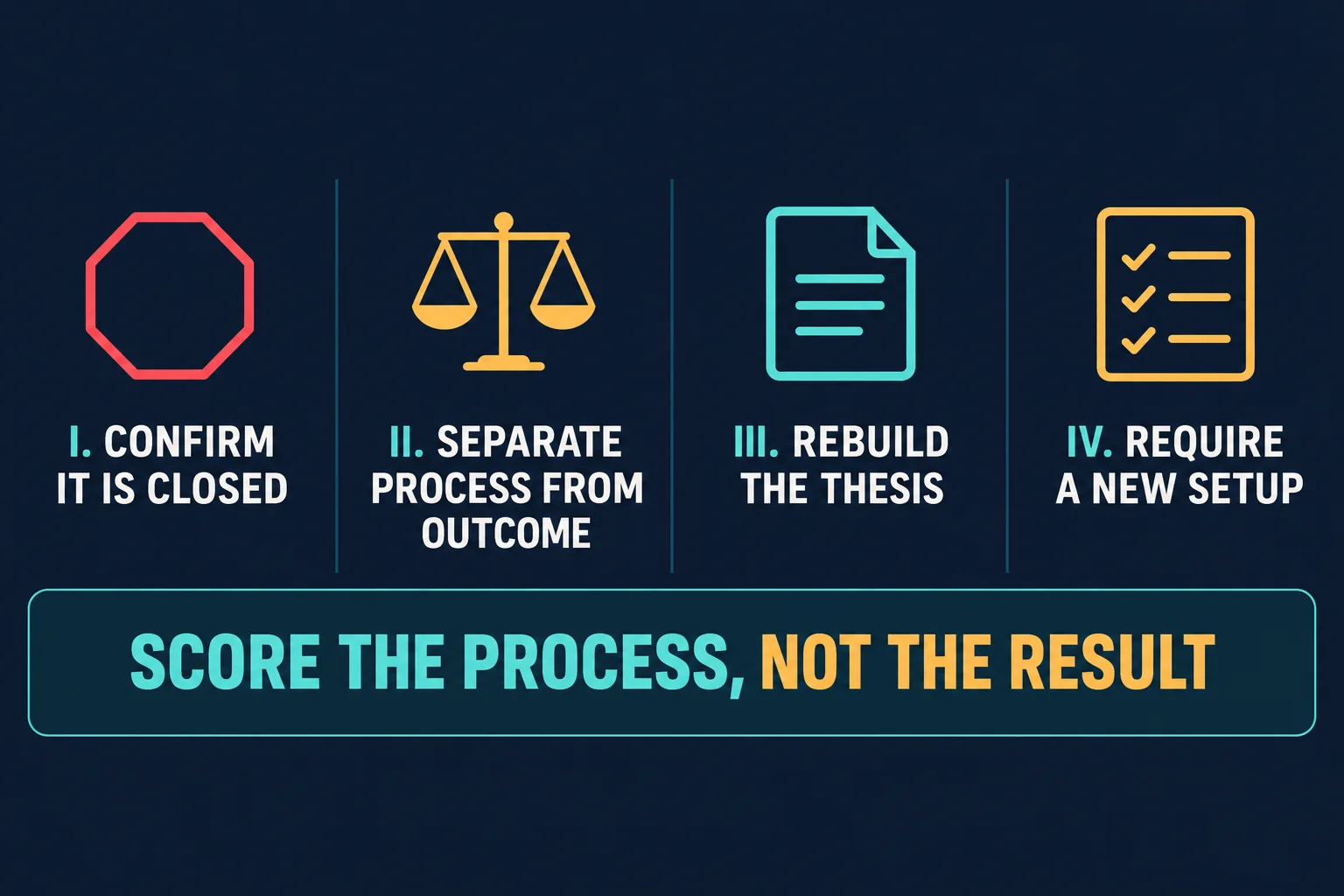
Stripped of the proprietary vocabulary, the recording walks through a sequence that transfers to any discretionary session:
- Record the closed trade and do not reopen it. The invalidation was a level named in advance (3:59), and the stop-out is treated as a completed transaction with a stated response (14:46).
- Separate the thesis from the execution. He can be right about the draw and wrong about the timing of one attempt; he says so before the loss and again while cutting size (20:54, 47:49).
- Re-check the premise against current price. Holding the same narrative is only defensible while the candles still support it, which is what the confirmation list above is for and what he admits gets harder as the range drags (26:15).
- Require a new setup with its own risk. The second long came from a separately identified area with its own stop, and he rules out adding once the move is advanced (10:12, 54:05).
He adds a fifth practice at the end of the recording: review. At 1:31:06 he describes the deliberate self-talk that keeps the outcome from becoming personal and allows reflection once the trade is over, and at 1:32:10 he explains journaling the chart after the fact — annotating the levels and writing the decision dialogue back in — as a way of priming attention for the same structures next time.
What the transcript does not establish
Three limits apply before anything here is reused. First, the source is machine transcription of audio, and no chart, price axis or order ticket was captured, so the article reports what he said about the market rather than what the market did. Second, the recording is a commentary stream, not an account statement: the transcript cannot establish account type, position size, fills, commissions or a net result, and he says elsewhere that he had used a demo account for his presentations (1:28:05). Third, his claims about manipulation, manual intervention and counterparty intent are interpretations of price behaviour rather than established facts, and the recording does not name the instrument traded.
That leaves the emotional and procedural content as the durable part of the lesson, which is how he closes it. He says if he drives himself into environments he would rather not trade in, he is prone to a stop-out (1:15:45), and he describes the session as a high-resistance liquidity run that spent a long time in inefficiencies yet still delivered (1:33:47).
Bottom line
Near the end he takes a final trim and moves the remaining stop so that either his limit or his stop will remove him, saying he no longer cares what price does (1:29:54), and he ties that indifference to being able to review the session afterwards without needing the target to have been reached (1:31:06). He still expects the 08:30 area to be reached, but accepts he will not be in the trade when it happens, because he has been stopped out, and asks viewers to carry the same measure of indifference into their own price action (1:34:05).
Read carefully, that is the whole argument of the recording. Turning a loss into a gain here means converting a stopped position into a recorded, reviewable, unemotional transaction and then requiring the next idea to justify itself on its own evidence — not recovering money. The title is aspirational language for a process, and this session is offered as a demonstration of that process inside genuinely difficult conditions rather than as proof of an edge.
Watch the original recording
This article draws on the timestamped transcript of Turning Loss Into Gain – Market Alchemy on the channel The Inner Circle Trader. The transcript is a source for the speaker’s words, not independent proof of anything he reports about his account or the market.
Watch the original recording on YouTube
This recording cannot be played inside another website. An embedded player test run on 14 September 2026 from a bestprops.com page origin, using the same iframe markup that would be authored here, returned from the player itself “Playback on other websites has been disabled by the video owner” and settled on a “Watch on YouTube” prompt, with no duration and no playback progress reported. That message is the reason no player area is reserved and no blank embed is left behind. The recording remains available directly on YouTube.
Watch “Turning Loss Into Gain – Market Alchemy” on YouTube ↗
Primary source and further reading
- The original Inner Circle Trader recording: use the timestamp links above to compare each explanation with its source passage.
- BestProps rule comparison: a first-party reference for checking a funded account’s current drawdown and prohibited-practice terms before sizing any decision on a losing day. It is a rule-risk scanner, not a recommendation to buy an account.
- 17 CFR 4.41 (eCFR): the regulatory text on advertising that includes simulated or hypothetical performance, relevant context for reading any recorded trading demonstration. It is a legal reference, not a statement that this recording or this article satisfies every requirement.
This is independent educational commentary. It is not official ICT material, not a tested trading system, and not evidence that the reported trade or its result can be reproduced. Trading involves substantial risk of loss.