Key takeaways
The Inner Circle Trader’s Monday Review On NQ & PreMarket Session Rules Revisited, published on YouTube on 2026-08-24, reviews Nasdaq-100 futures across daily and one-minute charts and teaches that consolidation from 7 to 9 a.m.
Read the full summary
The Inner Circle Trader’s Monday Review On NQ & PreMarket Session Rules Revisited, published on YouTube on 2026-08-24, reviews Nasdaq-100 futures across daily and one-minute charts and teaches that consolidation from 7 to 9 a.m. can precede one-directional movement after the 9:30 open, while direction must come from the higher-time-frame narrative. ICT formed a bearish bias from a daily buy-side imbalance, sell-side inefficiency, a wick midpoint close, volume imbalance, fair value gap, consequent encroachment, quadrants and octants, then expected a rally through body-defined highs before a decline. The open dropped too quickly for his planned retracement entry, no order ticket or verified fill was shown, the intended target at the low of the daily imbalance was not reached, and he said a hypothetical fill likely would have been stopped out. In the 10:00 to 10:30 Silver Bullet window, a sell-side imbalance, buy-side inefficiency initially led lower before price reclaimed the gap, converting it into a bullish inversion fair value gap, with octant tethering used to validate gaps and order blocks. He advises marking higher-time-frame imbalances, new week or day opening gaps, the 7 to 9 a.m. range, candle bodies near 9:00, actual fillable prices at 9:30, invalidation levels and expected targets, while treating missed moves honestly and avoiding over-leverage during potentially irregular Jackson Hole Symposium conditions. The recap is independent educational commentary based on auto-generated captions, not an official ICT transcript, verified performance record or evidence that the described structures predict price, and TradingView Bar Replay is suggested for testing whether session classifications were visible before the outcome.
How we researched this article
BestProps used document-based research from primary firm sources, checked September 14, 2026. The complete source list, scope, limitations, and commercial-state record appear near the end of this article.
In Monday Review On NQ & PreMarket Session Rules Revisited, ICT reviews Nasdaq-100 futures price delivery across a daily chart and a one-minute chart. The thread running through the recording is a single premarket rule: what price does between 7:00 and 9:00 a.m. tells him whether the regular-session open is likely to trend, and the higher-time-frame narrative is what supplies the direction. He also spends time on the open he did not trade, which makes restraint as much a subject of the video as chart annotation.
This recap is written from the video’s own captions, which are automatically generated. They mishear some of his vocabulary (repeated instances of “consequent encouragement” are read here as consequent encroachment) and the recording shows no order ticket, no verified fill and no performance record. Statements below about what he intended, expected or decided are attributed to the speaker, not established as results.
ICT Monday NQ Daily Chart Review
ICT opens on the daily chart and points to what he calls a buy-side imbalance, sell-side inefficiency (BISI), an area he had been describing as a likely draw on liquidity. His method of grading it is to divide the area: consequent encroachment is the midpoint, with quadrant and octant levels inside it. At 0:32 he says the first thing he wanted to see was a close below the midpoint of a wick, and that the market delivered it, his stated reason for expecting a move lower.
He then draws a distinction between bodies and wicks. Even where wicks connect two candles, the bodies can leave what he calls a volume imbalance, and that imbalance plus a small fair value gap becomes the objective he tracks on the lower timeframe (0:52). He adds a new week opening gap to the chart, checks a level he had plotted slightly wrong, and describes price later trading down into consequent encroachment, pressing to a lower octant, and returning to the midpoint (5:28). These are his chart interpretations; the captions do not establish that the structures predict price, only that he used them to form a directional expectation.
ICT Premarket Session Rule From 7 to 9 a.m.
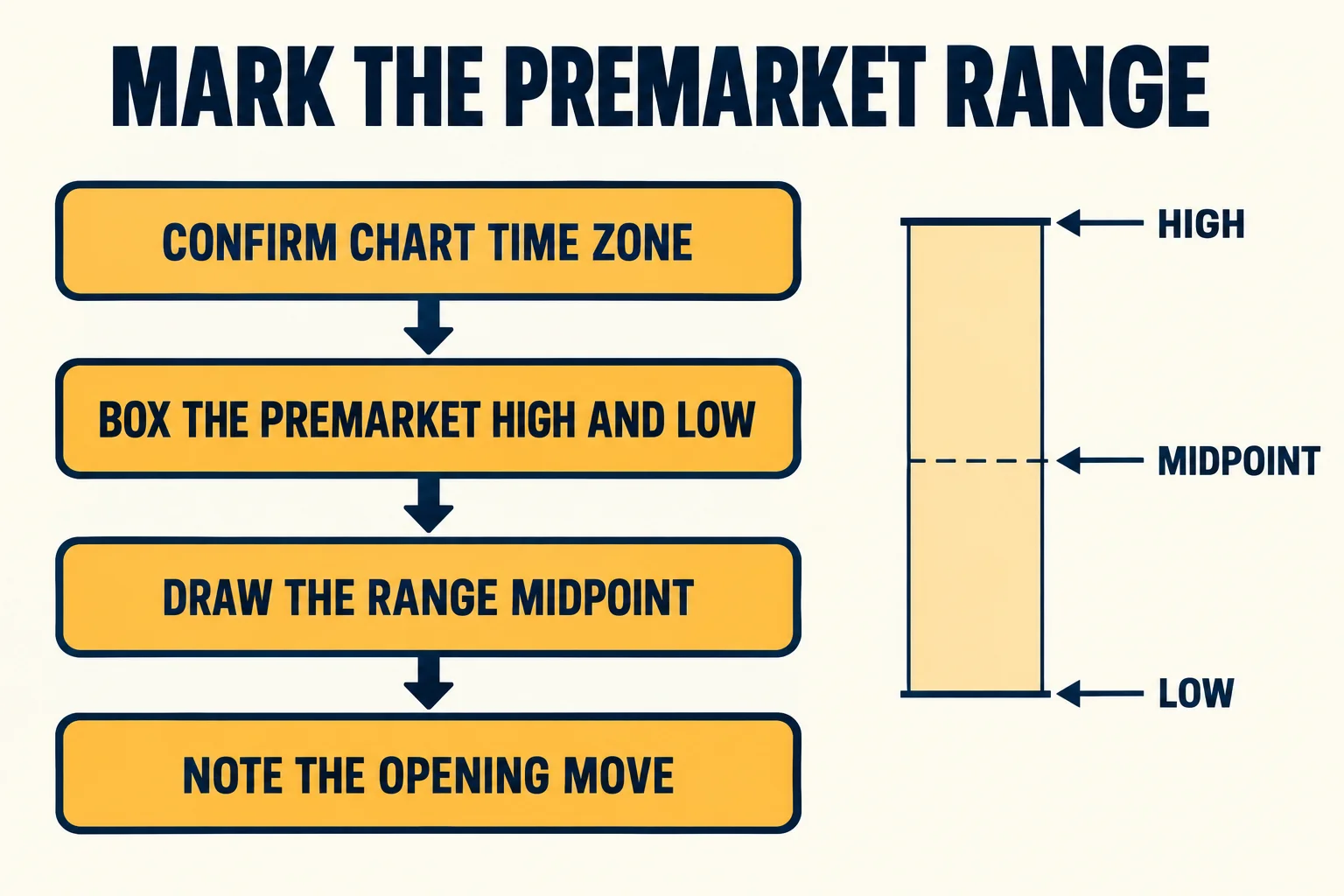
The rule itself arrives around 6:43, when he marks 7:00 a.m. A quick push above the prior high is dismissed: “that’s just running liquidity. That’s not a trend.” From there he watches what the next two hours do. Price runs for roughly 40 minutes to take the buy side out (7:22), then pulls back inside the low-to-high range and rotates around its middle. That return to the interior, not the excursion above the high, is what he calls consolidation (his phrase for a market that is not being allowed to extend).
He states the payoff of the classification plainly: consolidation between 7 and 9 means the 9:30 open should deliver one-directional movement (17:47). What the range does not supply is the direction. In this recording the direction comes from the daily imbalance and from a seasonal argument he says he had made in a weekend X space. That division of labour is worth keeping straight: the premarket window is treated as a condition, and the higher-time-frame draw as the bias.
At 7:58 he narrows the reading to candle bodies. The grouping of bodies near 9:00 is smooth where the wicks are jagged, and he treats the body-defined high as the buy-side reference while setting the large wick aside because price had already traded above its consequent encroachment. His working expectation was a rally through those body highs before the move lower.
ICT Monday NQ Open Review
Price ran above the body highs into the open, and then, as he puts it, “right at 9:30 it took off and it gave me no chance” (9:43). He describes the drop as an elevator ride out of the open that moved too fast and too far to enter, and says he and his son simply watched it (10:50). No trade is documented on the captions in that decline.
What he had wanted was specific. He wanted price to trade below a highlighted gap and come back up so the gap could be used as an inversion fair value gap, with the low of the daily imbalance as the objective (19:01). Later he walks back through the levels and states that his projection was wrong and that the target was never reached (19:35). Toward the end of the recording he also says that, had he been filled, he would most likely have been stopped out (23:39), a reported expectation about a trade that was never taken, not a result.
The distinction he draws is the practical one. A directional read can be correct and still produce nothing tradable: there was no retracement into the planned area, and the intended target never arrived. Documenting the missed move, rather than imagining an entry after the fact, is the behaviour he models in this recording.
ICT Monday NQ Silver Bullet Review
From 12:29 he looks back at the 10:00–10:30 window for a Silver Bullet model. The first fair value gap presented at 10:00 was a sell-side imbalance, buy-side inefficiency (SIBI) that he had tried to sell from. Price went lower off it, took out the swing low and the body lows, and then traded back above the gap. That return is what converts his reading into a bullish inversion fair value gap, and he then looks for a rally into the low of the opposing imbalance and a small gap above it (13:11).
He also explains why he treats that gap as valid: the third candle of the three-candle formation is tethered to one of his octant levels (14:11). The same tethering logic is applied earlier to an order block he marks as anchored to an octant (11:07). This is the speaker’s own validation framework, stated as a rule of thumb about knowing where the market is likely to go; the captions do not demonstrate that octant alignment has been independently tested or that it predicts price.
He closes that section by telling viewers to do the marking themselves rather than agreeing with his annotations (15:20).
ICT Premarket Session Outlook
After the cash close he stayed on the chart to the 6:00 p.m. session restart and marked the new day opening gap. He calls it “a little too clean” and says he suspects price will want to reach the volume imbalance it could not reach during regular hours (21:07), with the low of the daily imbalance as the level that would make things interesting if it were taken out (21:43). Those are stated expectations for a session that had not happened yet.
He also flags the Jackson Hole Symposium as a week that can create “wonky” conditions and advises against over-leveraging, while telling viewers to check their own economic calendar because he was not certain which day the event starts (17:00). The recording does not settle the event date, so none is asserted here.
ICT Monday Review Routine
- Start on the higher timeframe: identify the imbalance that price may be drawn toward, then grade it with its midpoint, quadrants and octants.
- Mark the new week or new day opening gap where one applies.
- At 7:00 a.m., mark the range as it forms and decide whether an excursion beyond the high or low was a liquidity run or genuine expansion.
- Classify the 7:00–9:00 behaviour as consolidating or trending before the open, and write the higher-time-frame bias beside it.
- Read the 9:00 area on candle bodies first, and note which wick midpoints price has already left behind.
- At 9:30, note whether the move was at a price your plan could actually have filled. If it was not, record it as a missed move.
- Review later models such as the 10:00 window separately, and state the invalidation level and the gap classification before looking at the outcome.
- Write down the target that was expected and whether it was reached. In this recording it was not, and he says so.
ICT Monday NQ Premarket Session Video
The mapped source lesson is Monday Review On NQ & PreMarket Session Rules Revisited from The Inner Circle Trader, uploaded 2026-08-24. This BestProps article is independent educational commentary: it is not a transcript, not an official ICT lesson, and not evidence that any entry, stop, partial or exit discussed in the recording occurred.
Watch the original lesson on YouTube
This video cannot be played inside another website: the embed shows “Playback on other websites has been disabled by the video owner.” That response was read from the player itself, so no player is embedded here. You can watch the full lesson directly on YouTube.
Watch Monday Review On NQ & PreMarket Session Rules Revisited on YouTube ↗
ICT Monday Review Sources and Chart Tools
Four references support this article: the recording itself, an unofficial community summary of the same session, a third-party overview of how this methodology is applied to NQ futures, and the charting help page for stepping through a session bar by bar.
Start With the ICT Recording
The upload titled “Monday Review On NQ & PreMarket Session Rules Revisited” is public, is credited to The Inner Circle Trader, and was published on 2026-08-24.[1] The captions are auto-generated, so terms and numbers in them should be checked against the audio before being reused: this article normalises “consequent encouragement” to consequent encroachment, where the surrounding explanation supports that reading.
Check the ICT Community Recap Carefully
The ICT Archivist entry dated 2026-08-25 is a community-run archive that summarises the same recording in its own words and links to the same YouTube URL.[2] It is unofficial, it is not the original lesson, and BestProps is not affiliated with it or with the Inner Circle Trader. It is listed for comparison only; the descriptions in this article come from the recording’s captions, not from that summary.
Understand the ICT Method
A third-party overview of ICT NQ futures describes how the terminology used in this recording is commonly applied to Nasdaq futures contracts.[3] It is a secondary explanation of the vocabulary, not a validation of any rule discussed in the video, and no tested performance is claimed for those rules here.
Replay the Premarket Session Range
TradingView’s help page How do I turn Bar Replay on? documents opening the replay panel, choosing a starting point and advancing bar by bar.[4] Replaying the 7:00–9:00 window in sequence is the practical test of whether it was consolidating rather than trending, and whether the opening move and any later reference level were visible before the move instead of only afterwards. Note that the 7:00 and 9:00 references are the speaker’s chart times; a chart set to another time zone will not contain the same candles at those clock positions.
Review ICT Sources and Tool Guides
- [1] YouTube: Monday Review On NQ & PreMarket Session Rules Revisited, The Inner Circle Trader (source recording, published 2026-08-24)
- [2] ICT Archivist: Monday Review On NQ & PreMarket Session Rules Revisited (unofficial community summary, 2026-08-25)
- [3] The Inner Circle Traders: ICT NQ Futures (third-party overview, unofficial)
- [4] TradingView Help: How do I turn Bar Replay on? (platform documentation)
BestProps is not affiliated with TradingView, ICT Archivist, The Inner Circle Traders or the Inner Circle Trader, and no source listed here endorses this article or any setup. Buy-side imbalance, sell-side inefficiency, volume imbalance, order block, fair value gap, consequent encroachment, octant and silver bullet are used only as descriptive study terms, and nothing on this page demonstrates a tested, repeatable or profitable result.
ICT Monday NQ Trading Risk Disclaimer
Futures trading involves substantial risk and can result in rapid losses. This recap is general educational information, not individualized financial advice, a trade recommendation or a promise of funded-account performance. ICT terminology and chart interpretations are subjective, and no range, imbalance, time window or narrative guarantees an outcome. Verify current prop-firm rules directly with the firm and use risk limits appropriate to your own circumstances.