How we researched this article
BestProps used document-based research from primary firm sources, checked September 14, 2026. The complete source list, scope, limitations, and commercial-state record appear near the end of this article.
The mapped source for this page is Trading In High Resistance Liquidity Run Conditions – July 21, 2026, an Inner Circle Trader recording in which ICT walks through one difficult morning session from his own chart work. He opens by checking back against the previous session and the objectives he says he had published in his pre-market video, then spends most of the recording explaining why the conditions in front of him, rather than the direction he expected, kept his size at one contract and eventually took him out of the market entirely (0:45, 3:13, 52:21).
Everything below is drawn from the recording’s own automatically transcribed audio. The transcript documents what ICT says and what he reports doing; it carries no chart prices, order tickets or account records, so nothing in it independently verifies fills, position results or the market behaviour it describes. This page is independent educational commentary: it is not official ICT material, not a transcript of the lesson, and not investment advice.
The setup he was working from
ICT describes a large opening-range gap left open by an earlier close, with the regular-hours session opening well away from the previous settlement, making that range the area he wanted price to travel back through. The draw he names is the midpoint of that range — the “half gap” — with the relative equal lows beneath the market as an interim objective (2:33, 2:45, 12:48).
He anchors the idea on a 60-minute level he calls a buy-side imbalance with sell-side inefficiency, and states that this level, not the gap by itself, was the only thing he was actually acting on (2:08, 3:29). The plan was a single short contract: he says plainly that he did not want to trade larger that day because the week had already gone well for him, and he put the stop just beyond his fill rather than leaving room to sit through a retracement (3:13, 3:23, 5:46).
What he means by a high-resistance liquidity run
The clearest definition arrives about twenty-two minutes in. ICT points at a stretch of candles sharing a very small range and says that overlap — many candles consuming very few price levels, with price repeatedly travelling back through the same territory — is what he calls high-resistance liquidity run conditions (22:21).
He contrasts it with the low-resistance version at around 28 minutes. There, one or two candles cover a whole range and price stretches away in the same direction, which he compares to pulling taffy (28:05). The practical conclusion he draws from the distinction is consistent across the recording: when delivery is low-resistance and the path is obvious, that is when he wants to participate; when it is high-resistance, he says his paid mentorship taught students to identify the condition and move to the sidelines, tape-reading or paper-trading it instead of risking live funds (50:37, 50:51, 51:04).
Candle bodies versus wicks at an old low
His main confirmation rule in this session concerns how price behaves as it tests a low he expects to break. Bodies closing beneath the low are what he wants to see; if price only wicks below it while bodies stay at or above the level, he reads that as a warning of retracement or reversal rather than continuation (23:11).
He returns to the same test near the end of the recording. Price had come back to the relative equal low he had targeted that morning, but only wicks were being left below it, which he called another failure to launch lower (49:09, 49:21). It is worth being precise about what that is: a reading rule inside his framework, demonstrated on one narrated example. The recording does not test how often bodies-versus-wicks resolves the way he expects.
The gap and half-gap as a morning framework
Around 27 minutes he gives the simplest version of his morning-bias routine: between 9:30 and roughly 10:30 or 11:00, note whether the regular-session open gapped higher or lower, find the midpoint of that gap, and treat it as the draw to aim at — while accepting in the same breath that price may never get there and that the value lies in having a framework rather than a forecast (27:34, 27:41, 27:47).
He applies it here. With about seventeen minutes left before 10:00 he puts a rough 70% likelihood on a draw back to the half gap, and shortly afterwards decides to take all his risk off so that nothing more could happen to him that day (14:12, 14:32). That percentage is a live estimate he gives at that moment, not a measured probability, and later he acknowledges the market never delivered the sharp move lower he had expected (44:03).
Managing exposure, size and fatigue
A large share of the recording is position management rather than market analysis. He reduces part of the position whenever he thinks the stop is about to be tested, and explains the reasoning directly: as soon as the thought that the stop is going to be hit appears, the first thing he does is take something off, which keeps the remainder easier to hold (23:48, 24:06).

He is explicit that the difficulty of the session is why he was trading small. He says that with his usual larger size — he refers to it in shorthand as “six and four,” ten contracts — the swings in unrealised profit and loss would have been far harder to manage, whereas here he was working with three contracts (17:40, 18:04). Those size conventions are given in shorthand and are worth checking against the recording itself.
He also describes posting his stop publicly for the previous day’s trade and being stopped out at the high of a wick, after which he re-entered without announcing it. That story is his own account of events as he tells it, and it is the reason he gives for not publishing levels while a trade is live: he says he does not want to be the catalyst that creates the liquidity he is trying to reach (1:14, 29:02, 35:09).
How the morning resolved
By his own description the session was a grind. He reports an initial stop-out that cost him little, goes back in, and is stopped again; at one point he takes a partial mainly so that the stop would not take everything, and by about 43 minutes he takes two contracts off and stops trading altogether (8:48, 9:04, 43:32, 43:49).
His own summary is that the day was not a net loss but delivered little, and that he did eventually get the move to the relative equal lows he had targeted that morning, at the cost of a lot of work (36:59, 44:25, 44:36). Whether that matches what actually happened cannot be settled from audio. He says he is showing his executions on screen, but the recording contains no fills, no account statement and no reliable figure, so the reported result should be treated as his description rather than a verified outcome (34:14).
His explanation for the price behaviour
ICT does not present the session as random. He describes the repeated pushes back against short positions as a run on everyone who was profitable going short, calls the move a fill maneuver, and personifies the counterparty he believes is engineering it as “Phil” — a running joke he uses for what he calls manual intervention (10:37, 10:51, 11:02).
The sharper version of the claim comes near 31 minutes, where he says obvious stop levels are not approached gradually, because the objective is to make traders take the largest loss available to them (31:16, 31:34, 31:51). None of that is established by the recording. The transcript can show that he frames the morning as adversarial; it cannot show why price moved, who was positioned where, or that anyone acted with the intent he describes, and the same back-and-forth behaviour is consistent with ordinary two-way trade around a large opening gap.
Sizing up high-resistance conditions
He closes by describing the day as stressful and hard even for him, saying he had no interest in getting back in once he stopped, and calling it enough (44:49, 45:41, 47:01). The questions below are the ones his commentary keeps returning to, in the order he raises them, and they are a way to review a session like this one rather than a signal.
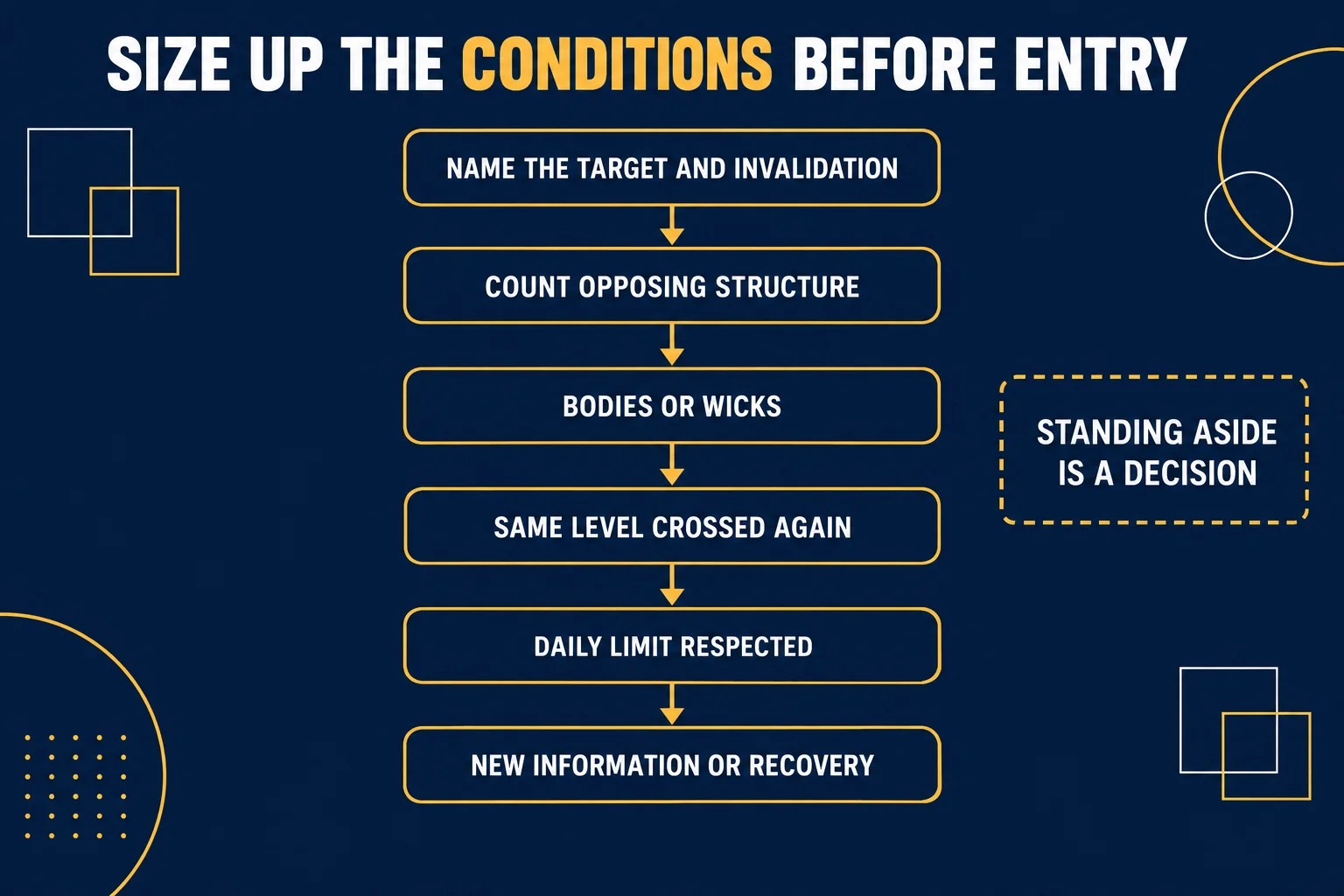
- Name the target and the invalidation. He chose the half gap as the draw and placed the stop just beyond the fill, adjusting both as price moved rather than leaving the original plan untouched (5:46, 27:41).
- Count the opposing structure. The number of candles sharing one small range is his own measure of resistance in the market, and heavy overlap told him execution would be difficult before he entered (22:21).
- Bodies or wicks? Bodies carried beyond a level support continuation in his reading; wicks alone suggest a retracement instead, which is what he saw both early and late in this session (23:11, 49:21).
- Has the same level already been crossed back through? Repeated failure to launch from one area is information to him rather than noise, and by mid-session he had counted several (42:06).
- Is the size inside a limit set in advance? He capped the day at one contract to start and kept the total small, on the argument that a good week is not a reason to press (3:23, 17:40).
- Is this new information, or recovery? He treats a re-entry as a fresh decision and says few of his students would have gone back in on the short that morning (39:52, 40:01).
His stated conclusion is that standing aside is itself a decision, and that on a day like this one the useful skill is recognising the condition rather than predicting the direction (50:51).
Watch the original ICT lesson
This article draws on the automatically transcribed audio of Trading In High Resistance Liquidity Run Conditions – July 21, 2026. The transcript is a source for the speaker’s words; it is not independent proof of the chart detail, the fills or the reported result, and the annotation-heavy charts in the recording remain the important visual reference when following the timestamps above.
Watch the original lesson on YouTube
The video cannot be played inside another website: when its embedded player was opened and clicked from a BestProps page origin on 13 September 2026, the player itself reported “Playback on other websites has been disabled by the video owner.” and settled on a “Watch on YouTube” prompt with no duration and no playback progress. That is why no embed is reserved or left blank here; the recording is available directly on YouTube.
Watch Trading In High Resistance Liquidity Run Conditions – July 21, 2026 on YouTube ↗
Primary source and further reading
- The mapped Inner Circle Trader recording: the primary source for every timestamp link in this article. Use those links to compare the explanation with its origin.
- A separate recording with a near-identical title for the same session date: the two uploads are distinct videos, so contract sizes, executions and summary details should not be merged between them without checking which recording is being described.
- TradingView — Time intervals: a quick introduction and tips: platform documentation on how each candlestick is constructed and what a chart interval defines, which is relevant to any opening-range gap or half-gap measurement. Official vendor documentation, not an ICT source.
- ICT Archivist page for the same recording: an independent third-party archive of ICT material. It is not affiliated with or endorsed by The Inner Circle Trader, it is not an official lesson, and it is used here only as a pointer to the recording — not as evidence that any described trade occurred as stated.
This is independent educational commentary. It is not official ICT material, a tested trading system, or a claim that the reported result can be reproduced. Leveraged trading can produce substantial losses, and any framework described here should be independently evaluated before it is used.