How we researched this article
BestProps used document-based research from primary firm sources, checked September 14, 2026. The complete source list, scope, limitations, and commercial-state record appear near the end of this article.
In “AM Session Review & Course Correction” (published by The Inner Circle Trader on August 11, 2026), ICT reviews an NQ morning in which price did not follow his preferred scenario. He says so himself: he had been looking for a run up into relative equal highs, and he was not correct that day.
The recording runs about seven minutes. The source for this article is a full timestamped transcript produced by automatic speech recognition of the recording’s audio rather than YouTube captions. It documents what ICT says, but it cannot verify chart levels, entries, fills, position size or outcomes. Two terms in the automated transcript are ambiguous and are flagged where they appear.
The opening read and how it failed
ICT says he had been looking for a run up into a group of relative equal highs, but the market “was simply not willing to participate” (0:06). He also had several pools of liquidity in mind. Price opened and went straight down, and he says he expected the relative equal lows to be taken out, noting that the lows he was watching sat at similar levels (0:23, 0:32).
His secondary interest was then a run back up. He describes the best case as clearing the highs he had marked and says that would have made for a good morning (0:47). In his framework, relative equal highs and lows are reference points where liquidity may rest, not guarantees.
The retracement measurement he calls the “secret sauce”
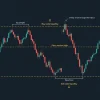
He takes the high and low of a retracement leg that still had an untraded pool of liquidity, then measures how far below it price might reach (1:21). He notes the measurement is taken on wicks only, and that even when candle bodies came down there, price was unwilling to go beyond it (1:43). He calls this something he has taught for years and corrects his own chart marking out loud as he goes (1:08).
He selects the opening price of the last down-close candle — which he calls “changing the state of delivery” — rather than the consecutive up candles, because in his reading that opening price sits at essentially the same level as the relative equal lows he had already annotated (1:48). He says several things converge on that specific price level, and that a neighbouring candle would have delivered a very similar reference (2:05). The practical point is confluence: more than one idea pointing at roughly the same area rather than one isolated annotation.
Reaction, relative equal highs, and a stopped long
Price rallied from that area and respected it. ICT highlights that the body of the candle did not surrender half of itself before price moved up, and calls that the most important detail of the candle (2:20). He says he wanted price above a nearby high and got it, after which relative equal highs were created and price came back down (2:51).
In his account he felt he could have reversed that long, added back in the inversion fair value gap, and was stopped out (2:56). This is his verbal report only. The transcript carries no brokerage record, no position size and no verified fill, so neither the entry nor the loss can be confirmed from it.
Premarket context and the mid-week news calendar
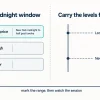
He reviews the range formed between the low and the highest high of that stretch (3:10) and points to the economic calendar: CPI and PPI as high-impact drivers on Wednesday and Thursday, alongside what he refers to as the free-market session (3:16).
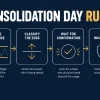
Checking the seven o’clock window, he says the market was trading inside that range and was not trending (3:36, 3:58). He contrasts it with the prior day, when he says the market was permitted to trend, and reasons from that difference that the session might deliver one-directional movement (4:08). He then says plainly that he wanted the run through the individual highs and was not correct (4:27). That admission is the course correction the title refers to: the read follows what price is doing rather than the original idea.
The revised read: waiting, then accumulating
He notes that what he had posted publicly about his preferred path got the opposite response, with price running the other direction soon after the 9:28 to 9:30 window (4:31). He says his job then was to wait (4:49).

He describes price trading lower into an inefficiency he had identified from Friday (4:56) and then trading back up into a series of wicks (5:06). He measures from the highest wick down to the next one, then repeats the same measurement on the following wick (5:18, 5:25). The area that produces he calls a “grey pool”, describing it as a place where a gap would most likely go unnoticed by everyone else (5:45, 5:55). That term is uncertain: the automated transcript may have misrecognised specialised vocabulary there, so it is reported as-is rather than defined as a fixed ICT concept.
He says price tapped the area one more time and sold off (6:05). Once price moved below the low he had been watching, he says he was accumulating and building the position back up for a move toward the area holding relative equal highs (6:25). He also says he was mocking the market in the moment for not being able to take that low out sooner.
Where he left the session
Even after the recovery he says he suspects the market could run down into the relative equal lows, naming those lows as draws and pointing out two sets that traders should be aware of (6:39, 6:59). He closes by describing that as the business for NQ that day and saying he may review again that evening if he gets the chance (7:12).
Educational takeaway
- Start with a scenario, not a certainty. ICT’s preferred move toward the highs failed almost from the open.
- Treat invalidation as information. The opening decline and the failure to hold the rebound forced a revised read rather than a repeat of the original one.
- Separate a reaction from continuation. Price can respond at a marked area and still fail to complete the larger move, as he says happened to his long.
- Look for confluence, not proof. He stacks ranges, candle openings, wicks, inefficiencies and relative equal highs or lows; the recording does not demonstrate a tested edge.
- Keep both sides of the range in view. He finishes monitoring references above and below price instead of presenting one outcome as assured.
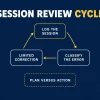
The educational value here is the revision itself: a stated idea was wrong, and the review explains how the levels were re-read afterwards. Nothing in it is investment advice, and none of it shows that the concepts produce repeatable or profitable results.

Watch the original session review
The mapped source for this article is AM Session Review & Course Correction on the channel The Inner Circle Trader. This BestProps page is independent educational commentary: it is not a transcript, not an official ICT lesson, and not evidence that any entry, stop or result described in the recording occurred as described.
Watch the original session review on YouTube
This video cannot be played inside another website: the embedded player itself reports “Playback on other websites has been disabled by the video owner.” That response was read from the player when this page was checked, so no player is reserved here and no embed is left blank. The full review is available directly on YouTube.
Source and further reading
- The original Inner Circle Trader session review: the recording summarised above; the timestamp links in this article point into it so each statement can be checked against its source.
- TradingView: how to turn bar replay on: the platform’s own documentation for replaying a completed session candle by candle when reviewing what was visible in real time.
- BestProps: Prop Firm Consistency Rule: a dated summary of how consistency requirements can constrain position sizing and course corrections on a funded account.
- BestProps: Prop Firm Drawdown Rules Explained: compares static, trailing, intraday and end-of-day drawdown calculations in the same way.
The BestProps pages are summaries with their own checked dates, and rules change: the firm or platform holding the account controls the current wording, and the reader’s own dashboard plus the current official document are final. No page linked here is a rule set for any particular account, and none is a performance record.
BestProps is not affiliated with The Inner Circle Trader, and no source listed here endorses this article or any setup. Inefficiency, inversion fair value gap, relative equal highs and lows, and pool of liquidity are used on this page only as descriptive study terms drawn from the recording. The content is educational and is not individualized financial advice.