Key takeaways
This independent ICT 2025 and SMC educational guide finds insufficient accessible evidence to verify the lecture’s exact opening range gap definition, timestamps, entry rules, or preferred instruments, and treats the January 12, 2025 Scribd mentorship notes as an unverified third-party source.
Read the full summary
This independent ICT 2025 and SMC educational guide finds insufficient accessible evidence to verify the lecture’s exact opening range gap definition, timestamps, entry rules, or preferred instruments, and treats the January 12, 2025 Scribd mentorship notes as an unverified third-party source. An opening range gap is an area between selected opening-related prices, while an ORB is movement beyond a defined opening range, NDOG and NWOG reference new-day and new-week openings, and an FVG is a multi-candle imbalance rather than a market-opening gap. Traders should record the symbol, contract, exchange, data feed, session, timezone, daylight-saving convention, fixed boundaries, reset rule, structure, liquidity, volatility, news, costs, entry, invalidation, exit, and no-trade conditions before testing. Price interaction should be classified objectively as no touch, partial fill, full traversal, rejection, acceptance, consolidation, or no revisit, since neither opening gaps nor FVGs are guaranteed to fill. Research should include failed and untouched examples, realistic spreads, commissions, slippage, separate in-sample and out-of-sample evaluation, simulation or controlled sizing, and direct verification of current prop-firm loss, timing, and position rules.
How we researched this article
BestProps used document-based research from primary firm sources, checked September 14, 2026. The complete source list, scope, limitations, and commercial-state record appear near the end of this article.
Searches for the ICT 2025 lecture series, SMC trading, and opening range gaps often lead to third-party mentorship notes, short videos, and general Smart Money Concepts guides. Unfortunately, those results also mix several ideas that are not necessarily interchangeable.
This independent educational guide explains how traders can study an opening range gap without reproducing or treating unofficial lecture notes as authoritative. It also distinguishes opening range gaps from opening range breakouts, New Day Opening Gaps, New Week Opening Gaps, and fair value gaps.
Source note: A search result describes a Scribd document as notes from a January 12, 2025 ICT mentorship lecture, but the document was not accessible for verification. Its authorship, completeness, and accuracy should therefore be confirmed before any statement is attributed to the lecture.
What the ICT 2025 Lecture Says About Opening Range Gaps
The available search results indicate interest in using an opening gap or range as a reference for intraday price analysis. However, the accessible evidence is insufficient to establish the lecture’s exact definitions, timestamps, entry rules, or preferred instruments.
Rather than assuming a universal formula, traders can approach the topic as a chart-study framework:
- Define the relevant session and timezone before looking at subsequent price action.
- Mark objective price boundaries around the opening transition.
- Observe whether price rejects, partially fills, fully traverses, or moves away from the area.
- Evaluate the reaction alongside structure, liquidity, volatility, and scheduled news.
- Test the definition on historical and forward data before using it in a trading plan.
This approach is especially relevant to funded and evaluation-account traders. A technically interesting area does not override a firm’s current loss limits, restricted-time rules, position limits, or other account conditions. Those terms differ and can change, so they must be checked directly with the provider.
Opening Range Gap Terms for SMC Trading
Much of the confusion around the long-tail query comes from treating every opening-related term as the same setup. The following distinctions provide a practical starting point, but traders should verify how any specific educator defines them.
Opening Range Gaps Versus Opening Range Breakouts
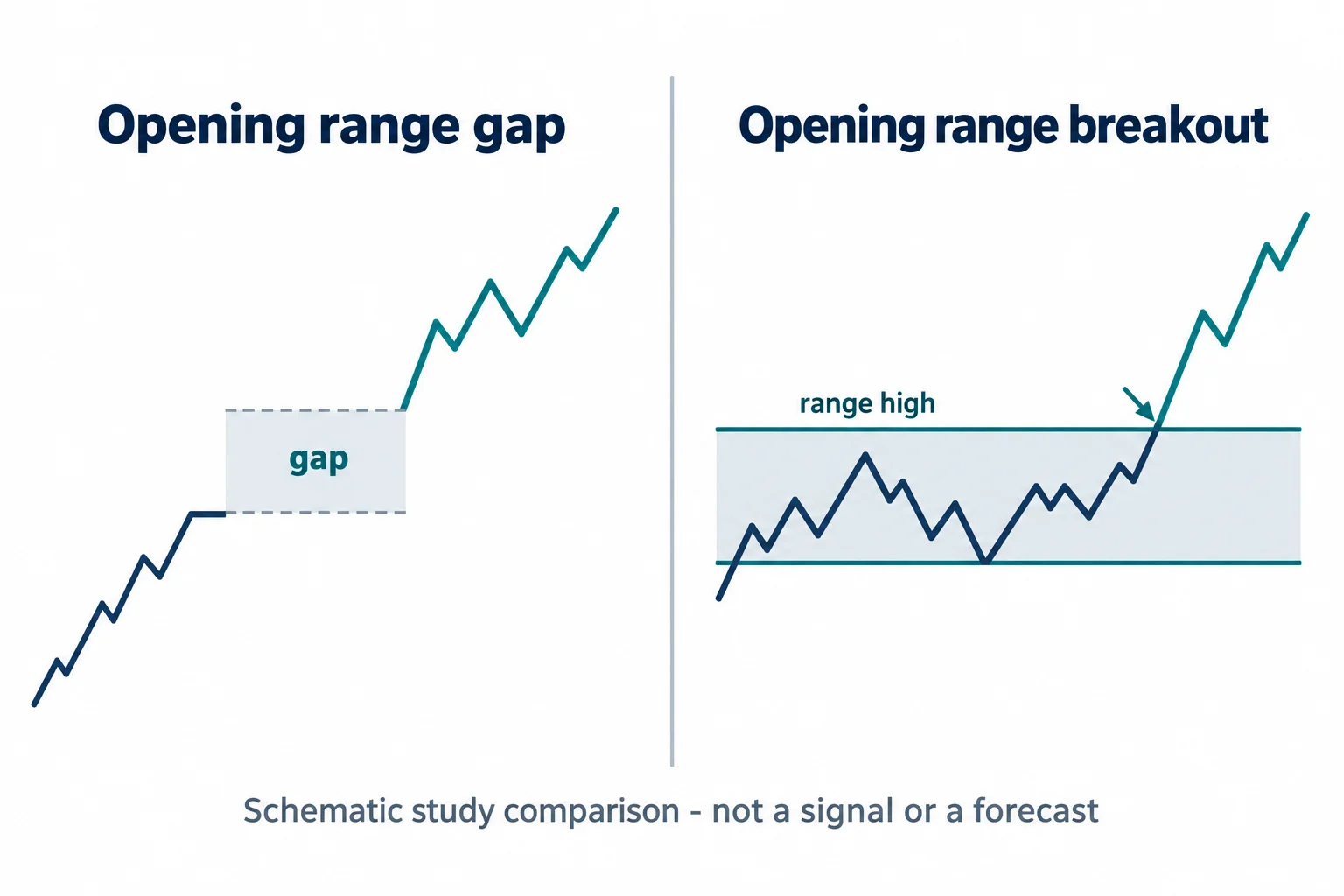
An opening range gap generally refers to a price difference or reference area associated with a market or session opening. Its exact boundaries depend on the method being studied.
An opening range breakout, commonly abbreviated ORB, is instead a strategy category based on price leaving a defined high-to-low range after an opening period. A gap is an area between reference prices; a breakout concerns movement beyond range boundaries. They may appear together, but they are not automatically identical.
New Day and New Week Opening Gaps
NDOG and NWOG are labels used in ICT and SMC communities for opening references associated with a new trading day or week. The precise construction may depend on which closing and opening prices, session conventions, instrument, and data feed are used.
These variables matter because futures, foreign exchange, equities, and contracts for difference do not share one universal trading schedule. Daylight-saving changes can also shift the relationship between local time and New York time.
Opening Range Gaps Versus Fair Value Gaps
In SMC vocabulary, a fair value gap, or FVG, usually describes a multi-candle price imbalance identified from the relationship among consecutive candles. It is not simply a market opening gap. For a broader treatment of order blocks, liquidity, and FVG terminology, the supplied SERP includes an ICT and SMC concepts guide from AlgoStorm.
Neither an opening gap nor an FVG is guaranteed to fill. A return into either area is an observation to test, not a certainty or standalone prediction.
How to Mark Opening Range Gaps
Because the source material does not verify one official definition, use the following as a research process rather than a claimed ICT rule.
- Select one instrument. Record the exact symbol, contract, exchange, and data source. Different feeds can print different opening and closing prices.
- Choose the session transition. Decide whether the study concerns a daily, weekly, cash-session, or another clearly defined opening.
- Fix the timezone. Write the timezone beside the setup and account for daylight-saving changes. Do not rely only on the visual position of a candle.
- Define both boundaries. State exactly which earlier and later prices create the area. Avoid adjusting the levels after seeing how the session develops.
- Extend the area forward. This makes it possible to classify later interaction as no touch, partial entry, full traversal, rejection, or consolidation.
- Set a reset rule. Decide when the reference expires or is replaced. Daily and weekly studies require different reset schedules.
- Capture context. Log trend conditions, nearby highs and lows, scheduled economic events, volatility, and the time of each interaction.
A screenshot should display the symbol, date, session, timezone, boundaries, and subsequent price path. Without those details, a chart may look persuasive while being difficult to reproduce.
How SMC Traders Interpret Opening Range Gaps
Traders commonly watch several possible responses, none of which guarantees the next move:

- Immediate rejection: price touches a boundary and moves away without traversing much of the area.
- Partial fill: price enters the marked area but reverses before reaching the opposite boundary.
- Full traversal: price crosses the entire marked zone. This describes what happened; it does not prove why it happened.
- Acceptance: price spends time trading within or around the area rather than producing a sharp reaction.
- No revisit: price continues away during the observation window and leaves the gap unfilled.
These labels are most useful when defined before testing. If every small pause is later called a rejection, hindsight bias can make a weak idea appear precise.
Opening Range Gap Trading Examples
Bullish Opening Range Gap Reaction
Suppose a trader marks a daily opening reference and price initially trades above it. Later, price returns to the upper boundary, enters part of the zone, and closes back above it. The trader could record this as a partial fill followed by a bullish reaction. Confirmation would still need an objective definition, such as a specified structural break or candle close.
Bearish Opening Range Gap Continuation
Price opens below the selected reference, retraces toward its lower boundary, and then resumes downward. This may be classified as rejection and continuation. It should not be relabeled a successful setup unless the entry, stop, target, costs, and timing rules were established in advance.
Failed Opening Range Gap Reaction
Price first reacts at the gap, creating what looks like a valid reversal, but then crosses the complete area and continues. This example matters because a level can produce a temporary response without becoming durable support or resistance.
Unfilled Opening Range Gap Example
Price opens and trends away for the entire session. The untouched area remains a historical reference under some methodologies, but traders should not assume price must return on a particular day or week.
Combining SMC Trading With Opening Range Gaps
An opening reference is often studied with market structure, liquidity, displacement, FVGs, and premium or discount ideas. Confluence should narrow a hypothesis rather than accumulate vague labels.
For example, a trader might ask whether a gap interaction occurs near a previously identified swing, follows a decisive move, or aligns with the chosen higher-timeframe context. Each condition needs a fixed definition. Adding more discretionary concepts after the result is known does not provide reliable validation.
Claims that a pattern reveals institutional intent or has a particular win rate require evidence, a reproducible methodology, and an adequate sample. Chart appearance alone cannot establish causation.
Common Opening Range Gap Trading Mistakes
- Using ORG and ORB as interchangeable terms.
- Combining daily, weekly, and cash-session gaps without separate definitions.
- Ignoring timezone, daylight-saving, exchange, or data-feed differences.
- Assuming every opening gap or FVG must fill.
- Choosing boundaries after observing the reaction.
- Testing only favorable screenshots and omitting failed or untouched examples.
- Entering during major scheduled news without accounting for volatility and slippage.
- Letting a setup override account-level risk controls or current prop-firm terms.
Opening Range Gap Trading Risk Checklist
- Write down the instrument, session, timezone, and gap formula.
- Define entry, invalidation, exit, and no-trade conditions before testing.
- Include spreads, commissions, slippage, and realistic execution assumptions.
- Separate in-sample research from later out-of-sample evaluation.
- Log partial fills, full fills, failures, and gaps that are never revisited.
- Review results across different volatility and market conditions.
- Confirm current account rules directly with the relevant prop firm.
- Use simulation or controlled sizing while evaluating an unproven process.
This article is general trading education, not individualized financial advice. Opening-range and SMC frameworks involve interpretation and risk; they do not assure profitability or funded-account success.
Opening Range Gap Trading FAQs
Is an Opening Range Gap the Same as a Breakout?
No. A gap generally describes an area between selected opening-related prices, while an ORB focuses on price breaking beyond the high or low of a defined opening range.
Do Opening Range Gaps Always Fill?
No. Price may partially fill, fully traverse, reject, consolidate around, or never revisit a marked area during the chosen observation period.
Which Session Time Should Traders Use?
There is no safe universal answer across instruments and methodologies. Verify the source definition, exchange schedule, timezone, daylight-saving convention, and data feed before marking levels.
Are the January 12, 2025 Lecture Notes Official?
The supplied Scribd result is presented as 2025 ICT mentorship notes, but its content and provenance could not be verified from the accessible search material. It should be treated as an unverified third-party source unless confirmed against authorized primary material.
Related source video: 2025 Lecture Series – SMC Trading Opening Range Gaps
The recording mapped to this article is 2025 Lecture Series – SMC Trading Opening Range Gaps, a public upload on the channel The Inner Circle Trader. Its watch page, read on 13 September 2026, displays the channel’s 2.22M subscriber count, 139K views and a player runtime of 32:36 (the page’s own metadata duration field reads PT32M37S), and the page’s publication metadata records that upload at 2025-01-12T16:11:02-08:00 with a normal playability status.[1] This section is source navigation, not a transcript: the recording has not been watched, transcribed or timed for this addition, so no timestamp, definition, level, order or outcome from it is asserted anywhere on this page.
Watch the original lesson on YouTube
The video cannot be played inside another website: when its embedded player was opened and clicked on 13 September 2026, the player itself reported “Playback on other websites has been disabled by the video owner.” and settled on a “Watch on YouTube” prompt, with no duration and no playback progress reported. That message is the reason no embed is reserved or left blank here; the recording itself is available directly on YouTube.
Watch 2025 Lecture Series – SMC Trading Opening Range Gaps on YouTube ↗
Sources and checks for the opening range gap study guide
Four references support this addition: the first-party upload this page is mapped to, a United States equities exchange’s own publication of its opening cross and session times, the time-zone database behind the article’s daylight-saving caution, and the United States rulebook for off-exchange retail forex transactions. None of them was used to reconstruct the lesson: the recording was not watched, and no third-party notes document was treated as a recording.
An editorial note on the source status this article raises
The body reports that a search result describes an inaccessible document as notes from a January 12, 2025 mentorship lecture, that its authorship and completeness should be confirmed before anything is attributed to that lecture, and that the accessible evidence is insufficient to establish the lecture’s exact definitions, timestamps, entry rules or preferred instruments. Verification on 13 September 2026 locates a public first-party upload titled 2025 Lecture Series – SMC Trading Opening Range Gaps on the channel The Inner Circle Trader, showing 2.22M subscribers, 139K views and a player runtime of 32:36, with page metadata recording the upload at 2025-01-12T16:11:02-08:00 (13 January 2025 at 00:11:02 UTC) and a normal playability status.[1] That gives the article a dated primary recording of its own topic, and its platform date falls on the same calendar day the third-party document description uses. Two things this does not do: it does not verify that document’s authorship, completeness or accuracy, so the body’s caution about it stands unchanged; and the recording was not watched here, so no definition, timestamp, entry rule, session window or instrument preference is confirmed from it. The body’s prose is preserved exactly as written, and the gap between “no accessible primary material” and the existence of this public upload is flagged for an editor rather than smoothed over.
The mapped recording, and what its watch page reports
Re-read on 13 September 2026, the watch page for the mapped upload carries the title above, attributes it to the channel The Inner Circle Trader, and shows 139K views with a normal playability status.[1] The embedded player for that upload was opened and clicked on 13 September 2026 and the player itself reported that playback on other websites has been disabled by the video owner, with no duration and no playback progress, which is why this article carries a watch card instead of an embed. Three limits stand: the recording was not watched, so no definition, gap level, session window, entry or outcome described in the body is verified against it here; no timestamp is added or corrected; and no claim is made about why embedding is disabled, only that the player reported it.
Where an opening price and session time actually come from
The article’s FAQ says there is no safe universal session time and that a trader should verify the source definition, exchange schedule, timezone, daylight-saving convention and data feed. For a concrete primary publication of both an opening mechanism and its clock, Nasdaq’s own Trader site documents its Opening Cross timetable, including that the cross occurs at 9:30 a.m. and that dissemination of imbalance information begins at 9:25 a.m., and it documents that on-open orders specifically request an execution at the opening price.[2] Three limits matter: that page is the US equities venue’s own mechanism on its own Eastern-time schedule, not forex, not futures and not an ICT definition; it is cited only to show that an exchange’s official opening price and session times come from the venue itself rather than from a third-party note; and nothing about it is used here to size an opening range, to time a gap or to define a rule. No session window, level or gap boundary is asserted as ICT’s own.
Clocks, daylight time and the data feed
The body warns that a marked area is only as reliable as the clock and feed behind it. The IANA Time Zone Database is listed because it holds code and data that represent the history of local time for many representative locations worldwide, and it is updated periodically to reflect changes made by political bodies to time zone boundaries, UTC offsets, and daylight-saving rules.[3] One limit is important: it is a maintained record of civil time rules, not a source for any instrument’s session or for any gap definition, and it does not say which timezone or feed the mapped lecture used.
Current rules for off-exchange retail forex
The body asks funded and evaluation-account traders to check current official account terms rather than a general article. As one example of primary rule text, the electronic Code of Federal Regulations publishes the rules for off-exchange foreign currency transactions, including the requirement that each futures commission merchant engaging, or offering to engage, in retail forex transactions and each retail foreign exchange dealer must collect from each retail forex customer a minimum security deposit for each retail forex transaction equal to the applicable percentage as set by the registered futures association of which they are a member.[4] Two limits matter: those are requirements on dealers and futures commission merchants, not evaluation or prop-firm terms, and no such firm’s current rules are quoted or characterised here; and that rulebook says nothing about whether an opening range gap fills, reverses or continues. No leverage figure, account limit or outcome is claimed anywhere in this addition.
Unofficial and untested material
Any ICT, SMC or third-party indicator, script, tutorial, transcript, transcript-style page, notes document, community index, spreadsheet or social-media summary referenced by this article or by the material it links to is unofficial unless it comes from the publishing channel’s own upload page, and none is presented as official, tested or free of repainting. That applies to the third-party concepts page already linked in the body and to the inaccessible notes document the body discusses, neither of which was used here to establish a definition, a level or a result. No performance test, backtest, win rate, drawdown figure or account result is claimed anywhere in this addition, and none of the references above was used to produce a signal, a forecast or a level.
- [1] 2025 Lecture Series – SMC Trading Opening Range Gaps — The Inner Circle Trader (watch page read 13 September 2026)
- [2] Nasdaq Trader — The Opening and Closing Crosses (timetable and on-open order handling)
- [3] IANA — Time Zone Database
- [4] eCFR — 17 CFR Part 5, Off-Exchange Foreign Currency Transactions
Leveraged currency trading involves substantial risk and is not suitable for everyone. This addition is educational, does not provide individualized financial advice, and reports no outcome from any lecture or account.