Key takeaways
A prop firm payout cap is a contractual withdrawal ceiling applied per request, payout cycle, account, program, trader, or lifetime, distinct from profit splits, payout schedules, minimums, scaling rules, and displayed account gains.
Read the full summary
A prop firm payout cap is a contractual withdrawal ceiling applied per request, payout cycle, account, program, trader, or lifetime, distinct from profit splits, payout schedules, minimums, scaling rules, and displayed account gains. Potential payout is the lower of the trader’s eligible share and the applicable cap, subject to trading-day, consistency, profitable-day, drawdown, fee, and withdrawal rules, with the agreement determining whether the split applies before or after the cap and whether excess profit carries forward. In one example, $5,000 eligible profit at an 80% split produces a $4,000 share but a $3,000 per-cycle cap limits the potential payout to $3,000. In another, a $100,000 account capped at 2% of starting balance has a $2,000 cycle limit, so $3,000 eligible profit at a 90% split produces a $2,700 share but only a $2,000 potential payout when the cap follows the split. A $500 minimum and $2,000 cap can apply simultaneously as the withdrawal floor and ceiling. Traders should verify reset triggers, percentage calculation bases, excess-profit treatment, fees, payout effects on static, trailing, intraday, or end-of-day drawdown, and whether resets, replacements, scaling, inactivity, violations, or account closure alter cumulative limits, using dated copies of current official agreements rather than dashboards, promotions, reviews, social posts, or outdated comparisons.
How we researched this article
BestProps used document-based research from primary firm sources, checked September 11, 2026. The complete source list, scope, limitations, and commercial-state record appear near the end of this article.
A prop firm payout cap limits how much a trader can withdraw under specified conditions. The limit might apply to one payout request, a payout cycle, an account, or the trader’s total participation in a program. Understanding the cap matters because the profit displayed in an account is not necessarily the amount available for withdrawal.
Payout caps should not be confused with profit splits, payout schedules, minimum withdrawal amounts, or account scaling rules. Each term can affect the final payment differently. The applicable funded-account agreement determines how these provisions interact, so traders should verify current official terms rather than relying on reviews, social posts, or outdated summaries.
Account labels also need verification. FTMO states that its FTMO Accounts are demo accounts using fictitious capital, while Topstep describes its Express Funded Account as simulated and its Live Funded Account as live-market trading. A payout cap therefore needs to be checked against the specific account model, not the word “funded” by itself.
What Prop Firm Payout Caps Mean
A prop firm payout cap is a contractual maximum on eligible withdrawals. For example, a hypothetical program might limit each payout request to a fixed dollar amount. Another might let a trader withdraw only a specified percentage of account gains during an initial period.
The phrase maximum prop firm payout can describe several different restrictions. A cap could be:
- A fixed amount for each request
- A percentage of the account’s starting balance
- A limit for each payout cycle
- A cumulative account-level maximum
- A lifetime maximum for a trader or program
These structures are not interchangeable. A recurring per-request limit may postpone access to profits, while a lifetime limit could permanently restrict total withdrawals. The agreement should also explain what happens to any amount above the cap.

How Prop Firm Payout Caps Work Step by Step
A typical calculation can involve more than the headline cap. Although the exact order varies, traders can evaluate a payout policy with the following process:
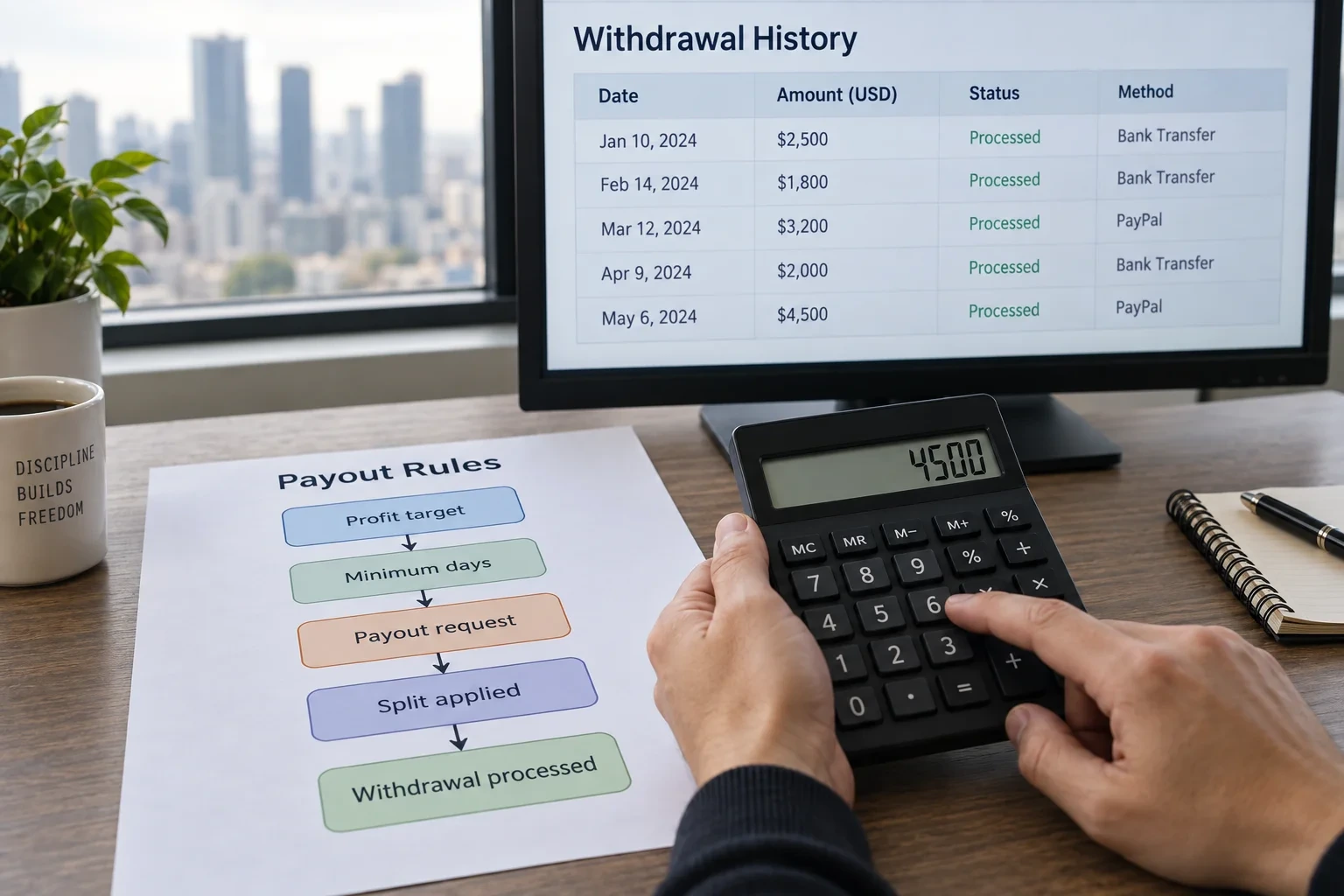
- Identify eligible profit. Start with the profit that qualifies under the program’s rules, not necessarily the account’s total displayed gain.
- Check payout eligibility. Confirm whether minimum trading days, consistency requirements, profitable-day criteria, or other conditions apply.
- Apply the profit split. Determine the portion allocated to the trader and whether the split is calculated before or after the cap.
- Apply the relevant payout cap. Check whether the limit applies per request, per cycle, per account, or cumulatively.
- Check withdrawal minimums and fees. A minimum request or disclosed processing charge may affect the payable amount.
- Review the remaining balance. Determine whether excess profit stays available, carries into another cycle, affects drawdown calculations, or is treated another way.
A useful starting formula is:
Potential payout = the lower of the trader’s eligible share and the applicable payout cap, subject to all other account rules.
This is only a framework. Some firms may define eligible profit or apply the calculation order differently.
How Prop Firm Payout Rules Differ
| Rule | What it controls | Why it matters at payout time |
|---|---|---|
| Profit split | The portion of eligible profit allocated to the trader. | Sets the share before any cap is applied. |
| Payout cap | The maximum that can actually be withdrawn. | Can reduce the payable amount below the calculated share. |
| Payout frequency | When requests may be submitted. | Delays access even when profits already qualify. |
| Withdrawal minimums | The smallest request a firm will process. | A floor, not a ceiling – it cannot raise the cap. |
| Scaling & account limits | Account size, buying power, or program progression. | Changes the capital base that caps are measured against. |
Prop Firm Profit Splits
A profit split determines what portion of eligible profit is allocated to the trader. If a hypothetical account has $4,000 in eligible profit and the trader’s share is 80%, the share before other limits would be $3,200.
Payout Caps
The cap limits how much of that share can be withdrawn under the relevant rule. If the hypothetical per-cycle cap is $2,000, the immediate potential payout would be no more than $2,000, assuming every other requirement is satisfied.
Payout Frequency
Payout frequency determines when requests may be submitted, such as after an eligibility period or during defined cycles. A frequent schedule does not automatically mean that the full account profit is withdrawable.
Payout Withdrawal Minimums
A minimum threshold is the smallest request a firm will process. It is a floor rather than a ceiling. A trader could therefore face both a $500 hypothetical minimum and a $2,000 hypothetical cap.
Prop Firm Scaling and Account Limits
Scaling rules concern account size, buying power, or progression within a program. They do not necessarily increase payout limits. Traders should verify whether scaling changes the cap, profit split, drawdown method, or other funded trading account rules.
Common Prop Firm Payout Caps
| Cap type | How it limits a withdrawal | What to verify |
|---|---|---|
| Fixed cap Monetary maximum | Sets a set monetary amount per request or per cycle. | Whether the limit applies per request or per cycle. |
| Percentage cap Share of a base | Limits a cycle to a percentage of the starting balance, current balance, or eligible profit. | Which figure the percentage is calculated from. |
| Per request or cycle Frequency limit | A per-request cap limits one submission; a per-cycle cap limits the total paid in a defined period. | How the cycle is defined and when it resets. |
| Account level Cumulative | Limits cumulative withdrawals from one funded account. | Whether partial withdrawals reduce the remaining allowance. |
| Lifetime Trader or program level | Limits cumulative payments associated with a trader, program, or relationship. | Whether any cumulative maximum exists at all. |
Fixed Payout Caps
A fixed cap sets a monetary maximum, such as an amount per request or cycle. Traders should check whether the amount changes with account size or tenure.
Percentage Payout Caps
A percentage cap may be based on the starting balance, current balance, eligible profit, or another defined figure. The base matters as much as the percentage.
Payout Caps by Request or Cycle
A per-request cap limits one submission. A per-cycle cap limits the total paid during a defined period, even if multiple requests are technically possible. The policy should define when a cycle begins and ends.
Account Level Payout Caps
An account-level maximum may limit cumulative withdrawals from one funded account. Traders should ask whether a replacement, reset, or scaled account starts a new limit.
Lifetime Payout Caps
A lifetime cap would limit cumulative payments associated with a trader, program, or relationship. Because this can materially affect long-term withdrawal potential, the scope and duration should be explicit.
Prop Firm Payout Examples

Fixed Cap Payout Example
Assume a trader has $5,000 in eligible profit, an 80% trader share, and a $3,000 per-cycle cap.
- Eligible profit: $5,000
- Trader share: $5,000 multiplied by 80%, or $4,000
- Per-cycle cap: $3,000
- Potential payout: $3,000, before any other applicable conditions
The remaining $1,000 of the trader’s calculated share cannot be assumed to carry forward. It might remain eligible, become available later, or receive different treatment depending on the agreement.
Current Topstep Payout Cap Example
As checked August 1, 2026, Topstep’s official payout policy says Express Funded Account requests are limited to 50% of the account balance, up to an account-size cap. For $50K, $100K, and $150K accounts, the Standard caps are $2,000, $3,000, and $5,000; the Consistency caps are $3,000, $4,000, and $6,000. Topstep identifies these accounts as simulated and says the caps do not apply to Live Funded Account payouts. These terms can change, so verify the current policy before buying an evaluation or requesting a payout.
Percentage Cap Payout Example
Assume a hypothetical $100,000 account limits a cycle’s withdrawal to 2% of the starting balance. That produces a $2,000 cap. If eligible profit is $3,000 and the trader share is 90%, the calculated share is $2,700. Under a policy that applies the cap after the split, the potential payout would be $2,000.
If a program instead applies a cap before calculating the split, the result could differ. This is why traders should look for worked examples in official terms or request written clarification.
How Payout Caps Affect Withdrawal Planning
A payout cap may change how quickly account profits can be withdrawn, but it should not be treated as a reason to increase risk. Attempting to reach a maximum payout quickly can conflict with drawdown limits, consistency rules, position-size restrictions, or a trader’s own risk controls.

Before submitting a request, consider:
- How the withdrawal could change the account balance and drawdown threshold
- Whether removing profit reduces the cushion available for future trading
- Whether the request closes, resets, or otherwise changes the account
- Whether excess eligible profit can move into the next cycle
- Whether a denied request affects future eligibility
The most cautious planning assumption is not that displayed gains are immediately withdrawable, but that each request must satisfy the complete payout process in force at that time.
Prop Firm Payout Rules to Check
Use the current official agreement, payout policy, and help documentation to answer these questions:
- Is there a cap per request, cycle, account, or trader?
- Is the cap fixed or percentage-based?
- What figure is used to calculate a percentage cap?
- Does the profit split apply before or after the cap?
- Does the cap reset, and what event triggers the reset?
- What happens to profit above the limit?
- Are there minimum profitable days or consistency requirements?
- How does a payout affect static, trailing, intraday, or end-of-day drawdown calculations?
- Can rule violations, inactivity, or account closure affect unpaid amounts?
- Do scaling, resets, or replacement accounts change cumulative limits?
- Which document controls if marketing material conflicts with the agreement?
Save a dated copy or screenshot of the terms reviewed before purchase. Policies can change, and third-party comparison pages may not reflect the current version.
Prop Firm Payout Cap Red Flags
Exercise caution when the maximum payout is advertised prominently but the calculation method is unclear. Other points needing clarification include undefined payout cycles, vague references to discretionary approval, and no explanation of excess-profit treatment.
Traders should also investigate apparent conflicts between FAQs, dashboards, promotional pages, and contractual terms. Ask for clarification in writing, but remember that a support response may not override the governing agreement.
A cap is not automatically favorable or unfavorable in isolation. Its practical effect depends on the profit split, drawdown model, eligibility rules, payout timing, and treatment of balances after withdrawal. Compare the complete rule set rather than one headline number.
Prop Firm Payout Cap FAQs
What Is a Payout Cap in a Prop Firm?
It is a maximum amount that may be withdrawn under defined conditions. The cap can apply to a request, cycle, account, program, or trader.
Is a Payout Cap Applied Before or After the Profit Split?
Either method is possible. The calculation order must be confirmed in the applicable program terms.
Do Payout Caps Reset?
Some cap structures may reset after a defined cycle or event, while others may be cumulative. Do not assume a reset unless the policy states when and how it occurs.
Can a Prop Firm Impose a Lifetime Payout Limit?
A program’s agreement may define a cumulative maximum, but its scope must be verified in current official documentation. Check whether it applies per account, program, or trader.
What Happens to Profits Above the Payout Cap?
They may remain in the account, become eligible later, or receive another treatment specified by the agreement. There is no universal rule, so this point should be confirmed before trading or requesting a payout.
How to Compare Prop Firm Payout Caps
Compare payout caps only after confirming the account model, eligible-profit definition, profit split, request timing, drawdown effect, and treatment of profit above the limit. Use the current agreement and payout policy for the exact program, save a dated copy, and treat every advertised maximum as conditional until the full withdrawal calculation is clear.