Key takeaways
ICT 2022 Mentorship is the subject of a roughly two-minute YouTube video published 15 November 2022 in which ICT asks students to use the comments like a graduation yearbook and describe whether the mentorship helped, what clarified price action, and what results followed.
Read the full summary
ICT 2022 Mentorship is the subject of a roughly two-minute YouTube video published 15 November 2022 in which ICT asks students to use the comments like a graduation yearbook and describe whether the mentorship helped, what clarified price action, and what results followed. At one minute 13 seconds he characterises many viewers as becoming funded or trading live money, while at one minute 22 seconds he also recognises consistent demo profitability as progress, but the recording provides no charts, levels, trades, account statements, performance figures, student comments, or evidence verifying those claims. Useful responses should distinguish concepts studied, practice through replay, journaling, demo, or live charts, observed outcomes, unresolved difficulties, and next steps. The video teaches no setup and does not define its references to the algorithm or smart-money content, while the article is independent educational commentary rather than investment advice or proof of a repeatable trading edge.
How we researched this article
BestProps used document-based research from primary firm sources, checked September 24, 2026. The complete source list, scope, limitations, and commercial-state record appear near the end of this article.
This is the shortest item in the channel’s library: roughly two minutes, published 15 November 2022, and it belongs to a different category from the market reviews. It is a request for feedback, framed as a keepsake. The source for everything below is the video’s own timestamped English captions.
ICT 2022 Mentorship as a Student Yearbook
ICT opens by calling the video “a real quick … informal video” and then explains the analogy he wants viewers to hold in mind (0:05). He asks them to “consider this as a graduation yearbook post” (0:13). In his description, the end of a school year meant passing yearbooks around to friends and classmates and writing “a message of encouragement or a ribbing or something funny,” a memory worth freezing and coming back to (0:24).
The comparison sets the tone of the request. He is not asking for testimonials in a marketing sense, and he says so by including the possibility of a ribbing alongside encouragement. What he wants preserved is a shared record of a study year, with the comment section standing in for the inside cover of the yearbook.
Questions for ICT 2022 Mentorship Students
At 0:45 he says the comment sections are open and invites feedback on “what you experienced this year with me”. He then narrows it to the 2022 mentorship and asks directly whether it was helpful (0:52). If it was, he asks three follow-ups:
- “what did you glean from it” (meaning which parts of the material were useful) (0:57);
- “what were the things that helped you build a better understanding about price action” (1:03);
- “what did it contribute to in terms of results” (1:08).
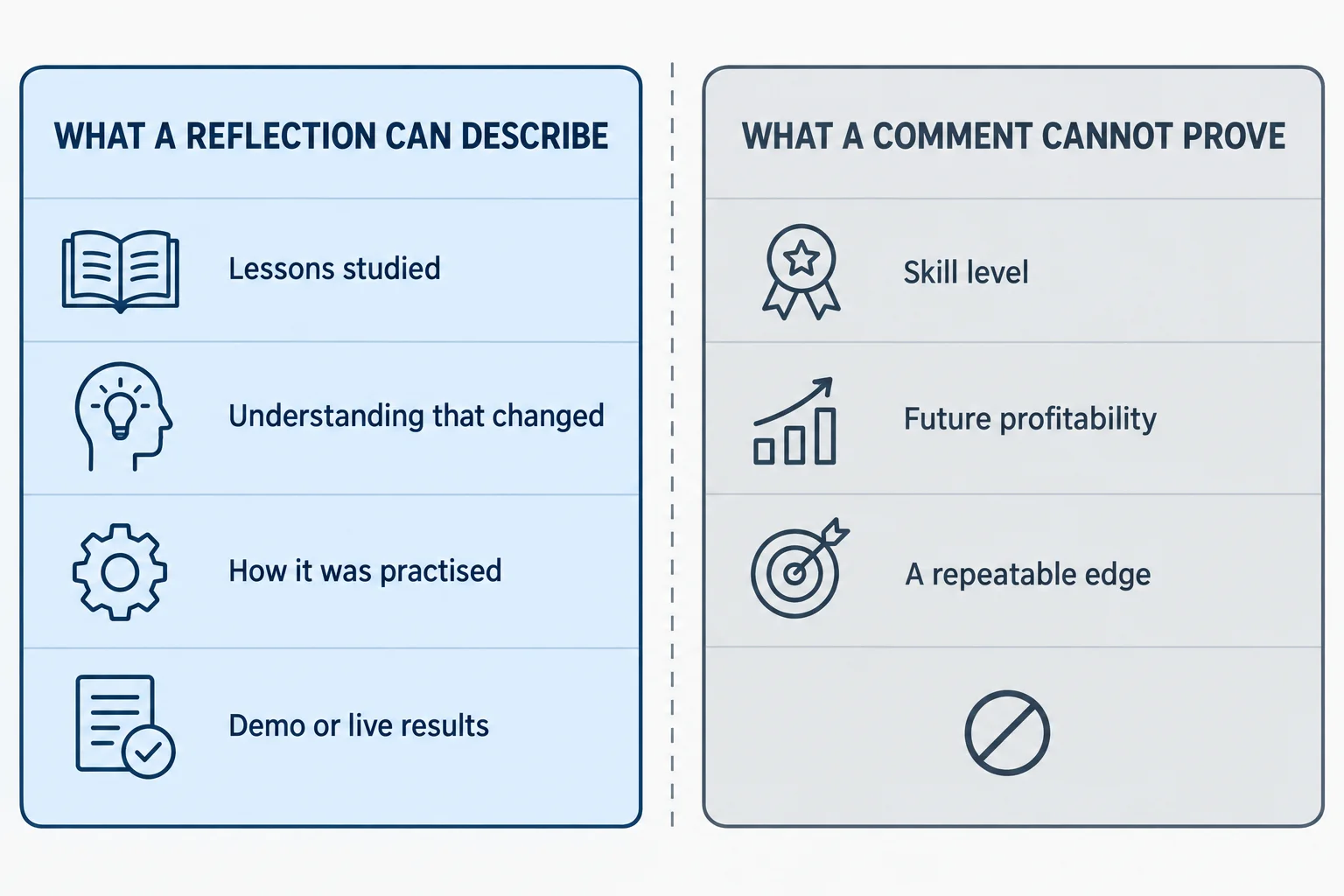
Those are requests for personal accounts. They are not findings. The transcript holds no student replies, no statements, no fills and no performance figures, and the video supplies no evidence with which any reply could be checked.
ICT Mentorship Progress Beyond Funded Student Accounts
Around 1:13 he says he knows “a lot of you are all becoming funded” and “actually trading with live money now improving profitability”, and calls that amazing. That is his characterisation of his audience. Nothing in the two minutes substantiates it, and the video shows no account, statement or certificate.
The part worth noticing is what he includes next. He says he is “still interested in hearing folks that are just getting to the point where they’re consistently profitable in their demo as well, because that is progress” (1:22). The invitation is therefore not limited to people with live results to report. Consistency in a simulated account is treated as a legitimate stage of the same process, not a lesser outcome.
Read as general educational guidance rather than a claim about anyone in particular, that framing is the useful part of the video. Development in discretionary trading tends to move through stages, and the stage a person is at changes what they should be measuring: whether the concepts are understood, whether the reading of a chart is repeatable, whether rules are followed, whether execution is consistent in simulation, and only then what happens with real money. Demo consistency describes how faithfully a process is applied under no financial pressure. It does not establish that the same behaviour will hold when real money is at risk, and the speaker does not claim otherwise.
Why Sharing the ICT Mentorship Experience Matters
From 1:32, ICT explains who the responses would encourage. He says it would be encouraging “not only me as the mentor and the author of all these Concepts but also the subscribers and readers that like to read the comments of this Channel and others like it”. Two audiences, then: himself as the person who produced the material, and the wider readership that treats comment sections as part of the learning material.
He closes by asking viewers to record “what your experience was this year with me exposing all these intricate details about price action the algorithm itself and smart money content” (1:44). The phrase “the algorithm” is used without definition in this recording, and nothing in these two minutes explains what he means by it or by smart-money content. A reader looking for those definitions will not find them here; this upload does not teach or validate a setup.
How to Share a Useful ICT Mentorship Experience
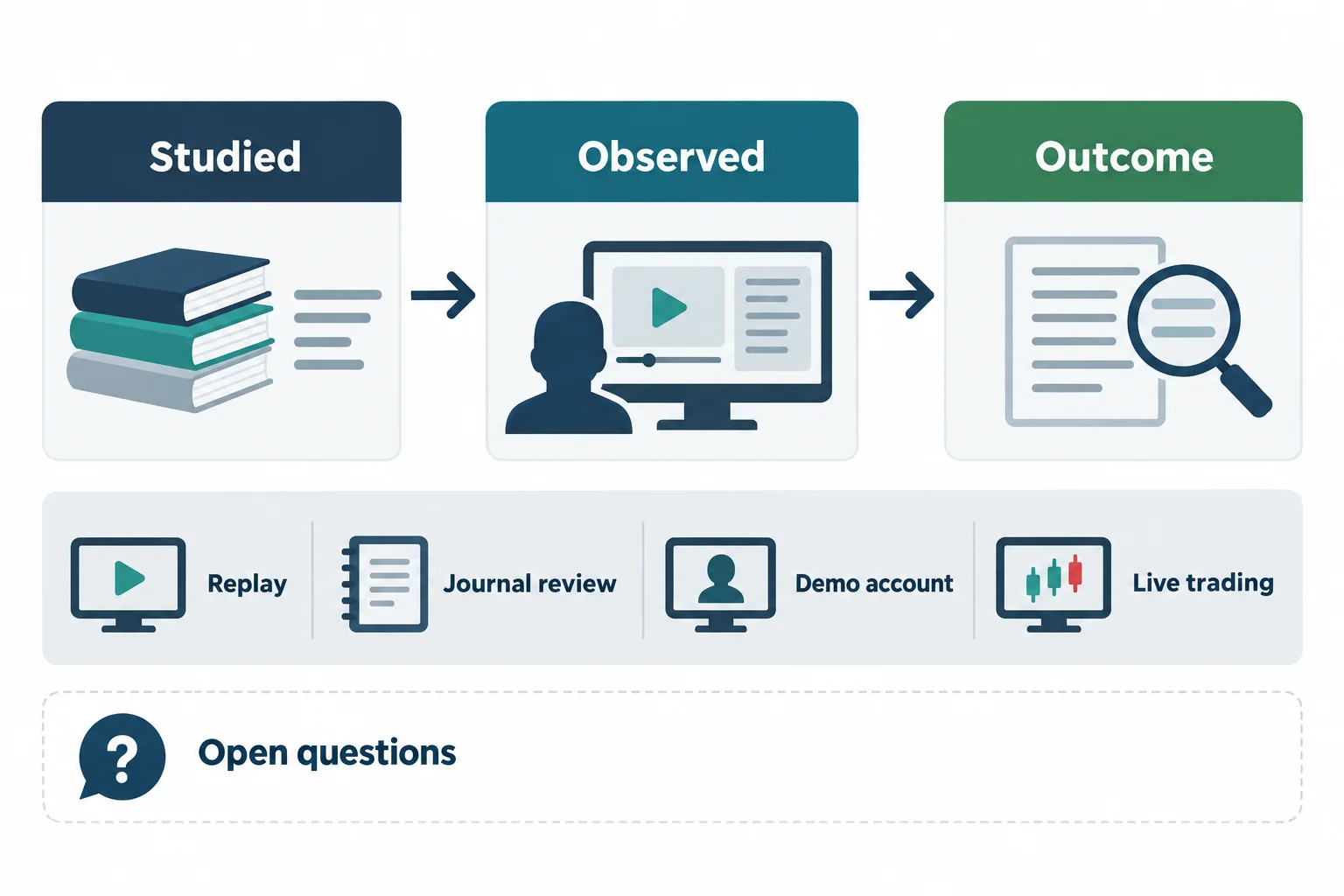
The request is broad enough that most replies would benefit from structure. Separating what was studied from what was observed, and observation from outcome, makes an account checkable by the person writing it and useful to everyone reading it. A reply that does that can cover six things:
- the level of experience before the mentorship began;
- which topics became clearer, in the student’s own words;
- how those ideas were practised (replay, journal review, or live chart time);
- whether any results reported came from replay, a demo account, or live trading;
- difficulties and questions that remain open;
- what the student intends to do next.
This structure follows the prompts ICT actually gives while avoiding the inference that taking part demonstrates a repeatable edge. A reader can apply the same split to any experience report, on this channel or elsewhere: the claim of what someone studied is usually well supported, while the claim of what it produced is the part that needs its own evidence.
Watch the ICT 2022 Mentorship Video
This article draws on the timestamped English captions of “Share Your Experience With Me & Your ICT Mentorship Progress”, published 15 November 2022 and listed at two minutes. Captions document what the speaker said; they cannot establish that any student result he describes is accurate, and the reviewer did not watch the video’s imagery.
Watch the original video on YouTube
This two-minute video cannot be played inside another website: when its embedded player was opened and clicked on 15 September 2026, the player itself reported “Playback on other websites has been disabled by the video owner.” at both desktop and mobile widths, with no duration reported and no playback progress. That is why no embed is used here. The video itself is public on YouTube and plays normally on its own watch page.
Watch “Share Your Experience With Me & Your ICT Mentorship Progress” on YouTube ↗
ICT 2022 Mentorship Resources
These are the sources checked for this article. The publisher’s own pages are the first-party record of what ICT releases; the other two are general material about how reported trading results should be read. None of them assesses this speaker, verifies a student outcome, or tests the framework he refers to. Any ICT, smart-money or third-party indicator, note set, script or re-upload circulating outside the publisher’s own pages, and any indicator built on these concepts, is unofficial and untested here.
- [1] Share Your Experience With Me & Your ICT Mentorship Progress, The Inner Circle Trader (primary source; watch page read 15 September 2026, listed at 2 minutes)
- [2] The Inner Circle Trader (official YouTube channel) (read 15 September 2026)
- [3] The Inner Circle Trader (publisher’s own site and free library) (read 15 September 2026)
- [4] CFTC (Fraud Advisory: Commodity Trading Systems Sold on the Internet) (read 15 September 2026) Background on how hypothetical or simulated results are described to the public.
This is independent educational commentary on one short video and the request for feedback it contains. It is not official ICT material, it is not a tested trading system and it is not investment advice. No result reported by any student is confirmed here and none is repeated as fact. Leveraged trading carries substantial risk.