Key takeaways
ICT’s YouTube video https://www.youtube.com/watch?v=Ic1rqvbk99c is a 17 minutes 30 seconds educational walkthrough of a paper-traded EUR/USD short from June 3, 2021 using a bearish order block, a 62%–79% Optimal Trade Entry retracement, bearish market structure, a Judas swing and liquidity below short-term and hourly lows.
Read the full summary
ICT’s YouTube video https://www.youtube.com/watch?v=Ic1rqvbk99c is a 17 minutes 30 seconds educational walkthrough of a paper-traded EUR/USD short from June 3, 2021 using a bearish order block, a 62%–79% Optimal Trade Entry retracement, bearish market structure, a Judas swing and liquidity below short-term and hourly lows. ICT contrasts his bearish view with a bullish astrofx tweet posted at six ten a.m., enters with a ten-pip stop, and expects employment news at eight fifteen a.m. to drive price through protective sell stops before taking most of the position off beyond the first marked level. He calls the move algorithmic interbank repricing rather than a sudden influx of sellers, but the article stresses that this is ICT’s unverified theory, not demonstrated evidence of institutional market mechanics. The practical lesson is to establish directional structure, measure the retracement, mark an order-block execution area, identify liquidity objectives, account for scheduled volatility and take a partial exit at the first target. The single replay cannot verify the exact entry, chart markings, executions, retail-sentiment causation or alleged algorithm, and ICT identifies the example as a paper trade rather than real-money performance.
How we researched this article
BestProps used document-based research from primary firm sources, checked September 25, 2026. The complete source list, scope, limitations, and commercial-state record appear near the end of this article.
In “Instagram Logic Vs Interbank Algorithm”, uploaded June 7, 2021, ICT reviews a EUR/USD short setup associated with the June 3, 2021 trading session. The presentation combines a trade walkthrough, criticism of social-media forex commentary, and ICT’s interpretation of algorithmic price delivery.
The central contrast is not a formal comparison between two established market models. “Instagram logic” is ICT’s dismissive label for bullish social-media commentary that he considers insufficiently supported. “Interbank algorithm” refers to his own theory that price is systematically repriced toward identifiable liquidity. These are ICT’s interpretations, not independently demonstrated facts about how the foreign-exchange market operates.
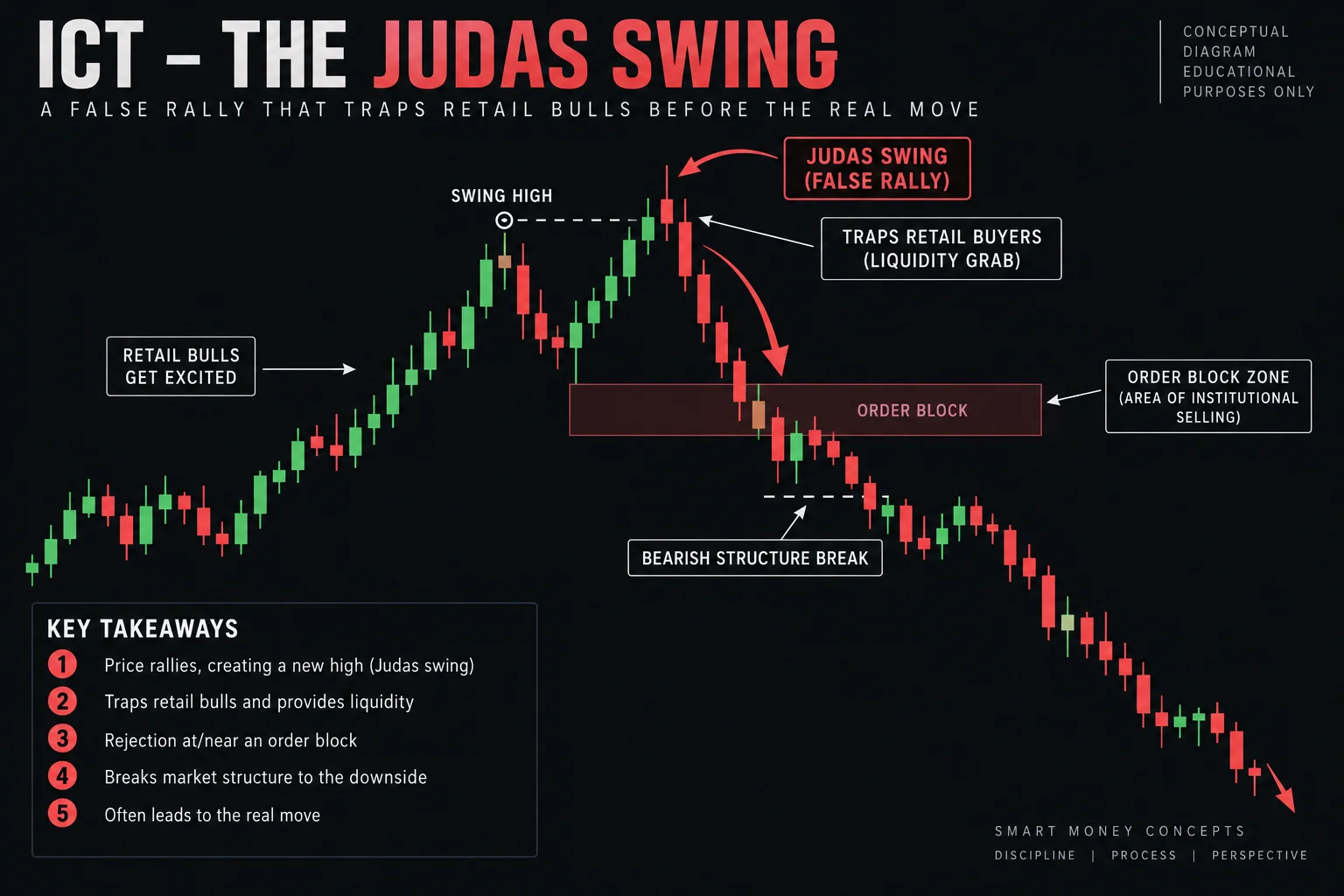
ICT Instagram Logic Trade Setup
ICT begins with a replay-style walkthrough of EUR/USD and initially uses exaggerated language to make the trade look effortless. He identifies what he calls a bearish order block and expects a rally into that area before a decline through nearby lows (0:43). After narrating the decline and simulated profit-taking, he reveals that the opening performance was intentionally sarcastic. His point is that drawing boxes over completed price action can create a misleading impression of certainty (2:36).
He then moves to a 15-minute view and presents the framework he says informed his short bias. The components include:
- A bearish order block near the anticipated entry area.
- A prior price leg measured from a swing high to a low.
- A retracement into what he calls an overbought or “optimal trade entry” region, approximately the 62%–79% portion of that range (3:41).
- Earlier breaks of lows, which he interprets as bearish market structure.
- A rally that he labels a "Judas swing" (rendered as "Judah swing" by the automated transcript) intended, in his model, to encourage bullish positioning before a reversal.
ICT says that when the preferred retracement forms before the New York session, he may instead use the bearish order block as the execution reference. He interprets the overnight rally as a false bullish move rather than evidence that EUR/USD is changing direction (5:28).
What ICT Instagram Logic Means
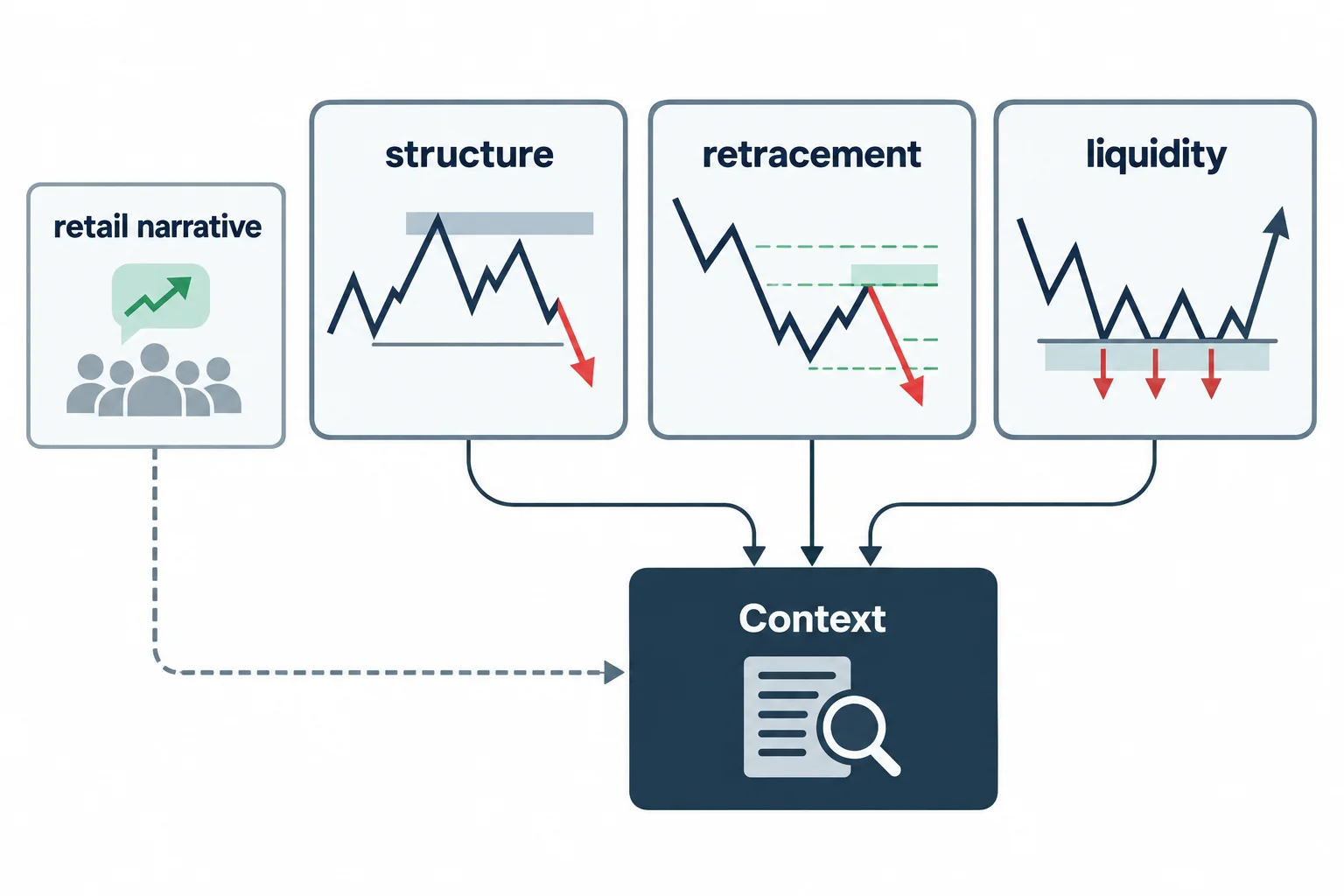
The social-media side of the comparison centers on another trader’s bullish EUR/USD post. ICT describes seeing a tweet on Twitter dated June 3, 2021 at 6:10 a.m. by the account astrofx, who expressed an intention to buy euro while ICT was developing a bearish view (5:58). He treats that opposing opinion as evidence of retail bullishness and argues that such positioning can provide liquidity below nearby lows through protective sell-stop orders.
This part of the video is confrontational and includes personal challenges to other online trading personalities. Those remarks do not add independent support to the market model. The educational substance is narrower: ICT says an opposing retail narrative can complement (but should not replace) his analysis of structure, retracement and liquidity.
At 7:07, he explains that breaking the lows makes the structure bearish in his reading. He therefore regards a subsequent rally as an opportunity to seek a short rather than confirmation of a new uptrend. This is the main difference between the two “logics” as framed in the video: one view reacts to an apparent rally, while ICT’s view places that rally inside a larger bearish narrative.
How ICT Interprets the Interbank Algorithm
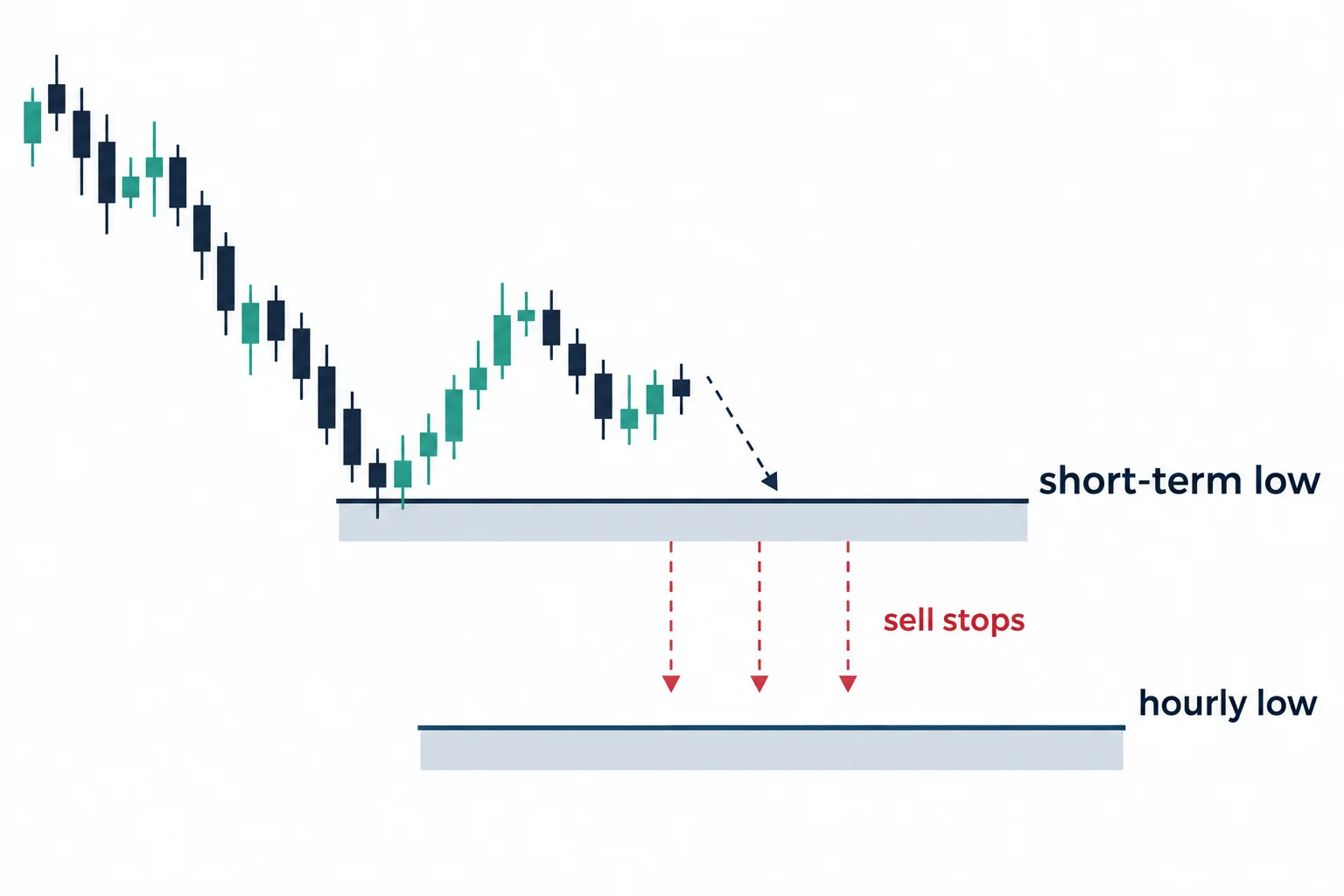
The later section presents what ICT describes as contemporaneous trade footage. EUR/USD appears on one side of his workspace and the US Dollar Index on the other. He says he enters short with a ten-pip stop while the social-media opinion is bullish (11:10). This section begins with a pantomime: he deliberately clicks the buy button and acts as though he agrees with the bullish commentary, before explaining what he actually sees on his chart (11:18).
He identifies a nearby short-term low and a lower hourly low as objectives. In his model, sell stops are likely to rest below those levels because bullish traders may place protective stops there. He anticipates that employment-related news at 8:15 a.m. will supply volatility for a move lower (14:04).
ICT explicitly rejects a conventional supply-and-demand explanation involving a sudden influx of sellers. Instead, he claims the move is an algorithmic “repricing” associated with the central-bank or interbank level. The transcript does not establish the internal mechanics of banks, central banks or trading venues, so this should be understood as ICT’s explanatory theory rather than verified evidence of a specific institutional algorithm (14:15).
As the clock reaches 8:15, he narrates price moving beneath the first short-term low and toward the hourly reference (16:19). He then says he closes most of the position after price crosses the red level. Importantly, he characterizes the position as a paper trade near the end of the recording (17:11).
ICT Algorithm Lessons and Limitations
Stripped of the rivalry, the lesson is a top-down trade narrative: determine directional structure, measure a retracement, mark an order-block area, identify lows that may attract price, and account for scheduled volatility. ICT also emphasizes taking a partial exit at the first objective rather than assuming the entire anticipated range will be delivered.
The recording is a single example, not a test of the method. The transcript alone cannot verify chart markings, platform executions, the exact entry price, or whether displayed markers were generated exactly as described. It also cannot establish that retail sentiment caused the move or that an interbank algorithm targeted the cited lows. Traders studying the video can therefore separate the observable sequence ICT narrates from his broader causal claims. This material is educational commentary, not investment advice or a promise that similar setups will produce comparable results.
ICT Interbank Algorithm Resources
- Primary source: ICT “Instagram Logic Vs Interbank Algorithm” The Inner Circle Trader (YouTube, June 2021, 17:30)
- Official ICT concepts referenced: Bearish Order Block, Optimal Trade Entry (OTE) retracement, Judas/Judah Swing, New York killzone framework, liquidity pools (protective sell stops below prior lows), ICT Market Internals terminology (source: video content; these are ICT's proprietary terms)
- Disclaimer note: The speaker explicitly identifies this as a paper trade and states “I’m not licensed to give trade advice” (17:20). No real-money performance is claimed or verifiable from the source.