Key takeaways
ICT Charter Price Action Model 12 is presented as a five-stage short-term scalping plan built to capture roughly 20 pips intraday rather than the full daily or weekly range.
Read the full summary
ICT Charter Price Action Model 12 is presented as a five-stage short-term scalping plan built to capture roughly 20 pips intraday rather than the full daily or weekly range. Preparation notes medium- and high-impact calendar events and marks the highest high and lowest low of the prior 20 trading days, excluding Sundays, to define the current dealing range; the analyst then forms a directional premise toward an old high or old low using PD arrays, order blocks and fair value gaps in line with that premise. A 15-minute chart supplies the context and a five-minute chart the entry, with bearish setups taking a short from a premium fair value gap with a bearish order block and bullish setups reversing that logic around a discount fair value gap. The return into the order block or gap must happen inside a London Open or New York Open kill zone for the setup to qualify. Execution uses the Institutional Order Flow Entry Drill adjusted by five pips, and the baseline management plan targets 20 pips on a single position, tightening the stop by 10 pips once 10 pips of progress is banked and moving it to break-even at 15 pips. Position size is equity times risk percentage divided by stop distance, illustrated with a $10,000 account, 1% risk and a 20-pip stop, always rounded down, with risk halved after a full-risk loss, halved again after a series of five consecutive wins, and restored as losses are recovered. All of this is offered as the speaker’s discretionary interpretation of market behaviour without independent evidence of an edge.
How we researched this article
BestProps used document-based research from primary firm sources, checked September 24, 2026. The complete source list, scope, limitations, and commercial-state record appear near the end of this article.
In ICT Charter Price Action Model 12 – Trade Plan & Algorithmic Theory, ICT presents a short-term scalping framework built around seeking a limited intraday move. He describes it as a “bread and butter” model rather than a strategy intended to capture an entire daily or weekly range.
The lesson combines directional preparation, liquidity objectives, 15-minute context, five-minute setups, time-of-day filters, fixed trade objectives, and predefined risk management. These are ICT’s interpretations of market behavior, not independently established evidence of a trading edge. The lecture repeatedly directs students toward demo execution, chart study, and backtesting rather than immediate live trading.
ICT Model 12 Five-Stage Trade Plan
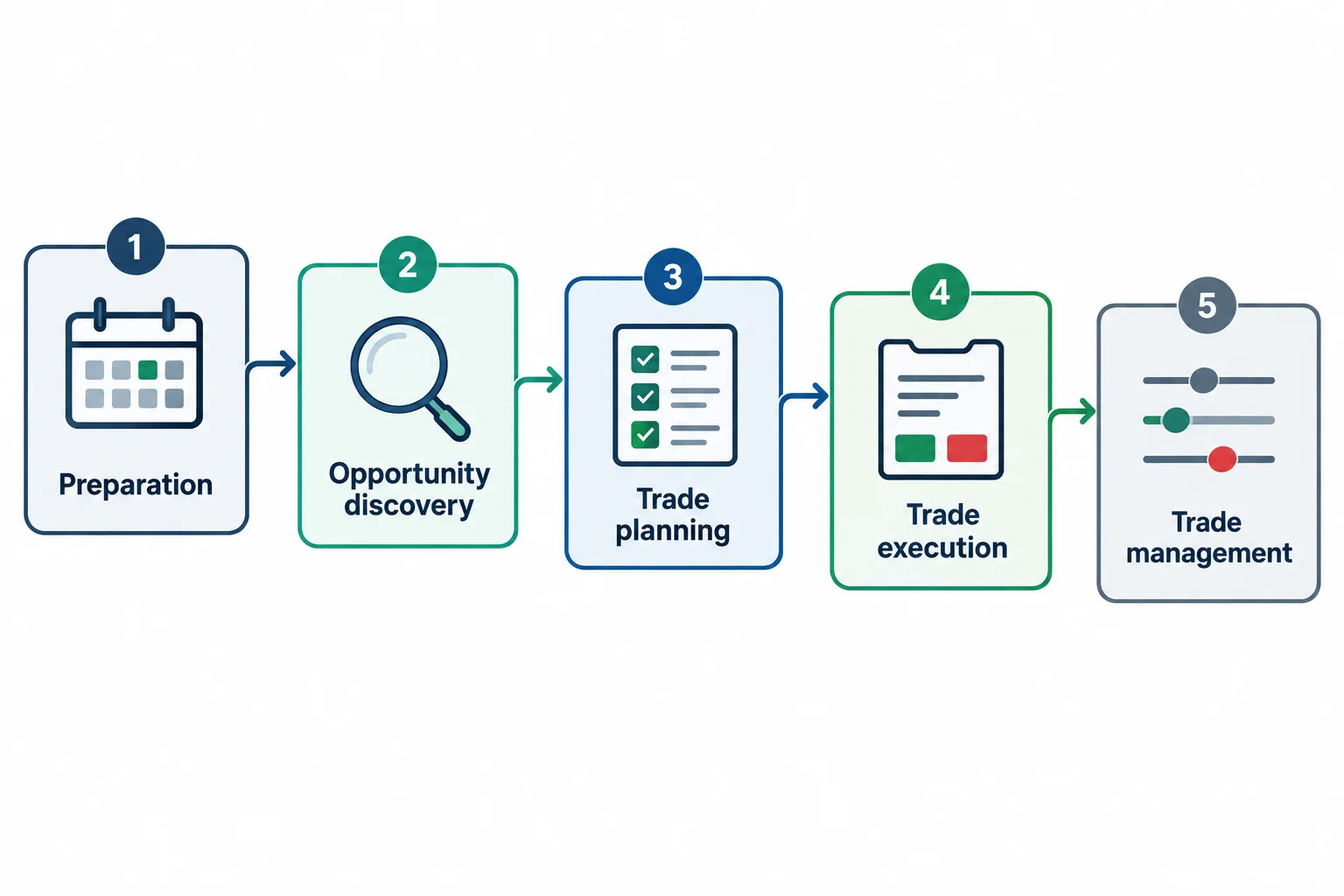
At 2:01, ICT organizes Model 12 into five stages:
- Preparation
- Opportunity discovery
- Trade planning
- Trade execution
- Trade management
This structure is one of the most reusable parts of the lesson. It separates market analysis from order placement and management, reducing the temptation to create a rationale only after price begins moving.
Prepare With Calendar Events and Price Liquidity
ICT begins preparation by noting medium- and high-impact calendar events for the markets being followed. He then considers which side of the coming weekly range appears more likely to expand. Importantly, he is not trying to predict the exact weekly close; he is seeking a directional premise that can support a much smaller intraday objective.
At 3:30, he introduces a 20-trading-day lookback, excluding Sundays, and marks its highest high and lowest low as the current dealing range. Within that range, the analyst looks for a possible draw toward an old high or old low. ICT calls for a “PD array” aligned with the directional premise and discusses an order block associated with a fair value gap.
In his framework, scheduled news may provide the volatility injection needed for price to move toward external range liquidity. This is a planning condition, not proof that a news event will produce the expected direction or distance.
Find Trade Opportunities With 15-Minute Price Context
Beginning at 4:59, ICT looks for a roughly 20-pip opportunity on the 15-minute chart. A bullish case targets buy-side liquidity when his reading indicates bullish institutional order flow; a bearish case targets sell-side liquidity under the opposite conditions.
The 15-minute chart supplies the broader setup or “stage,” while the five-minute chart is used later for the entry pattern. The stated objective is deliberately modest, so Model 12 is not presented as a high-R-multiple framework.
Plan the Trade Around Price Retracement
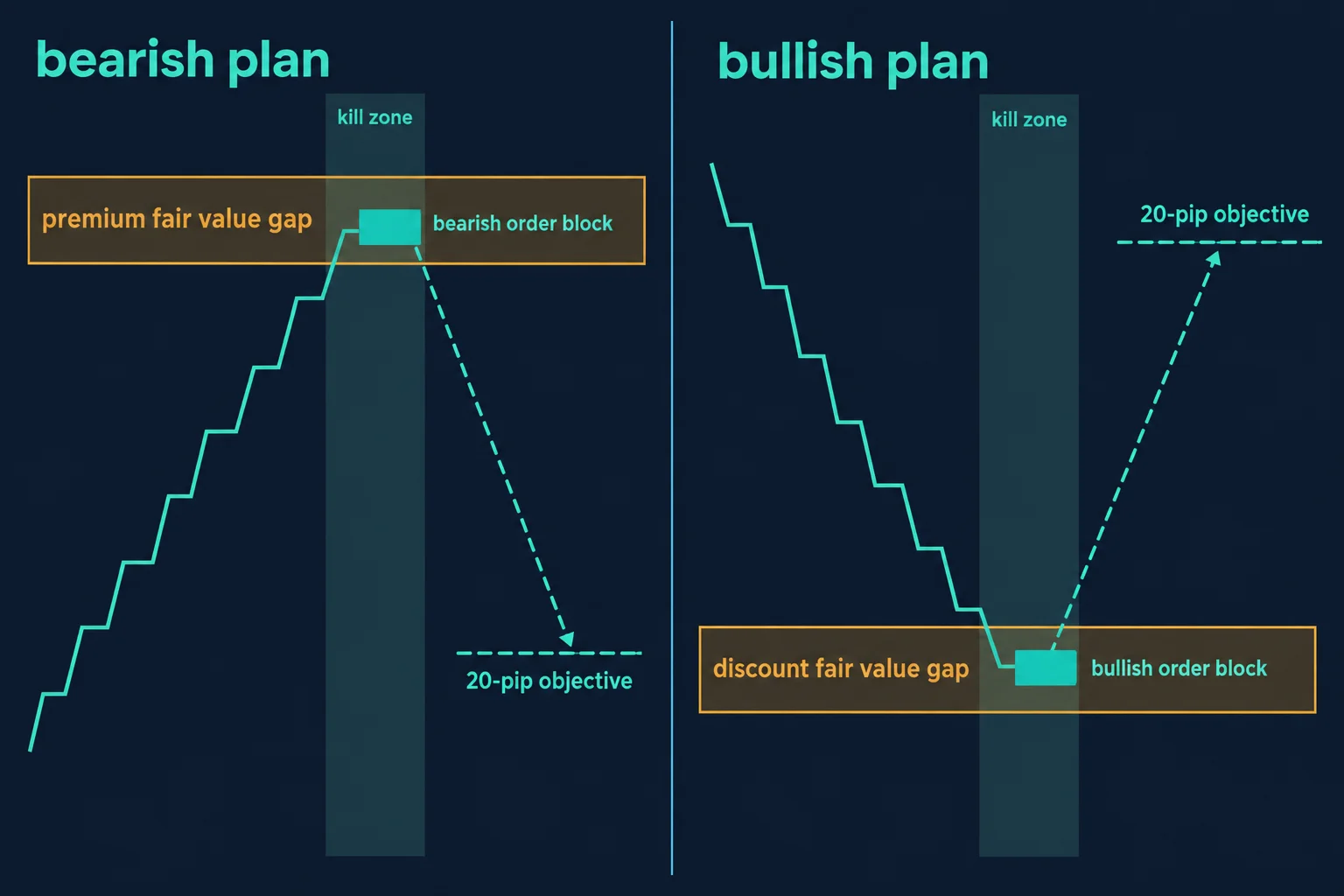
For a bearish plan, ICT seeks an upward manipulation or retracement near a scheduled volatility window, followed by a short from what he defines as a 15-minute premium fair value gap paired with a bearish order block. For a bullish plan, the logic is reversed: a downward retracement into a discount fair value gap and bullish order block.
A key timing rule appears at 6:32. The order block or fair value gap may originally form outside an ICT “kill zone,” but the return to the area must occur during the London Open or New York Open kill zone for the setup to qualify under this plan.
Execute the Trade With a Five-Minute Setup
At 8:08, ICT specifies the execution sequence. In a bearish scenario, he anticipates a five-minute premium fair value gap and bearish order block during a 15-minute retracement higher. In a bullish scenario, he looks for a five-minute discount fair value gap and bullish order block during a 15-minute retracement lower.
He describes using limit orders based on what he calls the “Institutional Order Flow Entry Drill,” adjusted by five pips according to direction, and explicitly says to execute the exercise in a demo account. The transcript alone cannot show whether any displayed order would have filled or what slippage would have occurred.
Manage the Trade With Targets and Stop Adjustments
The baseline plan uses a 20-pip profit objective on one position. ICT’s stated approach is to place the protective stop and opposing limit order, then avoid repeatedly interfering with the position.
- At 10 pips of unrealized progress toward the 20-pip objective, the stop may be tightened by 10 pips.
- At 15 pips of progress, the stop may be moved to break-even.
- If neither management threshold nor the target is reached, the original stop remains relevant.
ICT explains these rules at 10:49. His emphasis is on controlling the size of losing outcomes rather than requiring every setup to become a winner.
ICT Trade Plan Position Sizing and Risk Reduction
At 13:15, ICT discusses sizing from account equity, a selected risk percentage, and stop distance. He illustrates the idea with a hypothetical $10,000 account, 1% risk, and a 20-pip stop, then distinguishes micro- and mini-lot pip values. He advises rounding position size down.
He also proposes cutting the selected risk percentage in half after a full-risk loss and restoring it only after part of the loss has been recovered. Unusually, he also recommends reducing risk after five consecutive winning trades, reasoning that this may help smooth the equity path before an eventual loss. These are ICT’s discretionary money-management rules; the video supplies no comparative testing demonstrating that they improve results.
ICT Price Action Example and Trading Lessons
From 31:37, ICT narrates a USD/CHF example. He describes a daily fair value gap as context, a possible move through the prior day’s high, and a five-minute sequence involving an order block, market-structure shift, and return to a fair value gap. Because the source is an automatically transcribed audio track, unseen chart levels and the example’s visual details cannot be independently verified here.
The broader educational takeaway is to define a limited objective, a specific session, an invalidation point, and management rules before entry. ICT also warns against constant participation and action-seeking behavior. Near 19:02, he specifically discourages inexperienced students from attempting rapid live-account switching between long and short positions.
Watch the original recording
This embedded player was opened and clicked from a BestProps page on 14 September 2026 and began playing at the recording’s own duration, so the lecture can be watched in place. The timestamp links above point to the passages being described.
Primary source and further reading
- The original Inner Circle Trader recording — the timestamp links above are the passages being described; the lecture runs about 48 minutes.
- CFTC — customer advisories and articles — the U.S. derivatives regulator’s risk material for futures and retail forex customers, and the reason the narrated stages are described here as a plan rather than as a demonstrated result.[1]
- Investor.gov (U.S. Securities and Exchange Commission) — Day Trading — the SEC’s risk framing for short-horizon trading, including the caution that frequent trading magnifies costs; that is directly relevant to a model that aims at 20 pips per trade rather than the daily range.[2]
- 17 CFR 4.41 — disclosures concerning hypothetical performance — the rule governing hypothetical performance claims, cited because the lecture’s risk and sizing figures are worked through as arithmetic examples rather than as audited results.[3]
None of the reading above is an ICT publication, none of it endorses or tests Model 12, and none of it is offered as evidence for the plan’s reasoning or for any outcome. The regulatory links are included because the lecture sets out position-sizing rules, not because they validate them.
How to Study the ICT Model 12 Trade Plan
ICT closes the formal plan by asking students to backtest sample sets rather than wait for his examples. A practical educational review would record the directional premise, calendar condition, session, 15-minute context, five-minute trigger, intended liquidity target, stop distance, and outcome without changing definitions after the fact. That process can reveal how consistently a learner applies the model, but it does not establish future profitability.