Key takeaways
Inner Circle Trader presents a short-position management process built around partial exits, trailed stops and conditional orders rather than needing the final target to hit.
Read the full summary
Inner Circle Trader presents a short-position management process built around partial exits, trailed stops and conditional orders rather than needing the final target to hit. The bearish setup targeted an untraded new week opening gap, with 30,251 as a stop reference, but excessive discount sensitivity prompted ICT to realize part of the gain and fund the remaining position. He placed a buy stop at 30,213 and a limit at 30,179.75 as one-cancels-the-other alternatives, preserving participation toward 30,169.75, and later reported securing another $215 as a hassle fee. Continuation depended on candle bodies closing below range midpoints, including 30,196.25, while reclaiming invalidation areas, stronger-than-expected price action or personal anxiety justified reducing or closing exposure. His Monday framework applies only when the new week opening gap remains untraded through Sunday evening and London and price has not run directionally away from it. The target was never reached, but ICT argues that targets are best-case scenarios, partial exits reduce dependence on being right, and traders should follow their own model rather than another trader’s levels. The audio transcript cannot verify the chart, replay status, fills, reported profit, final stop outcome or net result, so the durable lesson is procedural rather than proof of performance.
How we researched this article
BestProps used document-based research from primary firm sources, checked September 24, 2026. The complete source list, scope, limitations, and commercial-state record appear near the end of this article.
In Trade Management & Removing The Need To Be Right, the Inner Circle Trader (ICT) narrates the management of a short position as price stops behaving the way his original idea required. The setup is a bearish draw toward the high of a new week opening gap; the lesson is about what he does between entry and target rather than about being proven correct.
This article explains that lesson from the recording itself. The primary source is the video’s audio, transcribed automatically and then read in full; the on-screen chart was not available for verification. Price levels quoted below are the ones read out in the narration and are reproduced as stated, not confirmed against the chart. Terms that the automatic transcription renders inconsistently (“SIBI” (sell-side imbalance, buy-side inefficiency), “consequent encroachment” and “PD array”) are normalized here only where the surrounding context makes the intended term clear.
ICT describes the session as a live management exercise, and he spends part of the recording arguing that market replay was not in use (5:54). That claim about his own screen is his, repeated from the narration; it is not something this article can verify independently.
ICT Trade Management for the Original Trade Idea
ICT opens by describing a bearish scenario aimed at the high of what he calls a new week opening gap, a level he says price had not traded back to since it formed. He marks relative equal lows and says that if price closed below a specific candle body and then below the midpoint of that same body, he would treat the odds as favoring a move through those lows (3:11). That is the pattern of the whole recording: state what should happen if the idea is valid, then define the observable behavior that would weaken it.
He also points to a high he reads out as 30,251 and describes the level one tick above it as an entry reference for his stop placement (10:07). He defines his levels relative to last Thursday’s dealing range between 7 p.m. and 10 p.m. Eastern time, and specifically the consequent encroachment of that range (15:05). He stresses that this is a time-of-day window, not the Asian session as used in foreign-exchange teaching (15:36).
The reasoning he gives for planning exits before the terminus is that a large draw acts like a magnet: price can be pulled toward it without ever touching it, so knowing where to be paid before arrival matters more than the exact final level (19:01).
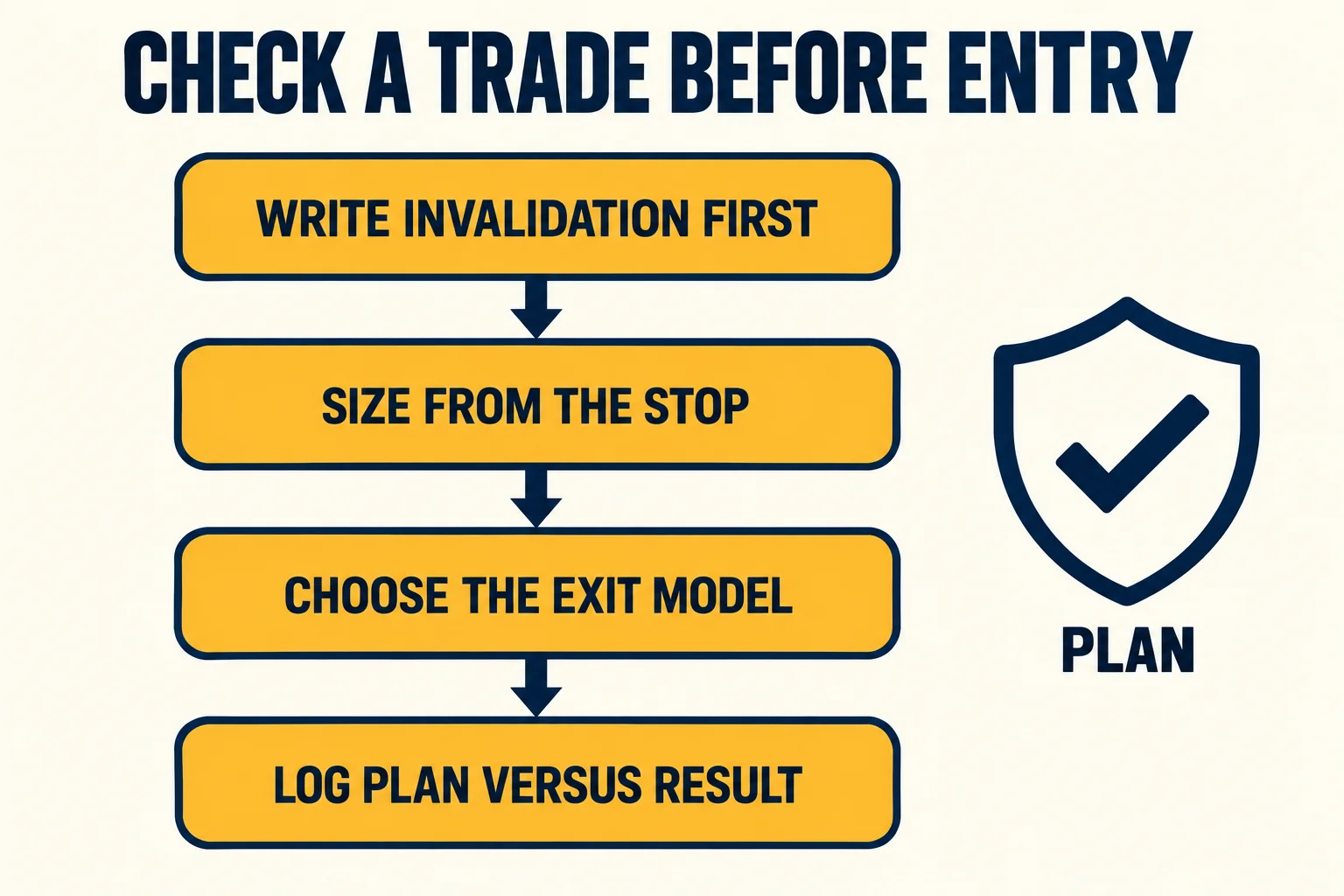
ICT Trade Management for the Monday Opening Gap
The recording contains a compact statement of how ICT approaches a Monday. If the new week opening gap has not been traded to during the Sunday evening session or the London session, and there is no runaway directional move away from it, he says aiming for a run into that gap is one of the simplest frameworks he uses (20:02). He frames it as a no-thought-required scenario rather than a high-conviction prediction (20:49).
Two qualifications follow immediately, and both matter more than the framework itself. First, he says he had already taken part of the position off, so a reversal would not necessarily turn the trade into a loss; then he corrects himself within the same breath, noting that a gap through his stop could still produce a net loss (20:54). Second, the framework is conditional on the gap remaining untraded; it is not a standing rule about Mondays.
ICT Trade Management With Partial Exits and Conditional Orders
The management section begins when price shows what he calls too much “discount sensitivity” for his liking (15:44). His response is to take part of the position off “to fund the position,” realizing a gain on a portion while leaving a smaller position open for further downside (15:52).
He then describes a second layer of management: adding a buy-stop order above a level he does not want to see reclaimed, so that if price rises into it, part of the remaining short exposure is removed instead of everything being stopped out at once (25:12). He reads out the two working orders (a buy stop at 30,213 and a resting limit at 30,179.75) and explains that whichever fills first, the other must be cancelled, because if both filled the remaining participation in a move down to 30,169.75 would be lost (26:19).
Later, after another stop adjustment, he says he has “secured 215 dollars more” and calls it paying himself a “hassle fee” for sitting through a drawdown in unrealized profit (31:06). The reported figures come from his narration of his own platform during the recording; nothing in the transcript independently confirms them, and execution in the reader’s market may differ.
ICT Trade Management When Invalidation Is Gradual
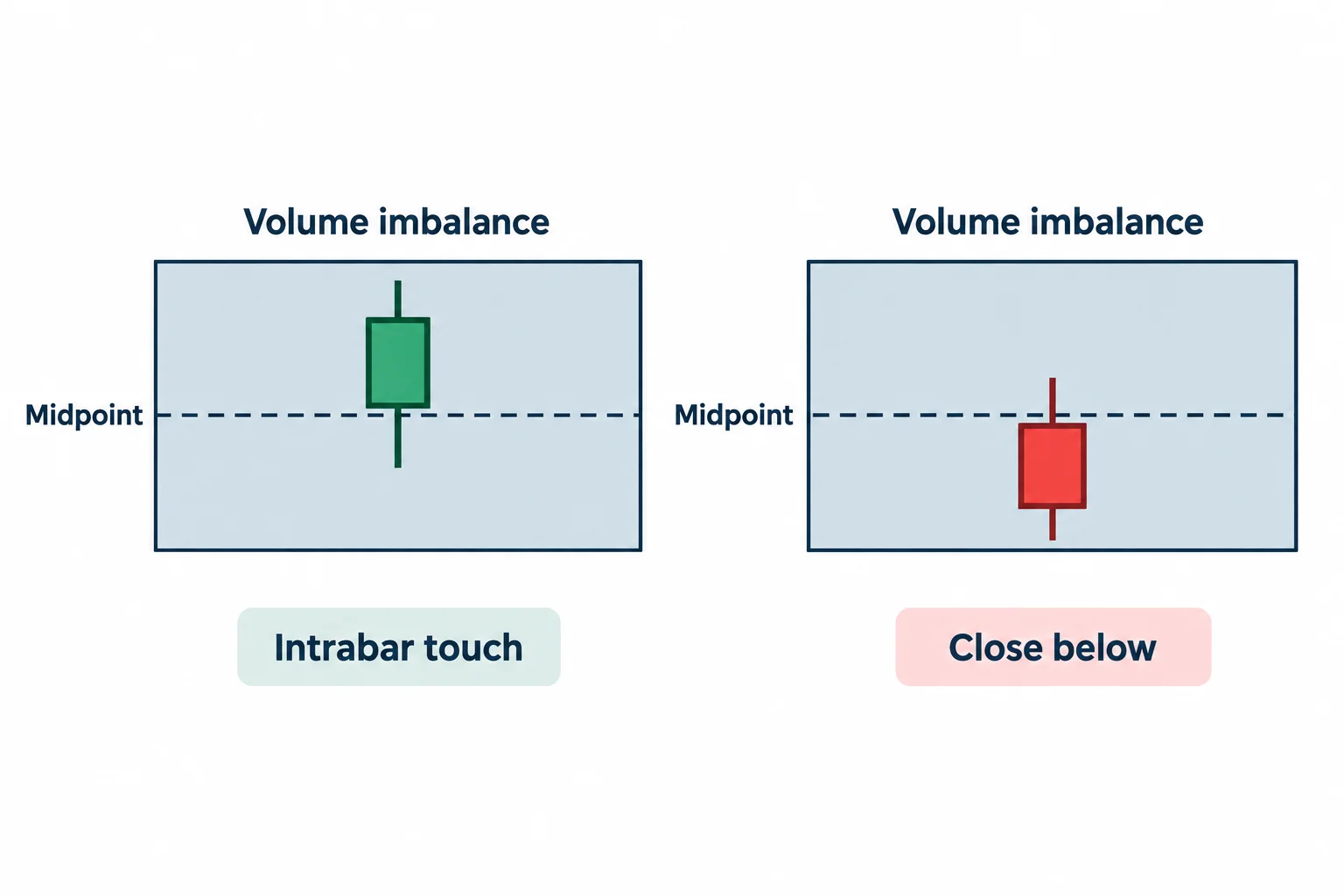
Throughout the session ICT grades the evidence instead of treating the idea as simply right or wrong. He puts the volume imbalance on the high and the low of the range and adds a midpoint line so he can judge where candle bodies close; as long as bodies stay in the lower half, he says he is comfortable (16:27). A close below the midpoint, and not merely an intrabar touch, is what he treats as favoring continuation lower; a close is described as more reliable than an open for that judgment (22:12).
He applies the same test to the area he wants to see flip from support into resistance. His stated expectation is that an area that previously delivered buy-side should fail on the retest and then be used as a premium array, producing an inversion fair value gap, a label that only makes sense relative to his own chart markings (24:10). He repeats the standard later with an explicit price: a close below 30,196.25 would, in his reading, point to rolling over toward the new week opening gap (50:32), and he restates at the end that a body closing below the midpoint of that reference candle was the warning sign for the deeper retracement (42:02).
ICT Trade Management Without Needing to Be Right
The title of the recording is its thesis. ICT says the example was fruitful even though price did not reach the new week opening gap (37:18), and he states that a target is a best-case scenario rather than something a trader is entitled to (41:25). His argument is that if a position is reduced while it is moving in the intended direction, the outcome of the remaining portion becomes far less important to the result.
He is direct about the resistance to that idea, noting that critics treat partial exits as a sign of poor conviction, and counters that this criticism usually comes from people who are not consistently profitable (37:53). He also answers the common objection that he is changing the story after the fact by saying the point of the recording is precisely that the final target was not required (39:29). Readers should treat this as his stated position on his own session, not as a demonstrated performance result; no independent record of the account, fills or net outcome is available from the source.
ICT Trade Management Protects Mental and Emotional Capital
One section deals with what he calls the cost of remaining in a trade he no longer cares about. With a single contract left and the meaningful part of the position already realized, he describes continuing to watch price as spending mental capital on a question that no longer matters to him (44:59).
His practical instruction is that when a trade starts producing anxiety, heart palpitations or a short temper, the position should simply be closed rather than managed through it (47:25). He frames stop losses and trade management as the tools that exist precisely because the outcome cannot be controlled (47:14).
ICT Trade Management Without Relying on One Trader
Near the end of the recording ICT responds to a viewer who complained about the effect of his posts. His answer is that anyone who lets another person’s level determine their trade is following a person rather than a model, and that the responsibility for the decision stays with the trader (52:12). He makes a stronger claim earlier in the session as well, that his publicly stated levels attract enough attention to create the liquidity he trades against. That is his interpretation of market behavior and is not something a transcript can establish (31:39).
What This ICT Trade Management Recording Cannot Prove
ICT tightens the stop for the last remaining contract above a candle high he treats as a meaningful invalidation point (53:03). Shortly afterwards he reacts to a fast move against the position and says he does not want to be in a market behaving that way (53:45), then closes the recording by summarising the session as a demonstration of what to do when a trade shifts to a lower probability (54:06).
The transcript does not confirm whether that final stop was hit, whether the target was ever reached, or what the net result of the sequence was. It also cannot verify the chart, the order tickets, the executions or the reported dollar amounts, and automatic transcription may have misread some of the levels quoted above. What the recording does show, in ICT’s own words, is a decision process: define what supports the idea, define what weakens it, reduce exposure when the evidence weakens, and do not require the final target to be reached.
The Core ICT Trade Management Lesson
The durable part of this lesson is procedural rather than predictive. A target is a scenario, not an entitlement; partial exits, trailed stops and conditional orders are ways of separating the management of risk from the emotional need to be proven right. Those techniques involve trade-offs, they do not guarantee a profitable result, and the specific levels in this recording were his readings of his own chart at the time, not verified market facts and not a recommendation to copy the trade.
Related ICT Trade Management Video
The mapped source lesson is Trade Management & Removing The Need To Be Right from The Inner Circle Trader. This BestProps article is independent educational commentary: it is not a transcript, not an official ICT lesson, and not evidence that any entry, stop, partial, exit or result discussed in the recording occurred.
Watch the original lesson on YouTube
This video cannot be played inside another website: the embed shows “Playback on other websites has been disabled by the video owner.” That response was read from the player itself, so no player is embedded here. You can watch the full lesson directly on YouTube.
Watch Trade Management & Removing The Need To Be Right on YouTube ↗
ICT Trade Management Sources and Replay Tools
Three external references are useful alongside the recording. The first two are BestProps rule pages, which cite their own official sources for drawdown and consistency requirements; the third is the charting help page for the replay feature that ICT discusses in the recording.
- Trade Management & Removing The Need To Be Right The primary source recording from The Inner Circle Trader. This article is based on an automatic transcription of its audio; the transcript is retained privately and not published.
- BestProps drawdown rules The loss limits that make partial de-risking relevant to funded-account traders. Check the firm’s current rulebook before relying on any figure.
- BestProps consistency rule Explains why the distribution of gains across trades can matter as much as the total.
- TradingView: turning bar replay on The official help page for the replay feature, for readers who want to study similar sequences without hindsight.
Nothing here is investment advice, and no third-party tool or indicator is endorsed. Where ICT describes his own platform, orders or results, those statements are attributed to him and are not independently verified.