Key takeaways
The Inner Circle Trader’s 10 minutes 40 seconds YouTube lesson demonstrates a discretionary opening-range method on paper trading, beginning with a sell-side expectation at a level he corrects from quadrant to octant, then turning bullish when price trades above and reclaims a bearish fair value gap as an inversion fair value gap.
Read the full summary
The Inner Circle Trader’s 10 minutes 40 seconds YouTube lesson demonstrates a discretionary opening-range method on paper trading, beginning with a sell-side expectation at a level he corrects from quadrant to octant, then turning bullish when price trades above and reclaims a bearish fair value gap as an inversion fair value gap. ICT targets an Event Horizon halfway between an old high and a one-hour minor buy-side liquidity pool, places protection beneath the reclaimed zone, and treats wicks through the midpoint as acceptable while candle bodies should not settle beyond it. A platform mis-drag closes the position before his intended partial exit and target adjustment, after which he adopts no directional bias rather than forcing another entry. The lesson was published June 22, 2026, uses unverified prices, fills, contract counts, and results, and presents discretionary chart interpretation rather than a tested system or investment advice.
How we researched this article
BestProps used document-based research from primary firm sources, checked September 24, 2026. The complete source list, scope, limitations, and commercial-state record appear near the end of this article.
In the video “Teaching Calub Complex Opening Range Delivery \ June 22, 2026”, ICT narrates a fast opening-range sequence while using a paper-trading interface. The lesson centers on changing directional expectations as price interacts with fair value gaps, prior liquidity, and a midpoint he calls the “Event Horizon.” Much of the recording also illustrates the practical limitations of demonstrating execution live through charting software.
The transcript provides ICT’s spoken interpretation, but it does not expose the chart’s readable prices or independently verify orders and fills. Accordingly, this recap explains the framework he described rather than treating the sequence as evidence of a repeatable trading edge.
ICT Opening Range Sell-Side Setup
At the outset, ICT expects price to seek sell-side liquidity. He also says that compliance considerations require him to demonstrate with paper trading rather than provide real-time trade advice. Almost immediately, platform behavior becomes part of the lesson: he complains about delayed or awkward order handling and describes difficulty managing an exit during the opening bell. See 0:07 and 1:52.
He briefly corrects his own terminology, referring first to a quadrant and then calling the level an “octant.” The chart needed to identify that subdivision is not available in the transcript, so the precise construction cannot be recovered confidently from the audio alone.
ICT Opening Range Bullish Inversion
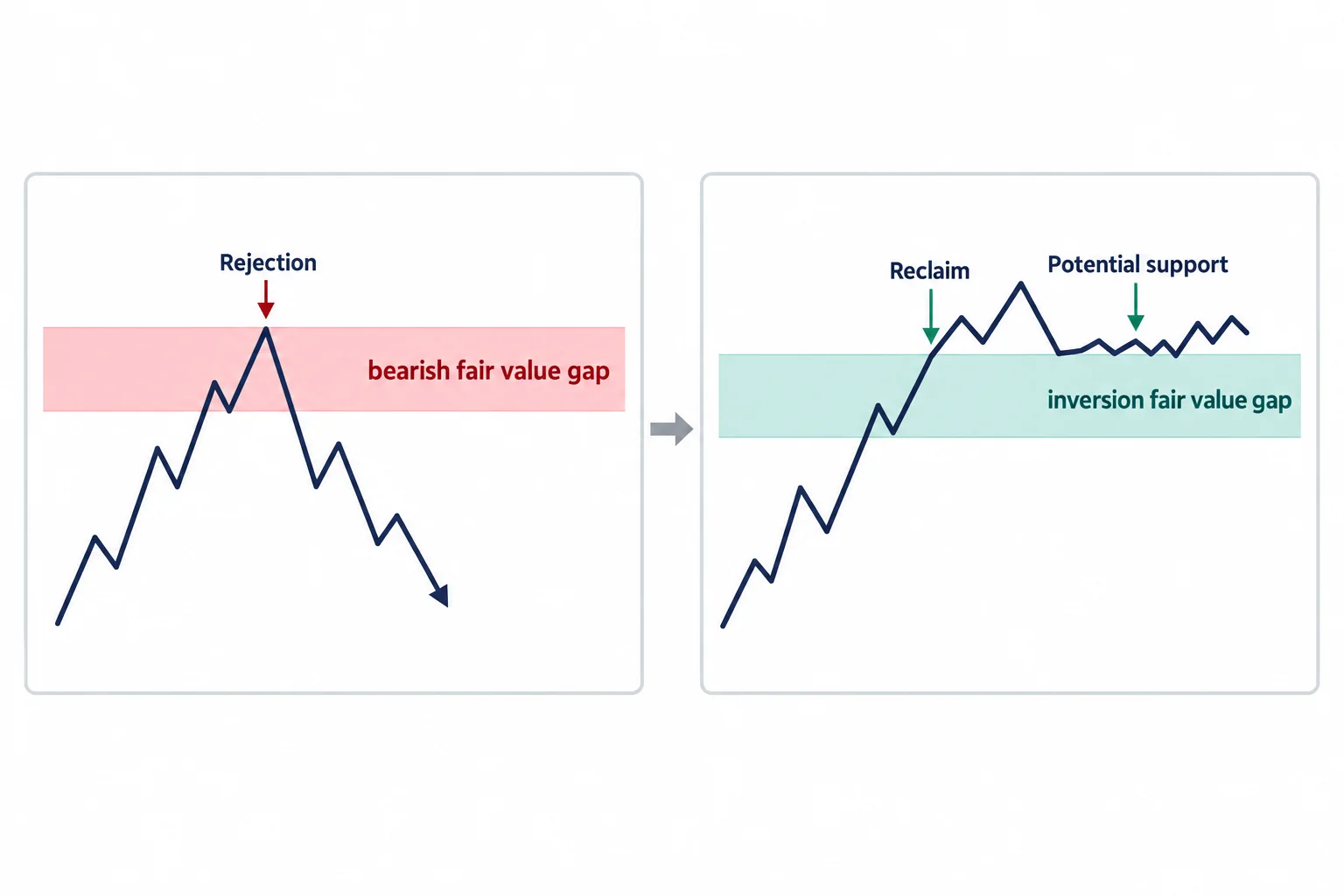
The central teaching begins around 3:24. ICT identifies an area that he says had been a bearish fair value gap. His proposed condition for changing the interpretation is straightforward:
- If price remains below or rejects the area, it retains its bearish character.
- If price trades above and reclaims it, ICT interprets the area as an inversion fair value gap with bullish sensitivity.
- Under that bullish reading, he wants price to use the reclaimed zone as support, clear a nearby high, and continue toward the next reference level.
ICT changes the zone’s color to help represent that shift in function. He openly frames this visualization as something that helps his own thinking, rather than as an infallible rule. In general educational terms, the important point is conditional reasoning: the original label matters less than how price behaves when it revisits and crosses the marked imbalance.
ICT Opening Range Event Horizon
ICT repeatedly identifies an “Event Horizon” as a halfway point between chart references. The automated transcript appears to describe those references as a one-hour minor buy-side liquidity pool and an old high, although part of that wording is unclear. He treats the resulting midpoint as an interim objective and reaction area rather than automatically aiming for a new all-time high.
After describing a bullish reclaim, he says he wants price to move above a nearby high, reach the Event Horizon, and potentially accelerate toward minor buy-side liquidity from the hourly chart. That sequence is discussed at 5:05.
ICT Opening Range Risk Management
ICT then moves his protective stop beneath the inversion fair value gap. His stated reasoning is that a return through that area would invalidate the immediate bullish premise for him. He summarizes the sequence as first taking a short associated with stops, then establishing a long within what he regarded as a bullish fair value gap. The transcript alone cannot verify the displayed orders, contract count, fill quality, or financial result.
A platform-management mistake interrupts the demonstration near 6:13. ICT says he was dragging an order when the position closed, preventing the partial exit and subsequent target adjustment he intended. He characterizes this as user error and explains that his laptop setup makes using an external mouse difficult while an external microphone is connected.
This portion offers a broader execution lesson independent of ICT’s market model: an analysis can be internally coherent while the actual order-management process remains vulnerable to interface limitations, hurried adjustments, and operator mistakes.
ICT Opening Range Candle Body Signals
Once price is at the Event Horizon, ICT focuses on the distinction between wicks and candle bodies. At 8:17, he notes that price has wicked around the midpoint but that candle bodies have not settled beneath it. In his interpretation, a wick below the halfway point is tolerable for the bullish scenario; a candle body left below it would make continuation more difficult during the remaining portion of the session he is observing.
He also references an older one-hour imbalance and smaller gaps as areas price could use if the bullish condition persists. One phrase in the automated transcript sounds like “balance off sign efficiency,” but it is likely a recognition error and should not be used to infer a distinct named concept.
Why ICT Turns Neutral During Opening Range Delivery
Near the end, price has moved into the area ICT had been monitoring, but he no longer sees a favorable directional premise. He says the market is now neutral for him and declines to enter again. Watch that conclusion at 9:57.
The session therefore presents a progression rather than a fixed forecast: an initial sell-side idea, a bullish reinterpretation after a fair value gap reclaim, monitoring of a midpoint objective, and finally a neutral stance once price reaches an area where ICT no longer has a clear opinion. These are ICT’s discretionary market interpretations, not independently tested signals or investment advice.
How to Study ICT Opening Range Delivery
The rules are spoken in the recording, so a study log can cite them directly: which session and clock the opening range covers, where the imbalance sat, whether price reclaimed it, where the halfway point sat, and whether candle bodies or wicks were used when price returned to it. The checklist below is a generic process reminder for that kind of logging.
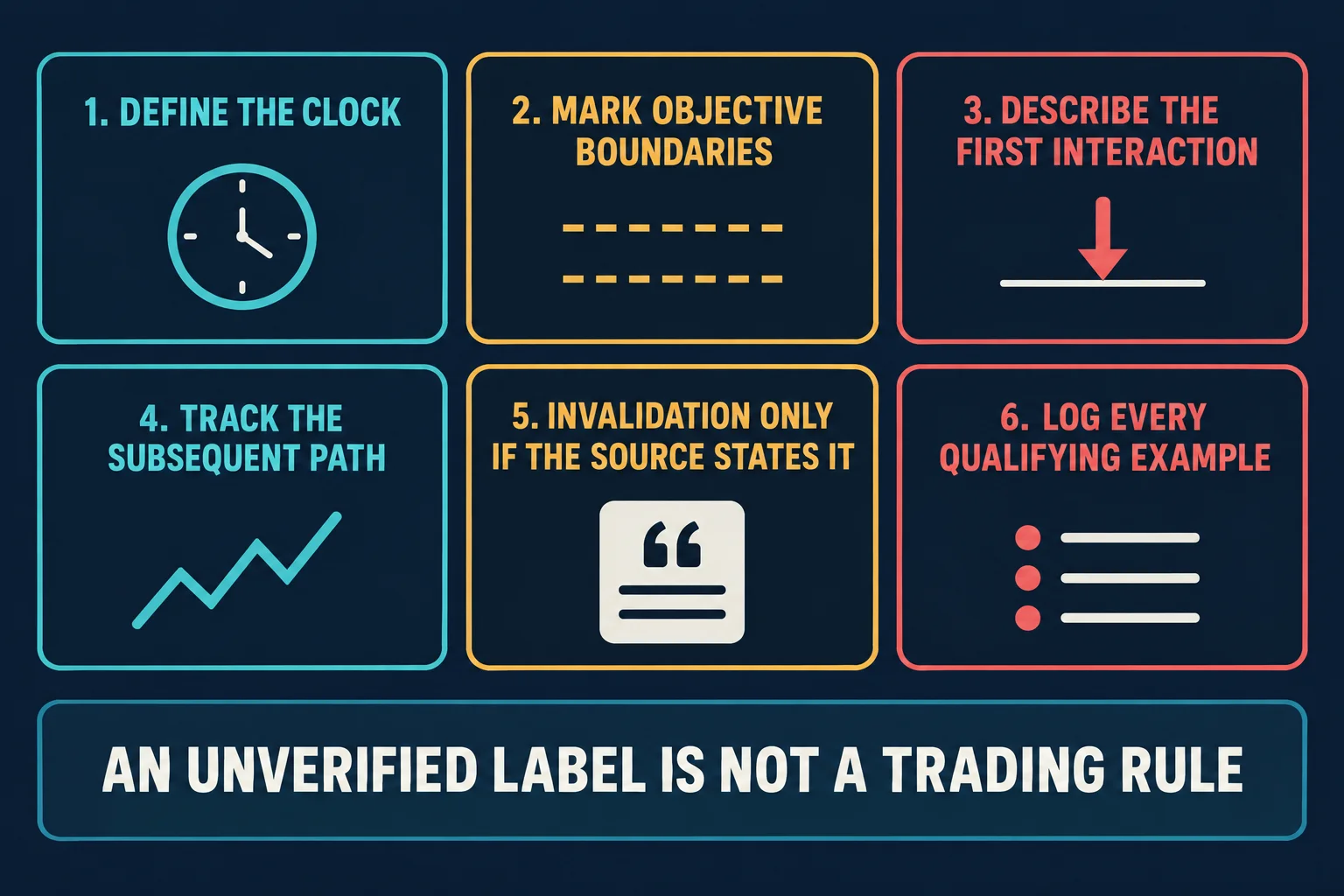
It is BestProps study material. It is not the recording’s chart, not ICT’s own notes, and not a signal.
ICT Teaching Calub Opening Range Video
The recording mapped to this topic is Teaching Calub Complex Opening Range Delivery \ June 22, 2026 on the channel The Inner Circle Trader. Its watch page returned that exact title, the channel name, an upload date of 2026-06-22 and a runtime of 10:40. For this review the original audio was downloaded and transcribed locally with automatic speech recognition, and the timestamps cited above come from that transcript; every claim about what the lesson says is drawn from it. BestProps has no affiliation with the creator, this is independent educational commentary, and it is not a verbatim transcript of the recording.
Watch the original recording on YouTube
This recording cannot be played inside another website. An embedded player test run on 2026-09-13 from a BestProps page origin, using the same iframe markup that would appear here, returned from the player itself “Playback on other websites has been disabled by the video owner”, so no player area is reserved here and no blank embed is left behind. The recording remains available directly on YouTube.
Watch Teaching Calub Complex Opening Range Delivery on YouTube ↗
ICT Opening Range Lesson Sources
The lecture this article paraphrases is educational material about chart interpretation. Before relying on any of its terminology, check the primary and provider sources below, and confirm the current contract and session specification with the listing exchange or your chart platform.
The Mapped ICT Lesson
The source is Teaching Calub Complex Opening Range Delivery \ June 22, 2026 from The Inner Circle Trader, published 2026-06-22 with a runtime of 10:40.[1] The word “Calub” appears verbatim in the published title; the recording never explains it, so this article does not guess what it means. The video owner has disabled playback on other websites, which is why this page shows a watch link rather than an embedded player.
How the Opening Range Window Is Set
Any opening-range study depends on how the session is defined in the chart software. NinjaTrader’s platform documentation states that “Trading Hour Templates are set up to contain the session start and end times of a specific market or instrument”, so the window a range is measured from is a configuration that must be recorded with the study.[2] Two reviews of the same instrument can otherwise be measuring different sessions.
Recording Events and Rules in ICT Sessions
BestProps’ RuleWatch page on news trading rules records where a firm publishes a fixed news window and flags the gaps where it does not, and it directs readers to “Recheck the linked firm source before trading around scheduled news.”[3] For anything account-specific, BestProps’ drawdown reference states that it “explains the evidence and its limits” and “does not replace current firm or platform terms”.[4] Read holding-period, trading-hours, news and loss-limit rules from your own provider’s current documents rather than from a lecture about chart reading.
ICT Teaching Sources
- [1] YouTube: Teaching Calub Complex Opening Range Delivery \ June 22, 2026 (The Inner Circle Trader; mapped source lesson; watch page read 2026-09-13, transcribed locally 2026-09-14, player tested 2026-09-13 and 2026-09-14)
- [2] NinjaTrader 8 Help Guide: Trading Hours (trading hour templates hold the session start and end times of a market or instrument; read 2026-09-13)
- [3] BestProps: Prop Firm News Trading Rules (documented news windows, source status and source gaps; read 2026-09-13)
- [4] BestProps Learn: Drawdown Rules, Decoded (mechanism explainer, not a current rule list; read 2026-09-13)