How we researched this article
BestProps used document-based research from primary firm sources, checked September 24, 2026. The complete source list, scope, limitations, and commercial-state record appear near the end of this article.
In Shotgun Saturday February 08, 2025, ICT pairs a Nasdaq market review with a wider discussion of risk, expectations and trader psychology. The mapped recording is a real, dated, first-party upload: the video’s own watch page lists the title Shotgun Saturday February 08, 2025, the channel The Inner Circle Trader, an upload timestamp of 8 February 2025, 09:12:25 (UTC−08:00) and a runtime of 28:23 (1,703 seconds). Published, public, not unlisted, not private.
His recurring message across the session is that a volatile, range-bound market calls for greater selectivity, not larger positions or more frequent trades. Everything below is attributed to ICT as the speaker: these are his readings, his forecasts and his description of his own habits. The recording is a spoken session — it does not establish a verified trading edge, and audio alone cannot confirm the chart levels, executions or later market outcome. The transcript used here is machine-generated and can misrecognise terms and numbers.
Why ICT called the market difficult
ICT opens the technical portion on a Nasdaq daily chart at 2:49, answering viewers who had asked what he meant by calling conditions difficult. He says difficulty is not limited to that week, arguing the market has been difficult “for the last few years” through 3:06: more manipulation, back-and-forth price action, aggressive retracements and long consolidation, punctuated by short, fast, sometimes violent runs that do not sustain themselves and fall back into the range.
He marks out a range on the daily chart around 3:52 and says there was one opportunity for price to leave it, followed by repeated attempts lower that were met with more accumulation inside it. His conclusion at 4:43 is that a well-defined range with violent internal volatility is what makes trading difficult — not a lack of movement.
He also describes his own seasonal routine at 5:21: January is normally when he paper trades, tape reads and re-syncs with the marketplace rather than placing live bets, and he says he usually starts trading live funds in the second week of February. That is his process, not a claim about how January performs for everyone.
Reference levels inside the range
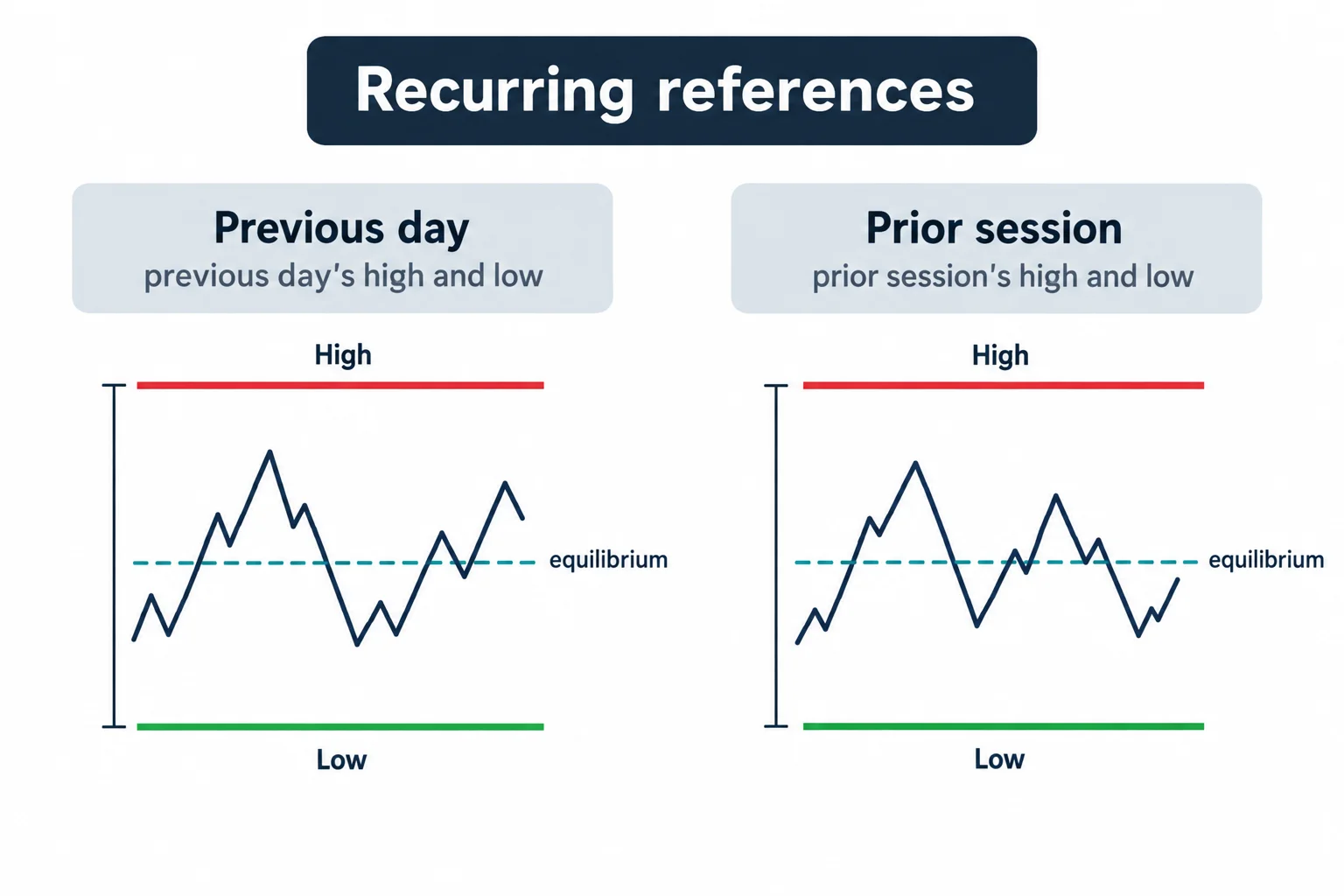
Because he says he is not a breakout trader and does not need the market to break out, ICT reduces the analysis to recurring reference levels. From about 7:32 he lists what he cares about: the previous day’s high and low, the prior session’s high and low (for example the morning high and low when trading the afternoon session), the equilibrium or halfway point of that range, the new-day opening gaps of the last five days, and the new-week opening gap of the last five weeks. He argues these levels matter because they are actual value levels that get referred back to repeatedly, not merely because price fills a number.
He is explicit about the consequence of ignoring them at 8:24: inside a range like this, a trader who is not nimble and not hunting easy, low-hanging objectives gets caught offside, then holds a weak trade because the decision has already been made. He describes that internal argument — closing early feeling like quitting, or like breaking the plan — at 9:20.
Permission to exit when the premise fails
His answer is to build the exception into the plan. At 9:34 he says a consistently profitable, professionally minded trader has to give themselves permission to abort when the reason for entry is no longer valid or is being questioned, and that in this environment pulling the plug is often the best response. He adds at 9:58 that something could pop off geopolitically at any moment, move the market in a hurry, and draw an account down into the lose-it-back cycle.
He argues the range environment amplifies the difficulty for new traders, especially impulsive personalities, and warns against the assumption of being able to “own the market” in such conditions at 10:56. He also says the real-time analysis and executions he has shared do not impress him, because he knows conditions are holding his trading back — his point is selectivity and nimbleness, not results.
Why he refuses to size up
ICT’s sharpest warning comes at 12:00, where he rejects the idea of trading bigger positions to compensate for smaller moves and calls it “trader suicide” — a mindset he says kills the future consistent trader in you. His alternative is listed immediately afterwards at 12:27: adapt to present conditions, size down, lower trade frequency, and lower what you expect to take from a trade.
The session’s forecasts are his own and should be read as such. He expects volatility windows rather than a trend: a stretch around May–July that he says could start as early as the last week of March (12:51), and a second, cleaner period from roughly late August through October, November and the first two weeks of December (13:10). He points to commodity moves — cocoa, which he says he flagged two years earlier, and coffee — as evidence that tariff and trade-war pressure is showing up in prices (14:29). He says he expects a black swan event at 18:03. None of these is a verified outcome; they are the speaker’s opinions, and no price level, fill or performance figure is asserted on this page.
He is equally direct about prop-firm funding at 16:53: he says it is easier to take the “lottery ticket” route of resetting an evaluation account, that firms keep changing the rules and moving the goalposts, and that they will not let a trader push a model’s edge at the moment it is most appropriate. He says that even at his own level of understanding he would not use the largest leverage available in this market.
The risk instructions he actually gives
At 21:08 ICT says he is not telling anyone to trade real money or to push leverage, and states the opposite: go down to one contract at 21:18, go down to one trade per day at 21:21, and be content with that until price leaves the range. He also says nobody should be influenced into a trade in this climate, including by him (20:55). He says he does not care which side the range leaves from — higher or lower — only that the back-and-forth while inside it will keep producing wide swings (21:31). Those sizing examples are his own restraint measures in that environment, not a recommendation to copy them.
Planning partial exits before entry
From about 22:04, ICT describes what he does instead: look for the setup in the pre-market or the opening range, take a piece of the move, and stop demanding all of it. He contrasts this with his normal practice of setting a wider best-case objective, then taking partials at nearer levels — in his vocabulary, an opposing fair value gap whose number gets filled, or an ageing bearish fair value gap that becomes an inversion, or the next short-term high where buy-side rests (23:07).
He frames the practical value at 23:35: partial-profit areas are decided before entry, ahead of the stop and the order, so the plan already contains where risk is taken off. Around 24:37 he says the aim is to refine the model to the point where you know a setup is coming in the current or next session and what it is likely to reach for, then place a realistic stop rather than one chosen to look impressive online. He notes the volatility at that moment was extremely high and that he was picking his shots very carefully (25:17).
His closing Nasdaq read
Near the end, from 26:24, ICT points to what he calls relative equal highs on the daily chart — a level he says he mentioned in another trader’s live stream on 22 January — and reads them as an obvious, by-sight buy-side liquidity pool. He says at 26:58 that he is not convinced the upward interest is finished and calls the highs suspect, while stating plainly that he is willing to be wrong.
He closes at 27:59 with the same instruction he gave during the session: be selective, be patient, and demand high-probability, high-quality setups. He notes he has been trading 33 years (22:21) and says he is lowering his expectations and his exposure rather than arguing with the conditions. He signs off by saying he expects to be in the Telegram channel on Monday morning.
Educational takeaway
The session’s theme is adaptation rather than prediction. When price action is volatile but directionally unreliable, ICT’s stated response is patience, reduced size and frequency, predetermined partial exits, and only the most selective setups — and he repeats that nothing he says is advice to trade with real money. Whether the range resolves higher or lower is not something the recording settles.
For the speaker’s complete explanation and the accompanying chart presentation, watch the full primary video on YouTube. This article is educational commentary on a dated session, not investment advice and not a promise of trading performance.
About this recording and its transcript
Source: Shotgun Saturday February 08, 2025, The Inner Circle Trader — a public first-party upload of 28:23, published 8 February 2025. Timestamp: the t= links above point into that recording at the moments quoted. Transcript: the spoken content was transcribed by automatic speech recognition of the full original audio (whisper-large-v3-turbo), so wording and timestamps are machine-generated. The transcript has no low-confidence segments flagged, but ambiguous terms and numbers were checked against context and anything the audio does not settle was left out rather than guessed.
What this transcript cannot establish: exact Nasdaq prices or chart coordinates, order fills, real-money results, and why the market moved. What is not claimed here: any verified performance, any endorsement by the channel, and any statement that the concepts discussed produce a tested edge. ICT’s forecasts — volatility windows, tariff effects, a possible black swan — are his opinions, reported as such.
Source recording: “Shotgun Saturday February 08, 2025” — The Inner Circle Trader
This recording cannot be played inside another website. When the saved player was loaded from this site’s origin in a test browser and clicked, the player itself displayed “Video unavailable — Playback on other websites has been disabled by the video owner” with a “Watch on YouTube” link, and the playback position never advanced past zero seconds. That is the owner’s own embed restriction, so the recording is linked here instead of embedded.
Draft-level facts read from the video’s own watch page: channel “The Inner Circle Trader” (youtube.com/@InnerCircleTrader), uploaded 8 February 2025, runtime 28:23, visibility public (not unlisted, not private), playability status OK.
Sources for this session
Original or official pages behind the factual statements above. Each was opened from the same browser session that tested the video player.
- [1] Shotgun Saturday February 08, 2025 — The Inner Circle Trader (YouTube) — the primary source: a public, first-party upload of 28:23 published 8 February 2025, carrying the exact date this article is about, with embedding disabled by the owner. All timestamped quotations above come from this recording.
- [2] The Inner Circle Trader — official YouTube channel — the canonical channel named on that recording (channel ID UCtjxa77NqamhVC8atV85Rog) and the first-party record of what was published and when.
- [3] YouTube Help: Use automatic captioning — official platform documentation that automatic transcription is machine-generated and “might misrepresent the spoken content due to mispronunciations, accents, dialects, or background noise”, with the instruction to review it before relying on it. The transcript used here is automatic, so timestamps and wording were checked against context rather than quoted as authority.
Indicators and third-party material: any third-party tool, archive or note set referenced alongside ICT material — including podcast directories and reposts — is unofficial and untested here. Nothing on this page states that a third-party indicator does not repaint, that a method is endorsed, or that a third-party archive is authorised, unless a page above establishes it.