How we researched this article
BestProps used document-based research from primary firm sources, checked September 24, 2026. The complete source list, scope, limitations, and commercial-state record appear near the end of this article.
ICT 2025 Lecture Series — Making Money With SMC Concepts is a transcript-grounded recap of the opening lecture in the series, “2025 Lecture Series – Making Money With SMC Concepts”.
TL;DR
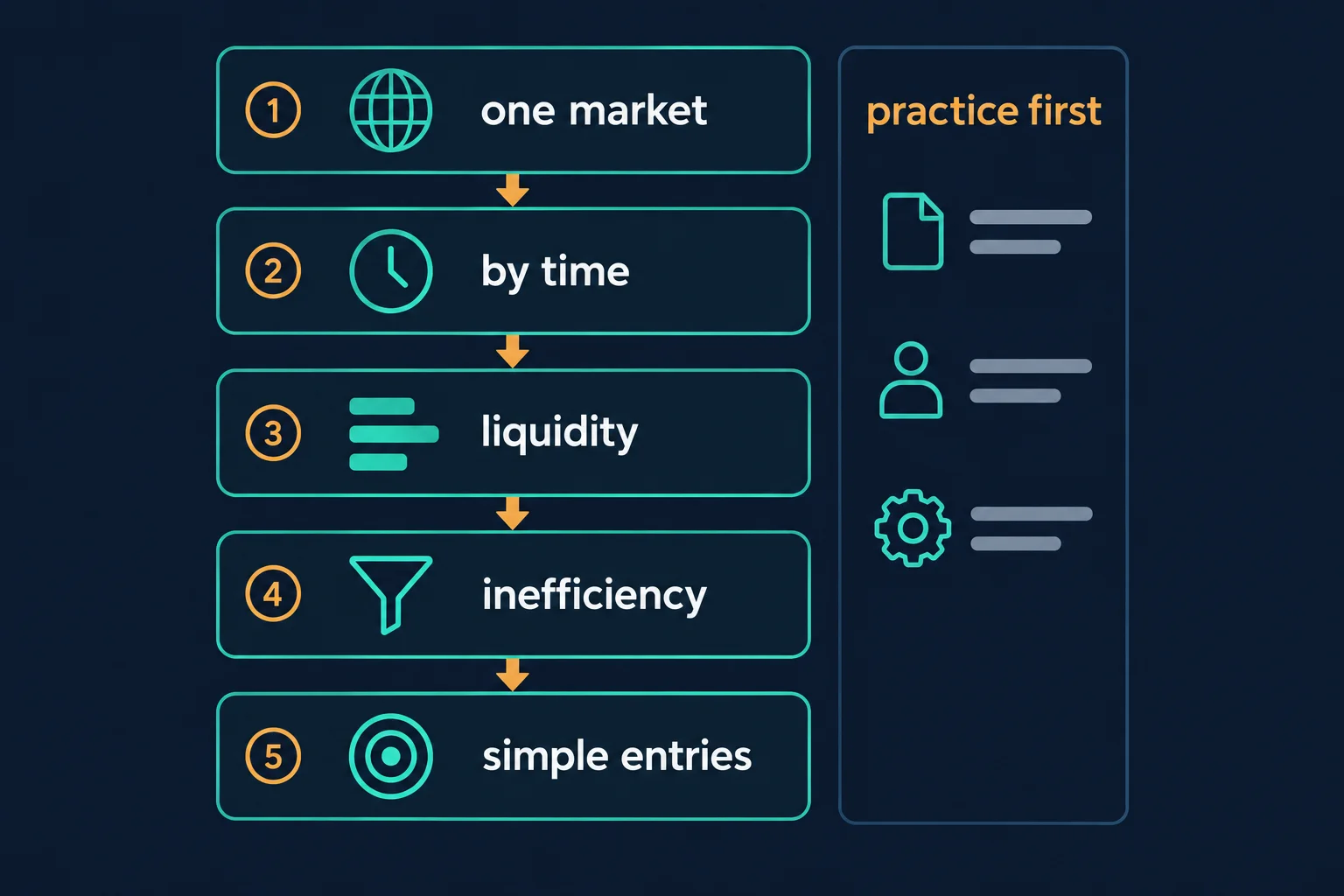
ICT opens a twenty-video series by narrowing Smart Money Concepts into five focal points: settle on one market, study how price delivers by time, pick the liquidity pools that matter, decide which inefficiencies belong in the model, and use simple entries with modest objectives. He applies that framework to a micro E-mini Nasdaq-100 short he narrates inside a 2:50–3:10 macro window, using the opening range gap and a 60-minute imbalance, and he reduces his stop after price moves his way. The trade, the 15-handle stop, the $30 risk figure and the outcome are all his spoken narration on his own account; it is not independently verified here.[1]
The lecture is a model-building discussion, not a performance record. It is worth reading as an example of how one trader converts a set of concepts into a written plan, with the caveat that the chart, the order fills and the account status behind the narration are not available to this recap.[1]
What the series is meant to be
At 0:03 he describes the project as discussions rather than a formal mentorship, framed for someone who has already worked through his 2024 material and wants to convert selected ideas into something executable. He says the series will run about twenty videos and will not exhaust his catalogue. At 3:42 he calls his own demonstration one example rather than the only valid route.
The progression he recommends is explicit: backtesting and historical study first, then tape reading, then paper or demo trading, and only after that a deliberate personal decision to accept live risk. Around 3:06 he stresses that the timing of that decision is the student’s, not his. He also acknowledges that losing trades will happen and that he is not infallible 47:43.[1]
The five focal points
1. Settle on one market
From 7:52 he advises concentrating on a single market or asset class, and says his own focus for the series will be Nasdaq index futures, with forex also expected. He gives volatility as his reason for Nasdaq 8:26, and at 8:05 notes forex will appear too. Later he extends the claim well beyond index futures, saying the model works in forex and currency futures and in commodities, while stating he cannot vouch for crypto 17:08. That is his assertion about the model’s applicability; nothing here tests it.[1]
On instruments, at 6:38 he states that a one-point move is worth $2 per contract on the micro E-mini Nasdaq-100 and $20 on the mini. Those figures are his own statement of contract mechanics, quoted as spoken; they are not checked against a contract specification here, and the exchange’s own specification page was not reachable from the host used for this review.[1]
2. Study delivery by time
The second tenet, introduced at 11:56, is that price delivery should be studied by time: economic calendars, recurring intraday windows and the periods he calls macros. At 25:52 he describes what a macro is in his vocabulary and adds that macros are not a panacea, and at 26:10 says he could build a different model every day using them. The practical point is that a location on a chart is not treated as actionable without a time context; the reader should keep in mind that this is his framing, not an established property of markets.[1]
3. Pick the liquidity that matters
At 14:11 the third tenet is understanding key pools of liquidity. He argues it is a misnomer to reason only that stops sit above highs and below lows and that price must therefore travel to them, and says at 14:26 that a model needs a reason for the draw, not just the bare observation that stops exist.[1]
4. Filter which inefficiencies count
The fourth tenet arrives at 15:23: identifying inefficiencies in price, meaning deciding which ones actually matter to the model rather than marking every apparent gap. Later he works with a 60-minute sell-side imbalance / buy-side inefficiency and explains that candle opens and closes help define the boundaries he draws. The automated transcript renders that array in several spellings — “Sibi”, “SIVI”, “Sibby” — and once as “consequent encouragement” where the context indicates consequent encroachment; the term is normalised only where the surrounding discussion supports it.[1]
5. Simple entries and realistic objectives
At 16:17 the fifth point is to use simple entry criteria and what he calls low-hanging-fruit objectives, then repeat the same process. Stated plainly, a model that keeps changing its conditions cannot be evaluated; the transcript presents this as a discipline argument rather than a claim about edge.[1]
The opening range gap, as he defines it
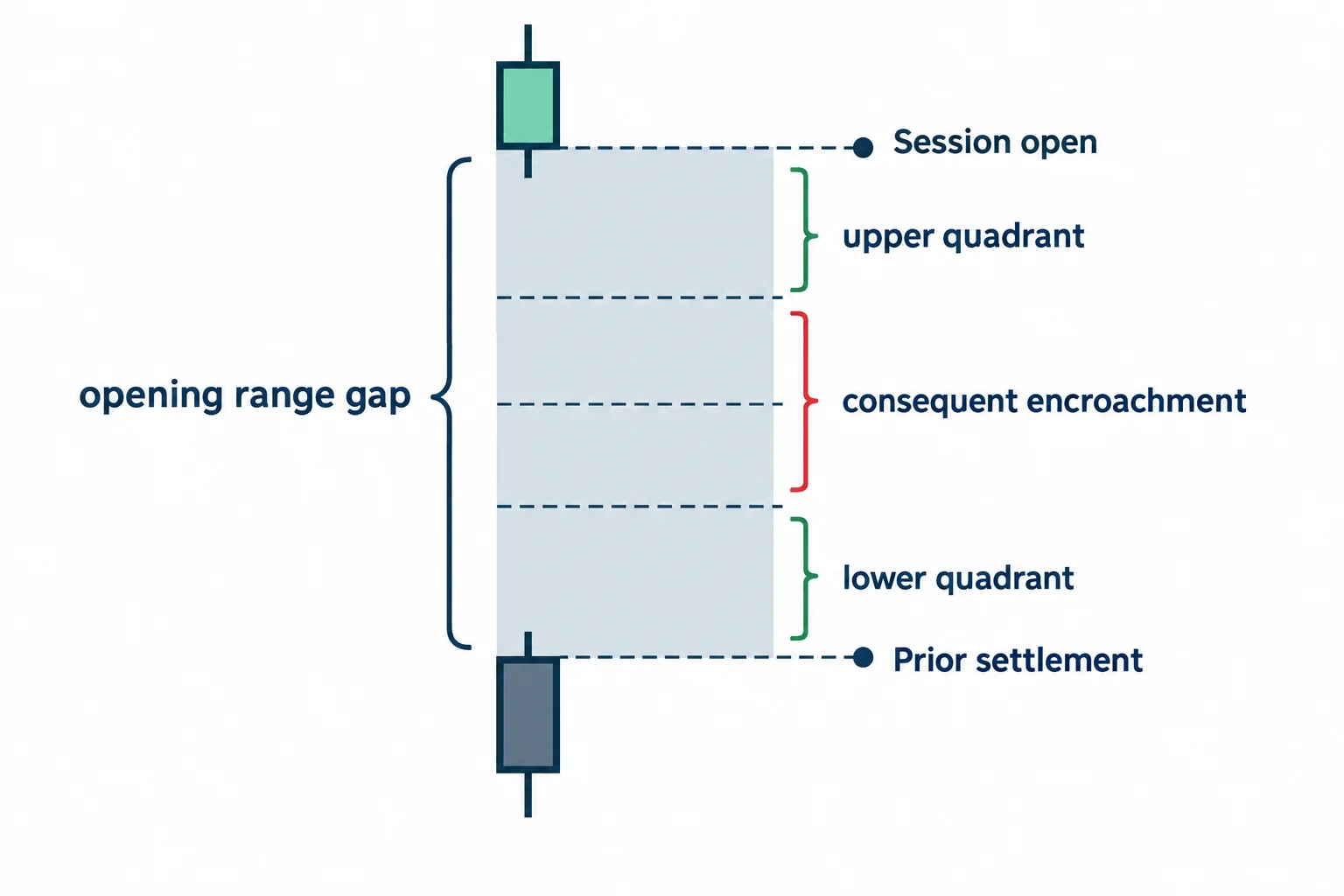
At 23:16 he defines the opening range gap as the regular-trading-hours difference between the current session’s opening price and the previous day’s regular-hours close or settlement, and at 23:50 describes splitting a sufficiently large gap into a lower quadrant, an upper quadrant and a midpoint he calls consequent encroachment. At 25:09 he calls the upper quadrant a very important level and a high-probability draw if the market shows it wants to trade lower; at 24:31 he notes he is not interested in trading long into such a large premium gap opening. The probability language is his, and no frequency or test result is offered for it in the recording.[1]
The session he narrates
He frames the afternoon trade around a 60-minute imbalance and the opening range gap. At 37:08 he says he is not looking to sell short simply to see price drop into the opening portion of the gap, and at 37:21 that he deferred that interest until price traded up into the 60-minute imbalance. He points to one-minute candles respecting the edges of that area 37:30, works through the lunch period, and at 38:07 says he starts looking for the PM session trade, with price at the low end of that one-hour array 38:12.
From 39:58 he sets out what he wants from the trade: a targeted liquidity draw, a simple entry, and the chance to hold for a runner if price reaches the midpoint of the gap. The entry he describes uses the open of a candle plus anything that trades back into that candle’s body or wick, which he calls an immediate rebalance; he quotes the low of the candle as 21,710.50 41:05. Those numbers are spoken narration captured by automatic speech recognition and are reported here as spoken, not as verified chart coordinates.[1]
He describes the initial objective as the upper quadrant of the opening range gap and the optional extension as the gap midpoint, saying at 41:51 that he did not want to simply take profit at the first level. At 42:12 he says he rolled the stop to 21,666.50 because price was holding the upper portion of that candle’s body, and at 42:34 he identifies the exit as being stopped out. In his description that left roughly 50 handles between entry and exit 43:05, taken with one micro contract 43:13. The transcript reports the trade; it does not contain an order ticket, and the fill sequence cannot be confirmed from audio.[1]
Risk, reward and the numbers he quotes
At 46:21 he calls the example a live account with real risk, and at 46:39 he states a 15-handle stop on the micro, which he translates at 46:52 into $30 of risk against a possible $90 or more — a three-to-one reward-to-risk he then discusses. He adds at 47:06 that a three-to-one profile allows being wrong a few times in a series and still being net profitable, and at 47:18 that larger ratios require more experience. That arithmetic is his illustration, not a verified expectancy: a favourable ratio does not establish a probability of success, and no costs, sample size or track record are provided.[1]
He also gives his reasoning for using the micro contract rather than larger size: at 21:00 he argues a first live trade is easier to absorb on smaller size, and says he does not suggest all viewers should move to live risk at all. This is risk-sizing advice framed around psychology, and it is not a recommendation to trade futures or to fund an account with any particular amount.[2]
Why he does not stream these trades
At 47:38 he explains he avoids live streaming entries because a large audience converging on one price would change the conditions, and at 48:37 he restates the transition path from backtesting and logging to forward testing and demo trading before real risk. He repeats at 50:53 that the example is not an instruction manual and not a promise of profit. That stance is itself a claim in the narration; the audience-size effect he describes is his reasoning, not something measured here.[1]
What this recap cannot establish
Everything attributed above to the recording is speaker narration captured by automatic speech recognition of the full audio. That means no chart overlay, execution label, order ticket, account statement or equity curve was inspected for this recap, and no level, fill, handle count or result should be treated as independently verified.[1] Price levels quoted as spoken, including the 21,710.50 and 21,666.50 figures, come from speech recognition rather than from reading the chart. The 60-minute array and opening range gap boundaries are described as he drew them, and the transcript contains no numeric axis data.
The general risk framing is the part that does not depend on his narration. Leveraged futures carry substantial risk of loss, and regulators publish guidance for exactly that reason: the CFTC states plainly that there is no such thing as a risk-free trade or investment.[2] The contract values he quotes are instrument mechanics rather than an endorsement, and the index behind the Nasdaq-100 contracts is described by its provider as including 100 of the largest domestic and international non-financial companies listed on The Nasdaq Stock Market based on market capitalisation[3] — an index description that establishes no contract month, tick size, tick value or session hours.
Two things are deliberately left out of this recap rather than guessed: precisely what instrument the afternoon trade was executed in beyond his description of the micro Nasdaq contract, and how the full session ended outside the narrated excerpt. The recording’s own reference at 49:40 to a same-day election certification is his stated context for the day’s conditions and is not used here to explain any price move.[1]
Watch the original lecture
The Inner Circle Trader — 2025 Lecture Series – Making Money With SMC Concepts
The video cannot be played inside another website: when its embedded player was opened and clicked on 14 September 2026, the player itself reported “Playback on other websites has been disabled by the video owner.” and settled on a “Watch on YouTube” prompt, with no duration and no playback progress, and the watch page’s own embed flag reads playableInEmbed: false. That is why this page carries a visible watch link instead of an embed.
Watch 2025 Lecture Series – Making Money With SMC Concepts on YouTube ↗
The watch page, re-read on 14 September 2026, attributes the upload to The Inner Circle Trader, dates it 2025-01-06T18:44:37-08:00, reports a length of 3,199 seconds and a view count of 266,486. The transcript used here covers 3,198.5 seconds of audio, which is consistent with that runtime.
Sources and further study
- [1] The Inner Circle Trader — “2025 Lecture Series – Making Money With SMC Concepts” (primary recording; watch page and full audio transcribed 14 September 2026)
- [2] CFTC — Learn & Protect (consumer protection guidance and fraud awareness)
- [3] Nasdaq Global Indexes — Nasdaq-100 Index overview
No third-party ICT summary, indicator page or spreadsheet was used to establish any definition, level or result in this recap, and any such material encountered elsewhere is unofficial and untested. No backtest, win rate, drawdown or account result is claimed anywhere on this page.
Futures trading involves substantial risk and is not suitable for everyone. This recap is educational, reports the speaker’s own narration rather than verified execution, and states no forecast or performance result.