Key takeaways
In AM Session – Opening Range Gap + Mitigation Block & FVG Entry, a two-and-a-half-minute live clip, ICT narrates a long he says he was already managing (0:00 and 0:02).
Read the full summary
In AM Session – Opening Range Gap + Mitigation Block & FVG Entry, a two-and-a-half-minute live clip, ICT narrates a long he says he was already managing (0:00 and 0:02). He describes the entry as coming from a mitigation block, which he defines here as an up-close candle formed through the consolidation (0:06 and 0:12), with the morning session opening range gap annotated beforehand (0:15) and a fair value gap in the same area (0:22 and 0:24). The draw on price, he says, is the new week opening gap (0:27 and 0:29). He wants price to leave an area of imbalance open and to see large green candles expanding away from the entry (1:01 and 1:11). His stated first target is a swing projection, where he says he took five contracts at once (1:16 and 1:18), then rolled the stop to better than break-even (1:38 and 1:41) and adjusted the limit toward the top of the new week opening gap (1:45), taking further partials as price got there (2:03) and leaving one contract for the limit (2:09). He also says the session was non-farm-payroll Thursday, that price came close to his stop, and that the precision was not as clean as usual (0:40, 0:53 and 0:49). The clip is his own narration over a live screen: it does not show an independently verifiable account result, and the captions establish no instrument, entry price, position size in dollars or final profit and loss.
How we researched this article
BestProps used document-based research from primary firm sources, checked September 24, 2026. The complete source list, scope, limitations, and commercial-state record appear near the end of this article.
Everything below is what he says in the recording, checked against its timed passages. The transcript used is the video’s own English caption track, which is auto-generated, so several terms and numbers are mis-recognised; those are named and flagged rather than quietly corrected. This is a short review clip, not a lesson, and the article is intentionally kept to what the source supports.
What he says the entry was built from
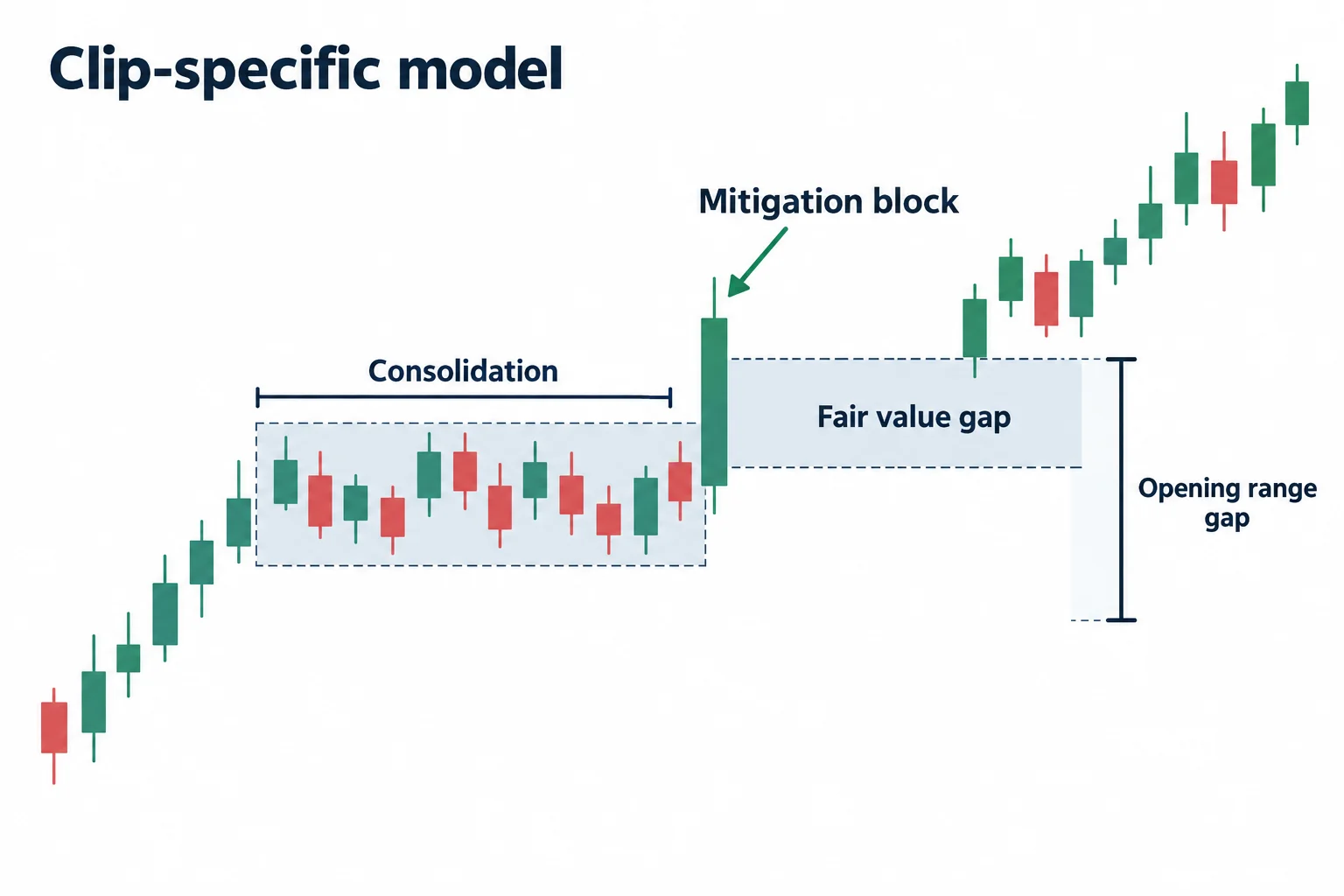
The first thing he announces is the trade type: a long on a mitigation block, which in this clip he defines as the up-close candle that formed through the consolidation (0:00, 0:02, 0:06 and 0:12). He says he had annotated the morning session opening range gap, and that is the reference he points back to as the structure the entry sat inside (0:15 and 0:18). He then describes a fair value gap in the same area, with the caption track rendering it once as “fair bag” and again as “fear back Gap” (0:22, 0:24 and 0:37); given that he is describing a price gap that price is returning into, those are read as caption artefacts for fair value gap rather than separate concepts, and they are flagged here rather than presented as clean quotes.
The directional objective is stated just as plainly. He says the new week opening gap is the draw, meaning the area he expects price to seek if the long works (0:27, 0:29 and 0:31), and he notes that price was already returning into the fair value gap, which he describes as positive feedback at that point (0:31, 0:34 and 0:37). In his framing the mitigation block and fair value gap are not stand-alone triggers: they are the local entry framework inside a move aimed at a higher reference.
The caveats he gives in the same breath
He is explicit that the session was not ideal. He calls it a non-farm-payroll Thursday and says that kind of day brings a lot of give and take, with the precision elements not as pristine as usual (0:40, 0:42, 0:45, 0:49 and 0:51). The caption track renders “non-front payroll” at one point (0:40); given the day of the week and the surrounding comment about imprecise conditions, that reads as non-farm payroll, and it is reported with that caption caveat, not as a verified calendar fact.
He then says the trade was close to the stop loss and explains why he did not move the stop (0:53, 0:56 and 0:58). What he wanted to see, he says, was an area of imbalance left open rather than traded through (1:01, 1:03 and 1:05). That phrase is badly garbled in the captions as “bison efficiency”; the surrounding sentence is about leaving an inefficiency open, but because the caption cannot establish which imbalance he had marked, the term is flagged rather than reconstructed as a specific technical name.
Confirmation, target and the management sequence he narrates
The confirmation behaviour he names is large green candles to the upside (1:11 and 1:14). His stated first target is a swing projection, and he says he would take five contracts there (1:16 and 1:18). The position size references in this clip are the sensitive part of the narrative and need care: he describes using a maximum funded 15-contract allocation against what the caption renders as an “850 000 account” (1:20 and 1:23). The caption track cannot establish those figures — the account value in particular is only a spoken number in an auto-transcribed clip — so they are reported as what he says on the recording, not as verified account details, and nothing here should be read as a template to copy.
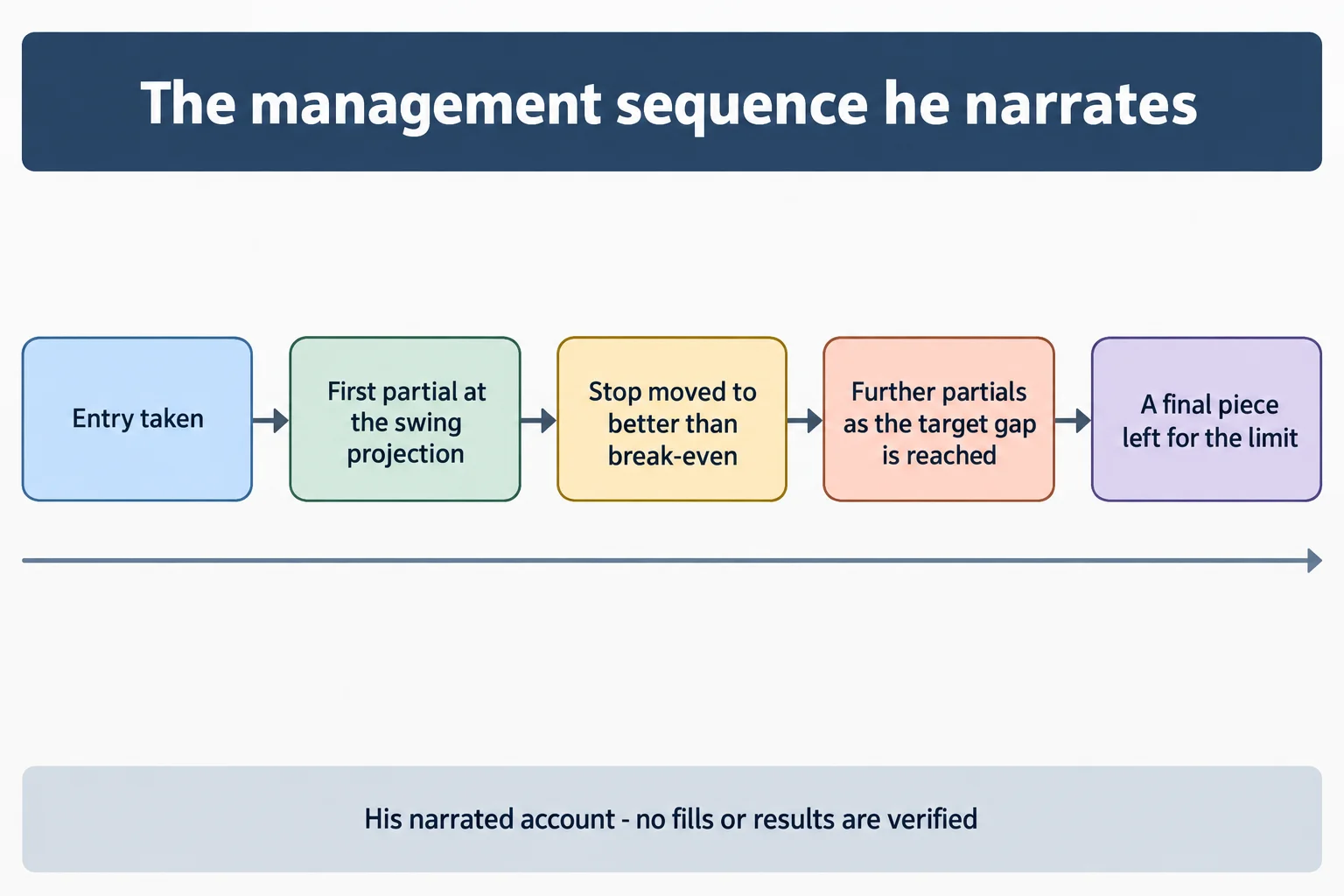
The rest of the clip is trade management narrated in real time.
- He says the first partial of five contracts has been taken (1:38).
- The stop is then rolled to better than break-even (1:41).
- He adjusts his limit order toward the upper end of the new week opening gap (1:45 and 1:48).
- Further partials are taken as price enters that gap (1:53 and 2:03).
- One contract is left running toward the limit (2:09 and 2:11).
He signs off by saying he is showing the results along with the drawdown (2:14 and 2:16). The recording shows his own screen and his own narration; the caption track and the article cannot verify the execution panel, the fills, the account balance or the net outcome, and no profit or loss figure is asserted here.
What this clip documents, and what it does not
Read as a sequence rather than a signal, the clip shows one narrated order of operations: identify a higher reference as the objective, locate a local entry built from a mitigation block and a fair value gap inside an annotated opening range gap, define where the idea would be invalidated, wait for expansion away from the entry, then reduce exposure into intermediate objectives and leave a remainder for the final level. That structure is worth understanding on its own terms, and it is also the full extent of what a captions-only review can support.
What it cannot support is any claim about how well the approach works. The clip does not identify the instrument, the timeframe, the entry price, the gap boundaries or a final account result; it is about two-and-a-half minutes long (0:00 to 2:18) and it is one session. The report that price came near the stop is his description of his own trade, not an independently observed excursion, and the fact that he calls the conditions imprecise argues against treating the outcome as representative.
AM Session – Opening Range Gap + Mitigation Block & FVG Entry
The Inner Circle Trader · published 9 March 2023 · about 2 minutes. This is the primary source for this article; every timestamp link above points into it.
The video is not embedded here because the owner has disabled playback on other websites. That was checked directly on 15 September 2026: the player loads and returns “Playback on other websites has been disabled by the video owner” instead of playing, at both desktop and mobile viewport sizes.
These are the sources checked for this article. The regulator and industry pages below are general material about leveraged futures trading and about trading systems sold to the public; they are not assessments of ICT or of anything said in the recording, and none of them verifies a statement made here. Any ICT, smart-money or third-party indicator, script, note set or transcript circulating outside the publishing channel’s own upload page is unofficial and untested here.
- [1] AM Session – Opening Range Gap + Mitigation Block & FVG Entry — The Inner Circle Trader (primary source; watch page read 15 September 2026, 2M19S)
- [2] The Inner Circle Trader — official YouTube channel (read 15 September 2026)
- [3] CFTC — Fraud Advisory: Commodity Trading Systems Sold on the Internet (read 15 September 2026)
- [4] NFA — Investor Education & Resources (read 15 September 2026)
This is independent educational commentary on one speaker’s framework and his narration of one trade. It is not official ICT material, it is not a tested trading system and it is not investment advice. Every size, target and outcome figure in the recording is the speaker’s own and is unverified. Leveraged index futures trading involves substantial risk and is not suitable for everyone.