Buyer-first forex comparison · reviewed July 25, 2026
FundedNext vs OneFunded Buyer’s Scorecard
Compare the same account size and the same evaluation type. Then compare total attempt cost, how daily and maximum loss are calculated, whether drawdown is static or trailing, the funded-account rules, platform fit, and evidence of trust. Branded challenge names identify products; they are not decision criteria by themselves.
| Decision point | OneFunded | FundedNext |
|---|---|---|
| Fee refund | Refunded on Core and Flash at first payout | Varies by model (confirm on site) |
| Payout cycle | 14 days (7 days with add-on) | First payout after a set number of trading days; recurring cycle thereafter |
| Base profit split | 80% (up to 90% with add-on) | Up to 90% on the funded account |
| Platforms | MT5, cTrader (web, desktop, mobile) | MT5, cTrader; Tradovate for futures |
Advanced checks before paying
- Calculate all-in attempt cost: evaluation or subscription fee, resets, activation, data or platform fees, and payout charges.
- Convert drawdown into a per-trade loss budget and model your normal losing streak.
- Audit funded-stage consistency, qualifying days, minimum balance, payout cap, number of payouts, scaling, and live-account transition.
- Check the contracting entity, recent complaint themes, support answer for your strategy, and a smaller first payout before scaling purchases.
This scorecard surfaces only decision rows without unresolved verification placeholders. Keep each row tied to the exact account size and program described; verify current checkout and official rules before purchasing.
If you are deciding between OneFunded and FundedNext, the core difference is scope. OneFunded keeps things focused on a small set of lower-cost CFD evaluations with optional add-ons and no time limits, while FundedNext offers a broader menu of models (including 1-step, 2-step, instant funding, and a separate futures program) with larger maximum account allocations. Which one fits depends on how much structure you want, how large you eventually want to scale, and whether you trade CFDs, futures, or both.
This comparison breaks down the evaluation models, profit splits, payouts, drawdown rules, platforms, and pricing for each firm so you can match the firm to your actual trading style rather than the loudest marketing. Both are evaluation-based, simulated-capital firms, and prop firm terms change often, so treat the numbers here as a starting point and confirm the live details on each firm’s official site before you buy. This article is educational and is not financial or trading advice.
OneFunded vs FundedNext at a glance
| Feature | OneFunded | FundedNext |
|---|---|---|
| Evaluation models | Value, Core, Flex, Flash (CFD challenges) | Stellar 1-Step, 2-Step, Lite, Instant; separate Futures program |
| Asset focus | CFDs (forex, indices, commodities, crypto) | CFDs and Futures |
| Account sizes | Up to $100,000 | Up to $200,000 per account; larger total allocation when scaled |
| Base profit split | 80% (up to 90% with add-on) | Up to 90% on the funded account |
| Payout cycle | 14 days (7 days with add-on) | First payout after a set number of trading days; recurring cycle thereafter |
| Time limit | None | None on core Stellar challenges |
| Platforms | MT5, cTrader (web, desktop, mobile) | MT5, cTrader; Tradovate for futures |
| Fee refund | Refunded on Core and Flash at first payout | Varies by model (confirm on site) |
| Profit targets / drawdown | Core: 8% then 5% targets, 5% daily loss, 10% overall loss, and 3 minimum days; Flash: 10% target, 4% daily loss, 6% overall loss, and 5 days; Value: 6% then 6% targets, 4% daily loss, 8% overall loss, and 4 days (official target guide) | 1-Step: 3% daily / 6% overall loss limits |
Figures above reflect each firm’s published terms at the time of writing and can change. Always confirm the live numbers on the official site before purchasing.
OneFunded overview
OneFunded positions itself as a simple, fast-funding CFD prop firm. The evaluation is a simulated trading account where you trade virtual capital and follow predefined risk rules, then receive a funded account once you pass.
The lineup is organized into four challenges (Value, Core, Flex, and Flash), each aimed at a different mix of cost and flexibility. Entry pricing is aggressive; the Value plan can start from around $16, which makes OneFunded one of the cheaper ways to test a strategy under prop firm rules. On the Core and Flash plans, the challenge fee is refunded at your first payout, so the cost behaves more like a deposit than a sunk fee.
The base profit split is 80%, and you can raise it to 90% with an add-on. Payouts run on a 14-day cycle by default, with the option to shorten that to 7 days through an add-on. The minimum payout is $100, withdrawals above $1,000 can be sent by bank transfer, and other payouts are handled in crypto (USDT). There are no time limits on the challenges, and a consistency rule applies to keep results from hinging on a single outsized day.
OneFunded supports MetaTrader 5 and cTrader across web, desktop, and mobile, and covers forex, indices, commodities, and crypto. The firm advertises a base of 25,000-plus traders and availability in markets including the United States.
FundedNext overview
FundedNext is a larger, more established multi-asset firm headquartered in Ajman, UAE, with operations in Cyprus and the Czech Republic. Where OneFunded keeps the menu short, FundedNext gives you several distinct ways to get funded.
The core offering is the Stellar family: a 1-Step challenge, a 2-Step challenge, and a lighter-rules Stellar Lite option, alongside a Stellar Instant route for traders who want to skip the evaluation. FundedNext also runs a separate Futures program in addition to its CFD challenges, which is a meaningful difference if you trade futures contracts rather than CFDs.
On profit share, FundedNext pays up to 90% on the funded account. During the challenge phase, some models pay a reward share (for example, the 1-Step plan shares profit from the challenge phase once you reach a growth threshold), and the share steps up to 90% once you are on a funded account. Account sizes reach up to $200,000 per account, and disciplined traders can scale toward a larger total allocation across accounts.
The rules are clearly published. On the Stellar 1-Step, your account cannot lose more than 3% of the initial balance in a single day or drop more than 6% overall, and you need to trade on at least two separate days. The 2-Step uses a 5% daily loss limit. FundedNext allows Expert Advisors and custom indicators, and supports MT5 and cTrader for CFDs plus Tradovate for futures.
Evaluation models compared
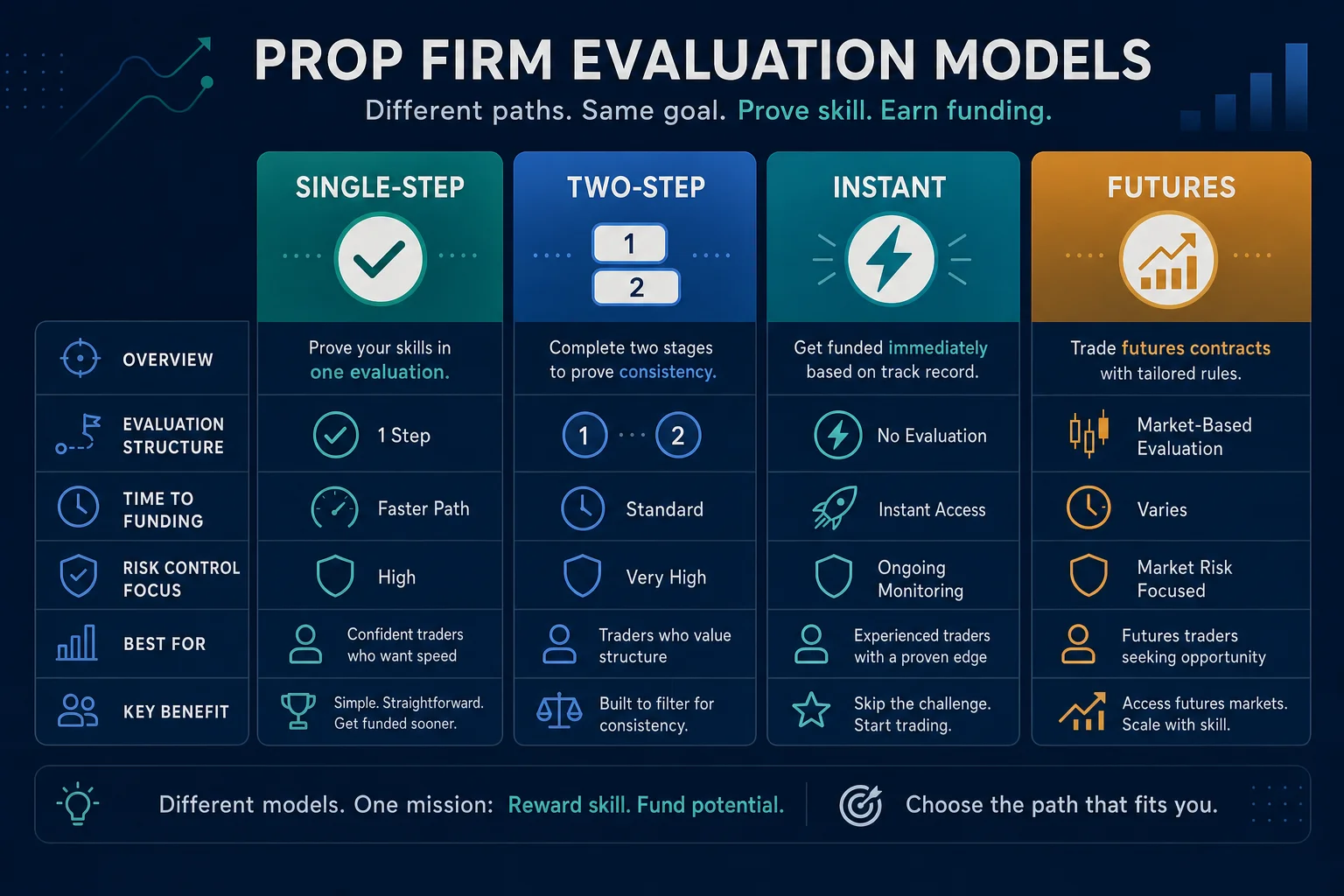
This is where the two firms diverge most. OneFunded is intentionally simple: four CFD challenges that mostly differ on price, payout speed, and refund treatment. If you find decision fatigue when a firm lists a dozen account types, OneFunded’s short menu is a feature, not a limitation.
FundedNext is the opposite philosophy. The Stellar 1-Step rewards traders who are confident enough to clear a single phase, the 2-Step adds a second verification stage that some traders prefer for the lower daily-loss pressure, and Stellar Lite softens the rules for a steadier approach. Instant funding removes the evaluation entirely for traders who would rather pay more upfront than prove themselves through a challenge. If you want to choose your own balance of difficulty, cost, and speed, FundedNext gives you more levers.
For a deeper look at the difference between paying upfront and proving yourself through an evaluation, see our guide on the instant funding versus challenge model for new traders.
Profit splits and payouts compared
Both firms top out around a 90% profit split, so the headline number is similar. The difference is in how you get there. OneFunded starts you at 80% and asks you to pay a small add-on to reach 90%, plus another add-on if you want the faster 7-day payout cycle instead of the standard 14 days. That keeps the base price low and lets you pay only for the features you want.
FundedNext bakes a higher share into the funded account and uses a phased structure during the challenge, which can be attractive if you value earning a reward share earlier in the process. Payout timing differs by model, with the first withdrawal available after a set number of trading days.
Payout reliability matters more than the advertised percentage. Many prop firm disputes come down to consistency rules and hidden conditions rather than the split itself, so it is worth understanding the consistency rules that cause prop firm payout denials before you commit to either firm.
Drawdown and trading rules compared
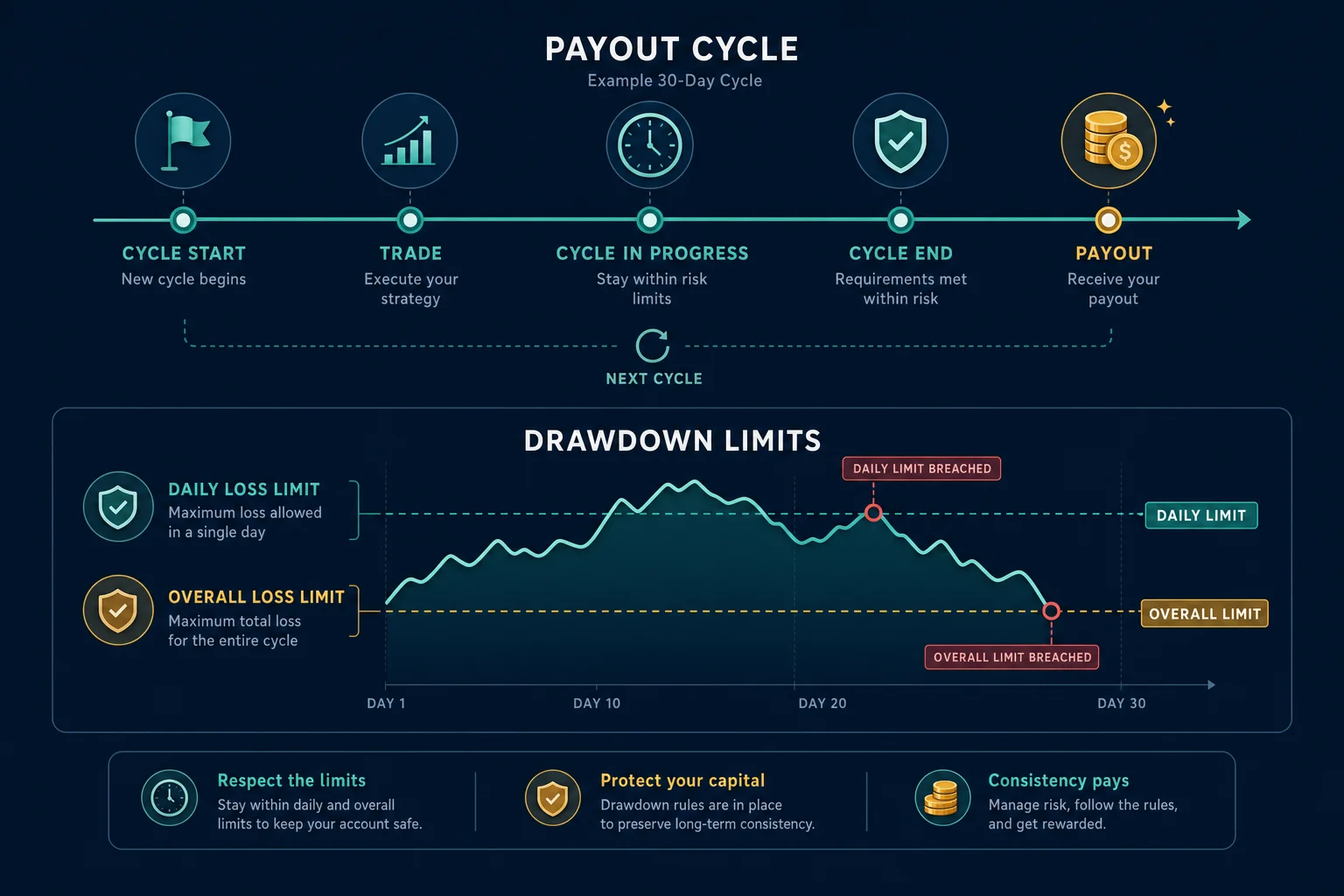
Drawdown rules decide how much room you actually have to trade. FundedNext publishes clear numbers for its Stellar 1-Step (a 3% maximum daily loss and a 6% maximum overall loss, with a two-day minimum trading requirement) and a 5% daily limit on the 2-Step. Those limits are typical for the one-step format and reward tighter risk control.
OneFunded applies its own daily and overall drawdown limits along with a consistency rule, though the exact percentages vary by plan and should be confirmed on the current plan page Core: 8% then 5% targets, 5% daily loss, 10% overall loss, and 3 minimum days; Flash: 10% target, 4% daily loss, 6% overall loss, and 5 days; Value: 6% then 6% targets, 4% daily loss, 8% overall loss, and 4 days (official target guide). If you tend to take a few larger trades around news, pay close attention to the daily-loss figure on whichever plan you choose, because that is the rule most new traders breach first.
If drawdown mechanics are new to you, our explainer on how FundedNext’s drawdown rules work for new traders walks through daily versus overall limits with examples.
Platforms and markets for each prop firm
OneFunded runs on MetaTrader 5 and cTrader, available on web, desktop, and mobile, and focuses on CFDs across forex, indices, commodities, and crypto. That is a clean fit if your strategy lives in the CFD world and you want familiar charting and execution.
FundedNext covers the same CFD platforms but adds a futures track through Tradovate. If you trade futures contracts (index futures, energies, metals) rather than CFD equivalents, FundedNext can keep you on one firm for both, while OneFunded would not be the right tool for a futures-only trader.
OneFunded and FundedNext pricing and refunds
OneFunded’s appeal is cost. With Value plans starting around $16 and fee refunds on the Core and Flash plans at first payout, the effective cost of getting evaluated can be very low for disciplined traders. The trade-off is that the cheapest plans lean on add-ons for the best split and fastest payouts.
FundedNext’s pricing scales with the model and account size you choose, and tends to sit higher than OneFunded’s entry tiers because you are buying access to larger allocations and a wider model menu. Neither approach is universally better; it depends on whether you optimize for the lowest possible entry price or for room to scale.
Which prop firm fits your trading style?
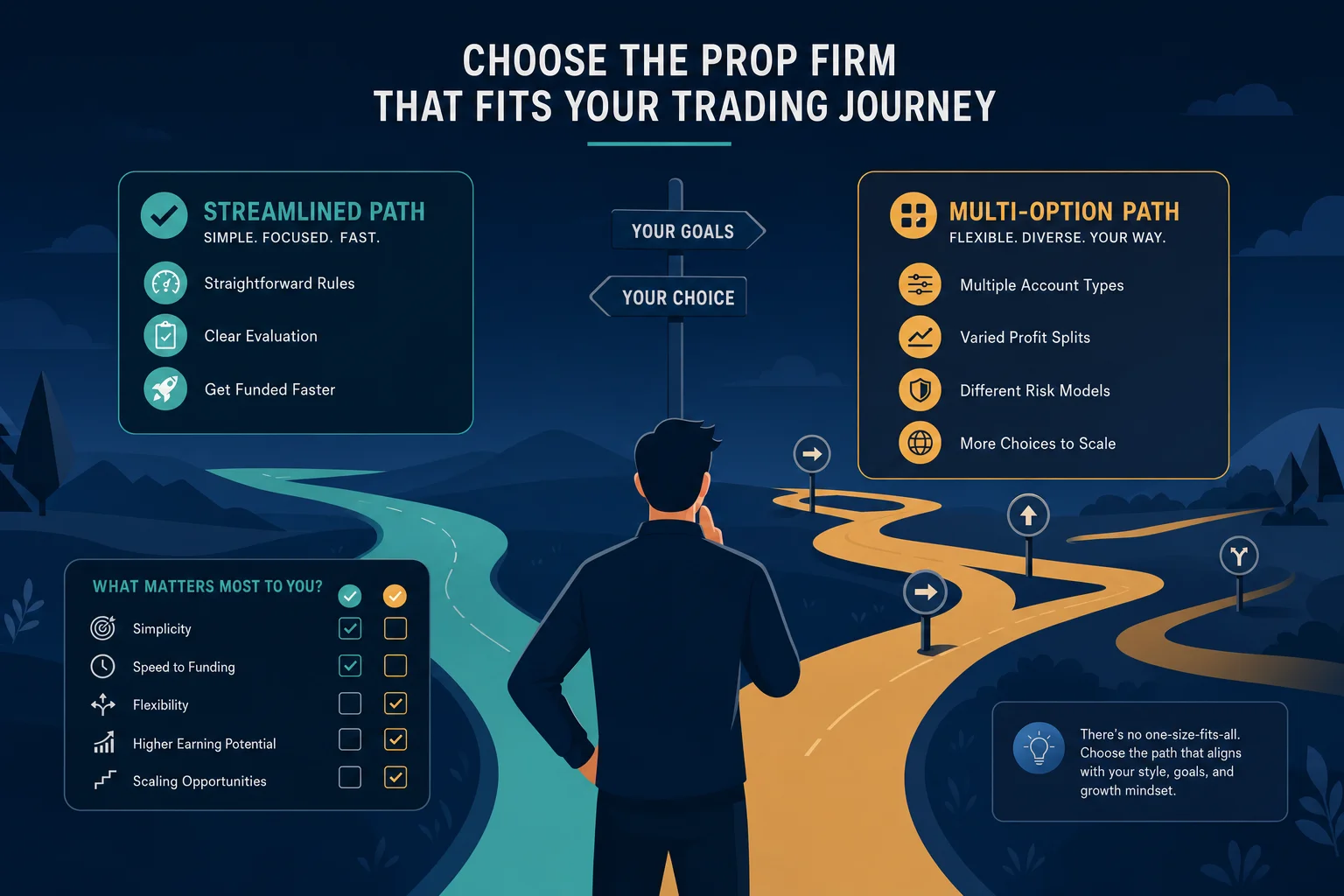
Choose OneFunded if you want a low-cost, no-frills CFD evaluation, you value a short and predictable menu, and you would rather add features à la carte than pay for a big platform you will not use. It is a strong fit for newer traders testing a strategy and for cost-conscious CFD traders who want the option of fee refunds and fast payouts.
Choose FundedNext if you want choice, with multiple evaluation styles, instant funding, larger account allocations, and a real futures program alongside CFDs. It suits traders who already know their style, who want to scale toward a bigger book, or who need futures access that OneFunded does not offer.
If you are still comparing, it can help to read how FundedNext stacks up against other firms, such as our Hola Prime versus FundedNext and GOAT Funded Trader versus FundedNext breakdowns.
A note on risk and how these accounts work
Both OneFunded and FundedNext are evaluation firms: you trade in a simulated account, and a “funded” account is access to the firm’s program rather than your own brokerage capital. That structure shapes the risks. Cheaper challenges use smaller account sizes with tight absolute loss limits, so the low headline price can come with a low statistical pass rate. Established firms with a longer operating history and clear corporate registration generally carry less counterparty risk than newer, smaller brands, so consider each firm’s track record on payouts, not just its advertised split. And because rules, fees, platform availability, and payout terms in this industry can change quickly, treat any specific number as something to re-check on the official site before you commit money.
Frequently asked questions
Is OneFunded or FundedNext better for beginners?
For a first evaluation, OneFunded’s low entry cost and simple menu are easier to start with. FundedNext is better once you know your style and want to pick a specific model or scale to a larger account.
What is the profit split at OneFunded versus FundedNext?
OneFunded pays an 80% base split that rises to 90% with an add-on. FundedNext pays up to 90% on the funded account, with a phased reward share during the challenge. Confirm current numbers on each firm’s site.
Does either firm have a time limit on the challenge?
OneFunded advertises no time limits on its challenges, and FundedNext’s core Stellar challenges also have no time limit. This favors traders who prefer to wait for high-quality setups.
Can I trade futures with OneFunded or FundedNext?
FundedNext offers a dedicated futures program through Tradovate in addition to CFDs. OneFunded focuses on CFDs, so it is not the right choice for a futures-only trader.
How fast are payouts at each firm?
OneFunded uses a 14-day payout cycle by default, which can be shortened to 7 days with an add-on. FundedNext allows a first payout after a set number of trading days, then runs on a recurring cycle. Payout speed can depend on the model you choose.
Which firm lets me scale to a bigger account?
FundedNext allows larger per-account sizes (up to $200,000) and scaling toward a higher total allocation. OneFunded’s published account sizes top out lower, around $100,000.
Are automated strategies allowed?
FundedNext permits Expert Advisors and custom indicators. Check OneFunded’s current rules for the specifics of automated trading on your chosen plan, as allowances can vary by firm and plan.
Page-one comparison check · US desktop results reviewed August 6, 2026
What to verify before choosing FundedNext or OneFunded
Decision summary: The headline account size and profit split do not identify the better fit on their own. Compare the complete cost, loss calculation, first-payout path, platform route, and restrictions for two specific programs before paying.
| Decision point | How to compare it |
|---|---|
| Payment, refund, and tax details | Check accepted payment methods, refund eligibility, taxes, currency conversion, chargeback restrictions, and whether a promotion changes any refund term. |
| Country and identity access | Confirm eligibility for your residence and citizenship, accepted identity documents, payment method, platform availability, and payout provider before checkout. |
| Simulated versus live status | Read the agreement for each stage and distinguish a simulated funded account from any later live-capital route; the word funded does not settle that question. |
Promotions and program rules can change independently. Use this page to narrow the choice, then confirm every decision-critical term in each firm’s current official program document, checkout, and trader agreement. Screenshots or saved copies help if a rule changes after purchase.
The bottom line
OneFunded and FundedNext solve two slightly different problems. OneFunded is the lean, low-cost CFD option for traders who want simplicity and a cheap way in. FundedNext is the broader, scale-friendly platform for traders who want model variety, futures access, and bigger allocations. Decide which of those descriptions sounds more like your trading, then verify the live rules, pricing, and payout terms on the official site before you buy.
This article is for educational purposes only and is not financial, investment, or trading advice. Proprietary trading involves significant risk, and evaluation rules, pricing, and payout terms change frequently. Always confirm current details directly with the firm and consider your own circumstances before making any decision.
Research and disclosure
How this comparison was reviewed
- Basis
- Document-based comparison of official product pages, trading objectives, and help-center material cited in this page.
- Scope
- FundedNext and OneFunded programs and the exact account comparisons stated on this page. Other firms and changing checkout promotions are outside this comparison.
- Limitations
- BestProps did not purchase an account or perform first-hand trading, support, identity-check, or payout testing for this comparison. Recheck current terms before purchase.
- Commercial state
- BestProps currently has no active affiliate or sponsor relationship with FundedNext, OneFunded, or any firm named on this page. Any future relationship will be disclosed next to affected links and in this record.