
Key takeaways
Alternatives to prop firms fall into three useful groups: an own-money brokerage account, a conditional allocation programme, or paper practice. For 100 total MES round trips over three months, Topstep Brokerage shows $132 in published charges, NinjaTrader Free and Tradovate Free $188, and Slay Free $190. Every futures total is incomplete, so none is a verified all-in cheapest winner. OANDA US belongs in a separate forex comparison; Axi Select and Darwinex Zero are allocation models, not unrestricted personal cash accounts.
Leaving a paid challenge does not mean leaving trading risk. You may exchange a service fee and payout restrictions for your own capital, margin calls and liability for an account deficit. The right question is not which provider displays the largest account number. It is who owns the money, which charges cannot be recovered, and what must happen before profit can reach your bank.
This is a product-level route chooser. For the broader trade-offs, see our prop firm trading versus own capital guide. Fee and qualification pages were checked October 8, 2026; older review and video dates are stated where used. Nothing here predicts returns or recommends a deposit for your personal circumstances.

Quick picks among alternatives to prop firms
- Small active futures scenario. Topstep Brokerage has the lowest published-charge subtotal here. Confirm missing fee components, margin and data qualification before choosing it.
- Same-brand plan flexibility. NinjaTrader/Tradovate offer Free, Monthly and Lifetime routes. Tradovate Free ties NinjaTrader Free on the published components; they are not two independent carrying brokers.
- Own-capital route from a prop payout. Slay Free allows personal futures trading on NinjaTrader Clearing infrastructure. Its linked current-rate endpoint failed, and its dated fee table must be confirmed.
- US spot forex. OANDA Corporation offers an own-money route, but spreads, commissions and financing do not share the MES comparison unit.
- Live-account qualification. Axi Select starts with your own equity and stage requirements, with no programme membership fee. Seed allocation profit share is zero.
- Subscription-funded track history. Darwinex Zero uses a virtual trading signal and conditional allocation. Its default performance share is 15%, not ownership of the displayed allocation.
- No trading capital to risk yet. TradingView Paper provides practice, not withdrawable trading profits. Optional paid features and exchange data are separate.
These are fit-based choices, not claims that any firm is safe, profitable or universally suitable. If losing the required capital would affect essential expenses, none of the live own-money routes solves that problem. If your goal is long-term investing rather than active trading, the decision itself changes; an investing plan is not another prop account to rank here.
Compare the account routes that replace a prop challenge
| Route/product | Own cash needed | Money at risk | 90-day fees | Profit access | Rules retained | Best fit |
|---|---|---|---|---|---|---|
| Topstep Brokerage | Your funded balance | Deposit and possible deficit | Published-fee bound | Own net gains; wire | Margin and broker rules | Own futures capital |
| NinjaTrader/Tradovate | Your funded balance | Deposit and possible deficit | Published-fee bound | Own net gains; bank | Margin and broker rules | Futures plan choice |
| Slay Free/Pro | Your funded balance | Deposit and possible deficit | Published-fee bound | Own net gains; bank | Margin and broker rules | Own futures capital |
| OANDA US forex | Own deposit; Core $10K | Deposit and shortfall | Variable; no total | Own net gains; bank | Margin and US rules | US spot forex |
| Axi Select | Own $500+ equity | Live equity and shortfall | No programme fee | Stage-based allocation share | Stage and market rules | Qualify on live equity |
| Darwinex Zero | Subscription cash | Fees; virtual signal | Subscription only | 15% eligible allocation profit | Rating and risk engine | Build a virtual history |
| TradingView Paper | No real deposit | No real trading loss | Basic practice $0 | No trading-profit cashout | Simulation limits | Practice without income |
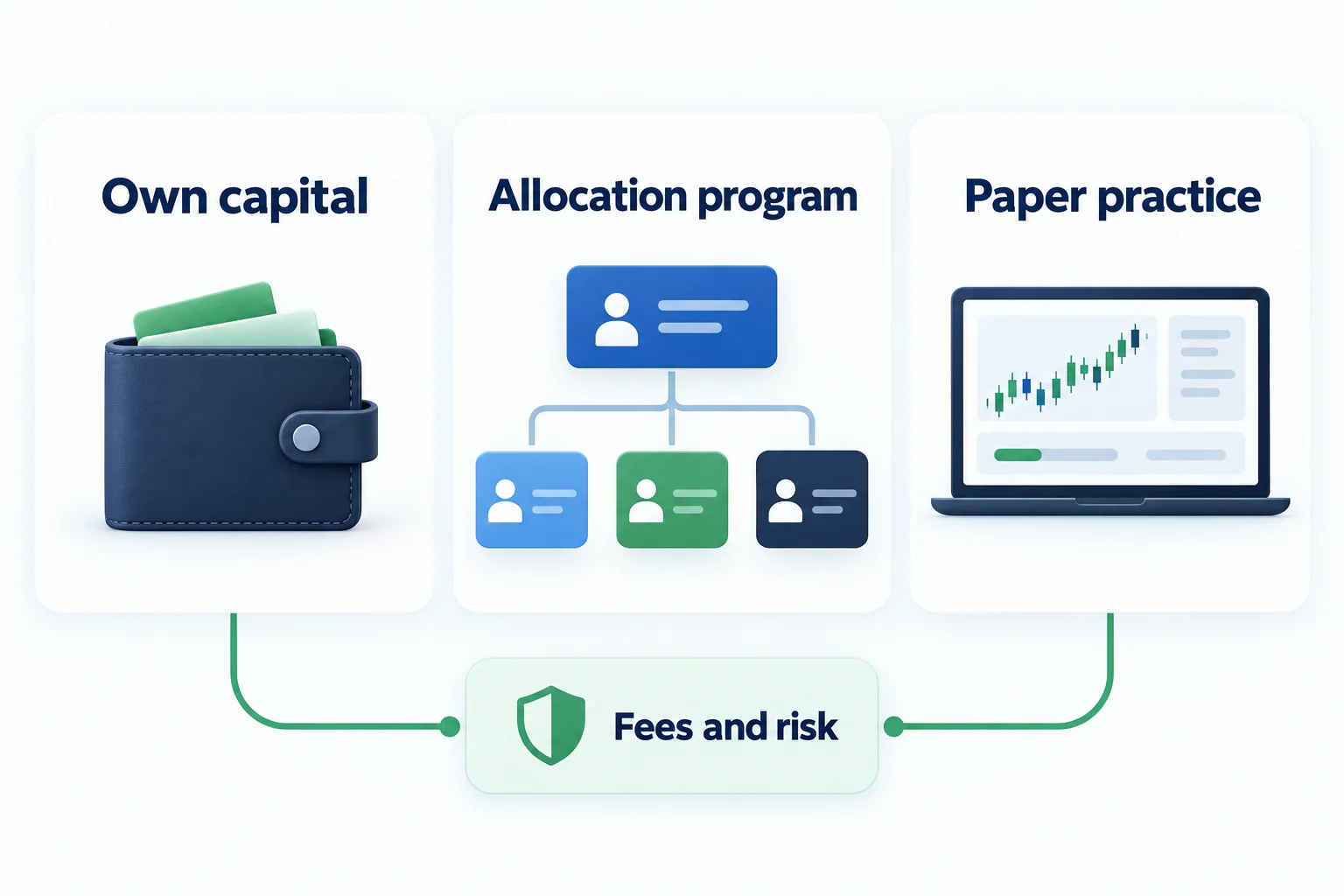
A brokerage deposit is your equity until charges or losses reduce it. It is not the same thing as a nonrefundable challenge purchase. An allocation cap is permission to participate under a contract, not cash you own. A paper balance is neither. Comparing all three by a cost per $1,000 of displayed buying power would obscure these differences rather than help you choose.
A real investor-funded account also differs from a provider-supplied notional allocation. Ask whether a displayed amount represents customer money, a simulated signal, seed capital used for performance calculation, or outside investors actually allocated to your strategy. The contract, not the size label, decides the answer.
How we compared costs for alternatives to prop firms
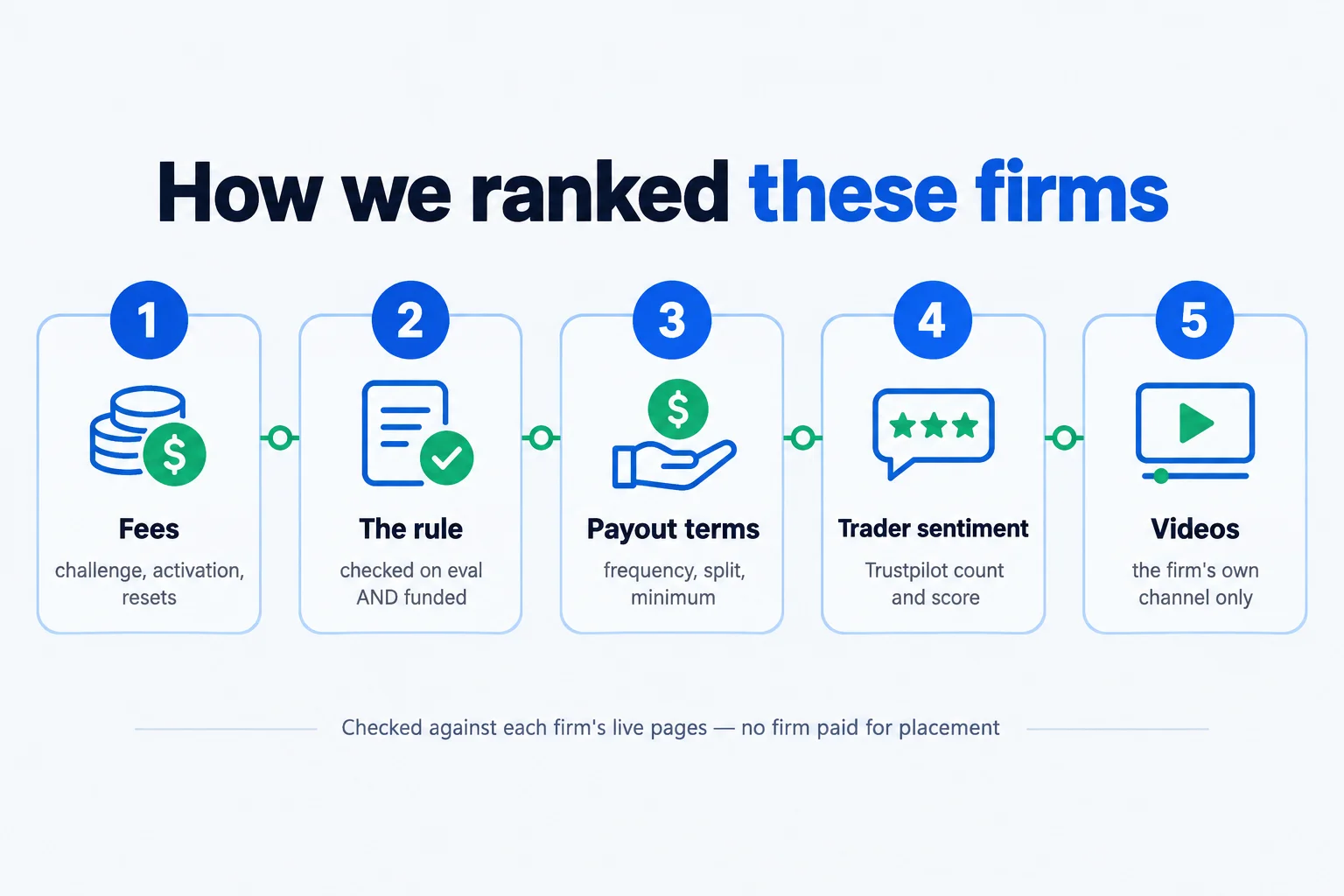
The shared method graphic describes the broader prop-account review framework. Here, challenge fees and funded rules are replaced by the relevant brokerage, allocation or practice charges and restrictions. Each full provider is checked for account identity, published charges, qualification, withdrawals, trading restrictions, loss liability, reviews and official video evidence. Missing evidence is disclosed in the same position, not turned into a different standard for one brand.
Our futures example uses a US nonprofessional individual, native routing, one MES contract per trade, 100 completed round trips total over 90 days, three monthly billing periods, regular activity split 34/33/33, no overnight positions, and one bank withdrawal. The Topstep route uses a $10 outbound wire; the other two use the documented no-fee ACH route. A round trip includes entry and exit. These are list-price calculations, not a prediction of your activity.
Known 90-day fees = published startup and activation charges + three published plan/data payments + 100 published round-trip charges + the scenario withdrawal charge. Deposits, margin, profit and market losses remain outside that calculation. We preserve unknown inputs rather than claim they are zero. All nine futures plan totals are published-fee lower bounds, because not every separate component has been established. No complete all-in futures winner is verified.
Topstep publishes commission, exchange and NFA charges but does not separately establish clearing in the material reviewed. NinjaTrader/Tradovate publish an all-in trade rate, yet the applicable funded-account data benefit could not be fully reconfirmed against the generic data schedule. Slay publishes an all-in trade table, but the linked current settlement-rate page returned 404. None of those gaps proves an extra fee exists; none supports a zero assumption either.
Forex costs use a different unit and stay unsorted against futures. Allocation programmes stay separate because a subscription and a personal live-equity deposit are not interchangeable. Native EUR and USD Darwinex subscription prices are shown without currency conversion. No old exchange rate, advertised allocation size or discount determines the list-price comparison.
Published futures costs for alternatives to prop firms
| Provider/plan | Monthly plan | MES round trip | 90-day known fees | Data condition | Overnight margin | Carrying entity |
|---|---|---|---|---|---|---|
| 1. Topstep Brokerage / TopstepX | $0 | $1.22 subtotal | $132 lower bound | Level I conditional | Higher; check cutoff | Plus500US carries |
| 2. Tradovate Free / NinjaTrader Free | $0 | $1.88 published | $188 lower bound | Unconfirmed entitlement | Higher; check cutoff | NinjaTrader Clearing |
| 3. Slay Free | $0 | $1.90 published | $190 lower bound | Level I; nonprofessional | Higher; check cutoff | NinjaTrader Clearing |
Tradovate Free is the exact branded route used for the detailed bank-withdrawal evidence. NinjaTrader Free has the same known fee result, but a branded fee match does not establish identical portal procedures. Their shared carrying entity also means these routes do not provide separate clearing counterparties.
| Exact plan | Known startup | Monthly plan | MES round trip | One withdrawal | 90-day known fees |
|---|---|---|---|---|---|
| Topstep Brokerage / TopstepX Level I | Not confirmed | $0 | $1.22 | $10 | $132 lower bound |
| NinjaTrader Free | Not confirmed | $0 | $1.88 | $0 | $188 lower bound |
| Tradovate Free | Not confirmed | $0 | $1.88 | $0 | $188 lower bound |
| Slay Free | Not confirmed | $0 | $1.90 | $0 | $190 lower bound |
| NinjaTrader Monthly | Not confirmed | $99 | $1.68 | $0 | $465 lower bound |
| Tradovate Monthly | Not confirmed | $99 | $1.68 | $0 | $465 lower bound |
| Slay Pro | Not confirmed | $149 | $1.70 | $0 | $617 lower bound |
| NinjaTrader Lifetime | $1,499 | $0 | $1.28 | $0 | $1,627 lower bound |
| Tradovate Lifetime | $1,499 | $0 | $1.28 | $0 | $1,627 lower bound |
The order is sensitive to missing components. If NinjaTrader Free requires three $4 single-CME data payments, its known total becomes $200, putting Slay Free’s $190 before it. Three $12 four-exchange payments produce $224. This is why a $2 published difference cannot support an unconditional cheapest recommendation.
Futures risk and trading terms after leaving prop firms
| Route | Own deposit | MES order margin | Loss liability | Rules retained | Bank withdrawal |
|---|---|---|---|---|---|
| Topstep Brokerage | Minimum $100 | $210 temporary notice | Deficit can be owed | Margin; only TopstepX | Wire $10; no ACH shown |
| NinjaTrader/Tradovate | No minimum shown | $50 intraday advertised | Deficit can be owed | Margin; house risk rules | ACH $0; wire charges |
| Slay Free/Pro | No minimum; transfer $5 | $50 help-table margin | Deficit can be owed | Margin; house risk rules | ACH $0; wire $30 |
The $210 Topstep MES notice overrides its general $50 marketing grid until the temporary adjustment is lifted. A $100 account-opening deposit therefore does not meet that current order requirement. NinjaTrader and Slay also advertise small intraday margins, but that is collateral for a position, not a recommended deposit or an amount you can safely lose.
A personal broker removes challenge profit targets, a provider reward split and prop consistency gates. It does not remove exchange halts, maintenance windows, higher overnight margin, liquidation, order restrictions or identity checks. A headline saying no daily drawdown is not an assurance that every news strategy, copier, algorithm or position size is allowed. Obtain the actual platform and house-risk permissions rather than transfer an old prop-account permission to a new broker.
NinjaTrader Clearing’s current risk disclosure says you may incur losses beyond deposited amounts and be liable for a resulting deficit. Slay is carried by that entity. Topstep’s account disclosure similarly requires attention to margin and shortfall liability. Stops can slip or fail to execute at the intended price. A broker’s liquidation process can also create fees and does not convert a leveraged account into limited-risk practice.
Topstep Brokerage for a conditional futures prop alternative
Topstep Brokerage is a personal futures account, not the Topstep Trading Combine or an Express Funded Account. The distinction matters when moving from simulated rewards to money you actually own: there is no prop profit split here, but your account absorbs live market losses.
Its $132 example is a published-fee lower bound, not verified all-in. Separately unconfirmed setup, activation and clearing inputs are not assumed zero. Own equity and any deficit sit outside the fee figure.
Account provider and register scope. Topstep Brokerage LLC is an introducing broker, with Plus500US Financial Services LLC carrying the customer account. The dated NFA check identifies Topstep Brokerage as an IB, NFA 0567079, and Plus500US Financial Services as an FCM, NFA 0001398, checked October 8, 2026. Those are different functions; Topstep’s IB registration is not proof that it holds customer deposits. This route is for US individual accounts, not a general offer to every international resident. Topstep account and entity information
Qualification and access. The published minimum deposit is $100, but trading depends on product margin and account approval. The current temporary MES margin is $210. TopstepX is the supported platform; access to other platforms is not established. Funds and withdrawals are subject to bank and compliance checks, not the payout gates of a prop evaluation.
Published charges. Micros show $0.25 commission each side, with $0.35 exchange and $0.01 NFA each side in the MES example. The published subtotal is $1.22 per round trip. A $10 outbound wire produces $132 across the defined 100-trade scenario. The commission subtotal is not labelled all-in because the clearing component was not separately confirmed.
New accounts receive two calendar months of Level I data, after which at least $5 of commission in the preceding calendar month qualifies for the benefit. It is not $5 of total fees across the life of the account. Our 34/33/33 activity produces $17, $16.50, $16.50 of commission in those months. Front-loading all trades could fail the later calendar-month condition.
Profit access. The documented bank route is an outbound wire at $10; no ACH option was shown. The help guide shows conflicting $20 and $10 minimums for debit/digital-wallet withdrawals; a wire-specific minimum was not confirmed. Processing can take one to three business days before bank receipt. This is a withdrawal of available personal equity, not a percentage reward. Leave enough settled cash to meet any open positions and charges.
Rules and loss liability. Higher overnight requirements and temporary margin changes remain. The consolidated disclosure says losses can exceed initial margin and requires customers to cover an account shortfall; margin liquidation is not a guaranteed loss ceiling. The published account does not provide a prop loss buffer funded by Topstep. Current temporary MES order/day margins are $210/$150, versus the general $70/$50 grid; the published $2,421 hold margin applies before the daily close. Automatic liquidation costs $10 per contract in the stated fee guide, except its documented customer-defined risk-control flattening case. Debit funding/withdrawals can cost 1% and depend on the original funding method.
Reviews and evidence. No standalone brokerage Trustpilot score or review count was confirmed; the exact domain returned generic directory material. Do not substitute Topstep prop’s much larger review profile for this brokerage.
Topstep video, published May 9, 2024. This platform explanation does not prove today’s fees, margin or bank receipt.
Choose it when. You want TopstepX and the available US individual own-money route, and can confirm the incomplete costs and current margin. Do not choose it solely because its published subtotal leads this scenario.
Exact account-model or loss clause. Official contract or disclosure says “You will be liable for any resulting deficit in your account.”
Written terms checked October 8, 2026. Official source 1 · Official source 2 · Official source 3 · Official source 4 · Official source 5 · Official source 6 · Official source 7
NinjaTrader and Tradovate for plan-based futures prop alternatives
NinjaTrader and Tradovate provide Free, Monthly and Lifetime pricing for personal futures trading. The useful choice is a plan decision within shared infrastructure, not a contest between two supposedly independent brokers. A lower commission can be expensive if the prepaid or recurring plan fee outweighs your actual trade volume.
All six branded plan results are published-fee lower bounds. Unconfirmed one-time inputs and the applicable mandatory data entitlement remain unknown; trade rates being labelled all-in does not make the whole account bill complete. Personal market losses and deficits are additional.
Account provider and register scope. The US carrying account is with NinjaTrader Clearing LLC, NFA 0309379, with the dated register check from October 8, 2026. NinjaTrader and Tradovate are brands using that entity. A separate European application flow names NinjaTrader Europe B.V.; its contract and access must be checked for the actual residence, not inferred from US pricing. This article’s ranked scenario is the US route. NinjaTrader account scope
Qualification and access. The published US route has no minimum deposit, but sufficient margin is required to place trades. $50 intraday MES margin is an advertised order threshold, not a complete funding budget. Live-account approval includes identity, residence and funding checks. Desktop, web or mobile access and any external routing add-ons should be matched to the chosen branded account.
Published charges. Free has no monthly plan fee; Monthly costs $99 per month; Lifetime takes $1,499 upfront. Published MES all-in rates are $1.88, $1.68 and $1.28 per round trip. At 100 total round trips, their known three-month totals are $188, $465 and $1,627, respectively. The same inputs give the same branded Tradovate results.
The current funded-account marketing mentions complimentary top-of-book data. The generic schedule also lists single-exchange and multi-exchange data charges, while relevant support reads returned incomplete shells. We therefore do not select a mandatory data price by assumption. Confirm the benefit applies to your funded account, professional classification, exchange and platform before treating a Free plan as the lower known bill.
The Free plan’s published inactivity condition is avoided by the regular activity assumed here; that does not mean the charge does not exist. The documented Free-plan inactivity charge is $35 after a 30-day interval with login but no live trade. A long pause, optional routing connection or professional data classification can change the bill. Margin calls carry a published $50 charge, with $25 for the first liquidation and $50 for subsequent liquidations; these event charges are absent from the compliant flat-before-cutoff scenario, not claimed nonexistent. We do not apply Free-plan conditions to Monthly or Lifetime without a source.
Profit access. For the Tradovate route, ACH is documented as free and wire withdrawals carry separate charges. Funding-source holds and settlement requirements apply; a same-day request is not a promise of same-day bank receipt. An available account balance can differ from a withdrawable balance while positions or transfer holds remain.
Rules and loss liability. Intraday collateral rises to overnight requirements at the relevant cutoff. The carrying broker can liquidate under its house-risk rules, and its disclosure expressly includes liability for a resulting deficit. NinjaTrader explicitly offers automated strategies and custom tools, but blanket third-party copying permission is not established. New positions may face up to four-times intraday margin at least 15 minutes before specified economic releases. Its published initial MES margin was $2,863.17 at the check, required 15 minutes before session close, with the help example using 3:45 p.m. Central Time. Rates can change; this is not a deposit recommendation.
Reviews and evidence. Trustpilot showed 3.8/5 from 1,242 reviews on October 8, 2026. This is a broker/platform-wide profile, not a controlled test of Tradovate withdrawals. The dated review material includes technical-support praise alongside data-renewal, liquidation-charge and software-stability complaints. October 2 and October 1, 2026 examples concern interrupted data access and extra liquidation charges respectively. Such reports are not proof that a specific fill or withdrawal failed.
NinjaTrader video, published August 28, 2026. This official position-sizing education is not proof of current data entitlement, successful trading or payment.
Choose it when. You need the available platform route and can compare your expected trade count with the whole plan fee. The Lifetime licence is a cash commitment, not automatically the cheapest way to begin.
Exact account-model or loss clause. Official contract or disclosure says “you will be liable for any resulting deficit”
Written terms checked October 8, 2026. Official source 1 · Official source 2 · Official source 3 · Official source 4 · Official source 5 · Official source 6 · Official source 7 · Official source 8 · Official source 9 · Official source 10
Slay Markets for a futures prop alternative after payouts
Slay Markets describes a path from a Tradeify reward into a personal futures account. Once transferred into your brokerage balance, that money is yours at risk, not a continuation of a simulated funded loss allowance. Slay can be considered without treating its related prop brand as a reason either to promote or exclude it.
Slay Free and Pro totals are published-fee lower bounds. The June 10 help table was read October 8, 2026, but its linked current-rate endpoint returned 404. Separate one-time inputs remain unconfirmed. This is an evidence gap, not proof of closure, and live equity can be lost beyond the deposit.
Account provider and register scope. Tradeify Brokerage LLC doing business as Slay Markets is the introducing broker, NFA 0575972; accounts are carried by NinjaTrader Clearing LLC, NFA 0309379. The register check is dated October 8, 2026. Slay’s official disclosure says it does not accept or hold customer funds. It shares the carrying dependency used by the NinjaTrader/Tradovate routes, so opening both is not independent clearing diversification. Slay entity disclosure
Qualification and access. No minimum account deposit is advertised, while ACH/debit transfers have a $5 minimum. These are separate from the $50 intraday MES margin in the help table. Identity and residence approval still apply; international applicants are subject to supported-country and compliance checks, not blanket global access. The published platforms include NinjaTrader and Tradovate. Its detailed international restricted-country list was not readable, so support confirmation is needed for a particular residence.
Published charges. Slay Free has no monthly plan fee, while Pro costs $149 per month. The help table gives MES $0.95/$0.85 per side for Free/Pro, so round trips are $1.90/$1.70. The known totals at 100 round trips are $190 and $617. The table bundles some fee components; no NFA amount is added a second time. The table cautions readers to check current settlement rates at the linked /fees endpoint, which failed. Confirm the active rate before making a price-dependent decision.
Nonprofessional Level I is included in the published account description. Optional CME Level II adds $16 per month, giving $238 for Free and $665 for Pro in our scenario. A four-exchange Level II bundle is $48 per month instead. Professional pricing is stated as $156 per exchange per month, alongside broader free-data wording that needs clarification for that classification.
Profit access. ACH withdrawals are documented as free with one to three business days of processing; outgoing wire is $30. Funding holds, account settlement and bank delivery remain relevant. Keeping net gains without a prop split is not the same thing as withdrawing all cash while a position still requires margin.
Rules and loss liability. Brokerage trading has no prop consistency target or daily drawdown gate in the published description, but exchange and carrying-broker margin, liquidation and operational controls remain. NinjaTrader Clearing’s deficit-risk disclosure applies to the carrying account. No claim of unlimited loss-free trading follows from the absence of a prop gate. Slay Free has a $35 monthly inactivity charge when no live trade occurs over 30 days; paper activity does not waive it. The help material lists $50 margin calls and $25 first/$50 later liquidations. Optional CQG/Rithmic routing adds $0.25 per contract; native routing is the baseline. The carrying-broker initial MES margin shown is $2,863.17, not the $50 intraday threshold.
Reviews and evidence. No standalone Slay Trustpilot score or review count was confirmed. Tradeify’s reviews are not Slay brokerage evidence. This gap is stated without manufacturing a complaint, score or firm-specific approval condition.
Video evidence. No directly relevant official video was confirmed. Written product terms remain the source for this comparison.
Choose it when. You want the supported own-capital route and are prepared to confirm its active rate, bank holds and data classification. A convenient prop-payout transfer is not a risk reduction once the funds become your trading equity.
Exact account-model or loss clause. Official contract or disclosure says “you will be liable for any resulting deficit”
Written terms checked October 8, 2026. Official source 1 · Official source 2 · Official source 3 · Official source 4 · Official source 5 · Official source 6 · Official source 7