
Key takeaways
This is a rule-by-rule tactics guide, not a firm ranking.
Read the full summary
This is a rule-by-rule tactics guide, not a firm ranking. We read the current rules, help-center and pricing pages of 16 prop firms (checked October 3, 2026) for seven mechanics that actually end a challenge: profit target, daily loss limit, drawdown type and lock point, consistency rule, minimum trading days, news and weekend rules, and the funded-stage scaling trigger. For each, we name the ONE tactic the rule forces, with a worked dollar example at $50,000 and 2 to 4 firms’ exact current clauses, including where the right tactic flips depending on which version of a rule your own firm uses. No firm publishes a verified pass rate, and this post does not invent one.

Freshness: checked October 3, 2026. Firms change terms without notice; re-check your own firm’s current pages before you trade. Each firm’s Trustpilot figure carries its own read date.
Editorial disclosure. BestProps has no affiliate or sponsor relationship with any firm named in this post (FTMO, Topstep, Apex Trader Funding, The5ers, FundedNext, FundedNext Futures, My Funded Futures, Blue Guardian, E8 Markets, Alpha Capital Group, FundingPips, TakeProfitTrader, BluSky, Bulenox, Purdia and Tradeify), and has received no money from any of them. Codes shown, if any, are uncompensated and firm-published only. No firm paid for placement or reviewed this post before publication. Full policy: affiliate disclosure.
The five rules that fail most challenges
Across every firm we checked, the same five mechanics end more evaluations than anything else. Each one has exactly one tactic that defends against it, detailed in its own section below.
- Daily loss limit counts your open positions, not just closed trades: size so a floating loss alone cannot trip it on an equity-basis firm. See Daily loss limit below.
- The drawdown floor keeps moving until it locks, and some reset after a payout: know your firm’s lock point before you treat the floor as fixed. See Drawdown type below.
- One big winning day can fail a consistency rule even though it made money: pace profit across multiple days, especially before a payout request. See Consistency rules below.
- Zero minimum trading days does not mean no deadline exists: check the pricing or checkout page, not just the FAQ. See Minimum trading days below.
- A rule published only in the FAQ still ends the account: read the help center, not just the main rules page, for news, weekend and time-of-day restrictions. See News and weekend rules below.
How to read your firm’s rules first
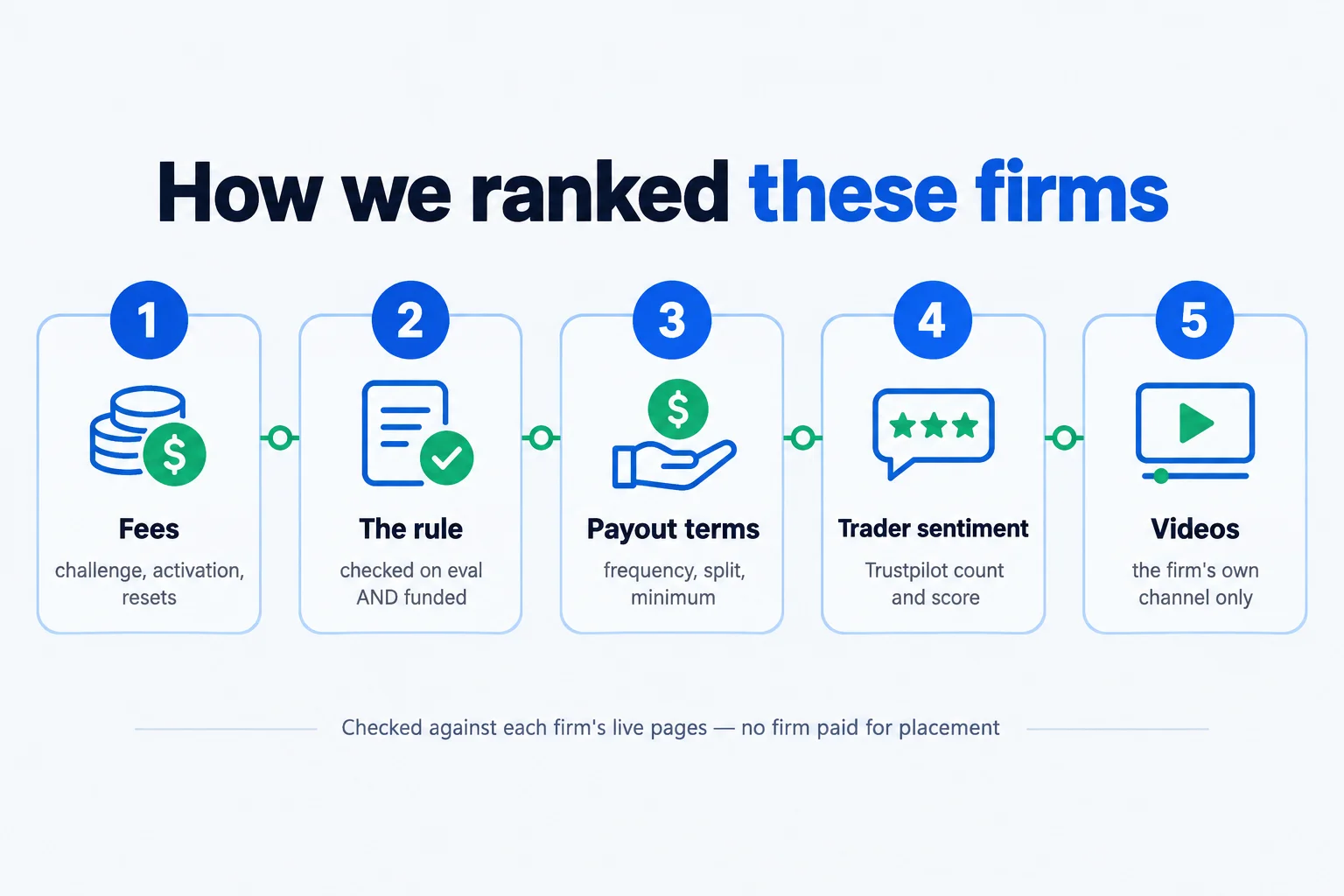
A firm’s rules rarely live on a single page. The exact numbers that end an account are split across the pricing or trading-objectives page (profit target, loss limit, drawdown percentage), a help-center or FAQ article (consistency rule, scaling plan, news and weekend restrictions), and sometimes the checkout page itself. FTMO’s funded-stage news-trading and weekend-holding restrictions, for example, exist only in two standalone FAQ articles, not on its main Trading Objectives page. Bulenox’s FAQ says there is no maximum number of trading days, while its own pricing card and Account Cancellation article publish a 30-day access window from the moment of purchase, a hidden deadline the FAQ’s wording denies exists (see Minimum trading days below for both quotes).
Read every page at three levels before you trade: the evaluation stage, the funded stage, and, where it exists, what changes again after a live call-up. Most “no consistency rule” or “no daily loss limit” marketing describes only one of those stages; My Funded Futures’ Rapid and Rapid EOD products, for instance, carry no consistency cap at the payout stage even though a non-breaching day-count check exists during the evaluation. If you have not picked a firm yet, our guide to the best prop firms for beginners and our ranking of the easiest prop firms to pass cover that decision; this guide assumes you already have a challenge in front of you and starts from the specific rule mechanics that decide whether you keep it.
Challenge structures also vary (one-step, two-step, and instant-funding products each trade rule strictness for speed differently); see our breakdown of prop firm challenges by type if you have not settled on a structure yet. This guide focuses on the rule mechanics inside whichever structure you pick.
Profit target and loss room
Your profit target and your loss room (the dollar distance from your starting balance to your drawdown floor) are two separate numbers, and their ratio decides how much margin for error you have. A firm whose floor is the same size as its target gives you no more room to be wrong than you need to be right; a firm whose floor is smaller than its target gives you even less.
| Firm and product | Phase 1 target | Loss-room floor | Floor-to-target ratio |
|---|---|---|---|
| FTMO 2-Step Challenge | $5,000 (10%) | $5,000 (10%, static) | 1.0 |
| Blue Guardian 2 Step Standard | $4,000 (8%) | $4,000 (8% equity, static) | 1.0 |
| FundingPips 2 Step Standard | $4,000 (8%) | $5,000 (10%, static) | 1.25 |
| Topstep 50K Trading Combine | $3,000 | $2,000 (EOD trailing) | 0.67 |
Topstep’s own live selector and help center quote the target and floor plainly: “Profit Target: $3,000” at $50K, against a Maximum Loss Limit of $2,000 that “rises as your end-of-day balance grows, but never moves down”. A 0.67 ratio means the floor is smaller than the target you need to clear, which leaves less room for a losing stretch than FTMO’s or Blue Guardian’s 1.0 ratio, where “Profit Target: 8% (Phase 1)” sits against an equally sized 8% equity floor.
Apex Trader Funding’s evaluation has no single profit-target dollar figure at all; qualification instead requires 5 non-consecutive days each meeting a minimum net-profit floor, a day/profit-count structure rather than a cumulative target. That changes the tactic entirely: instead of pacing toward one cumulative number, you are pacing toward a repeated daily floor, with no single large day able to finish the evaluation early.
Tactic: compute your own firm’s floor-to-target ratio before you size a single trade. A ratio under 1.0 (Topstep) needs tighter position sizing than a 1.0 ratio (FTMO, Blue Guardian) at the same account size, because the same dollar loss eats a larger share of your remaining room. A wide loss-room-to-target ratio is not itself a strategy; it only matters once you decide how to spend that room, which is exactly what the Position Sizing section below works through in dollars.
Daily loss limit and what counts toward it
A daily loss limit can measure only your closed-trade profit and loss, or it can count every open position’s floating gain or loss the instant it moves, in real time. That distinction changes whether holding a losing trade through a dip is safe or account-ending, and several firms in this set publish no daily loss limit at all, which only moves the risk control onto the overall drawdown floor instead.
FTMO’s own rule text names floating P&L explicitly: “the combined result of all closed positions plus the floating Profit and Loss of any open positions must not exceed the defined daily loss limit”, at 5% of the initial balance on the 2-Step ($2,500 at $50K). Apex Trader Funding uses the same real-time basis: “If at any moment your net intraday loss (including open positions) reaches the Daily Loss Limit (DLL), all open positions are automatically liquidated at the prevailing market price and trading is paused for the remainder of the session.”. Bulenox’s Option 1 checkout choice works the same way, trailing the account’s real-time peak including unrealized P&L, while its own Option 2 recalculates only once per day after the close.
Blue Guardian takes a third approach: its daily limit is not continuous, it is reset once per day from a snapshot. “This value resets daily at 5pm EST and is calculated using the higher value between the account balance or equity at the time of the reset.” The firm’s own worked example shows what that means in practice: “On a 100K Account, if at 5pm EST you have an open trade with a floating profit of $2,000, your account equity will be 102K. With a 4% daily drawdown, the equity cannot drop below $98,000 on the next trading day.” FundingPips builds its daily limit the same way, from “the higher of opening balance or equity” at a trader’s chosen 3% or 5%.
My Funded Futures publishes no daily loss limit at all on either Rapid or Rapid EOD, at the evaluation or the funded stage: “Does the Rapid plan have a daily loss limit? No.” Purdia, BluSky and Tradeify’s Select Flex product each publish no daily loss limit on their evaluation and funded products either; on every one of these, your only real-time protection is the overall drawdown floor covered in the next section, not a separate daily number.
Tactic: on a real-time, equity-basis daily limit (FTMO, Apex, Bulenox Option 1), size every trade so that an open, unrealized loss alone cannot reach the limit, because a position that would have recovered by the close can still end your day the moment it moves too far. On a snapshot-basis limit that resets once daily (Blue Guardian, FundingPips), manage what is open at the exact reset time deliberately: an unrealized profit open at the snapshot moment raises tomorrow’s floor in your favor, while an unrealized loss open at that moment locks in a worse floor for the next day even if the trade later recovers. On a firm with no daily loss limit published at all (My Funded Futures, Purdia, BluSky, Tradeify Select Flex), do not read that as less risk, read it as all your real-time risk control living inside the drawdown rule instead.
Drawdown type, trailing, static, or end of day, and where it locks

The overall loss floor is the single rule most likely to end a profitable-looking account, and it comes in several shapes that behave very differently once you are holding a position. A static floor is fixed to your starting balance for the life of the account and never moves. A trailing floor rises as your balance makes new highs, calculated either once per day (end-of-day, or EOD) or continuously through the trading session (intraday, counting unrealized P&L). Most trailing floors eventually lock at a fixed dollar point and stop moving altogether, but not every firm locks the same way, and not every firm’s lock is permanent.
A static floor never moves
FundedNext’s CFD Stellar 2-Step product states its floor plainly: “Maximum Loss Limit 10% Drawdown Type Static”, a fixed $5,000 at $50,000 for the life of the evaluation and the funded FundedNext Account stage, with no relock event at any payout. A static floor gives you a known, unchanging cushion from day one, but that cushion never grows as your balance does, unlike a locked trailing floor below.
An end-of-day trailing floor ignores intraday swings, until it locks
Apex Trader Funding’s EOD product recalculates its floor once per day from the prior session’s close, then stops moving entirely once it reaches a fixed point: “Apex says the EOD threshold stops increasing once it reaches starting balance plus $100. Its 50K EOD PA example gives a $50,100 stop level.” My Funded Futures runs the identical lock figure on both its products, but reaches it through two different mechanics at the same size and the same price: Rapid’s funded stage trails the “Your Max Loss trails your account equity high-water mark (HWM) during the day.”, counting every open position in real time, while Rapid EOD’s funded stage “trails upward each time your account closes at a new end-of-day high. It does not move intraday, only at the close of each trading session.” Same brand, same $209 price, same $100 lock value, genuinely different intraday risk.
FundedNext Futures locks the same way Apex does, at starting balance plus $100, but handles a payout differently from what you might expect: its own rules article states “Your first withdrawal resets the MLL to the lock point for your size”, never to $0. Topstep’s XFA does the opposite on purpose: “After your first Payout: Your MLL is set to $0 regardless of where it was before. The remaining balance becomes your effective loss floor.” A floor that resets to zero after a payout is a materially different risk than one that merely stops rising at a fixed point; confirm which your own firm does before you assume a payout made you safer.
The same firm can switch drawdown type between stages
Purdia’s 50K EOD Instant Funded product carries an end-of-day trailing floor through its Sim Funded Account (SFA) stage, not a static one, despite Purdia selling a separately named static-drawdown product at other sizes: “End-of-Day (EOD) Instant Funded Accounts are Instant Funded Accounts that utilize an End-of-Day trailing drawdown structure during the Sim Funded Account (SFA) stage.” At $50,000 specifically, “The 50K account utilizes a $2,000 profit target, a $1,500 End-of-Day trailing drawdown.” Once that SFA stage is cleared, Purdia moves the account into a Temp SFA stage that switches to a genuinely static floor with daily payouts immediately available: “The account utilizes a static drawdown structure rather than a trailing drawdown model, and there are no consistency rule requirements. Daily payouts are permitted immediately once the Temp SFA is issued.” Reading only the SFA stage, or assuming the whole product is static because a different Purdia product is, understates how the floor actually behaves at each step.
Verify before you build a strategy on this: The5ers’ own pages disagree. The5ers’ live High Stakes account selector shows “Maximum Daily Loss 4%” and “Maximum Loss 8%” at $50K, while the firm’s own FAQ states “The maximum loss is 10% of the initial balance. Daily loss is 5% of the starting equity of the day OR the starting balance of the day (the highest between them).” A $50,000 account could end at $4,000/$2,000 (selector) or $5,000/$2,500 (FAQ), and both pages were still live as of October 3, 2026, with no resolution between them. Size to the stricter 8%/4% reading and confirm directly with The5ers before trading this program.
BluSky’s own pages disagree too, so verify before you rely on either. BluSky’s rewritten help-center articles now agree with each other that its Sim Funded floor is “$100” static per account, matching its separate Sim Funded Accounts Processing article BluSky’s own homepage pricing-table script, read live the same day, still sets startingBalance: 3000, minBalance: 1000 and price: 59 for the identical 50K Launch product, a $1,000 minimum balance, ten times the help center’s $100. Trust the rewritten help-center figure over the stale homepage object, but know the discrepancy is live on BluSky’s own site as of October 3, 2026, and check both pages yourself before relying on either number.
Tactic: hold positions through intraday volatility only on an EOD-trailing or static floor, where a loss has to still be open at day’s end (EOD) or simply never trips an unmoving number (static) to matter; on an intraday-trailing floor like Rapid’s (not Rapid EOD’s), a floating loss can end the account the instant it happens, with no chance to wait for a recovery. Treat a locked trailing floor as fixed from that point forward, but confirm whether your firm’s floor merely stops rising (Apex, My Funded Futures, FundedNext Futures) or resets all the way to $0 after your first payout (Topstep), because the second case removes your entire cushion at exactly the moment you might assume you earned more room.
Consistency rules at evaluation vs funded
A consistency rule caps how much of your total profit a single day is allowed to supply, and it can apply at the evaluation, at the funded stage, only at the moment you request a payout, or not at all, depending on the firm and sometimes on which payout path you pick. The percentage itself varies almost as much as whether it applies.
FTMO’s 1-Step product applies its cap at both stages, compounding every single payout, not just the first: “50% Best Day Rule, best single day must stay at or below 50% of Positive Days’ Profit, both to pass the Challenge and to be eligible for each Reward on the funded 1-Step FTMO Account.” Topstep draws a hard, zero-tolerance line at the evaluation and a materially looser, opt-in one once funded: its Combine rule is “55% is a hard line. It is not rounded, and there is no buffer.” while the XFA funded stage only applies a 40% cap if a trader opts into the Consistency payout path at all; the XFA Standard path carries none.
Alpha Capital Group ties its 40% cap directly to a dollar worked example at the payout-request stage: “if you earn $1,000 on a particular trading day, you will be eligible to request a withdrawal only after your account balance exceeds $2,500.” FundingPips compounds its consistency cap with a separate day-count rule, but only on one specific payout cycle: its help center states the “35% Consistency Score applies only on the On Demand and Monthly reward cycles”, and the 7-profitable-day requirement (“At least 7 profitable days to qualify for a reward, each with 0.5% or more profit”) belongs specifically to the Monthly cycle, not to On Demand, which needs only the 35% score and a 2%-of-balance minimum with no day count at all.
Tradeify runs two products with opposite answers to the same question: Select’s 40% consistency cap applies only during the evaluation and disappears completely once funded, while its Growth product’s 35% cap, per the firm’s own funded-stage card, keeps applying to every single payout. Bulenox splits the same way by product: Momentum Master’s 35% cap resets every payout cycle, while the regular Master’s 40% cap is checked over the account’s entire life, never resetting.
Tactic: before requesting any payout, check whether your firm’s consistency cap applies at your current stage at all, and whether it resets per cycle or accumulates over the account’s whole life. Where a rule is opt-in (Topstep XFA, FundedNext On-Demand), you can sometimes choose the payout path with no consistency rule entirely; where it compounds with a day-count rule on one specific cycle (FundingPips Monthly), you cannot front-load the whole target on one lucky day even once you are otherwise eligible, because both conditions must clear together.
Minimum trading days and time limits
A minimum trading day count can sit at the evaluation, move entirely to the funded stage, or hide inside a calendar deadline on the pricing page that a firm’s own FAQ denies exists.
FTMO’s 2-Step requires “Min Trading days 4 days” per phase, 8 total, while its 1-Step publishes none. My Funded Futures runs two same-brand, same-price products with different day counts at evaluation: Rapid: “Minimum Trading Days 2 Days” against Rapid EOD: “Minimum Trading Days 4 Days”.
Purdia’s EOD Instant Funded product needs zero trading days to become funded at all, since no evaluation phase exists, but the day-count rule has simply moved to the stage right after: “The account requires a minimum of 10 trading days and 5 profitable trading days with at least $200 profit on each qualifying day.” before the first payout. A product marketed as “instant” or “no evaluation” can still gate your money behind a day count; it has only moved, not disappeared.
Bulenox’s FAQ and its own pricing page contradict each other on a hard deadline. Bulenox’s FAQ states “As long as you need. There is no minimum and no maximum number of trading days, reach the profit target within the drawdown rules and you’re through. You don’t have to trade every day.” Its own pricing card for the identical Qualification and Momentum products reads “$143 one-time” with “Access valid for 30 days”, and the Help Center’s Account Cancellation article confirms the account “expires automatically at the end of its access period, no renewal and no recurring charge,” with a paid reset not extending the window. Read together, you must reach the profit target within 30 calendar days of purchase or the account simply expires, a real deadline the FAQ’s own wording denies exists.
Tactic: never plan your pacing from a day-count figure alone. If a firm advertises zero minimum days, check its pricing or checkout page for a calendar access window (Bulenox), and if a firm advertises an instant or no-evaluation product, check whether the day count simply reappears at the funded stage (Purdia) before you assume you are free of it. If you trade a style this post does not cover in depth, the firm-by-firm rule tests in our guide to prop firms for scalping and our guide to prop firms for day trading go further on day-count and holding-period interactions for those specific styles.
News and weekend rules
Firms restrict news and weekend trading in three genuinely different ways: a timing blackout window around a release, a size cap on how much you can hold into a release, or an outright ban on holding any position overnight or over a weekend. Knowing which mechanic your firm uses, or whether it uses more than one, changes what you actually need to do differently.
FTMO’s restriction is a pure timing blackout, and it exists only in standalone FAQ articles, not on the main rules page: “it is not permitted to open or close any trades, including the execution of pending orders (such as Stop Loss or Take Profit), within a time window starting 2 minutes before and ending 2 minutes after the release of selected news announcements.” FTMO separately warns that “if a Stop Loss or Take Profit is triggered within the restricted time window, this will also be considered a breach” of the Account Agreement, funded stage only. Blue Guardian runs a similar timing window, but allows overnight and weekend holding with no restriction on any stage: “We have no restrictions on holding trades over night or the weekend on all account types.”
Topstep’s rule is a size cap, not a timing ban: among its named Prohibited Trading Strategies is “purposefully trading your full Maximum Position Size directly into a scheduled major news event.” That sits separate from its unrelated daily 5 PM to 3:10 PM CT trading window. FundedNext Futures and Topstep both run outright holding bans instead of a news-specific rule at all: “FundedNext Futures does not allow overnight or weekend trade holding. You must close all positions by 3:10 PM Central Time (CT) each trading day.” Tradeify is a rare exception that allows trading through news events entirely: “We do not have any rules against or guidelines around trading news events.” The firm pairs that freedom with its own warning instead of a rule: “NEVER use the Daily Loss Limit as a stop loss, system protection may not be effective during extreme volatility.”
Tactic: identify which of the three mechanics your firm actually uses before you assume a strategy works around news events. A timing blackout (FTMO, Blue Guardian) needs a buffer around the clock; a size cap (Topstep) needs smaller size, not avoidance; and a holding ban (FundedNext Futures, Topstep’s own 3:10 PM close) needs every position flat well before the deadline regardless of news at all. A rule that exists only in the FAQ (FTMO’s) is exactly as enforceable as one on the main rules page, so read both before you trade through a scheduled release.
Scaling plans and the funded-stage changes
Once funded, several firms grow your tradable balance or your profit share on a published, numeric trigger, and the shape of that trigger changes what pacing actually earns you more capital.
FTMO’s scaling plan grows the account by a flat percentage on a fixed schedule: “Get a 25% boost to your FTMO Account balance every 4 months.” To qualify, the firm requires a minimum of 4 months trading as an FTMO Trader (or since the last scale-up), at least 10% net simulated profit above the starting balance generated within that prior 4-month window, and at least 2 processed Rewards in the same period. FundedNext’s Pro Scale-Up ties growth to four separate cycles that must each individually clear a bar, not an average across them: “Demonstrate a minimum of 4% growth within each qualifying Performance Reward cycle.” A trader who clears three strong cycles and one weak one restarts the whole four-cycle clock, because the rule checks every cycle individually, on top of receiving 4 Performance Rewards and maintaining an active trading presence for a minimum of 2 months.
The5ers scales automatically on every single profit milestone, with no cycle count or time window at all: “Your account will scale up upon meeting each 10% target” (High Stakes) or each 5% target (Bootcamp), up to published ceilings. Alpha Capital Group’s trigger is a flat, non-compounding dollar gain pinned to the account’s original starting balance, even after several scale-ups already happened: “Traders who achieve 10% virtual capital growth on their trading account can request scaling. The scaling amount will be 10% of the initial account balance.”
Tactic: on a multi-cycle scaling trigger (FundedNext), treat every single cycle as its own pass/fail test, not an average, because one weak cycle resets the whole clock. On a flat, non-compounding trigger pinned to the original balance (Alpha Capital Group), budget roughly the same dollar profit for every future scale-up as for the first one, since the bar does not rise in dollar terms as your account grows.
The rule-to-tactic summary table
Every mechanic above, condensed to one row each. Read the full section for the worked dollar example and the exact quoted clauses behind each tactic.
| Rule | What it does | Tactic | Example firms | Where to check |
|---|---|---|---|---|
| Profit target | Sets the profit needed vs. your loss room | Match position size to the floor-to-target ratio | FTMO, Topstep, Blue Guardian, Apex | Rules or objectives page |
| Daily loss limit | Caps one day’s loss; may count open trades | Size for worst-case floating loss on equity-basis firms | FTMO, Blue Guardian, FundingPips, My Funded Futures | Rules page and help-center FAQ |
| Drawdown type and lock | Sets the floor: fixed, trailing, or relocking | Know if your floor rises, holds steady, or resets to $0 | Apex, My Funded Futures, Topstep, Purdia | Firm’s drawdown explainer article |
| Consistency rule | Caps one day’s share of total profit | Pace profit |