
Key takeaways
We checked 16 prop firms and 15 products against two published rule mechanics that matter specifically for a day trader who re-enters a position several times a session and holds nothing overnight: whether the funded-stage loss limit ratchets against an open trade mid-session (intraday trailing) or only recalculates once a day or never at all,…
Read the full summary
We checked 16 prop firms and 15 products against two published rule mechanics that matter specifically for a day trader who re-enters a position several times a session and holds nothing overnight: whether the funded-stage loss limit ratchets against an open trade mid-session (intraday trailing) or only recalculates once a day or never at all, and whether the firm restricts trading around scheduled high-impact news. Thirteen products clear both tests; two fail outright because their funded-stage floor trails continuously on open equity. Among futures firms, Topstep’s No Activation Fee Combine is the cheapest clean pass at $47.50 per $1,000 of loss room; among forex/CFD firms, Alpha Capital Group’s Alpha Pro 10% is cheapest at $53.40 per $1,000. A live call-up to a discretionary live account is a warning worth reading, not a ranking reason: we name it for every firm whose terms carry one.

Freshness: checked October 3, 2026. Firms change terms without notice; re-check before you buy. Each firm’s Trustpilot figure carries the date we read it.
Editorial disclosure. BestProps has no affiliate or sponsor relationship with any firm in this post (Topstep, DayTraders, Bulenox, Alpha Futures, Lucid Trading, MyFundedFutures, Tradeify, TradeDay, Top One Futures, Apex Trader Funding, Alpha Capital Group, The5ers, FXIFY, FTMO, FundingPips, Earn2Trade), and has received no money from any of them. Codes shown are uncompensated and firm-published only. No firm paid for placement or reviewed this post before publication. Full policy: affiliate disclosure.
Quick picks for day trading prop firms
- Cheapest futures pass: Topstep Combine 50K, No Activation Fee path, $47.50 per $1,000 of loss room, floor never trails intraday, no published news restriction.
- Cheapest forex/CFD pass: Alpha Capital Group Alpha Pro 10% 50K, $53.40 per $1,000, a static floor fixed for the life of the account.
- No news restriction at all: Topstep, DayTraders, Bulenox, Lucid Trading, MyFundedFutures and Tradeify all publish no news-trading restriction on their ranked product.
- Static floor (never recalculates): DayTraders Static 50K and every forex/CFD firm in this post use a static floor.
- Fastest payout cadence: Top One Futures’ Elite Daily pays every 24 hours once eligibility is met.
Why brand-level reputation misleads: a firm’s funded-stage floor and its news-trading rule are both set at the PRODUCT level, not the brand level. TradeDay sells one product (Fast Pass) that passes both day-trading tests and a second (Quick Pay) that does not, both from the same checkout page. Reading only a firm’s marketing page gets the wrong answer for several firms we checked.
What makes a prop firm good for day trading
A day trader opens and closes several positions within one session, often re-entering multiple times, and holds nothing overnight. Two published rule mechanics determine whether a firm’s product actually fits that style, and neither is the kind of fact a firm’s marketing page leads with:
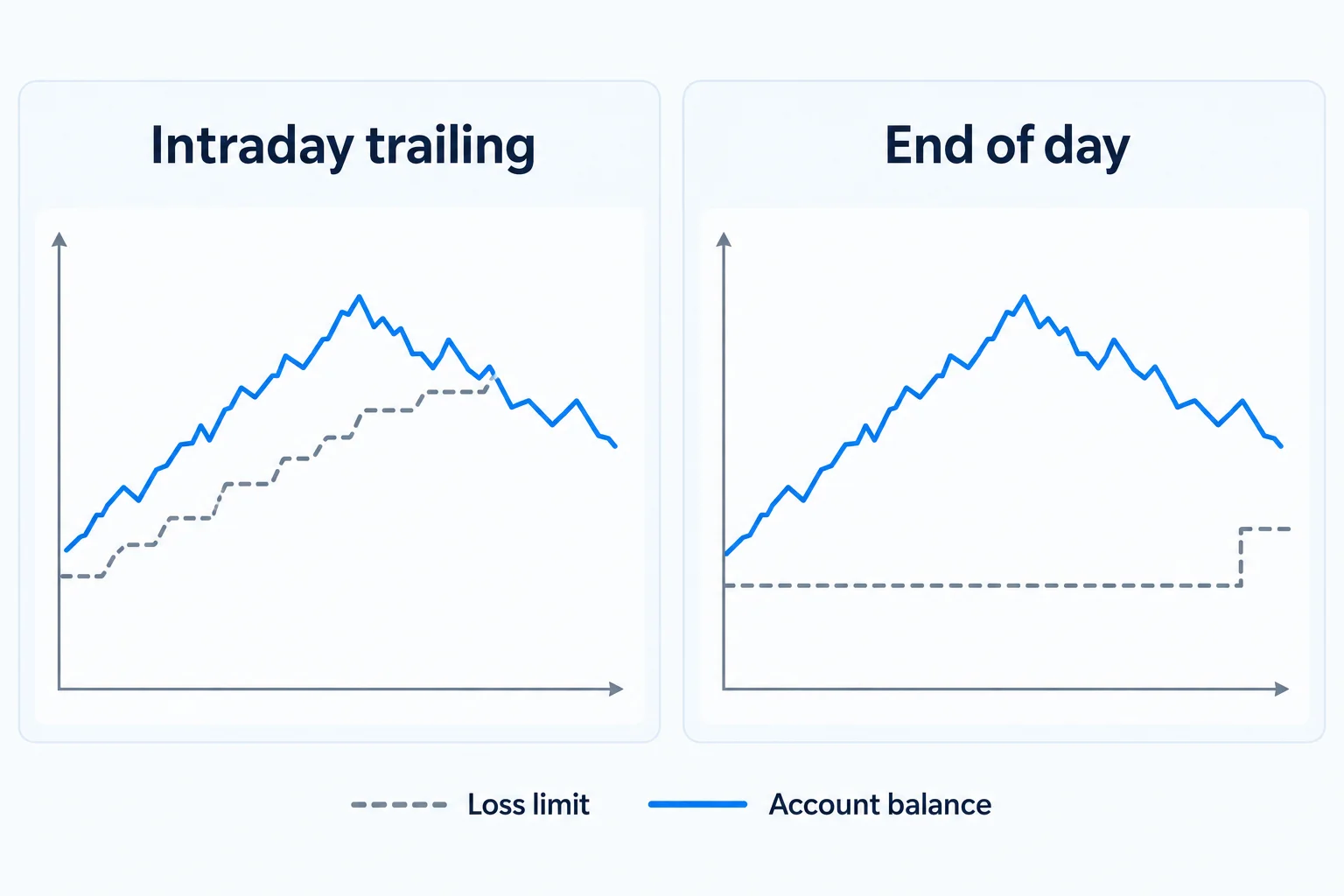
- Funded-stage floor mechanic. The product’s overall max-loss floor at the funded stage, the stage a day trader actually trades on, must not be an intraday-trailing mechanic that recalculates against open, unrealized profit while a trade is still live. A static floor never moves from the day you fund the account. An end-of-day (EOD) trailing floor recalculates once per day, after the close, from your realized balance, then often locks permanently once it reaches a milestone; either of these is workable for a day trader who re-enters often. An intraday-trailing floor is the one mechanic that fails: it moves up in real time as your unrealized profit grows, which means a normal re-entry after a pullback can trip a floor that was never designed with an open position in mind.
- News-trading rule. Whether the firm restricts trading around scheduled high-impact releases like CPI, NFP or FOMC, and if so, how narrowly. A published, dated, numeric window (commonly a few minutes before and after a named release) is something a day trader can plan around with a calendar. A vague, unscoped ban on trading during volatile periods, with no numbers and no named events, leaves a trader unable to verify in advance whether a given session is allowed at all.
A worked example. Picture a $50,000 funded account with a $2,000 floor. You open a position, it runs $1,500 in your favor on paper, and you add to it. Under an intraday-trailing floor, that $1,500 of unrealized profit can raise your floor in real time, shrinking the room you have left on the very trade you just added to, before you have closed anything. Under an end-of-day floor, that same $1,500 does nothing to your floor until the session closes; the floor only moves the next morning, calculated from your realized balance at that day’s close. A day trader re-entering several times an hour needs the second kind of floor, not the first, which is exactly why this post treats intraday-trailing as a fail rather than a mere watch-out.
News rules explained
Among the 15 products we checked, none publish a blanket, unscoped news-trading ban; the finding splits three ways instead:
- No restriction published. Topstep’s help center states plainly: “Topstep doesn’t require you to flatten positions during economic releases, in SIM or Funded Accounts,” naming exact release times purely as an informational calendar, with no lockout attached. Bulenox goes further, naming CPI, FOMC and NFP by name and stating, “No blackout windows, no forced position closing, no penalties. The only limits are your drawdown and your position size.”
- A narrow, dated window. FTMO’s funded-stage restriction is precise: “it is not permitted to open or close any trades…within a time window starting 2 minutes before and ending 2 minutes after the release of selected news announcements,” scoped to a published list of named events and instruments. Top One Futures and Apex Trader Funding both publish similarly scoped windows (4 minutes and a one-direction-per-event rule, respectively) with a named consequence for violating them.
- Auto-enforced versus conduct-reviewed. Some restrictions are enforced automatically: FTMO treats a Stop Loss or Take Profit triggered inside its window as an automatic breach of the account agreement. Others are a conduct rule reviewed after the fact: Apex Trader Funding’s one-direction rule has no automatic lockout described, only a standard enforced on review.
Quoted directly: Topstep (“doesn’t require you to flatten positions during economic releases…in SIM or Funded Accounts”), Bulenox (“No blackout windows, no forced position closing, no penalties”), and FTMO (“not permitted to open or close any trades…within a time window starting 2 minutes before and ending 2 minutes after”) show the full range this post found, from no restriction at all to a precise, plannable window.
How we checked prop firms for day trading
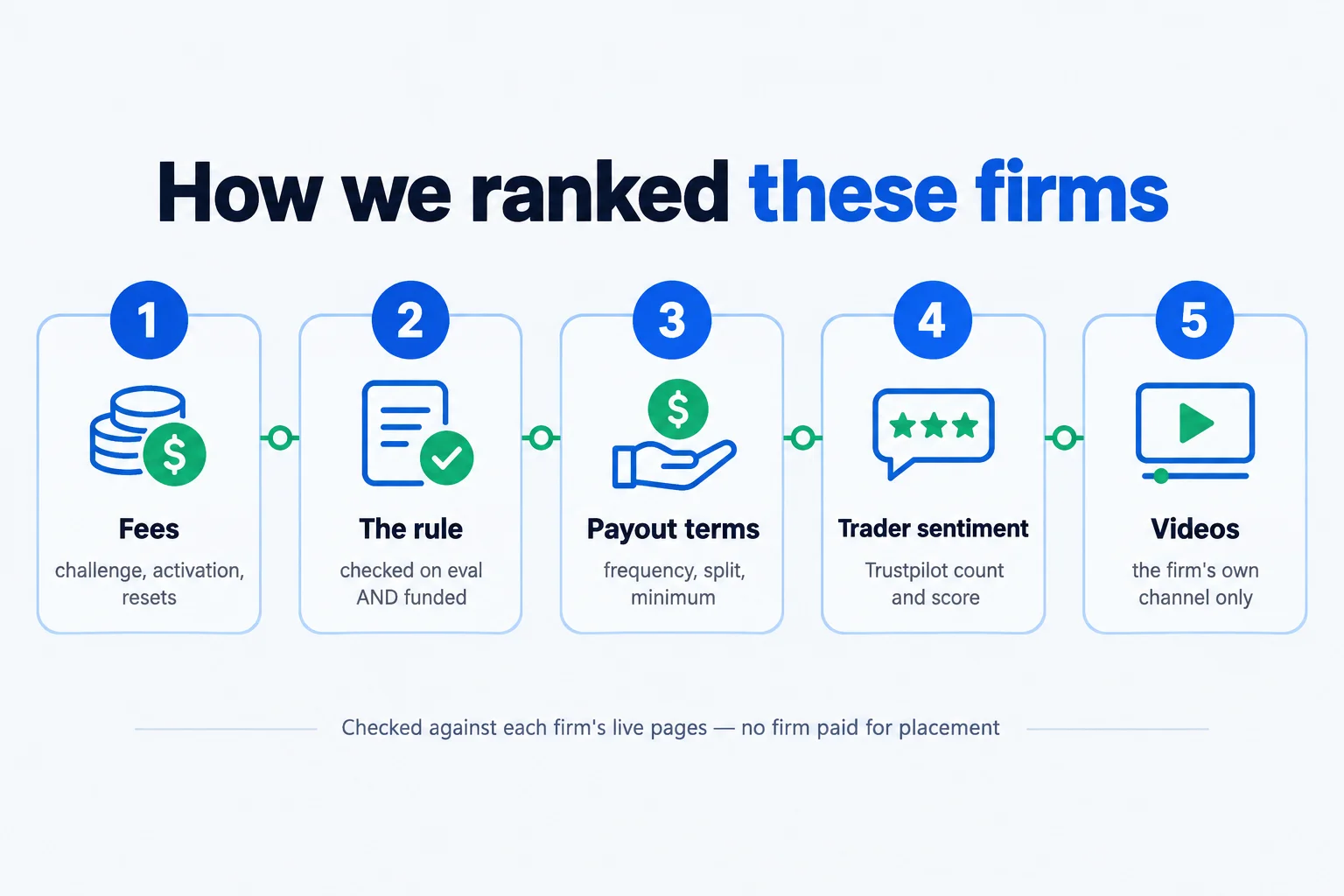
- Sources: each firm’s help centre, FAQ, rules page and terms, read October 3, 2026; never a bot vendor’s list or a competing roundup.
- Per product: we grade the funded-stage product (not the whole brand) specifically for its loss-limit mechanic and news-trading rule, which can differ from the evaluation stage and from a sibling product at the same firm.
- Rank test: a product ranks only when its funded-stage floor does not trail intraday on open, unrealized profit, and its news-trading rule, if one exists, is a dated window rather than a blanket ban.
- Cost metric: ranked products are ordered by cost per $1,000 of loss room, (list price plus activation fee) divided by the smallest overall max-loss floor in dollars, times 1,000. The floor is never a daily loss limit, a per-position rule, or a minimum balance.
- Asset classes: futures and forex/CFD firms are ranked in separate tables; a firm’s forex arm and futures arm are treated as entirely separate listings.
A discretionary live call-up is a fact to weigh, never a ranking reason: we name it for every firm whose terms carry one, and whether the trader keeps or forfeits the balance if it comes. For the full per-firm cost breakdown on futures products specifically, see our detailed futures cost breakdown for day traders. If you are weighing whether to use a prop firm at all, see prop firm pros and cons for day traders.
Futures prop firms for day trading, checked October 3, 2026
| Rank and product | Funded loss limit | News rule | Daily loss limit | Cost per $1,000 | Live stage | Payout cadence |
|---|---|---|---|---|---|---|
| 1. Topstep Combine 50K, No Activation Fee path | Static once locked (EOD, never intraday) | None published | None at all (optional add-on) | $47.50 | Non-declinable, 20% of balance kept | 5 wins/$150+, non-consecutive |
| 2. DayTraders Static 50K | Static from day one | None published, caution noted | None on this product | $55.00 | Non-declinable, up to 50% converted | On demand, $500 min |
| 3. Bulenox Momentum 50K Option 2 (EOD) | EOD, locks at start+$100 | None published, affirmative | $1,200 pause, not a breach | $63.56 | Declinable, forfeits balance | On demand, 5 days/$150+ |
| 4. Alpha Futures Standard 50K1 | EOD, locks at balance | 4-minute order block1 | No daily loss limit published | $64.50 | Declinable, forfeits group ties | Up to 4x/month, 5 days/$200+ |
| 5. Lucid Trading LucidFlex 50K, DLL on | EOD, locks at start+$100 | None published, affirmative | $1,200 pause, not a breach | $73.00 | Non-declinable, sim forfeited | On demand, 5 days/$150+ |
| 6. MyFundedFutures Builder 50K | EOD, locks at start+$100 | None published, carved out | $1,000 pause, not a breach | $76.50 | Non-declinable after 5 payouts | Every 48 hours |
| 7. Tradeify Select 50K5 | EOD, locks at start+$100 | None published, caution noted5 | No daily loss limit published | $82.50 | Non-declinable, resets to $0 | 5 wins/$150+ |
| 8. TradeDay Fast Pass 50K4 | EOD, locks at start balance | 4-release auto-flat window4 | None, trader-set in Tradovate only | $94.50 | Non-declinable, resets to $0 | 5 days/$150+, 45% cap |
| 9. Top One Futures Elite Daily 50K3 | EOD, locks at start+$100 | 4-minute window, funded only3 | No daily loss limit published | $109.00 | Non-declinable, resets to $0 | Daily, once eligible |
| 10. Apex 50K EOD2 | EOD, locks at start+$100 | One-direction-per-event rule2 | No daily loss limit published | $359.50 | Declinable, forfeits sim/vault | Up to weekly, 5 days/$250+ |
Notes on this ranking: 1 Alpha Futures’ Standard 50K carries a 2-minute order block before and after high-impact news (a 4-minute window total), named here as a watch-out, not a disqualifier; three other Standard-line variants (Zero, Advanced, Direct) are priced differently and not ranked. 2 Apex’s 50K EOD permits normal directional news trading but bans holding both long and short positions on the same news event; its $590 list price plus $129 activation fee makes it the most expensive product in this table by a wide margin. 3 Top One Futures’ 4-minute news window applies only once funded, not during the evaluation. 4 TradeDay’s Fast Pass auto-liquidates positions 2 minutes before and after 7 named Tier-1 releases (FOMC, CPI, Non-Farm Payrolls among them); its sibling product, Quick Pay, fails this post’s floor test outright and appears in the fails table below. 5 Tradeify’s floor recalculates only once a day, but is enforced continuously against net liquidation value including unrealized profit, so an open position through a volatile news spike can still breach it instantly even though the floor’s dollar value itself never recalculates mid-session.
Forex and CFD prop firms for day trading, checked October 3, 2026
| Rank and product | Funded loss limit | News rule | Daily loss limit | Cost per $1,000 | Live stage | Payout cadence |
|---|---|---|---|---|---|---|
| 1. Alpha Capital Group Alpha Pro 10% 50K6 | Static, fixed for life | 10-minute window6 | 5% hard breach ($2,500) | $53.40 | Declinable, keeps payout | On demand or bi-weekly, 80/20 |
| 2. The5ers High Stakes 2-Step 50K7 | Static, fixed for life | 4-minute window7 | 4% to 5% hard breach, page conflict | $62.25 | No call-up mechanism | Bi-weekly, 14-day wait |
| 3. FXIFY Two Phase Classic 50K | Static, fixed for life | None for this product | 4% equity hard breach | $75.80 | No call-up mechanism | 14 or 30 days |
| 4. FTMO 2-Step 50K8 | Static, fixed for life | 4-minute window, funded only8 | No separate daily limit; floor is the limit | $77.45 | No live account exists | On demand from day 14 |
| 5. FundingPips 2 Step Pro 50K9 | Static, fixed for life | 10-minute window, swing exception9 | 3% hard breach | $83.00 | Non-declinable Prime invite | Weekly 80% or monthly 100% |
Notes on this ranking: 6 Alpha Capital Group’s 10-minute window (5 minutes either side of a release) applies only once funded; the evaluation stage has no restriction. 7 The5ers’ own pages disagree on the exact floor value for this product: a size table shows an 8% floor ($4,000 at $50K), a separate current FAQ shows 10% ($5,000); we ranked on the more conservative 8%/$4,000 figure, which is the one shown here. At the FAQ’s 10%/$5,000 reading, the cost per $1,000 drops to $49.80, which would move The5ers ahead of Alpha Capital Group into first place; confirm the current figure before buying. 8 FTMO’s figure converts €345 at the European Central Bank’s October 2, 2026 reference rate of 1.1225 USD per EUR; its 1-Step product (also tested) carries an end-of-day trailing floor instead of this product’s static one and costs $71.62 per $1,000, cheaper on the metric but with a floor that recalculates daily rather than staying fixed. 9 FundingPips’ 5-minute window (10 minutes for speeches) excludes trades opened 5 or more hours before the event (the “Swing Trader Exception”); its cheaper sibling product, 2 Step Flex, was not independently tested for this post, but published at $299 against a $6,000 floor it would cost $49.83 per $1,000 if it passes the same two tests.
Futures firms ranked for day trading
Ten futures products clear both tests. Ranked by cost per $1,000 of loss room, cheapest first.
Topstep waives Reset credits for news losses instead of restricting when you can trade
Verdict: Cheapest futures pass on this post’s metric: a floor that locks permanently after your first payout, and a firm that explicitly declines to restrict news trading at all.
Video: “What Is a Topstep Express Funded Account (XFA)? | Funded Trader Payouts Explained,” Topstep official YouTube channel, 2026-05-14. Source type: vendor-produced. Why selected: Official 2-minute explainer of the funded-stage XFA covering payout rules and the Maximum Loss Limit, directly relevant to this post’s floor-mechanic test; no dedicated news-trading video exists on the official channel.
Topstep’s Maximum Loss Limit recalculates once per day at end-of-day close, never against an open position: “The MLL is a trailing limit. It rises as your end-of-day balance grows, but never moves down. Once it reaches your starting balance, it locks permanently.” At $50,000, the limit starts at -$2,000 and locks at $0 once your balance first reaches $2,000; after your first payout it is forcibly reset to exactly $0, turning your whole remaining balance into the loss cushion going forward. On news trading, Topstep states outright: “Topstep doesn’t require you to flatten positions during economic releases, in SIM or Funded Accounts,” adding that trades impacted by a release are simply not eligible for Reset-credit exceptions, a cost the firm puts on the trader rather than a restriction on when they can trade.
- Funded loss limit: Static once locked (EOD trailing before that), never intraday
- News rule: None published; Reset-credit exceptions excluded for news-driven trades
- Daily loss limit: None by default; an optional add-on doubles payout caps
- Flat-by time or weekend rule: Flat by 3:10 PM CT every weekday, no overnight holds on any product
- Consistency rule and payout cadence: 55% best-day cap raises the target rather than failing the account; payouts after 5 winning days of $150+
- Cost: $95/month (No Activation Fee path), $0 activation; $47.50 per $1,000 of loss room
- Live stage: Non-declinable; keeps 20% of cumulative balance, capped at account size
- Best for: active day traders who re-enter often with no news-trading restriction
- Watch out for: All positions must be flat by 3:10 PM CT, the Maximum Loss Limit resets to exactly $0 after your first payout, and the live call-up is non-declinable.
- Trustpilot: 3.6/5 on 14,892 reviews, read October 2, 2026. Topstep rules.
DayTraders’ Static product carries no daily loss limit at all, a rare combination
Verdict: The only futures product in this post with zero daily loss limit, on a floor fixed from day one through the funded stage.
Video: “What Is Funded Trading? How DayTraders.com Helps You Trade Without Risking Your Own Money!,” DayTraders official YouTube channel, 2025-10-10. Source type: vendor-produced. Why selected: Official-channel evaluation overview covering Trailing vs Static vs Straight-to-Funded, the closest available match to the floor mechanic graded here.
DayTraders’ Static threshold “never moves, regardless of profits,” confirmed identical at the evaluation and Pro (funded) stage in the firm’s own Drawdown Threshold Guide. Its Evaluation Account Rules and Funded Account Trading Rules state, word for word: “News Trading: is allowed. Trading during news is not recommended as liquidity can drastically decrease and volatility can drastically increase, potentially leading to unfavorable fills. Exercise caution during these times,” an explicit permission with a plain-English caution attached, not a restriction. Static is also the only one of DayTraders’ four product families with no daily loss limit whatsoever, removing one common day-trading friction point entirely, though positions can still be held overnight and over weekends, marked to market against the static floor.
- Funded loss limit: Static from day one, identical at evaluation and funded
- News rule: None published; explicit permission with a volatility caution
- Daily loss limit: None on this product at all
- Flat-by time or weekend rule: Overnight and weekend holding explicitly allowed
- Consistency rule and payout cadence: 50% best-day cap at evaluation, tightening to 30% at Pro payouts; 8 qualifying days of $200+ net for first payout
- Cost: $50 one-time (Static) plus $5 Pro activation; $55.00 per $1,000 of loss room
- Live stage: Non-declinable by inference; up to 50% of payouts over $10,000 cumulative can be converted to a live account
- Best for: day traders who want zero daily loss limit and a floor that never moves
- Watch out for: The discretionary live call-up can convert up to 50% of payouts over a $10,000 cumulative total into a live account at the firm’s sole discretion.
- Trustpilot: 4.6/5 on 495 reviews, read October 1, 2026. DayTraders vs Apex comparison.
Bulenox names CPI, FOMC and NFP directly and states no restriction applies to any of them
Verdict: An affirmative, named news-trading permission rather than mere silence, paired with a floor that locks permanently once you clear your starting balance.
Video: No official Bulenox video addresses day trading or news trading specifically, so no newer official upload exists to swap in.
Bulenox’s EOD floor “is updated once per trading day, after the market closes… Intraday fluctuations do not affect your threshold,” locking permanently at starting balance plus $100 once an end-of-day close reaches $52,600 on a $50,000 account. On news, the firm’s FAQ answers directly: “Yes. Trade straight through the economic calendar, CPI, FOMC, NFP and every other release. No blackout windows, no forced position closing, no penalties. The only limits are your drawdown and your contract limit.” The catch is that this clean EOD floor is Option 2 at checkout, priced identically to Option 1, which is a real-time intraday-trailing floor that would fail this post’s own test; a buyer must deliberately choose Option 2.
- Funded loss limit: EOD, locks at start + $100 once reached
- News rule: None published; CPI/FOMC/NFP named directly as unrestricted
- Daily loss limit: $1,200 at $50K, pauses trading for the day, not a breach
- Flat-by time or weekend rule: Flat by 3:59 PM CT every session, no overnight holding
- Consistency rule and payout cadence: 35% consistency rule at payout; 5 qualifying days of $150+ net
- Cost: $143 one-time, $0 activation; $63.56 per $1,000 of loss room
- Live stage: Declinable after 3 payouts, but the sim balance does not transfer if you decline
- Best for: active day traders who re-enter often and want an explicit, affirmative news-trading permission
- Watch out for: Option 1 (sold at the identical price) is a real-time intraday-trailing floor that would fail both day-trading tests above; the buyer must deliberately choose Option 2 at checkout.
- Trustpilot: 4.7/5 on 1,800 reviews, read October 3, 2026. Bulenox rules, status.
Alpha Futures’ 2-minute order block names its exact source, the ForexFactory calendar
Verdict: A dated, numeric news window rather than a vague caution, on a brand kept entirely separate from its forex/CFD sister, Alpha Capital Group.
Video: “Futures Trader Makes $30,000 Pay-out From a $150 Challenge,” Alpha Futures official YouTube channel, 2025-11-30. Source type: vendor-produced. Why selected: No official day-trading- or news-trading-rules explainer video exists on the firm’s channel; this is the firm’s general trader-payout story.
Alpha Futures states none of its accounts use intraday trailing: “The Maximum Loss Limit (MLL) is EOD (end of day) trailing on all of our accounts here at Alpha Futures… calculated from your account balance high at the end of each trading day, not intraday equity high like many others out there,” locking at the starting balance once the EOD high reaches it. Its news-trading policy is precise: “no orders may be executed within 2 minutes before or 2 minutes after high-impact news events,” referenced to the ForexFactory calendar by name, with a first violation drawing only a warning and subsequent violations risking a breach. The firm separately restricts strategies over 100 trades a day, automated or not, a re-entry-frequency fact worth knowing even though it is not part of the two day-trading tests above.
- Funded loss limit: EOD, locks at the account’s starting balance once reached
- News rule: 2-minute order block either side of high-impact releases (4-minute window), ForexFactory calendar
- Daily loss limit: Not published for this product
- Flat-by time or weekend rule: Flat by 4:20 PM EST; no trading Friday 5 PM EST to Sunday 6 PM EST
- Consistency rule and payout cadence: 40% consistency since last request; 5 winning days of $200+ for payout
- Cost: $129/month, $0 activation; $64.50 per $1,000 of loss room
- Live stage: Technically declinable, but forfeits all relations with the Alpha Group and the sim profit
- Best for: day traders who re-enter often and can plan around a named 4-minute news window
- Watch out for: A discretionary review can call a trader to live at 5 performance fees or a significant lifetime total; declining forfeits the sim profit and all relations with the Alpha Group.
- Trustpilot: 4.4/5 on 6,048 reviews, read September 30, 2026. Alpha Futures vs Apex comparison.
Lucid Trading’s day-trading pass sits one toggle away from a product that fails outright
Verdict: LucidFlex clears both tests at list price; a VAULT discount code can cut the per-account cost, but its sibling, LucidDaily, has the best-scoped news rule in the firm’s catalog yet fails this post’s floor test regardless.
Video: “The Closet Within: The Lucid Trading Story,” Lucid Trading official YouTube channel, 2026-05-13. Source type: vendor-produced. Why selected: Official channel lists only a brand-story video and a golf clip; no day-trading or news-trading-specific video exists.
LucidFlex uses “an End-of-Day Drawdown (EOD Drawdown) system… Once your account exceeds the Initial Trail Balance, the MLL locks and no longer moves,” fixing at $50,100 on a $50,000 account once the EOD balance exceeds $52,100. News trading is explicitly allowed on this product: “Allowed on Flex, Pro and Direct: Traders may enter or exit positions around scheduled or unscheduled news events on these plans without it being a breach.” The firm’s other day-trading-flavored product, LucidDaily, has the single best-scoped news rule anywhere in the catalog (a 1-minute window around US high-impact releases only) but its funded account “always uses an Intraday Drawdown,” which fails this post’s floor test outright regardless of which evaluation option was purchased; it is not ranked here for that reason.
- Funded loss limit: EOD, locks at start + $100 once exceeded
- News rule: None published on LucidFlex specifically; explicit permission
- Daily loss limit: $1,200 (DLL on configuration), pauses until next session
- Flat-by time or weekend rule: Flat by 4:45 PM EST; no weekend holding; resumes 6 PM EST Sunday-Thursday
- Consistency rule and payout cadence: No consistency rule once funded (50% applies only at evaluation); 5 days of $150+ for payout
- Cost: $146 one-time list ($90.20 with code VAULT, limited-time layer, no end date), $0 activation; $73.00 per $1,000 of loss room
- Live stage: Non-declinable; sim balance is retired on the move to live
- Best for: active day traders who re-enter often with an explicit, unrestricted news-trading permission
- Watch out for: LucidDaily’s daily-payout appeal hides an always-intraday funded floor that fails this post’s test outright; do not confuse it with the LucidFlex product ranked here.
- Trustpilot: 4.3/5 on 6,052 reviews, read September 30, 2026. Lucid Trading vs Topstep comparison, payouts.
MyFundedFutures carves out one plan from its own firm-wide news restriction
Verdict: Builder is the single plan at this firm with no news-trading restriction at any stage; its three siblings all restrict news trading once funded, even though their evaluation stage allows it.