
Key takeaways
“Easiest to pass” is usually claimed, never measured.
Read the full summary
“Easiest to pass” is usually claimed, never measured. We computed a Pass Margin Ratio for 19 products across 18 prop firms at $50,000: the overall max-loss floor in dollars divided by the total profit target in dollars, same product, summed across every phase to funded. E8 Markets and FTMO tie for the highest evaluation-stage ratio (1.00), and we separately checked whether that forgiveness survives once you are funded, where some firms tighten, switch to an intraday-trailing floor, or replace the target with a much smaller first-payout gate. No firm in this post publishes a verified pass rate; the ratio is the closest comparable measure we could compute from each firm’s own published numbers.

Freshness: checked October 3, 2026. Firms change terms without notice; re-check before you buy. Each firm’s Trustpilot figure carries the date we read it.
Editorial disclosure. BestProps has no affiliate or sponsor relationship with any firm in this post (E8 Markets, FTMO, Earn2Trade, Bulenox, FundedNext, FundingPips, Alpha Capital Group, Topstep, TradeDay, Tradeify, Apex Trader Funding, MyFundedFutures, Take Profit Trader, BrightFunded, FXIFY, AquaFunded, The5ers or Phidias), and has received no money from any of them. Codes shown are uncompensated and firm-published only. No firm paid for placement or reviewed this post before publication. Full policy: affiliate disclosure.
Easiest prop firms to pass, quick answer
- Highest eval-stage ratio: E8 Markets and FTMO, tied at 1.00. Loss room equals the profit required, no more.
- Easiest futures firm to pass: Earn2Trade’s TCP25, the single highest eval-stage ratio in this post (0.857), though its Live account later shifts to an intraday-trailing floor.
- Easiest forex/CFD firm to pass: E8 Markets’ E8 Pro, a genuinely static floor with no consistency rule at the evaluation stage.
- Easiest that stays easy once funded: E8 Markets, the biggest eval-to-funded jump (1.00 to 8.00) on a floor that is confirmed static throughout.
- Cheapest of the easy ones: Topstep at $95 a month, tied with ten other firms at a 0.67 eval-stage ratio.
A high ratio is not the same as a verified pass rate; no firm in this post publishes one. It is a computed measure of how much loss room you are given relative to how much profit you must show, built entirely from each firm’s own published rules.
What makes a prop firm easy to pass
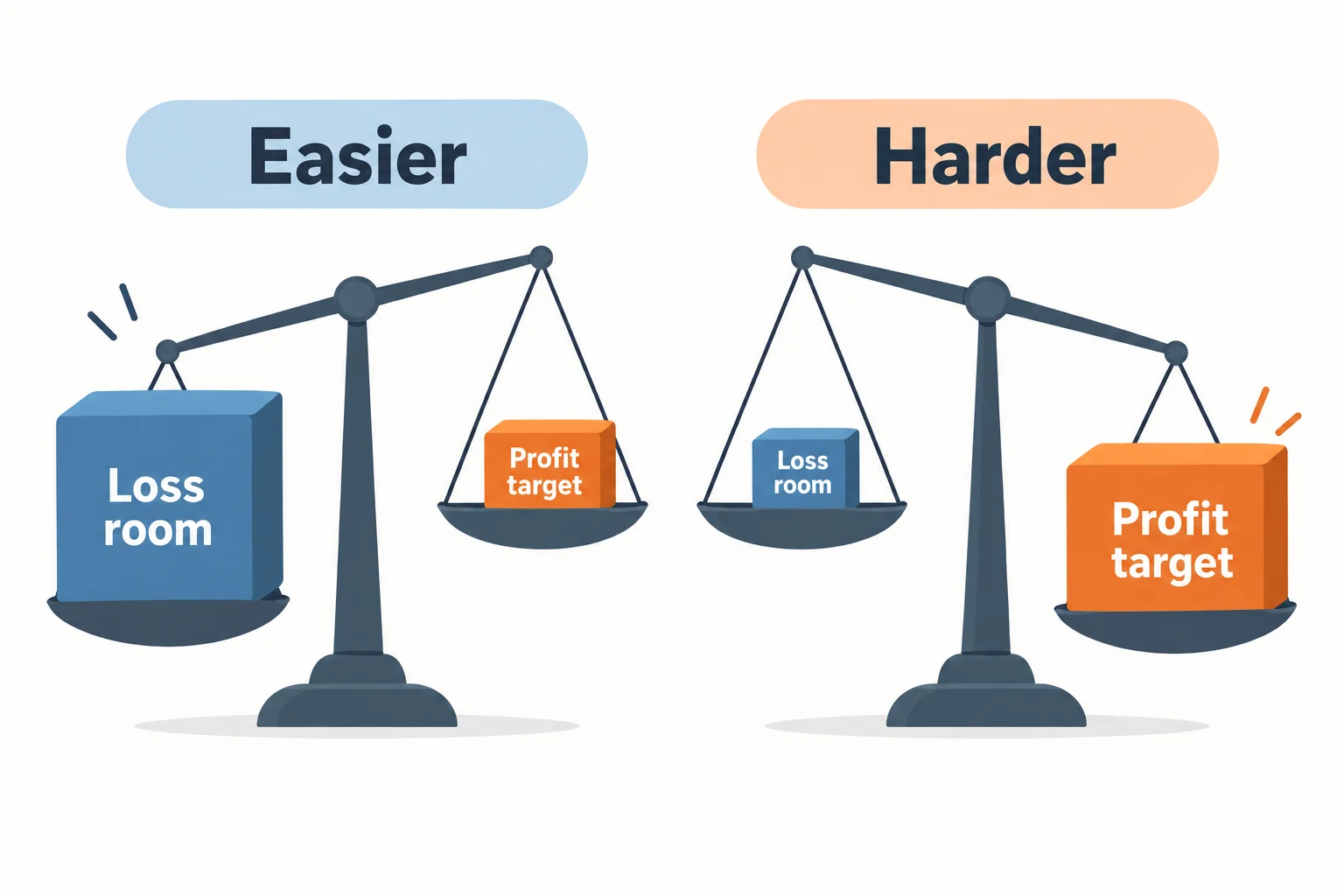
The ratio, in plain words. Pass Margin Ratio equals the overall max-loss floor in dollars, divided by the total profit target in dollars, on the same product and the same $50,000 account size. A ratio of 1.00 means you are allowed to lose exactly as much as you must make. A ratio of 0.50 means you must make twice what you are allowed to lose, a genuinely harder test even if the headline profit target looks small in isolation.
Worked example. Take a $50,000 account with a $5,000 max-loss floor and a $5,000 profit target: the ratio is 1.00 (5,000 divided by 5,000). Now take a $50,000 account with the identical $5,000 floor but a two-phase $7,500 combined target: the ratio drops to 0.67 (5,000 divided by 7,500), a harder test even though the loss room never changed. This is why a cheap, low-looking profit target is not automatically the easiest option: it has to be measured against the loss room allowed on the exact same product.
Floor type matters as much as the ratio. A static floor is a fixed dollar amount for the whole period, never moving. An end-of-day (EOD) trailing floor recalculates once a day and can only rise, never fall, locking in gains as you make them. An intraday-trailing floor recalculates continuously on open, unrealized profit and loss, which means an in-progress winning trade that later gives back profit can trigger a breach before you ever close it and bank the gain. This post excludes any product whose evaluation-stage floor is intraday-trailing from its ranked list, though it still reports that product’s on-paper ratio, clearly labeled.
Does the easy part survive once you are funded? Every page-1 competitor for this keyword describes only the evaluation stage’s forgiveness. This post explicitly checks the funded stage too: whether the same floor type and dollar figure carry over, or whether a first-payout gate quietly becomes the new, much smaller target, or whether the floor itself changes type, tightening from static or EOD trailing to intraday trailing the moment you are funded.
Consistency rules, minimum trading days, and time limits do not move this post’s ranking metric, but they do make passing, or getting paid, materially harder in practice; each firm block below names the specific rule that bites, and where it applies.
How we checked the easiest prop firms to pass
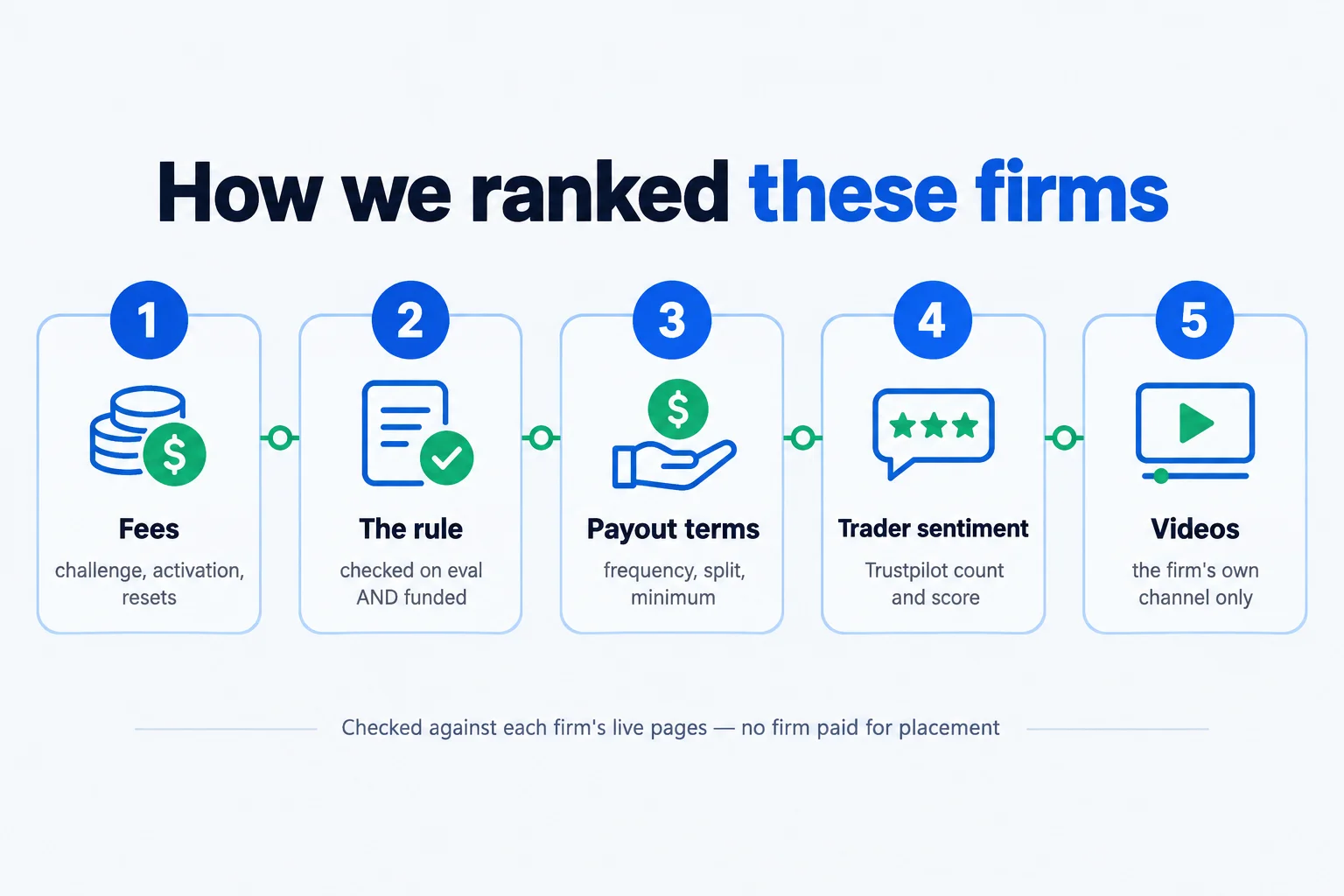
- Sources: each firm’s own rules page, help center, and pricing or checkout page, read October 3, 2026; never a third-party roundup or affiliate site.
- Per product: we grade one named product per firm, the one that scores best on this post’s funded-stage test, at the $50,000 size.
- The ratio: overall max-loss floor in dollars, divided by the total profit target in dollars summed across every phase to funded, same product and size.
- Rank test: a product ranks only when its evaluation-stage floor is static or end-of-day trailing, never intraday-trailing; an intraday floor is reported on paper only, in the checked-not-ranked table.
- Funded-stage check: every ranked firm block states whether the same floor type and ratio survive into the funded stage, or what replaces them.
A discretionary live call-up is a fact to weigh, never a reason to rank a firm lower or mark it as a failed test; it is reported in each firm’s Live stage line exactly as the firm’s own pages describe it. A hidden Trustpilot rating is likewise never a ranking reason, reported plainly where it applies.
Easiest prop firms to pass, ranked by Pass Margin Ratio
One ranked table, futures and forex together: the ratio is unit-free, so every eligible product is sorted on the same scale regardless of asset class. Ties share a rank number.
| Rank, firm/product | Loss room / target ($) | Pass Margin Ratio | Floor type | Funded-stage ratio | Price at $50K | Live stage |
|---|---|---|---|---|---|---|
| 1. E8 Markets | $4,000 / $4,000 | 1.00 | Static | 8.00 | $228 | No live stage |
| 1. FTMO‡ | $5,000 / $5,000 | 1.00 | EOD trailing | No 2nd target | $358 | No live stage |
| 3. Earn2Trade† | $1,500 / $1,750 | 0.857 | EOD trailing | On paper only | $150/mo | Not declinable |
| 4. Bulenox | $2,500 / $3,000 | 0.83 | EOD trailing | 0.96 | $175 + $148 | Not declinable |
| 5. FundedNext | $4,000 / $6,000 | 0.67 | Static | 200.0 | $230 | No live stage |
| 5. FundingPips | $6,000 / $9,000 | 0.67 | Static | 12.0 | $299 | Not declinable |
| 5. Alpha Capital Group | $5,000 / $7,500 | 0.67 | Static | 5.00 | $267 | Not published |
| 5. Topstep | $2,000 / $3,000 | 0.67 | EOD trailing | 2.67 | $95/mo | Not declinable |
| 5. TradeDay | $2,000 / $3,000 | 0.67 | EOD trailing | 2.67 | $189/mo | Not declinable |
| 5. Tradeify | $2,000 / $3,000 | 0.67 | EOD trailing | 2.67 | $165 | Not declinable |
| 5. Apex Trader Funding | $2,000 / $3,000 | 0.67 | EOD trailing | 1.60 | $590 + $129 | Not declinable |
| 5. MyFundedFutures | $2,000 / $3,000 | 0.67 | EOD trailing | 0.95 | $225 | Not declinable |
| 5. Take Profit Trader† | $2,000 / $3,000 | 0.67 | EOD trailing | On paper only | $170/mo + $130 | Invitation only |
| 5. BrightFunded§ | $5,000 / $7,500 | 0.67 | Static | Not published | $333 | No live stage |
| 5. FXIFY | $5,000 / $7,500 | 0.67 | Static | No 2nd target | $379 | No live stage |
| 16. Earn2Trade TCP50 | $2,000 / $3,000 | 0.67 | EOD trailing | On paper only | $190/mo | Not declinable |
| 17. AquaFunded | $4,000 / $6,500 | 0.62 | Static | Not computable | $317 | No live stage |
| 18. The5ers¶ | $4,000 / $7,500 | 0.53 | Static | 26.67 | $249 | Not published |
| 19. Phidias | $650 / $2,500 | 0.26 | Static | 0.26 | $723 | Not published |
Notes on this ranking: † Earn2Trade and Take Profit Trader pass the evaluation-stage test cleanly, but each firm’s own funded or live account shifts to an intraday-trailing floor, disqualifying the funded stage; their on-paper funded ratio is shown in each firm’s own block. ‡ FTMO’s price is converted from euros at the ECB reference rate for October 2, 2026 (EUR/USD 1.1225); its funded-stage figure has no second profit target to divide by, so the huge ratio reflects the absence of a second target, not a loosening floor; see the Best Day Rule explained in FTMO’s block. § BrightFunded’s price is converted from euros at the same ECB rate; its funded-stage floor type is not confirmed on the firm’s own pages and is shown as not published rather than assumed static. ¶ The5ers’ own pages disagree on the floor value itself at $50,000 (8%/$4,000 on the size table versus 10%/$5,000 on a separate FAQ); this post ranks on the more conservative table reading and shows the FAQ’s alternate ratio (0.67) here for comparison.
Also checked, not ranked
Every product below shares an evaluation-stage floor that trails the real-time equity peak, including open, unrealized profit and loss, intraday. Per this post’s rule, that disqualifies a product from the ranked table above, even though its on-paper ratio would otherwise place it competitively. Each is a named sibling of a ranked firm above; see that firm’s block for full detail on the ranked alternative.
Bulenox Qualification 50K, Option 1
The checkout’s default-styled option at the identical $175 price (plus the same $148 Master activation fee) and $50,000 size as the ranked Option 2 above. Its floor trails the real-time equity high-water mark, including open, unrealized profit and loss, rather than locking at the end of the day. On-paper eval ratio 0.83 (2,500 / 3,000), identical to Option 2’s number, but excluded from ranking because the floor type is intraday-trailing.
BrightFunded 1-Step, 50K
BrightFunded’s single-phase product at $50,000. Its 6% max-loss floor trails the real-time equity peak, including floating, unrealized profit and loss, disqualifying it at the evaluation stage. On-paper eval ratio 0.60 (3,000 / 5,000), worse than the ranked 2-Step Classic’s 0.67 even before the floor-type exclusion.
FXIFY One Phase, 50K
FXIFY’s single-phase product at $50,000. Its 6% floor trails the real-time equity peak intraday rather than locking at end of day, disqualifying it at the evaluation stage. On-paper eval ratio 0.60 (3,000 / 5,000).
AquaFunded 2 Step Pro and 1 Step Standard, 50K
Both products trail the real-time equity peak, including open, unrealized losses, at the evaluation stage, disqualifying each from this post’s ranked list. AquaFunded’s own 2 Step Standard, the genuinely static product, is ranked above instead.
Alpha Capital Group Alpha One 10% and Alpha Direct, 50K
Alpha One 10% (1-Step, $277 one-time) and Alpha Direct (instant funding, no evaluation phase, $257 one-time) both use a floor the firm itself describes only as trailing, based on high-water mark, with no page confirming whether that trail recalculates intraday or only at day’s end. On-paper eval ratio for Alpha One would be 0.60 (3,000 / 5,000); Alpha Direct has a $0 profit target by definition, since it skips the evaluation phase entirely. Neither is ranked here because the floor type is not confirmed non-intraday.
Notes on this table: an intraday-trailing floor can trigger a breach on an open, unrealized loss before a trade is ever closed and the stated loss room is usable, which is why this post treats it as a disqualifying trap rather than a genuinely easier path, regardless of how favorable its on-paper ratio looks.
Firms ranked by Pass Margin Ratio
In rank order. Every figure below traces to the firm’s own published rules, read on the date shown at the top of this post.
E8 Markets ties for first on the eval ratio, then multiplies it eightfold once funded
Tied for the widest eval-stage pass margin here, and the single largest funded-stage jump of any firm we checked
Video: “Consistency Rule Explained in 2 minutes (Best Day rule),” E8 Markets official YouTube channel, May 21, 2026. Why selected: E8’s own explainer of the Best Day consistency rule, the clearest official video naming the funded-stage condition that applies to this exact product.
E8 Pro, E8’s branded “8% Static Drawdown” product, sets an $4,000 loss floor against a $4,000 profit target at $50,000, a 1.00 Pass Margin Ratio: you are allowed to lose exactly as much as you must make. The floor is genuinely static, fixed at 8% of the $50,000 starting balance for the life of the account, never trailing up or down with price movement or an account high-water mark.
- Loss room and targets: $4,000 static floor vs a $4,000 profit target (8% vs 8% of $50,000). Ratio 1.00 (4,000 / 4,000).
- Funded-stage test: The $4,000 static floor survives unchanged into the funded stage. The first-payout gate is just 1% gross profit ($500), so the funded-stage ratio jumps to 8.00 (4,000 / 500), the single biggest eval-to-funded jump of any firm in this post.
- Other rules that make passing harder: No consistency rule and no minimum trading days on E8 Pro. A 2% daily profit cap limits how much of a single day’s gain counts toward the target, and 50% of every payout cycle’s profit is withheld as a buffer before the split applies.
- Fee: $228 one-time at $50,000 (list price).
- Payout rules: Daily on request once the buffer clears; 80% default split, selectable up to 100% at a higher checkout price; $100 minimum payout firm-wide.
- Live stage: No live-funded transition exists at E8; every account, including funded ones, stays in a simulated setting powered by real market data.
- First watch-out: The 2% daily profit cap means a single huge day does not count fully toward the target, so the easy-looking ratio still takes multiple good days to realize in practice.
- Best for: the single largest jump from eval-stage ease to funded-stage ease on a genuinely static $50K floor
- Trustpilot: rating hidden (“breach of our guidelines” banner), 3,301 reviews. E8 Markets profile, rules.
FTMO’s 1-Step ties for first on the eval ratio, but its funded ratio is a different kind of number entirely
Ties for the widest eval-stage pass margin among the largest, most-reviewed firms in this post
Video: “FTMO 1-Step Challenge Explained: All 4 Rules You Must Know,” FTMO official YouTube channel, March 22, 2026. Why selected: FTMO’s own explainer of the 1-Step’s four core rules, the clearest official source for the exact numbers graded here.
FTMO sells both a 1-Step and a 2-Step Challenge at $50,000. The 1-Step scores the higher eval-stage ratio (1.00 versus the 2-Step’s 0.67) because it has only one profit target to clear instead of two phases summed together, so this post grades the 1-Step. Its loss floor is end-of-day trailing, not static: it recalculates once a day and can only rise, never fall.
- Loss room and targets: $5,000 EOD-trailing floor vs a $5,000 profit target (10% vs 10% of $50,000). Ratio 1.00 (5,000 / 5,000). The 2-Step scores 0.67 ($5,000 floor against a combined $7,500 two-phase target) with a static, never-trailing floor instead.
- Funded-stage test: The funded-stage figure is not a real 250:1 margin. FTMO does not publish a second dollar profit target once funded; instead, every Reward request is gated by the 50% Best Day Rule, which requires no single day to account for more than half of the profit being withdrawn. That rule, not a shrinking loss floor, is the real test once you are funded.
- Other rules that make passing harder: The 1-Step’s €319 entry fee is never refunded, unlike the 2-Step’s €345 fee, which is refunded in full with the first Reward. The 50% Best Day Rule applies to every Reward request for the life of the account, not just the first one.
- Fee: $358 (€319, converted at the ECB reference rate for October 2, 2026, EUR/USD 1.1225), non-refundable.
- Payout rules: On request from day 14 after the first placed trade on the funded account; 1-Step pays 90% from the first Reward with no rollover option; $20 minimum (bank wire).
- Live stage: No live-funded transition exists; FTMO accounts trade on fully fictitious funds with real market quotes for the life of the account.
- First watch-out: The huge funded-stage number comes from the absence of a second target, not from a loosening floor. The 50% Best Day Rule can stall a payout request without the account ever breaching a rule.
- Best for: the highest eval-stage Pass Margin Ratio on a $50K single-phase product among the largest, most-reviewed firms here
- Trustpilot: 4.8/5 on 53,666 reviews. FTMO profile, rules.
Earn2Trade’s TCP25 posts the highest eval-stage ratio here, then its floor changes shape at the funded stage
The highest eval-stage ratio of any firm in this post, on its smallest and cheapest size
Video: “How Does The Trader Career Path Work? Learn About Earn2Trade's Scaling Plan,” Earn2Trade official YouTube channel, February 23, 2022. Why selected: Earn2Trade’s own walkthrough of how the Trader Career Path scales, the clearest official explanation of the LiveSim-to-Live progression graded below.
Earn2Trade’s Trader Career Path TCP25, its smallest and cheapest size, sets a $1,500 end-of-day trailing floor against a $1,750 profit target, the single highest eval-stage Pass Margin Ratio of any product in this post. The identical pattern repeats at the $50,000 TCP50 size (a $2,000 floor against a $3,000 target, ratio 0.67, same floor type).
- Loss room and targets: $1,500 EOD-trailing floor vs a $1,750 profit target (TCP25, $25,000 size). Ratio 0.857 (1,500 / 1,750).
- Funded-stage test: The eval-stage floor and ratio survive unchanged into the LiveSim funded sub-stage. But every LiveSim account eventually moves to a real-money Live account, either at the trading partner’s discretion or automatically once the profit target is hit, and the Live account’s floor changes shape: it recalculates continuously on open, unrealized equity rather than locking at the end of the day. That intraday-trailing floor excludes the Live sub-stage from this post’s ranking at the funded stage; its figures are shown on paper only.
- Other rules that make passing harder: A daily loss limit ($550 at TCP25) ends the account outright on open-plus-closed profit and loss, not just closed trades, and is separate from the ranking floor itself. A $139 one-time LiveSim activation fee is deducted from the first withdrawal.
- Fee: $150/month (TCP25, $25,000 size, Earn2Trade’s smallest and cheapest; dynamic pricing).
- Payout rules: Weekly, processed Wednesdays; 50% split on a single withdrawal under $1,500, rising to 80% at or above that threshold; $100 net minimum.
- Live stage: Exists, and it is where the ratio collapses: a trader cannot decline the automatic move from LiveSim to a real-money Live account, and the floor’s own type changes once there.
- First watch-out: This is a live-stage floor-type change, not a small detail: the strong eval-stage ratio is real, but it survives only in the simulated LiveSim sub-stage, not in the real-money Live account every trader eventually reaches.
- Best for: the highest eval-stage margin (0.857) on the cheapest size, if you plan around the Live-account floor change
- Trustpilot: 4.6/5 on 5,013 reviews. Earn2Trade profile.
Bulenox scores well on this test, but only on the option the checkout does not default you toward
A clean eval-stage ratio once you pick the right option off a confusing two-choice checkout card
Video: No official Bulenox video addresses the evaluation rules directly; this post relies on the firm’s own help-center text for every figure graded here.
Bulenox’s Qualification Account $50,000 checkout offers a binary choice, and only one option belongs in this post. Option 2 (end-of-day drawdown) sets a $2,500 floor against a $3,000 profit target, a clean 0.83 eval-stage ratio. Option 1, sold at the identical price and size, uses an intraday-trailing floor instead and is excluded from this post’s ranked list (see the checked-not-ranked table below).
- Loss room and targets: $2,500 EOD-trailing floor vs a $3,000 profit target (Option 2). Ratio 0.83 (2,500 / 3,000).
- Funded-stage test: The same EOD-trailing floor and dollar amount carry into the Master funded account, against a $2,600 first-payout gate. Funded-stage ratio 0.96 (2,500 / 2,600), essentially unchanged from the evaluation stage.
- Other rules that make passing harder: A fixed 30-day access window from purchase, not a trading-day count, despite marketing both options as having no minimum trading days. A reset does not extend that window.
- Fee: $175 one-time, Option 2 Qualification 50K (list price), plus a $148 Master activation fee due on passing; $323 all-in.
- Payout rules: Weekly, processed Wednesdays; 100% of the first $10,000 earned (counted once per trader across every account), then 90/10; $1,000 minimum.
- Live stage: Exists, and is not declinable: profits and balance do not transfer to the new Funded Account, which starts its own fresh Initial EOD Drawdown regardless of which option you choose.
- First watch-out: The checkout’s default styling favors Option 1, the intraday-trailing choice that does not qualify for this post’s ranking; read the Option 2 description carefully before buying.
- Best for: a clean eval-stage ratio (0.83) that survives almost unchanged into the funded stage, once you pick the EOD option
- Trustpilot: 4.7/5 on 1,800 reviews. Bulenox profile, rules.
FundedNext’s Stellar Lite ties the pack on the eval ratio, then posts the largest funded-stage jump of any firm here
The biggest eval-to-funded jump among the tied firms, on a product priced below FundedNext’s own easier-scoring sibling
Video: “Restart Your Trading Account: Resetting FundedNext Account | FundedNext Explained,” FundedNext official YouTube channel, January 9, 2024. Why selected: FundedNext’s own explainer of how account resets work, the closest official video to this product’s rules; no dedicated Stellar Lite walkthrough exists.
Stellar Lite sets a $4,000 static floor against a two-phase $6,000 total profit target ($4,000 at Phase 1 plus $2,000 at Phase 2) at $50,000. FundedNext’s own Stellar 2-Step scores mathematically higher on this exact test (0.77, a $5,000 floor against a $6,500 two-phase target), but Stellar Lite is the product graded here because of its funded-stage result.
- Loss room and targets: $4,000 static floor vs a $6,000 total profit target across two phases (8% then 4%). Ratio 0.67 (4,000 / 6,000).
- Funded-stage test: FundedNext does not publish a second dollar profit target once funded; the first-payout gate is just a $20 minimum. Using that minimum as the denominator, the funded-stage ratio balloons to 200.0 (4,000 / 20), the largest jump among every firm tied at 0.67 in this post.
- Other rules that make passing harder: All three $50,000 Stellar variants tie the loss-floor breach to equity, including unrealized profit and loss on open trades, not closed balance alone. Daily loss limits (5% on Lite) are equity-based and end the Challenge on breach.
- Fee: $230 one-time, Stellar Lite 50K (list price).
- Payout rules: 21 days after the first funded trade, then recurring bi-weekly; 80% starting split on all three $50,000 variants, rising to 90% via a scale-up; $20 minimum (USDT/USDC).
- Live stage: FundedNext’s only live-money path on the CFD side is an optional post-payout transfer of an already-paid reward to a sister broker, not a forced transition off the simulated account.
- First watch-out: Stellar Lite’s challenge fee is refunded only at the third Performance Reward, unlike the 2-Step, which refunds sooner; choosing the better funded-stage number costs a slower refund.
- Best for: the cheapest $50K static-floor eval with the biggest funded-stage margin against a $20 payout minimum
- Trustpilot: 4.5/5 on 80,702 reviews. FundedNext profile, rules.
FundingPips’ 2 Step Flex carries the firm’s biggest static floor, and ties its own 1 Step Flex on the eval ratio
The largest static headroom at $50,000 among FundingPips’ own products, tied with one of its own sibling plans
Video: “FundingPips Pro is crafted for traders looking for a more affordable 2-Step Model,” FundingPips official YouTube channel, April 25, 2025. Why selected: FundingPips’ own comparison of its Pro model against Flex, the clearest official source distinguishing the product graded here from its siblings.
2 Step Flex sets a $6,000 static floor (FundingPips’ largest headline floor at $50,000) against a two-phase $9,000 total profit target. FundingPips also sells 1 Step Flex at the identical $6,000 floor against a single $6,000 target, a mathematically easier 1.00 ratio, at a higher sticker and no minimum trading days; it is not the product graded here because this post prices the firm’s most-purchased $50K plan.
- Loss room and targets: $6,000 static floor vs a $9,000 total profit target across two phases (10% then 8%). Ratio 0.67 (6,000 / 9,000).
- Funded-stage test: The $6,000 static floor survives unchanged into the Master funded stage. The first-payout gate is a $500 minimum (1% of the $50,000 size), so the funded-stage ratio climbs to 12.0 (6,000 / 500).
- Other rules that make passing harder: FundingPips’ own breach-condition language tests equity or balance, whichever falls first, so an open losing trade can breach the floor before anything closes. A Strike System tied to one trade idea’s loss cuts the funded split on repeat warnings.
- Fee: $299 one-time, 2 Step Flex 50K (list price).
- Payout rules: Bi-weekly at 80% (or 95% with 3 profitable days at 0.5% each per phase), or monthly at 100% with a 35% consistency requirement and 7 profitable days; $500 minimum.
- Live stage: FundingPips has no live-funded transition to decline; a discretionary call-up converts unpaid Master profit into non-cash Prime capital rather than paying it out directly.
- First watch-out: Reddit sentiment on this firm turned sharply negative in a mid-2026 wave of payout-related account closures tied to device matching, a buyer-sentiment signal worth factoring in alongside the clean ratio.
- Best for: the largest headline eval-stage floor ($6,000) among FundingPips’ own $50K sta