Key takeaways
The Inner Circle Trader’s roughly 33-minute YouTube video published 18 September 2025 walks through a one-contract demonstration short in Nasdaq futures using a Turtle Soup failure above a pre-session high, where buy stops are deemed taken and breakout buyers exposed before a reversal toward downside liquidity.
Read the full summary
The Inner Circle Trader’s roughly 33-minute YouTube video published 18 September 2025 walks through a one-contract demonstration short in Nasdaq futures using a Turtle Soup failure above a pre-session high, where buy stops are deemed taken and breakout buyers exposed before a reversal toward downside liquidity. The plan requires price to move through an inversion fair value gap and remain in its lower half, allowing an upper-half wick but no candle body established above the upper portion, with the stop vulnerable to a spike above the gap. Repeated objectives include the transcribed 24,715.50 low and the seven o’clock pre-session low, while traders buying above the transcribed 24,730 level are described as caught long. ICT says commissions were covered, banks part of the move as a steak dinner, then leaves the position running while cooking an omelet with sweet potato and berries. The example is explicitly framed as a demo rather than verified real-money performance, and its entry, stop, fills and result were not independently confirmed because the article relies on automatic transcription without chart review. Price references including 764.5, 64.25, 723, 714, 715.50 and 730 may be mistranscribed and should be checked against the video. CME specifications cited by the article define Micro E-mini Nasdaq-100 futures as $2 times the index with a 0.25-point minimum tick, while the main educational takeaway is to mark intraday liquidity pools before price reaches them and build prioritisation skill through months of annotation.
How we researched this article
BestProps used document-based research from primary firm sources, checked September 25, 2026. The complete source list, scope, limitations, and commercial-state record appear near the end of this article.
The lesson mapped to this page is Cooking breakfast and NQ…, a first-party upload from The Inner Circle Trader published on Thursday 18 September 2025 and running about thirty-three minutes. ICT narrates a bearish Nasdaq futures idea from before the opening bell, keeps talking through the session as the position works, and then cooks breakfast on camera while the trade is still on. The title is literal: the cooking is the interlude, and the market content is a continuous walkthrough of how he organises an intraday premises around a pre-session high and the liquidity he has marked below it.
No captions were published for this upload, so this article was written from an automatic transcription of the full original audio. The transcription mangles specialist phrases and renders the price levels inconsistently, and those points are flagged rather than smoothed over. The reviewer read the timestamped transcript and did not see the charts, so no level, candle, order or fill is independently confirmed here.
One detail matters for how the whole recording should be read: ICT describes the position as a demonstration. At 17:38 he says he would rather be stopped out and be “quote-unquote profitable in this demo example” than hold a scenario that has become less likely. Nothing below should be read as a real-money performance record.
ICT Turtle Soup Trade Above the Pre-Session High
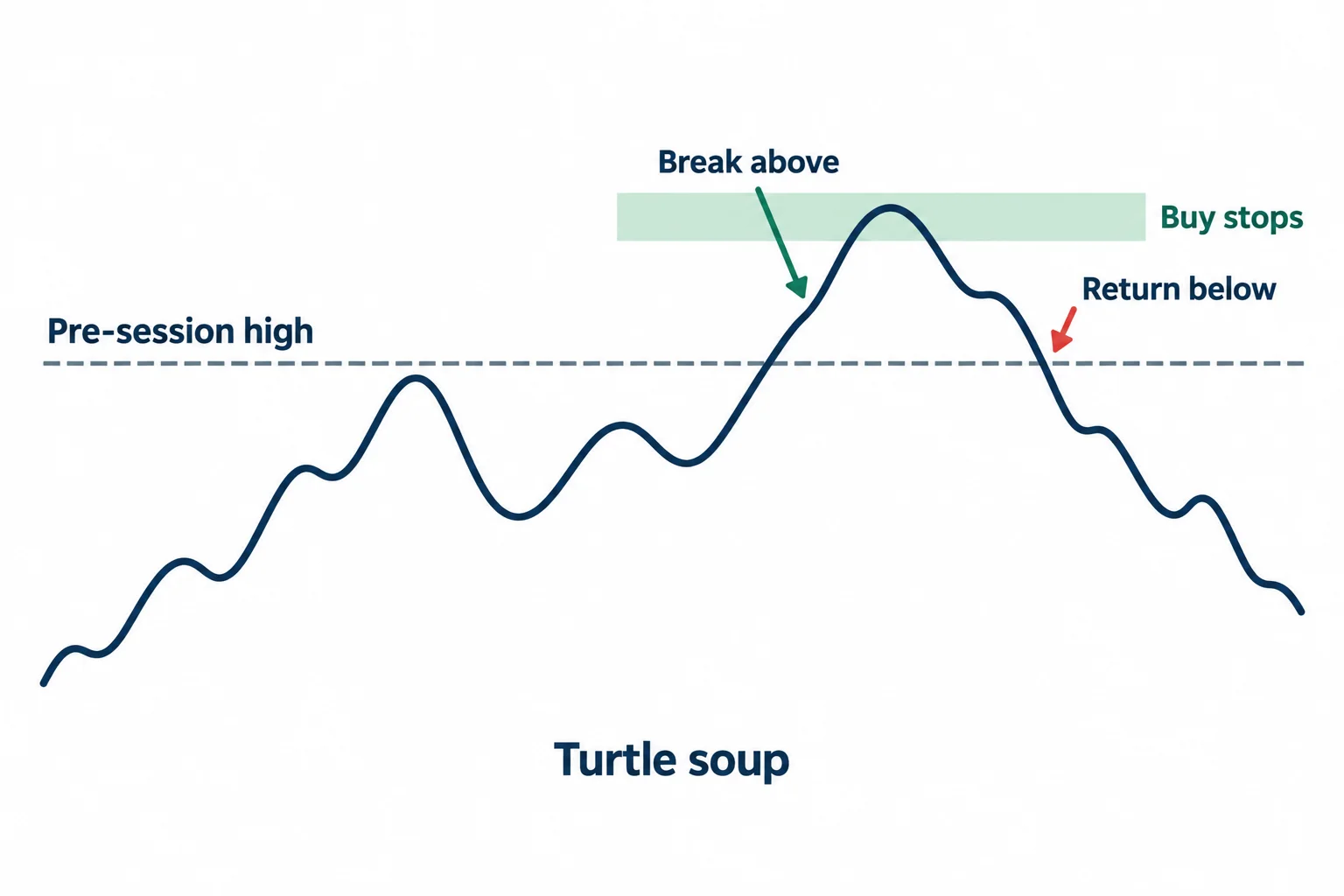
At 0:00 he opens with what he calls a turtle soup: price is trading above a high that formed before the session, and he expects that move to fail. In his telling, the buy stops above that pre-session high have already been taken (0:28), which leaves breakout buyers exposed if price rotates lower, traders he describes as being “caught long” without knowing it (0:38). He explains the stop he is using and why it sits where it does (0:56); the automatic transcript renders that number as “764.5”, which reads as part of a 24,7xx quote but should be checked against the video. He also says he is deliberately trading a single contract so the exercise stays simple rather than looking like bragging, while noting he could have added (1:39).
The mechanics of a failed breakout are general market structure; the motives he attributes to “smart money” and “retail” are his interpretation, not something the transcript establishes.
ICT Trade Plan Using the Inversion Fair Value Gap
From 2:00 he describes the imbalance he wants price to interact with. The transcript calls it an inversion fair value gap; he says he wants it to act as an inversion area, with price working down through it and staying in its lower half rather than reclaiming it. At 4:55 he sets out the behaviour he wants to see: price staying in the lower half of the marked rectangle, a wick allowed into the upper half, but no candle body establishing itself beyond the upper portion to the upside (5:16). Those are his conditions for his own thesis, not universal rules.
He also states that he is trading against a higher timeframe (5:36) and wants the decline to reach a quoted level quickly (6:34), then to erode the intervening range and break below a lower level decisively rather than pausing inside it (7:39). Because price did not open the gap in the way he expected, he says he has to be careful about the stop sitting above the gap: a spike into it could take him out before the move he is anticipating (8:59). He accepts that risk explicitly later, saying he would rather be stopped out of a scenario that has stopped behaving well (17:32).
ICT Trade Targets Downside Liquidity
Repeatedly through the session he names lows beneath the market as the destination: the pool he refers to around 5:47, the low he wants washed out at 12:40 (transcribed as 24,715.50), and what he calls the seven o’clock pre-session low (21:58), which he returns to as the objective at 24:59, 30:15 and 31:06.
His ranking method is worth separating from the jargon. At 23:03 he compares several highs and lows and argues that because liquidity on one side has already been taken, the remaining aligned liquidity on the other side is the next conspicuous objective. He also points at the traders who bought above the transcribed 24,730 level, remarking that they are next in line to be caught (31:13). That framing is his market commentary; the transcript cannot establish who was positioned where or why.
ICT Turtle Soup Trade Example Explained
The recording carries an unusual amount of self-assessment. Besides the demo framing at 17:38, he notes at 18:49 that commissions would be covered at that point, uses the phrase “we locked in a steak dinner” when he banks part of the move (24:52), and then says the market is behaving almost as if he knows what he is doing and that “this stuff really works”, adding that he may write a book about it (33:09). Those are the speaker’s own claims about a single narrated example, not tested evidence, and they are reported here as claims.
He also pre-empts criticism. Early on and again mid-session he anticipates viewers saying he should have shown the trade live (0:26), says he will not read negative comments and will block them (32:15), and answers a recurring question about how he could be running dozens of laptops by saying he is not doing that (31:39).
ICT Breakfast Interlude During the Trade
At 25:34 he says he will leave the position on for the remainder and starts cooking: an omelet at medium heat, eggs kept moving, with sweet potato, blackberries, blueberries and strawberries on the plate (26:35). Market commentary continues across the cooking segment. He breaks off at 30:15 to show how price is still reaching for the seven o'clock low. That combination is what the mapped phrase “cooking breakfast and NQ” describes: a live market walkthrough that keeps running while breakfast gets made.
ICT Trade Walkthrough Review Process
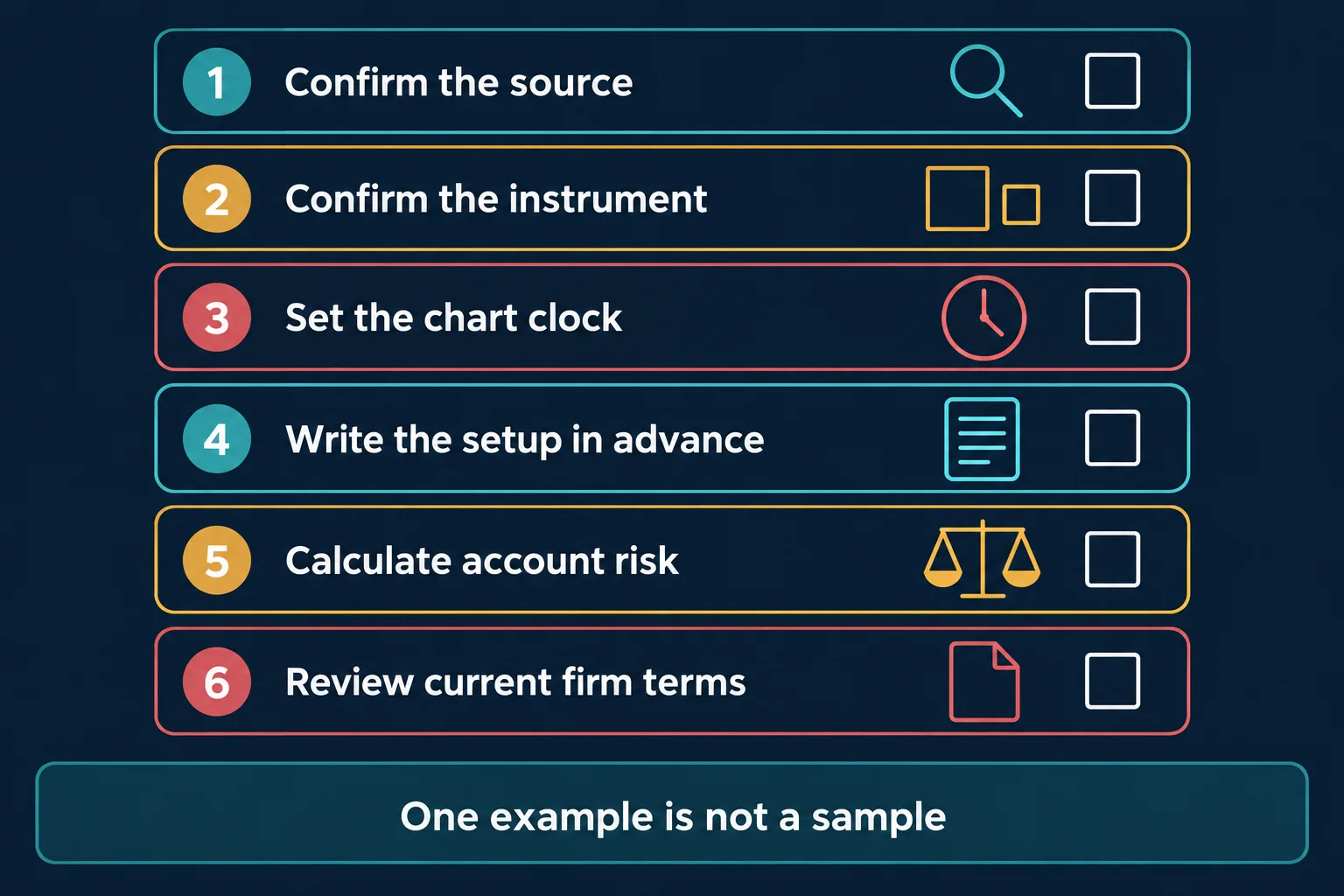
Near the end he makes the educational point directly: the exercise for a student is to identify these intraday pools of liquidity before price reaches them (32:26), and he concedes that a beginner will not know which pool to prioritise at first and that the judgement builds over months of annotation (32:35). The checklist below is a generic, AI-generated study aid for that process. Confirm the source, confirm the instrument, set the chart clock, write the setup before the outcome is known, convert chart distance into account risk, and check the terms of the specific account. It is not a chart of this session and not market data; every box is left for the reader to complete with their own documents.
What the ICT Trade Walkthrough Proves
The transcript supports the sequence ICT narrates and the reasoning he gives for a failed-breakout short with pre-session liquidity as the objective. It does not establish that price moved for the reasons he describes, that the pools he marked were the cause of the move, or that the reported outcome is reproducible. He frames the exercise as a demo example, and no entry, stop, size or result here is verified.
Because the source is automatic speech recognition, terminology and numbers need care. The gap phrase appears as “inversion pyramid gap”, “inversion curve I got” and “inversion everybody got”, and is read here as inversion fair value gap; “cell-sidin balance” and “cell-sidin efficiency” read as sell-side imbalance and sell-side inefficiency; and the price references appear inconsistently as 764.5, 64.25, 723, 714, 715.50 and 730, so they are quoted as spoken rather than corrected. Six short segments are flagged low-confidence, all of them asides such as “I’m sorry” or “Okay” with no figures in them. Verify any level against the video before using it.
ICT NQ Trade Walkthrough Source Video
The lesson this page covers is a published upload from The Inner Circle Trader on YouTube: Cooking breakfast and NQ…, published Thursday 18 September 2025. This BestProps article is independent educational commentary, not an official ICT lesson and not a verbatim transcript of the video.
Open Cooking breakfast and NQ… on YouTube ↗ if the player above does not load in your browser.
Verified References for the ICT Turtle Soup Trade
These references come from the publisher’s own channel, official exchange and regulator documentation, and this site’s rules tracker. They support the instrument, chart-session and account-rule points below. They do not establish what was said, marked or traded in the mapped lesson.
Original ICT Video
The mapped lesson is a first-party upload titled “Cooking breakfast and NQ…” on the channel The Inner Circle Trader, published 18 September 2025.[1] Its description carries the standard CFTC Rule 4.41 hypothetical-performance disclaimer and no chapter marks, so the timestamp links above are the working index to the passages they summarise.
ICT NQ Contract and Tick Size
CME Group’s contract specifications state that the Micro E-mini Nasdaq-100 futures contract is $2 times the Nasdaq-100 Index and has a minimum tick of 0.25 index points.[2] That is why the levels narrated in the recording are index points rather than currency amounts, and why a one-tick difference matters when reading a quoted stop or target.
ICT Pre-Session and Core Trading Hours
The exchange references in the recording are to the US cash-equity session and the hours before it: the NYSE lists an early trading session from 7:00 a.m. to 9:30 a.m. Eastern time and a core trading session from 9:30 a.m. to 4:00 p.m. Eastern time.[3] Nasdaq futures trade far beyond those windows, so a “pre-session high” or a “seven o’clock low” is a chart-session reference as much as a clock time.
ICT Funded Account Trade Restrictions
BestProps’ rules reference describes prop firm rules as the account conditions traders must follow to pass an evaluation, keep a funded account and request payouts, and lists daily loss limits, maximum drawdown, trailing drawdown, consistency requirements, payout buffers, news trading, weekend holds and position limits among the conditions that most often catch traders out.[4] A demonstration example run on a sim account does not answer any of those questions, so confirm the current wording of your own firm’s conditions before sizing anything taken from an educational session.
Independent ICT Turtle Soup Resources
ICT is an independent educator and is not affiliated with BestProps. Third-party transcripts, re-uploads and archive pages are unofficial unless they come from the publisher’s own channel, and no source listed here has been performance-tested for this article. Terms such as turtle soup, inversion fair value gap, displacement, sell-side liquidity, in-line liquidity and premium array are used on this page only as descriptive study terms from the general ICT vocabulary; none is presented as official, tested or free of repainting, and nothing here has been replayed or backtested. No source listed here endorses this article.
ICT Trade Sources
- [1] Cooking breakfast and NQ… (The Inner Circle Trader)
- [2] CME Group: Micro E-mini Nasdaq-100 Index Futures Contract Specs
- [3] NYSE: Holidays & Trading Hours
- [4] Best Props: Prop Firm Rules
Method note: no captions were available for this upload, so the article was written from the automatically transcribed English audio of the full recording (local speech-to-text, Whisper large-v3-turbo, complete audio, 208 segments, six short segments flagged low-confidence). That transcript is a rendering of speech rather than a verified document, and the reviewer did not see any chart in the recording, so every level, zone and result above is reported as spoken rather than confirmed against the screen. Nothing here is investment advice, a performance promise, or a recommendation to copy the trade described.