Key takeaways
In this four-and-a-half-minute premarket recording from August 27, 2024, ICT narrates a bearish Nasdaq futures idea from a premium order block toward minor sell-side liquidity and a New Day Opening Gap.
Read the full summary
In this four-and-a-half-minute premarket recording from August 27, 2024, ICT narrates a bearish Nasdaq futures idea from a premium order block toward minor sell-side liquidity and a New Day Opening Gap. He places his stop against a rejection block, then rolls it to just above the midpoint of a wick he identifies as consequent encroachment, and waits for price to return to the opening level of a candle inside the bearish order block before pyramiding. He states that if price declines without offering that retracement he will simply leave the position alone. He contrasts the approach with bear-flag and trend-line confirmation, describing it as trading specific algorithmic PD arrays. The clip contains no prices, no order sizes, no fills and no reported outcome beyond his narration of the moment.
How we researched this article
BestProps used document-based research from primary firm sources, checked September 24, 2026. The complete source list, scope, limitations, and commercial-state record appear near the end of this article.
In the short Premarket NQ -OB To Discount NDOG \ August 27, 2024 video, published to The Inner Circle Trader channel at 4:15 a.m. Pacific on August 27, 2024, ICT talks through a live premarket short on Nasdaq futures. The recording is under five minutes long, so its value is not a full lesson but a compact example of how he describes one setup: entry inside a block he reads as premium, a stop defined by another reference, an optional add at a candle opening, and a target below.
Two limits belong up front. First, no chart is visible in the transcript being used here; the source is automatic speech recognition of the recording’s audio, so every level, quadrant and block name is his own spoken reading and none of it is reconstructed as a number. Second, nothing in the audio establishes that the trade was filled, sized, or profitable. He narrates what he is doing while he does it, and this article reports that as his account, not as a verified result.
The short from a premium order block
He opens by saying he is selling short in the order block (0:01). The reference for risk comes immediately: he places his stop loss at what he calls a rejection block (0:14) and repeats a moment later that the rejection block is not in jeopardy (0:39). In his vocabulary these are two different objects, and he treats the second as the boundary that invalidates the first.
He then names his objective. He points out minor sell-side liquidity and says he is aiming for it, and adds that he will take another level as well (0:23). Sell-side liquidity, in his usage, is the pool of resting sell stops beneath a prior low, so the plan is to be positioned above and to exit into that liquidity. At 0:36 he describes the position as sitting deep in premium inside the body of the block. The automatic transcript renders the term there as “water block,” which is a misrecognition of “order block” as spoken; nothing else in the recording supports the other reading.
Risk: a rejection block, then the midpoint of a wick
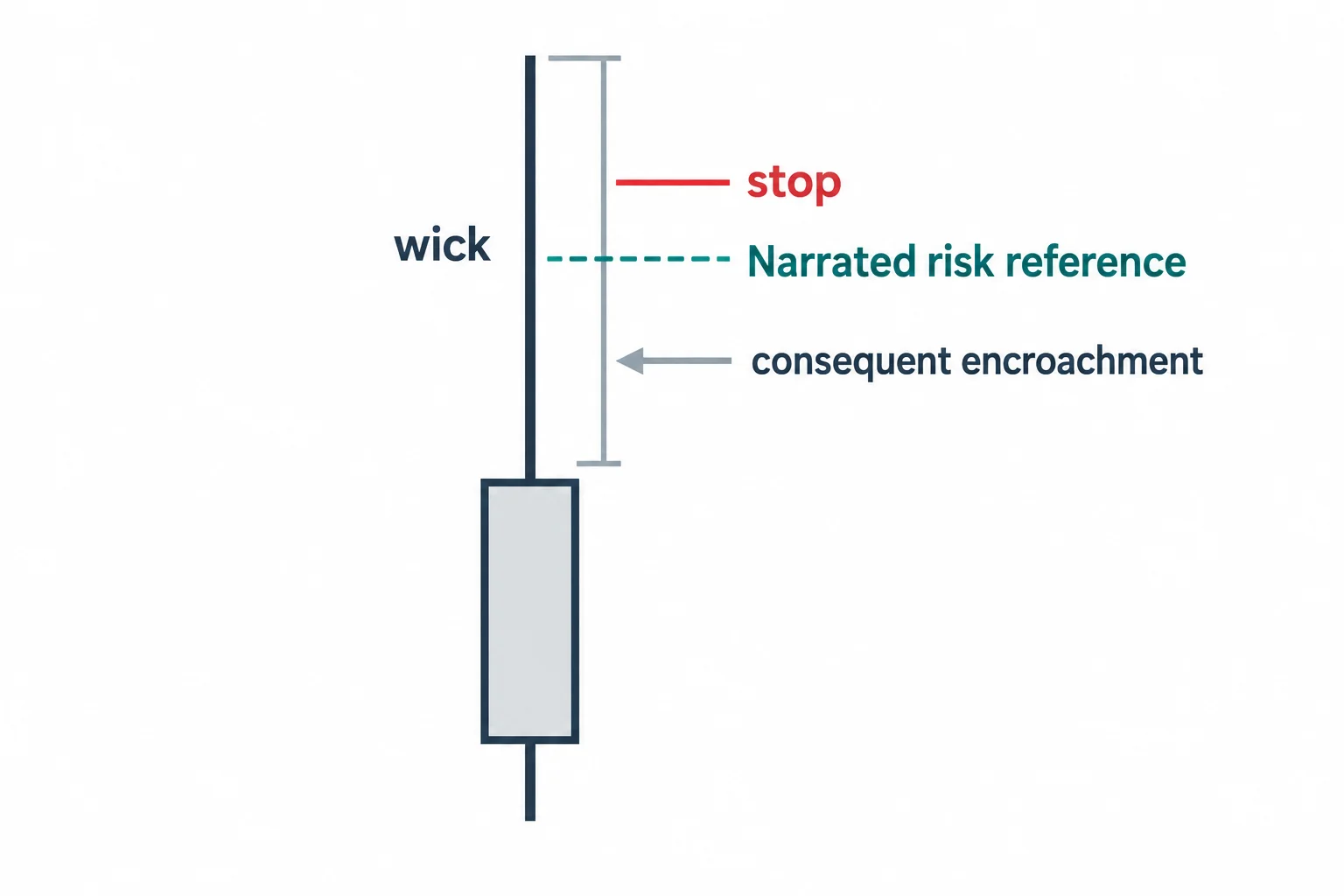
The more specific risk management comes later. After a stretch of price action he calls wonderful, he refers to the consequent encroachment of a wick and says his stop has to roll just above it (1:34). He then spells out what that means in this case: he is looking at half of the wick, and his stop rests just above that halfway point (1:39). Consequent encroachment is his term for the midpoint of a referenced range, and here it is being used as a tightening mechanism rather than as an entry. He does not state a price, a distance in handles or a tick value for the stop.
Just before that he describes the sequence he wants to see: the volume imbalance staying where it is, price breaking down, and then coming back up into it (1:07). The transcript is automated, and the phrase rendered as “volume of balance” is best read as the imbalance he refers to elsewhere in the same series. Read together, his preferred path is a displacement lower that leaves an imbalance behind and then a retracement back into it, which is the same path that would give him the add described next.
Waiting for the candle open before adding
At 2:03 he asks whether the market will give him one more pyramided entry, and the answer is conditional. He says he wants to wait and see if price touches the open of a particular candle (2:20). He identifies that candle’s surroundings as the bearish order block and notes that he has changed the state of delivery, then says he is being patient to see whether it gives him one more chance to tag that level, adding that if it does he will add a lot more contracts (2:34).
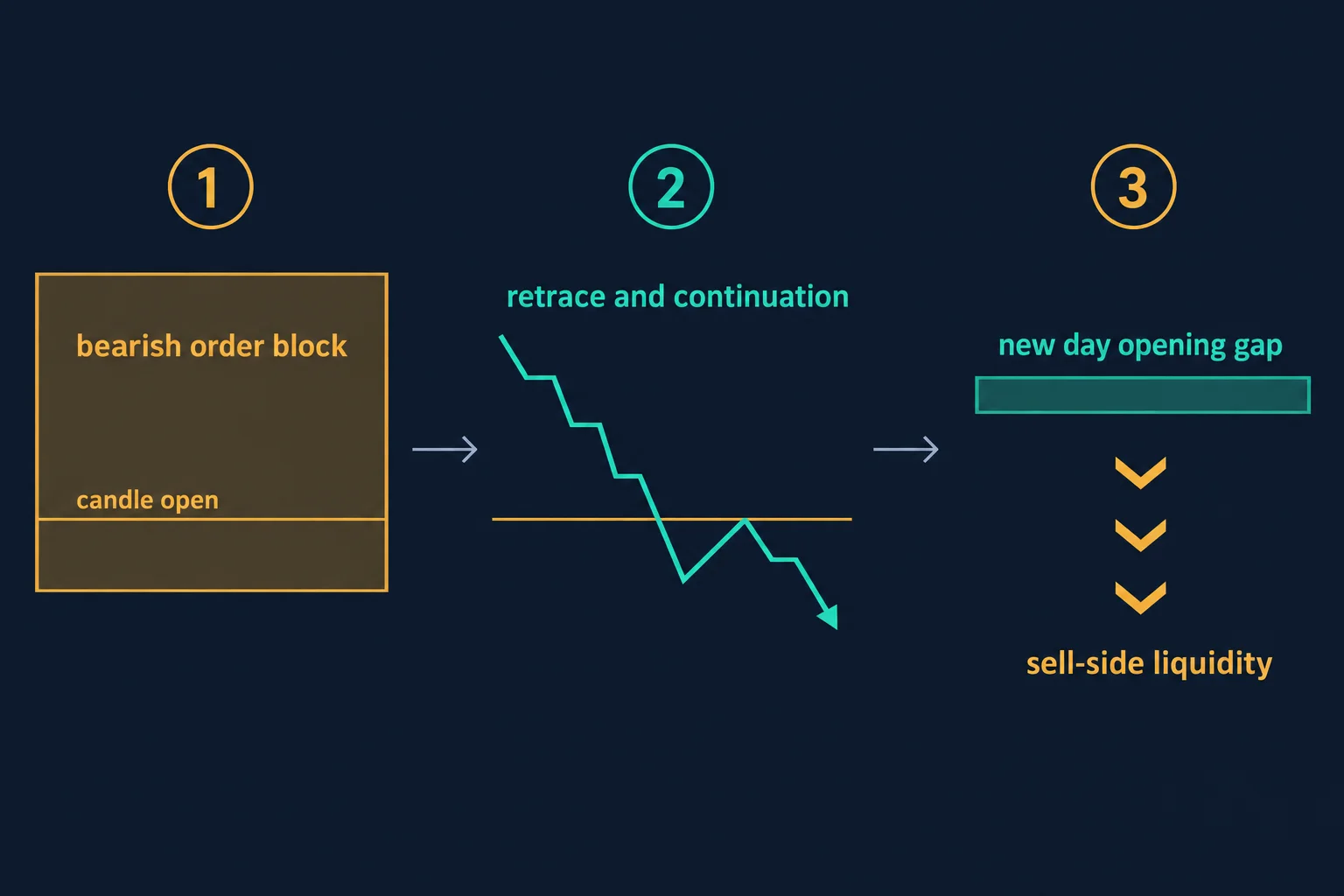
The alternative is stated plainly as well: if price simply starts dropping from there, that is fine with him, and he is not going to add (2:52). This is the part of the clip worth separating from any performance claim. He is describing a preference, not a rule with an edge, and a decline without the retracement costs him the opportunity to add rather than producing a different result he reports.
What sets up the entry drill
A few seconds later he says the candle close just formed sets the stage for an “institutional overflow entry drill” up to the opening of that candle (3:06). That phrase is itself a misrecognition of his entry wording in this series; the construction he is describing is the retracement to a candle opening followed by continuation. His ideal version, in his words, is a return to a change in the state of delivery that leaves a small portion of the opening untouched and then runs lower (3:13). Whatever label is attached, the mechanic is specific: the add is anchored to a candle’s opening price, and the failure case is an opening that is fully filled back in.
PD arrays instead of pattern confirmation
He draws the contrast with conventional technical analysis directly. There are no bear-flag breakouts and no trend-line breaks used to confirm the move, he says; instead he is trading inside specific algorithmic PD arrays, selling short while the market is going up and buying long while it is dropping (3:38). This is a statement of method preference, not evidence about markets. Nothing in the recording tests whether PD arrays outperform chart patterns, and the description of price delivery as algorithmic and institutional is his framing rather than a measured finding.
The objective between the low and the New Day Opening Gap
Near the end he returns to the target. He says he will take the area between a low and something he calls an order block, corrects himself mid-sentence to the New Day Opening Gap, and says he will aim for that (3:58). The self-correction matters for reading the video title: the NDOG is the objective, and the opening gap is defined by the difference between a prior session’s closing price and the current day’s opening price. He closes by saying the trade would cover commissions, costs and grocery money, and signs off (4:21). That remark about covering costs is not a profit figure, and no outcome is stated before the recording ends.
Several passages in the automatic transcript are not recoverable as coherent speech, including a remark about a minor quadrant and chart colours at 0:52 and a partly clipped sentence about closing a candle at 2:52. They are noted rather than guessed at, because chart-colour remarks and half-sentences cannot safely be turned into trading instructions.
Watch the original recording on YouTube
The video cannot be played inside another website. When its embedded player was loaded from a bestprops.com page and clicked on 14 September 2026, the player itself reported “Playback on other websites has been disabled by the video owner” and offered only a “Watch on YouTube” prompt, with no duration and no playback progress. That is why this article carries a watch card instead of an embed. The recording is four minutes and 36 seconds long and is available at the link below.
Primary source and further reading
- The original Inner Circle Trader recording — the timestamp links above are the passages being described; the entire clip runs under five minutes.[1]
- CFTC — customer advisories and articles — the U.S. derivatives regulator’s risk material for futures customers, and the reason a narrated premarket short is not presented here as a result.[2]
- Investor.gov (U.S. Securities and Exchange Commission) — Day Trading — general risk framing for short-horizon trading; it says nothing about this method.[3]
- 17 CFR 4.41 — disclosures concerning hypothetical performance — the rule governing hypothetical performance claims, cited because channels in this space generally state that displayed performance is hypothetical.[4]
Any ICT, SMC or third-party indicator, script, transcript, note set, spreadsheet or social summary circulating outside the publishing channel’s own upload page is unofficial and untested here. The order block, rejection block, consequent encroachment, state of delivery, entry drill and algorithmic PD array descriptions are the speaker’s own framework and terminology. No win rate, drawdown figure, fill, position size or account result is claimed anywhere in this article.
Futures and leveraged trading involves substantial risk and is not suitable for everyone. Pyramiding into a losing or adverse position increases that risk. This article is educational commentary, does not provide individualized financial advice, and reports no outcome from any session or account.
[1] Premarket NQ -OB To Discount NDOG \ August 27, 2024 — The Inner Circle Trader (watch page read 14 September 2026). [2] CFTC — customer advisories and articles. [3] Investor.gov (U.S. Securities and Exchange Commission) — Day Trading. [4] 17 CFR 4.41 — disclosures concerning hypothetical performance.