Key takeaways
The Inner Circle Trader presents an 11 minute 34 second real-time June 10, 2024 Nasdaq futures short using a premarked volume imbalance as the nearer entry reference because price might not retrace to the larger zone above.
Read the full summary
The Inner Circle Trader presents an 11 minute 34 second real-time June 10, 2024 Nasdaq futures short using a premarked volume imbalance as the nearer entry reference because price might not retrace to the larger zone above. ICT conditionally mentions six contracts at half of a wick and four more at a candle open, but no fills or account are shown. After price trades through a tiny inversion fair value gap and quickly rejects it, he moves the stop from one tick above its consequent encroachment to just above the rejecting candle’s open. On the five-minute view he wants price to break the midpoint of a discount wick, slice aggressively through a nearby low without hesitation, and enter a lower buy-side imbalance and sell-side inefficiency. He calls volume imbalances the weakest but most flexible PD array, usable for entries, partials, or targets even after price moves beyond and reuses them. He refuses partials until price prints below an unclear spoken 62 fragment, says he would remove six contracts there, then places a buy limit as the low is swept and price reaches below a second level. The clip ends without confirming the limit fill, executed size, exit price, profit, loss, or net result, and all price fragments come from automatic speech recognition rather than verified chart or account data.
How we researched this article
BestProps used document-based research from primary firm sources, checked September 24, 2026. The complete source list, scope, limitations, and commercial-state record appear near the end of this article.
In NQ Lunch Macro 06/10/2024, a public upload on The Inner Circle Trader channel, ICT works through a short-term Nasdaq idea as it develops. The upload was published at 10:43 a.m. Pacific on June 10, 2024, which is 1:43 p.m. Eastern (the New York lunch hour the title refers to).
Two things shape how the recording should be read. First, he states that everything shown is live and that the candlestick countdown is visible on the price axis (0:18), so this is narration during the session rather than a retrospective edit. Second, the transcript used here is automatic speech recognition of the audio, not human captions, so the spoken price fragments and a few terms have to be handled as reported speech rather than as verified data. No chart, order panel or account statement was examined for this article.
ICT Lunch Macro Entry at the Volume Imbalance
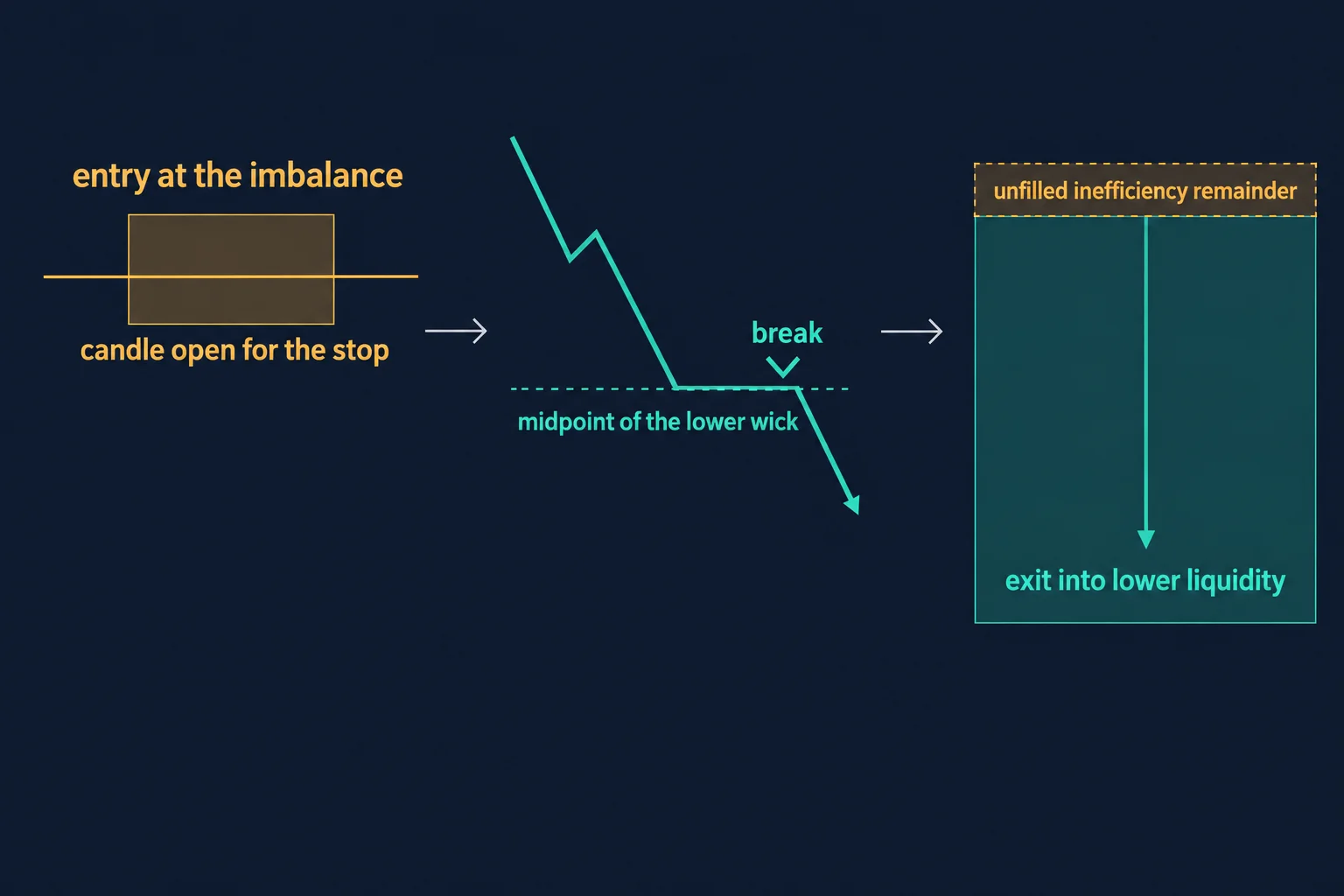
He starts by pointing at a volume imbalance and saying he will look at it for a short (0:26). He notes that he was still drawing the level when price traded up into it, and says he hopes it gives him “one more kiss” before it runs away (0:42). Then he states a size conditional: if it gives him half of a particular wick, he will go with six contracts on that as well (0:54).
The reasoning for choosing that reference over the larger area is the part worth taking from the clip. He says price could reach up into the higher zone, but because he wants to be certain he has a position on, he is using the nearer volume imbalance as the entry point (2:20). He then shows that candle bodies stopped around that imbalance, which he describes as the imbalance where he pointed before the fact (2:03). He also says he will use the open of a particular candle and will look to add four more contracts there (1:18, 1:22). Both size figures are his own spoken intentions during the session, not confirmed fills, and the account behind them is never shown.
ICT Lunch Macro Inversion Gap and Short Stop
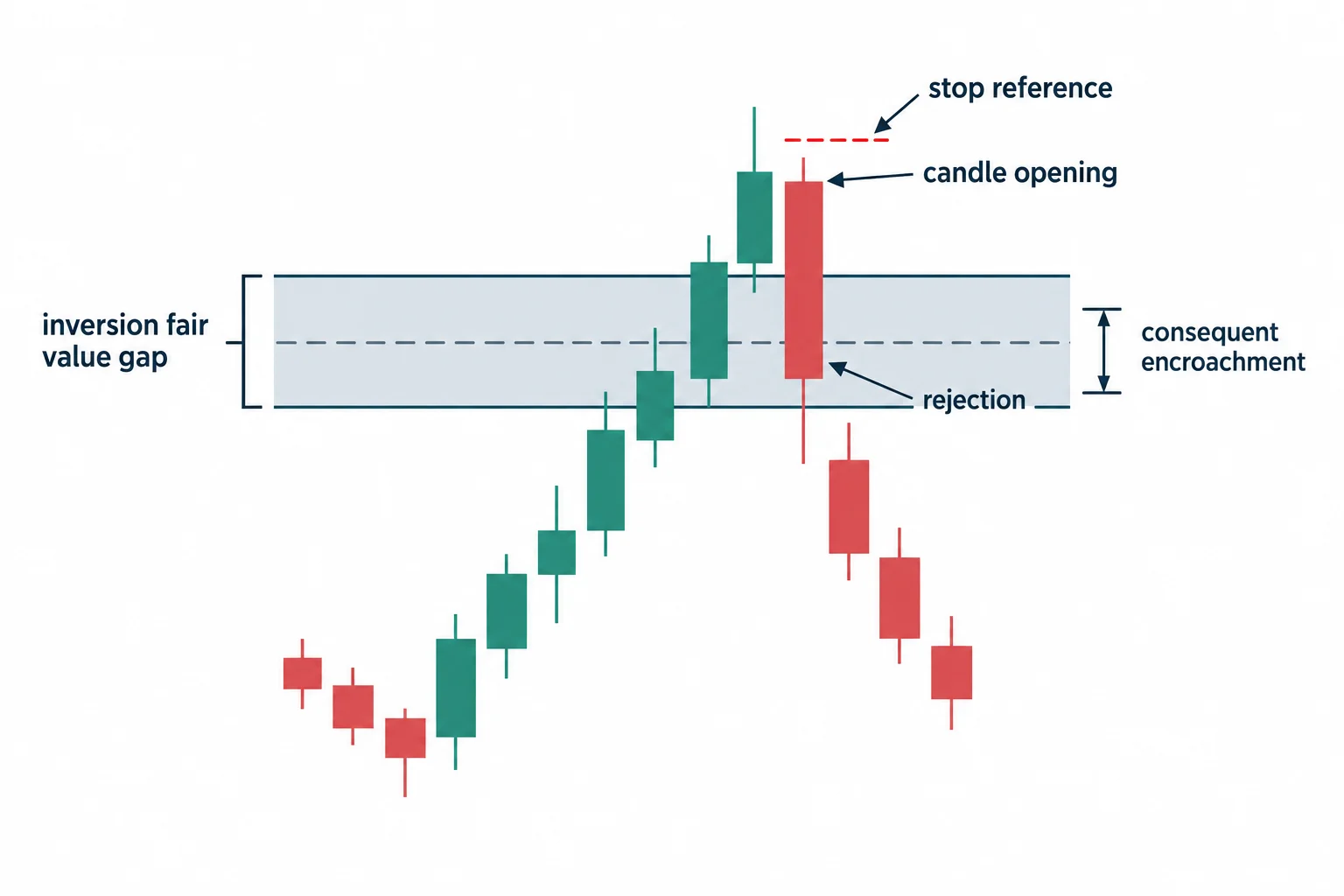
He identifies a very small inversion fair value gap, acknowledges it is tiny, and watches price trade up into it (2:39). An inversion fair value gap, in his usage, is a gap that has already been traded through and is then read as a reference rather than as an untouched imbalance. He says he will place his stop just above the consequent encroachment of that inefficiency and points out that it sits one tick above a small line he has drawn (2:56).
The stop is then moved again on the strength of a reaction. He says that because price went above the volume imbalance and the inversion fair value gap and then quickly rejected it, he is taking the stop and placing it just above the opening of that candle (5:33). That is the only explicit invalidation logic in the recording: a reference is used to tighten risk after price reacts at it. He does not state a price for the stop or a risk figure in dollars or handles, and none is reconstructed here.
What the ICT Lunch Macro Looks for Below the Low
Switching to the five-minute view, he sets out his expectation. He wants price to erode down at least beyond and below the halfway point, or consequent encroachment, of a discount wick (3:31), then to go below a nearby low aggressively, with no respect for that low, slicing through it and speeding into the lower area he calls a buy-side imbalance and sell-side inefficiency (3:50). The distinction he draws is between hesitation at a level and the lack of it, and he is explicit that he wants the second.
His stated reasons are that the day has been mostly a pump and that there is liquidity under that low (7:08). He adds that this is part of why he wants to be sitting right at the consequent encroachment, since the buy-side imbalance and sell-side inefficiency in question has a small wick in it (7:14). Liquidity under a low is his reading of where resting sell stops would sit; the recording does not show order book data, and he says himself that he does not need depth of market for this (4:34).
ICT Lunch Macro Guide to Volume Imbalances
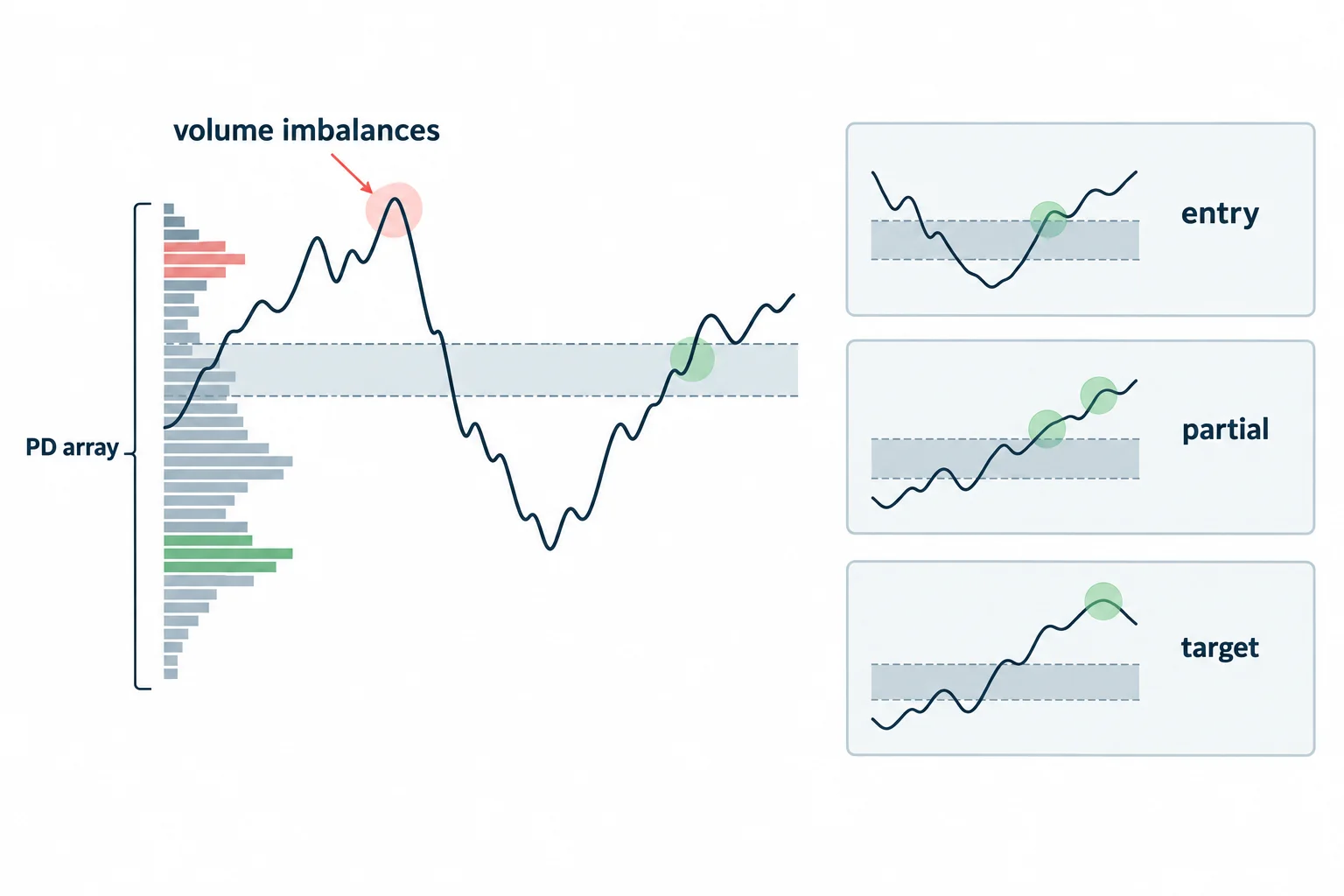
Roughly six minutes in, he pauses the trade narration to characterise the tool itself. He calls volume imbalances the weakest PD array, and explains that he means most flexible: price can go beyond one, come back and reuse it (6:19). He says they help him get a read on price, that sometimes they sit deadlocked right at a turning point, and that he can use one as a target, a partial or an entry (6:45). That self-description matters because it sets the expectation: he is not presenting the imbalance as a precise level, and the rest of the recording treats it accordingly.
The same passage contains his rebuttal of the claim that his teaching is rebranded auction theory. He argues that auction theory has nothing to do with what he is doing, that he rebranded nothing, and asks why critics who call it rebranded would not simply keep using the older material instead of adopting his terminology (4:36, 7:41). This is his characterisation of a dispute about terminology, not an independently established distinction, and it is reported here the same way.
ICT Lunch Macro Short Exit Below 62
He is specific about not taking profit early. After noting that a wick turned and retreated into the area he wanted, he says he is not interested in taking any partial until price gets down below “,” and separately says he will take off six if price prints below that level (9:44, 10:12). The spoken figure is only a fragment of a price (the full contract level is never stated), so it is not treated here as a reconstructable instruction.
He then narrates placing a buy limit so that he can get a favourable price (10:44), and shortly after points out that the low has been swept, drawing a line on that little low and noting how price reached for it and then reached below another level (11:02). He signs off saying he will see whether there is any more to get out of it (10:57). The clip ends there. No fill, exit price, contract count actually transacted, or net result is reported, so the episode’s outcome is unknown from this source.
What the ICT Lunch Macro Recording Proves
The value of the clip is the conditional process rather than any single level: mark a near reference because the far one may not be reached, state what reaction would tighten risk, state what price behaviour would confirm the idea, and state in advance what would and would not trigger a partial. Everything specific to the day (the levels, the wick, the quadrants he refers to, the “62” fragment and the size figures) is his spoken reading of his own chart during a live session.
Some passages in the automatic transcript are unclear and are left as such rather than guessed at, including a remark about chart colours and quadrants at 3:14 and an apology about not having something on screen at 8:13. Neither is load-bearing for the explanation above.
This embedded player was opened and clicked from a BestProps page on 14 September 2026 and began playing at the recording’s own duration, so the original session can be watched in place.
ICT Lunch Macro Source and Further Reading
- The original Inner Circle Trader recording The timestamp links above are the passages being described; the clip runs 11 minutes 34 seconds.[1]
- CFTC (customer advisories and articles) The U.S. derivatives regulator's risk material for futures customers, and the reason a narrated live short is not presented here as a result.[2]
- Investor.gov (U.S. Securities and Exchange Commission), Day Trading General risk framing for short-horizon trading; it says nothing about this method.[3]
- 17 CFR 4.41 (disclosures concerning hypothetical performance) The rule governing hypothetical performance claims, cited because channels in this space generally state that displayed performance is hypothetical.[4]
Any ICT, SMC or third-party indicator, script, transcript, note set, spreadsheet or social summary circulating outside the publishing channel’s own upload page is unofficial and untested here, as are the “auction theory” comparisons the recording argues against. The volume imbalance, inversion fair value gap, consequent encroachment, quadrants and PD array descriptions are the speaker’s own framework and terminology. No win rate, drawdown figure, fill, position size or account result is claimed anywhere in this article.
Futures and leveraged trading involves substantial risk and is not suitable for everyone. Scaling into a position while it is working, and holding for a lower partial target, both increase the loss when the idea fails. This article is educational commentary, does not provide individualized financial advice, and reports no outcome from any session or account.
[1] NQ Lunch Macro 06/10/2024, The Inner Circle Trader (watch page read 14 September 2026). [2] CFTC, customer advisories and articles. [3] Investor.gov (U.S. Securities and Exchange Commission), Day Trading. [4] 17 CFR 4.41, disclosures concerning hypothetical performance.