Key takeaways
The Inner Circle Trader demonstrates NQ micro-scalping on a 15-second chart in an approximately eleven-minute YouTube recording from May 6, 2024, trading both directions without a fixed session bias while using fair value gaps, volume imbalances, order blocks, inversion levels and liquidity draws.
Read the full summary
The Inner Circle Trader demonstrates NQ micro-scalping on a 15-second chart in an approximately eleven-minute YouTube recording from May 6, 2024, trading both directions without a fixed session bias while using fair value gaps, volume imbalances, order blocks, inversion levels and liquidity draws. He adds within a volume imbalance up to an unspecified self-imposed maximum, takes five contracts off inside a lower inefficiency, places a limit order for another move toward a daily fair value gap, buys to run buy-side liquidity and then sells short toward liquidity below. He cites about $10 in commissions and fees per contract, moves the first stop to cover costs, and contrasts scaling out with hit-and-run scalping, which exits the entire position at the first logical liquidity level. Volume imbalances are described as flexible PD arrays that price may cross repeatedly without invalidating the narrative, with context and order flow favored over exact reactions. The final stop is hit and deemed acceptable, while no position size, stop distance, win rate, drawdown, verified fill or account result is provided, and the article relies on automatic speech recognition rather than chart or account inspection.
How we researched this article
BestProps used document-based research from primary firm sources, checked September 24, 2026. The complete source list, scope, limitations, and commercial-state record appear near the end of this article.
In Micro-Scalping Without Bias – NQ May 06, 2024, a public upload on The Inner Circle Trader channel, ICT narrates a short-horizon session live. The upload was published at 6:34 a.m. Pacific on May 6, 2024, and the recording runs about eleven minutes.
Two limits shape how this should be read. The source here is automatic speech recognition of the audio rather than human captions, so the spoken price levels and a few terms are handled as reported speech, and the chart, order panel and account behind them were not examined for this article. He also makes claims in the closing minutes about carving out income and doing well that no evidence in the recording supports; those are reported below as his statements, not as results.
ICT Micro-Scalping Session Opening Setup
He opens by noting that Nasdaq is at a small premium relative to the previous day’s settlement and that price is inside a fair value gap, and he thinks it can go a little higher from there (0:30, 0:40). He then describes going beneath a down-close candle with his stop and says this is how he maximises the position (0:49).
The word he uses for the activity is his own. He says this is micro scalping and adds that it is what funded account companies do not want you doing, because the activity is unprofitable for them (1:32). That is a claim about firms’ incentives, made in passing, and the recording offers no evidence for it.
ICT Micro-Scalping With Volume Imbalances
He adds more right inside a volume imbalance, points out where the draw on liquidity is, and then reasons through why the setup is legible: a down-close candle and a volume imbalance are enough of a reason for price to be drawn back down inside an order block, which he notes in case price goes back there (1:16, 1:54). He says that hypothetically he would add one more there, but that he is already at the maximum for the trade (2:02).
That self-imposed maximum is worth noting because it is the only risk constraint stated in the clip beyond stop placement. He does not give a figure for the maximum, the position size, or the stop distance, and none is reconstructed here. He asks for the volume imbalances to be included in the analysis on screen and describes the buy-side resting just above the market (2:27, 2:46).
ICT Micro-Scalping Costs and Inversion Levels
As price approaches his target he says the stop should be covering costs, and calls the move as it happens (2:56). He then puts a limit order into the volume imbalance that price has already traded back up into a couple of times, aiming to capture another run toward a daily fair value gap (3:16, 3:45). He notes the limit price was given but the spread did not allow a fill, which is the kind of execution detail that only his own platform could confirm.
He then points to the order block he had mentioned becoming an inversion level, and labels the area a bearish fair value gap (4:52, 4:40). Roughly six minutes in he explains why he is drawing his limit order just below the bodies of a run of candles rather than at the daily fair value gap high: the order flow had not come back to touch that high, so price may not reach it again (5:51, 6:09). That is the same logic he applies to entries: place the working order where the reaction is likely to occur rather than at a level price may never revisit.
ICT Micro-Scalping With Flexible PD Arrays
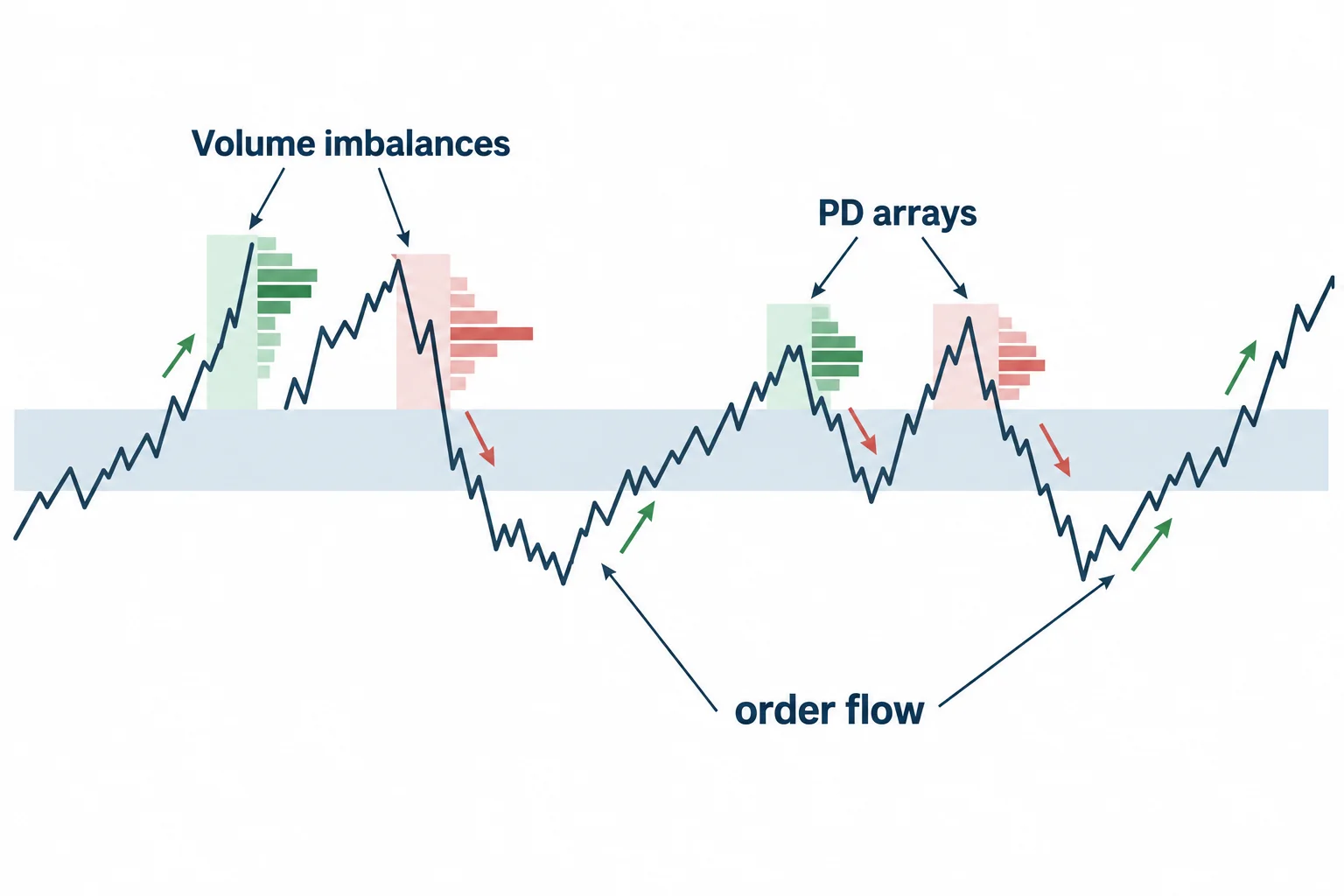
He tags very short-term sell-side liquidity pools and then makes the point the video’s title rests on. Volume imbalances, he says, are flexible PD arrays: price can go back and forth over the top of them and still keep the underlying narrative active, so they should not be expected to turn the market on a dime every time (6:48, 6:56). His stated substitute for precision is context: judge where the order flow sits in and around the level (7:06).
This is a useful corrective to how such levels are often presented elsewhere. Rather than being treated as exact support or resistance, the imbalance is described as a zone worth reading, sometimes coinciding with a turn and sometimes not. Nothing in the recording tests whether that reading adds an edge.
ICT Micro-Scalping Exits and Partials
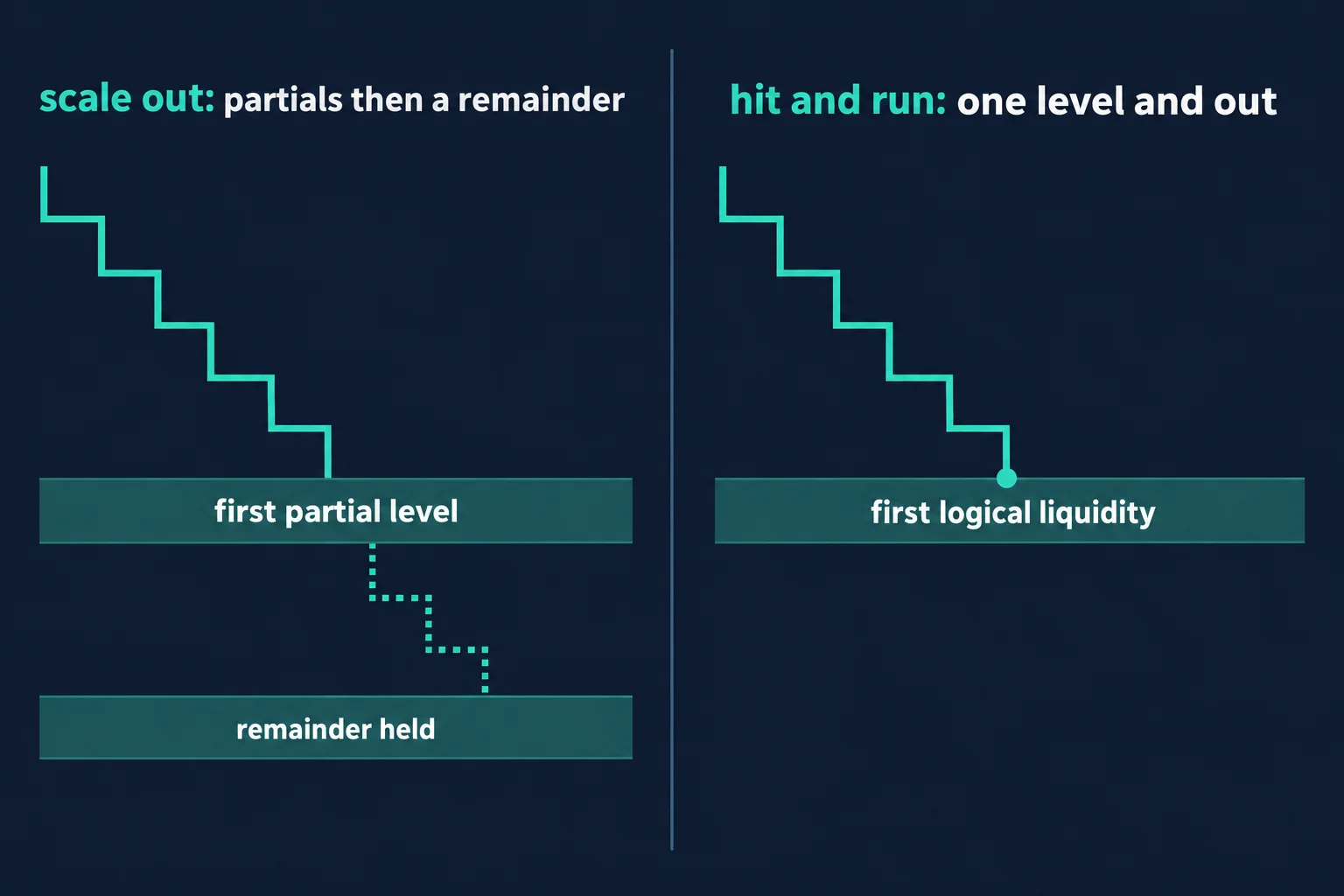
He takes five off just below the current price and right inside an inefficiency, explaining that between one candle’s high and another’s low there is a reason to take profit, and that this also covers costs and commissions (7:20, 7:33). He then gives the figure that anchors the whole approach: commission costs are around ten dollars with fees and everything else, per contract (7:47). That is his own number for his own arrangement, not a general schedule, and it is what makes a scalp that covers costs but little else still worth taking in his account.
He identifies the chart as a 15-second chart, in case that was unclear (8:20). After price returns into the inefficiency he says that at this point it could stop him out with the cost covered, and that this is fine (8:33). He points out the new high that makes his stop vulnerable, and uses it to explain why he takes partials at all. A hard, surgical hit-and-run scalper, in his description, takes no partials: they take the first logical level of liquidity, are out, and wait for the next setup (9:05, 9:15). Taking partials instead realises part of the position while leaving a remainder exposed to the same stop.
ICT Micro-Scalping Without Session Bias
His summary is that you can trade without a bias, trade the liquidity available intraday, drop to a very small timeframe and work a very small range (10:01). He qualifies it immediately: if you lose sight of trying to make money at logical levels with a logical draw on liquidity, the reason for the trade stops making sense. So “without bias” here means without a fixed session direction, not without a thesis or a reference for risk.
The recap at the end fits that reading: buying in, running the buy side, then going back in and selling short to take the liquidity underneath, with the stop being hit and that being acceptable (10:55, 11:02). He also claims in this closing stretch that a viewer can carve out a little income, win competitions and do very well with this reading of price action (8:41, 10:47). No account, track record or verified result accompanies any of that, and it is not presented here as demonstrated performance.
A few passages in the automatic transcript are too garbled to use, including the remark at 1:09 and the aside at 8:06 about buying and selling pressure. They are noted rather than guessed at, and neither is load-bearing for the explanation above.
Watch the original recording on YouTube
The video cannot be played inside another website. When its embedded player was loaded from a bestprops.com page and clicked on 14 September 2026, the player itself reported “Playback on other websites has been disabled by the video owner” and offered only a “Watch on YouTube” prompt, with no duration and no playback progress. That is why this article carries a watch card instead of an embed. The recording runs about eleven minutes and is available at the link below.
ICT Micro-Scalping Session Sources
- The original Inner Circle Trader recording The timestamp links above are the passages being described; the clip runs about eleven minutes.[1]
- CFTC (customer advisories and articles) The U.S. derivatives regulator's risk material for futures customers, and the reason the narrated sequence is not presented here as a result.[2]
- Investor.gov (U.S. Securities and Exchange Commission), Day Trading The SEC's own risk framing for short-horizon trading, including the warning that frequent trading magnifies costs; on that point it is directly relevant to the ten-dollar per-contract figure he cites.[3]
- 17 CFR 4.41 (disclosures concerning hypothetical performance) The rule governing hypothetical performance claims, cited because the recording's closing remarks about income and consistency are not accompanied by any verified record.[4]
Any ICT, SMC or third-party indicator, script, transcript, note set, spreadsheet or social summary circulating outside the publishing channel’s own upload page is unofficial and untested here. The fair value gap, volume imbalance, order block, inversion level, PD array and “draw on liquidity” descriptions are the speaker’s own framework and terminology, as is the claim about what funded account firms prefer customers to do. No win rate, drawdown figure, fill, position size or account result is claimed anywhere in this article.
Futures and leveraged trading involves substantial risk and is not suitable for everyone. Micro-scalping on a 15-second chart concentrates transaction costs and slippage relative to the size of each move, and partial exits leave a remainder exposed to the same stop. This article is educational commentary, does not provide individualized financial advice, and reports no outcome from any session or account.
[1] Micro-Scalping Without Bias – NQ May 06, 2024, The Inner Circle Trader (watch page read 14 September 2026). [2] CFTC (customer advisories and articles). [3] Investor.gov (U.S. Securities and Exchange Commission), Day Trading. [4] 17 CFR 4.41 (disclosures concerning hypothetical performance).