Key takeaways
The Inner Circle Trader recording on YouTube documents a roughly fifty-minute live discretionary short on April 22, 2026 as price rallies near the roughly 26,901 all-time high, with ICT expecting that high to remain intact until sell-side liquidity near 26,830 or 26,805 is taken.
Read the full summary
The Inner Circle Trader recording on YouTube documents a roughly fifty-minute live discretionary short on April 22, 2026 as price rallies near the roughly 26,901 all-time high, with ICT expecting that high to remain intact until sell-side liquidity near 26,830 or 26,805 is taken. He labels the developing structure a market maker sell model and sells the smart money reversal, requiring a fast decline, candle bodies to remain below the midpoint of the referenced imbalance or premium wick, and price not to linger near Monday’s regular-trading-hours opening range gap, which he identifies as his failure point. As momentum weakens and price defends roughly 26,804, he reduces micro-contract exposure through layered buy limits, reports two partial exits, lowers his stop, replaces one touched but unfilled limit with a market partial, and leaves a stopped remainder on for educational purposes. Price moves sharply against him near the end, he cancels a remaining order, and the recording states no final fill, net result, instrument, contract month, verified chart prices, or account performance. The market maker sell model is mentioned but not taught, Judas swing is never spoken or defined, and automatic transcription errors mean terms and levels should be checked against the original recording.
How we researched this article
BestProps used document-based research from primary firm sources, checked September 24, 2026. The complete source list, scope, limitations, and commercial-state record appear near the end of this article.
In ICT 2026 Fading Run To ATH Using MMSM \ Judas Swing \ April 22, 2026, a roughly fifty-minute recording from the channel The Inner Circle Trader, ICT manages a short position while price runs up close to, but not through, an all-time high. His stated thesis is that the high stays intact while price first reaches for liquidity beneath the market. He then spends most of the recording arguing with the tape about whether the move down is developing properly.
This is live commentary rather than a structured lesson, and he says as much: at 3:29 he notes that the session is not market replay. What follows is therefore a record of his decisions as the candles form, not a retrospective explanation, and the article treats it that way.
ICT 2026 ATH Fading Thesis and Key Levels
He opens by saying he is selling short inside a candle structure the automatic transcript renders as a “suspension block” (a bullish up-close candle) and that he wants an aggressive breakdown toward sell-side liquidity around the 26,805 and 26,830 levels (0:20, 0:31). At 1:38 he describes the day’s intention in order: let price rally, see it fall short of the all-time high, sell that reversal, and then look for a long.
The condition that matters is stated plainly at 6:18: he is trading the idea that the all-time highs are left intact until sell-side liquidity has been taken, and he admits he does not yet know whether the destination is the higher or the lower of the two sell-side references. Later he names the high he is watching as an all-time high around 26,901 (26:51). Those levels come from automatic transcription of his speech and should be checked against the recording before being treated as exact chart values.
He also states what he would expect if he were on the other side of the trade: if he were long and had rolled a stop up to the higher reference, he says he personally would not feel safe there (12:25). His short is therefore conditional on the market failing to hold those levels, not on the mere fact that price has risen.
What ICT Watches When Fading the ATH Run
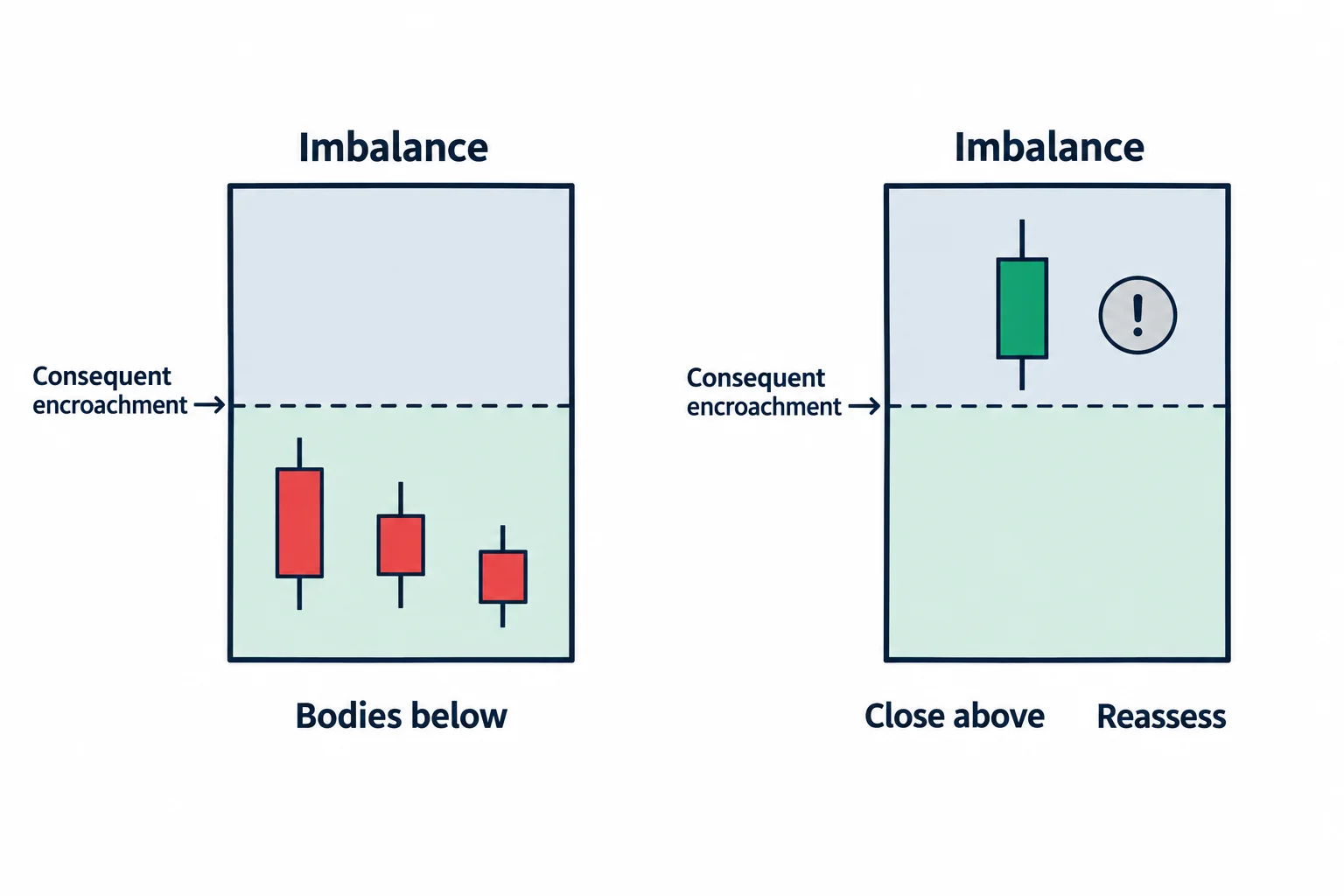
Three checks appear repeatedly. The first is speed: he wants the decline to cover distance quickly, and a slow drift is treated as evidence against him (9:34).
The second is where candle bodies close relative to a midpoint. He refers throughout to what the transcript renders variously as “consequent encroachment”, and his rule is consistent: bodies must stay in the lower half of the referenced imbalance or wick, and he explicitly dislikes a body closing above the midpoint of the premium wick he has marked (12:42, 14:03). If bodies do start closing above that level he says he will collapse half the position (23:27). He also marks the high of Monday’s regular-trading-hours opening range gap as the level he does not want price staggering around (17:59), and later calls it his point of failure (30:01).
The third is time spent inside an imbalance. He argues that many candles lingering inside a sell-side imbalance without a decisive drop suggests price will revisit its midpoint or an inversion fair value gap above him (32:16). Near the end, when price is printing only slightly lower lows and defending the 26,804 area, that hesitation becomes his main reason for reducing further (43:15).
His explanations for why price is not behaving include manual intervention and a personified market maker he addresses by name. Those are his interpretations of the tape, not facts the transcript establishes; the recording does not demonstrate that anyone is defending a level.
Managing the ICT ATH Fading Position and Exits
He manages the trade in steps. He layers buy-limit orders beneath the market to reduce the short, describing the arrangement as a “canopy” of limits in case price drops (22:49), and reports taking two partials before moving his stop down (28:58). He trades in micro contracts and the exact sizes he mentions vary in transcription, so no position size is asserted here.
The interesting decision comes when an order does not behave as planned. One limit is touched without filling, so he removes it and takes part of the position off with a market order instead (44:26). He explains the preference at 44:49: when price reaches the area he was targeting but the order is not filled, and the market is no longer showing the expected continuation, he would rather take a manual partial than keep losing an argument with himself. He states the principle bluntly at 41:24: you never go wrong taking profits.
He also says he is deliberately staying in the remainder “for the culture” (for the audience) while expecting to be stopped out, on the argument that a worst-case outcome on camera is instructive if obvious manipulation follows (47:18, 47:53, 48:24). The recording ends as price moves sharply against him and he cancels a remaining order; no final fill, net result or subsequent market outcome is stated in the transcript (49:18).
How ICT Uses the MMSM Label
The title’s most specific term does appear in the spoken content, but only as a passing observation: at 31:06 he calls the developing structure a nice little market maker sell model and describes himself as selling at the smart money reversal. He does not stop to define it, and the transcript does not describe how the pattern is validated beyond the checks above.
“Judas swing” from the title is not spoken anywhere in the transcript, and neither is a definition of it. That absence may be a recognition artifact, but it is the honest state of the source: this recording should not be treated as a lesson on the Judas swing label. The same caution applies to one transcript term used above: “suspension block” appears as a recurring label in the automatic transcription and is retained cautiously rather than redefined, because no explanation of it is captured.
Six Checks for the ICT 2026 Fading Setup
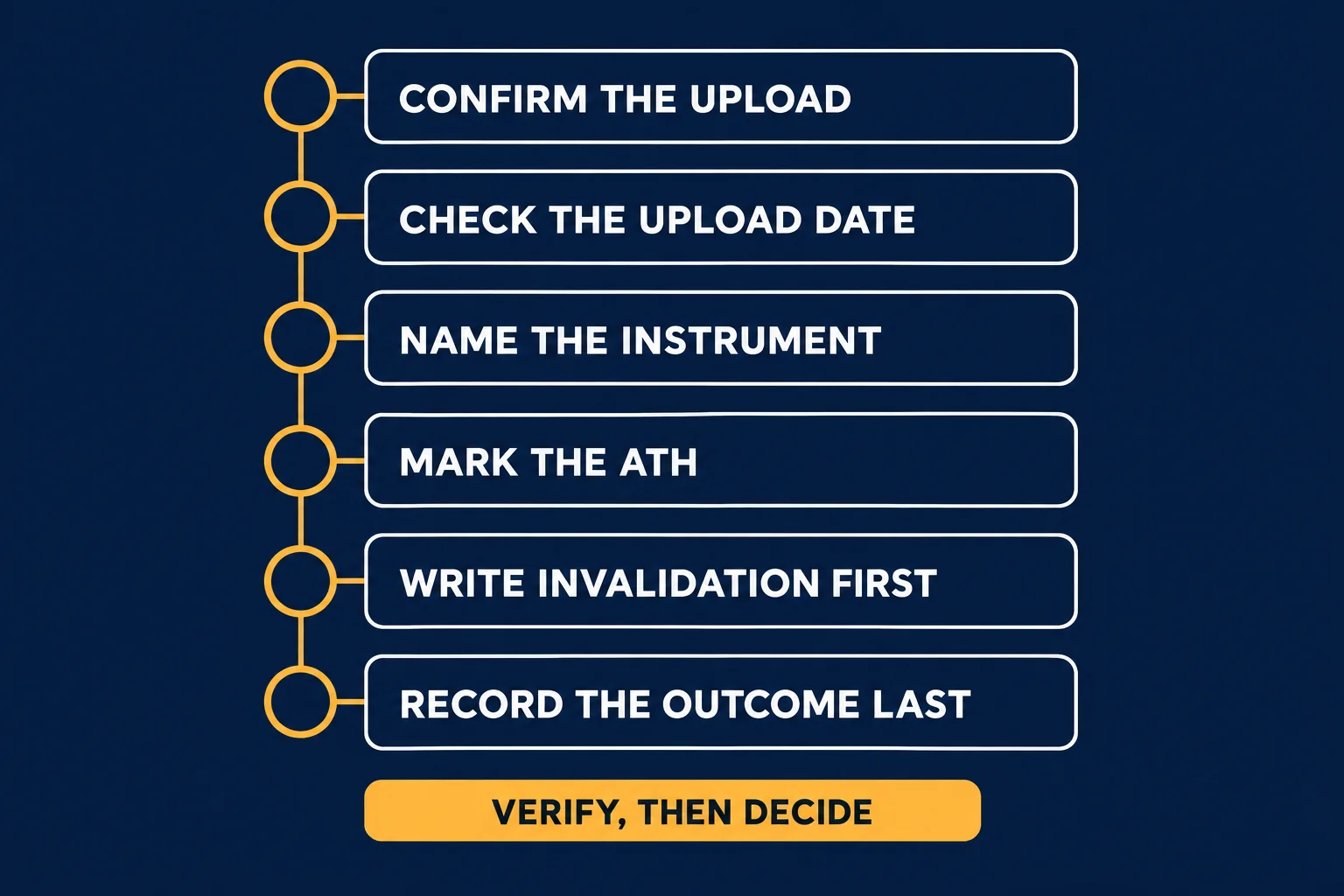
Read as a template rather than a trade, the recording demonstrates an order of work that can be applied to any lesson or stream before its claims are repeated:
- Confirm the upload. This is a public first-party upload on the channel The Inner Circle Trader, read from its watch page, not a re-upload of unknown origin (watch page).
- Check the date and length. The page records an upload and publish time of 2026-04-22T10:11:24 in the UTC-07:00 offset and a runtime of 2,996 seconds, about fifty minutes, consistent with a live session, and consistent with the transcript’s coverage of the same window.
- Name the instrument. The recording does not name it. The levels spoken and the 08:30 news reference are consistent with a US index future, but the transcript does not establish the contract or month, so this article deliberately does not.
- Mark the all-time high. The level that drives the trade is the all-time high he wants left intact, spoken as roughly 26,901, plus the sell-side references he expects below (26:51).
- Write invalidation first. Before the outcome is known he states the body-closes and wick highs that would undermine the idea, and acts on them when they appear (23:27, 30:01).
- Record the outcome last. The tape ends without one. Partial exits are reported, one limit is explicitly described as touched but not filled, and the final result is not stated, which is precisely why no performance claim is made from this recording (44:26).
What the ICT 2026 Transcript Confirms
Three limits apply. First, this is automatic speech recognition of the audio only, with garbled fragments left visible rather than silently repaired: terms such as “consequent encroachment” are sometimes rendered as “consequent croissant” or “consequent encouragement”, and spoken numbers can be misheard. Second, no chart visuals were captured, so the article reports the levels he named rather than what price did. Third, the recording is a live stream of a discretionary session, not an account statement: the transcript cannot confirm the instrument, the displayed prices, the order fills or any net result, and he says himself that he annotates the chart as the session runs, which the transcript shows him doing rather than proving.
One further point of provenance is worth recording. He notes that he posts sped-up clips of these sessions elsewhere and rebuts the claim that he adds his chart comments after the fact, pointing out that the annotations are typed on the platform as the session runs (14:27, 15:13). That is his own account of his process, and this article neither confirms nor disputes it beyond noting that the recorded session is not sped up.
ICT 2026 ATH Fading Takeaway
The transferable material in this recording is not the direction of the trade but the sequence of decisions around it: state the level that would prove the idea wrong, insist that price deliver quickly and close in the right half of the reference area, reduce size in stages as the behaviour stops matching the expectation, and take the manual exit when the planned order is not filled. The one technical label the title promises (the market maker sell model) is asserted in passing rather than taught, and the Judas swing label is absent from the spoken content altogether.
Because the session is live and its outcome is left open, it is a demonstration of process under uncertainty rather than evidence of an edge. It is educational commentary, not investment advice, and trading involves substantial risk of loss.
Watch the ICT 2026 Judas Swing Recording
This article draws on the timestamped transcript of ICT 2026 Fading Run To ATH Using MMSM \ Judas Swing \ April 22, 2026 on the channel The Inner Circle Trader, a local automatic transcription of the full audio rather than YouTube captions. The transcript is a source for the speaker’s words, not independent proof of his account or the market.
Watch the original recording on YouTube
This recording cannot be played inside another website: when its embedded player was tested from a bestprops.com page origin on 14 September 2026, the player itself reported “Playback on other websites has been disabled by the video owner” and settled on a “Watch on YouTube” prompt with no duration and no playback progress reported. That is the reason no player area is reserved and no blank embed is left behind. The recording remains available directly on YouTube.
Watch “ICT 2026 Fading Run To ATH Using MMSM \ Judas Swing \ April 22, 2026” on YouTube ↗
ICT 2026 MMSM Sources and Further Reading
- The original Inner Circle Trader recording: the source for every timestamp in this article.
- CME Group holiday and trading hours: the exchange operator’s own schedule page, useful for checking whether a session reference such as an opening range gap lines up with the venue’s trading day.
- TradingView documentation on trading sessions: explains how session boxes are drawn and how session times interact with time zones on a chart.
- CFTC customer advisory on acting on social media trading claims: a regulator’s guidance to research markets and understand risk before acting on tips circulated online. Background reading, not a comment on this recording.
This is independent educational commentary. It is not official ICT material, not a tested trading system, and not evidence that the described approach produces a repeatable edge.