Key takeaways
In ICT Mentorship 2023 – September 22, 2023 – High Frequency Trading Algorithmic Entries, published 22 September 2023 and running 12 minutes 41 seconds, ICT narrates a discretionary long setup across a one-minute and then a 15-second chart.
Read the full summary
In ICT Mentorship 2023 – September 22, 2023 – High Frequency Trading Algorithmic Entries, published 22 September 2023 and running 12 minutes 41 seconds, ICT narrates a discretionary long setup across a one-minute and then a 15-second chart. Price returns to an order block, he reads a change in the state of delivery, and he takes entries inside what he calls a bullish breaker, defining it on the recording as the highest up-close candle in the swing before a lower low formed. He reads progressively larger risk figures off his platform as he adds, places the stop below the mean threshold and then below a newer low only after structure clears, and describes separate sell-limit orders for individual contracts with a nearby high as a partial exit and a volume imbalance as a farther objective. The phrase “high frequency trading” is his own title wording: the recording shows chart reading and order management on a 15-second chart, with no automated execution code, no institutional infrastructure and no backtest. Every contract count and risk figure below is a platform reading he states aloud; no fill, statement or result is verified here, and the captions never identify the instrument.
How we researched this article
BestProps used document-based research from primary firm sources, checked September 24, 2026. The complete source list, scope, limitations, and commercial-state record appear near the end of this article.
What the recording actually demonstrates
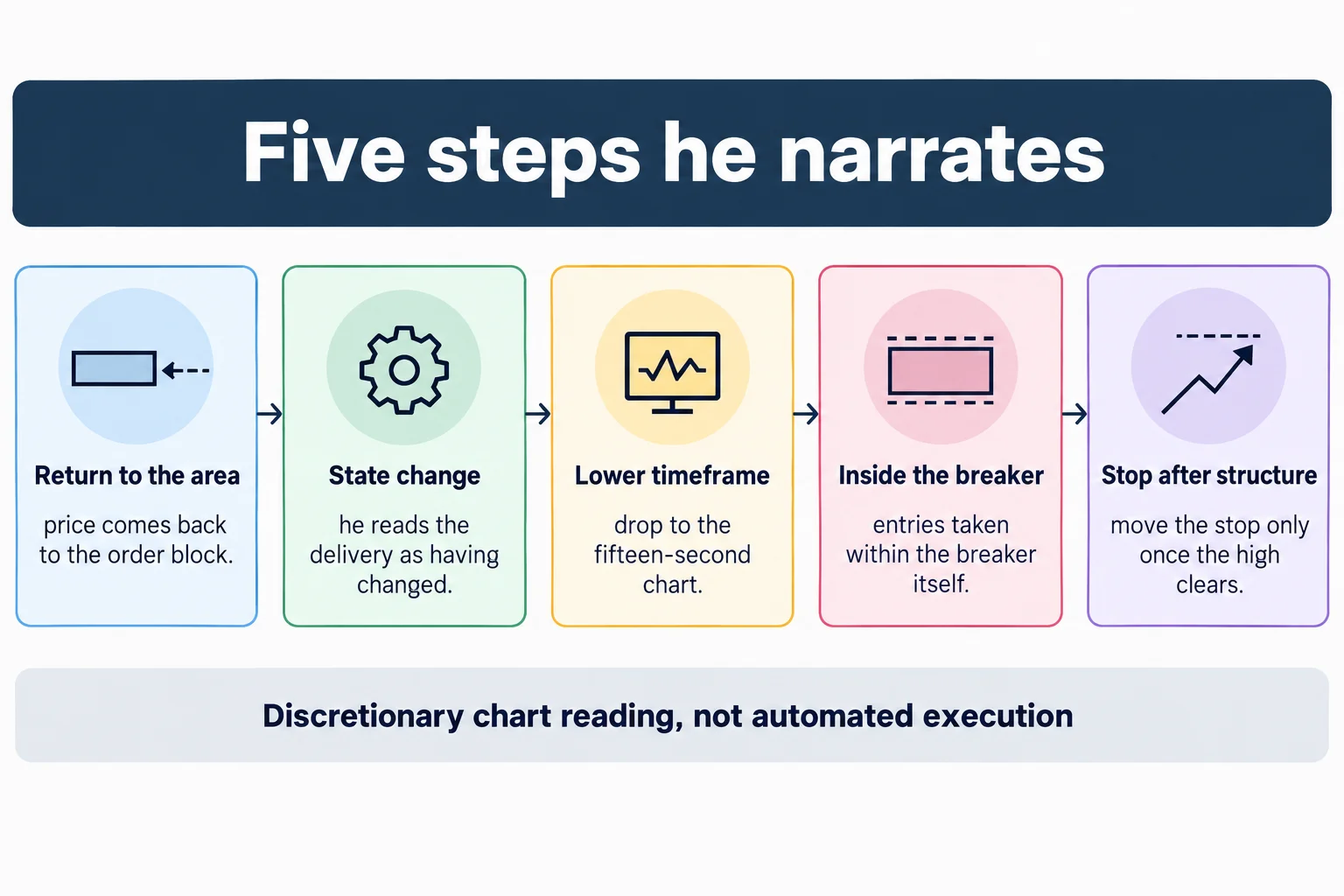
At 0:02 he introduces the session as an “algorithmic high frequency trading entry strategy”. At 0:06 he says price has come back to an order block and that he will go long when it trades down and touches it again. Two things are worth separating at the outset. The label he uses is his own; nothing in the recording describes automated order generation, co-location, latency infrastructure or a coded strategy, and he is working from charts by hand. The 15-second view he drops into is a fast timeframe, which is not the same thing as high-frequency trading as the term is normally used.
He gives a reason for being interested in the area. At 0:36 he calls what he sees there a change in the state of delivery, and at 0:43 he places the stop below the mean threshold. He then sets out the structural premise at 1:21, describing a low, a high and a lower low inside one candle’s range, and at 1:35 he moves down to a 15-second chart before price runs away from him.
The lower-timeframe sequence: gap, rebalance, breaker
On the faster chart he walks through three observations in order. At 2:02 he points to a gap and calls the following move an immediate rebalance, complaining he was a moment too slow to catch the drop. At 2:12 he says that as price keeps rising it will start to build momentum outside the breaker, and he marks the sell-side liquidity that sat just below the low. Later, at 3:58, he returns to a one-minute chart to read a volume imbalance as the objective, and at 3:38 he says a further touch of the breaker would be another place for him to add.
He also rejects named pattern frameworks outright at 4:07, saying the delivery he wants the reader to see requires no harmonic or animal patterns. That is a statement of his own position on terminology, not a finding the recording establishes.
His definition of the breaker, and where entries go
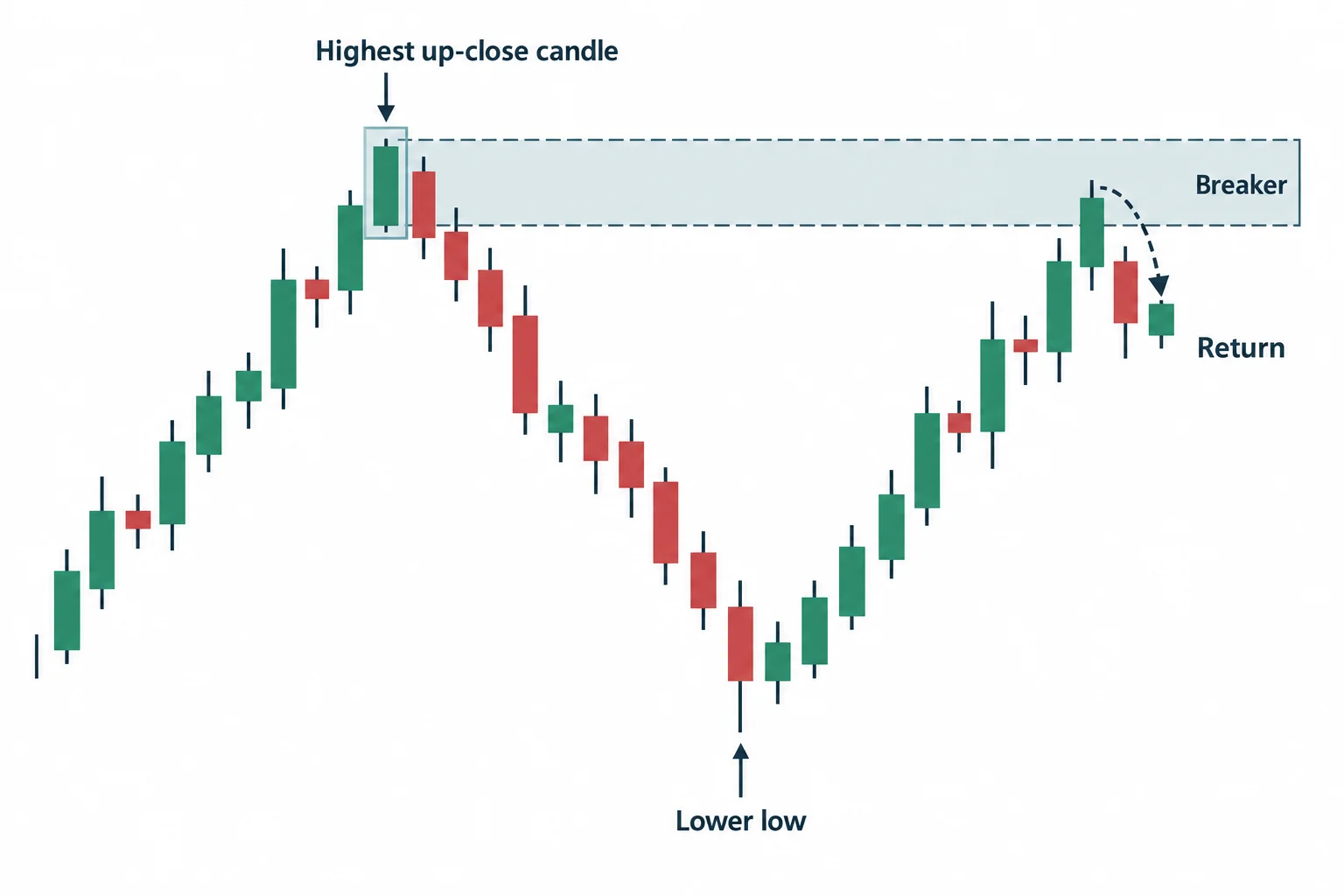
The operative definition arrives at 6:42, where he says he is entering inside the breaker and then defines it as the highest up-close candle in that swing before a lower low was met. That is a specific, testable description rather than a vague label, and it is the clearest instruction in the recording. He then says at 6:59 that he is deliberately not looking at the relative equal lows in front of him, because it is Friday and he expects a run up against buy stops.
He is careful to grade his own expectations. At 7:16 he calls the farther objective the best case scenario and says it does not need to be reached. The practical consequence is that his exits are spread out rather than dependent on one distant target, which is the next part of the recording.
Adding: stated risk readings while the premise held
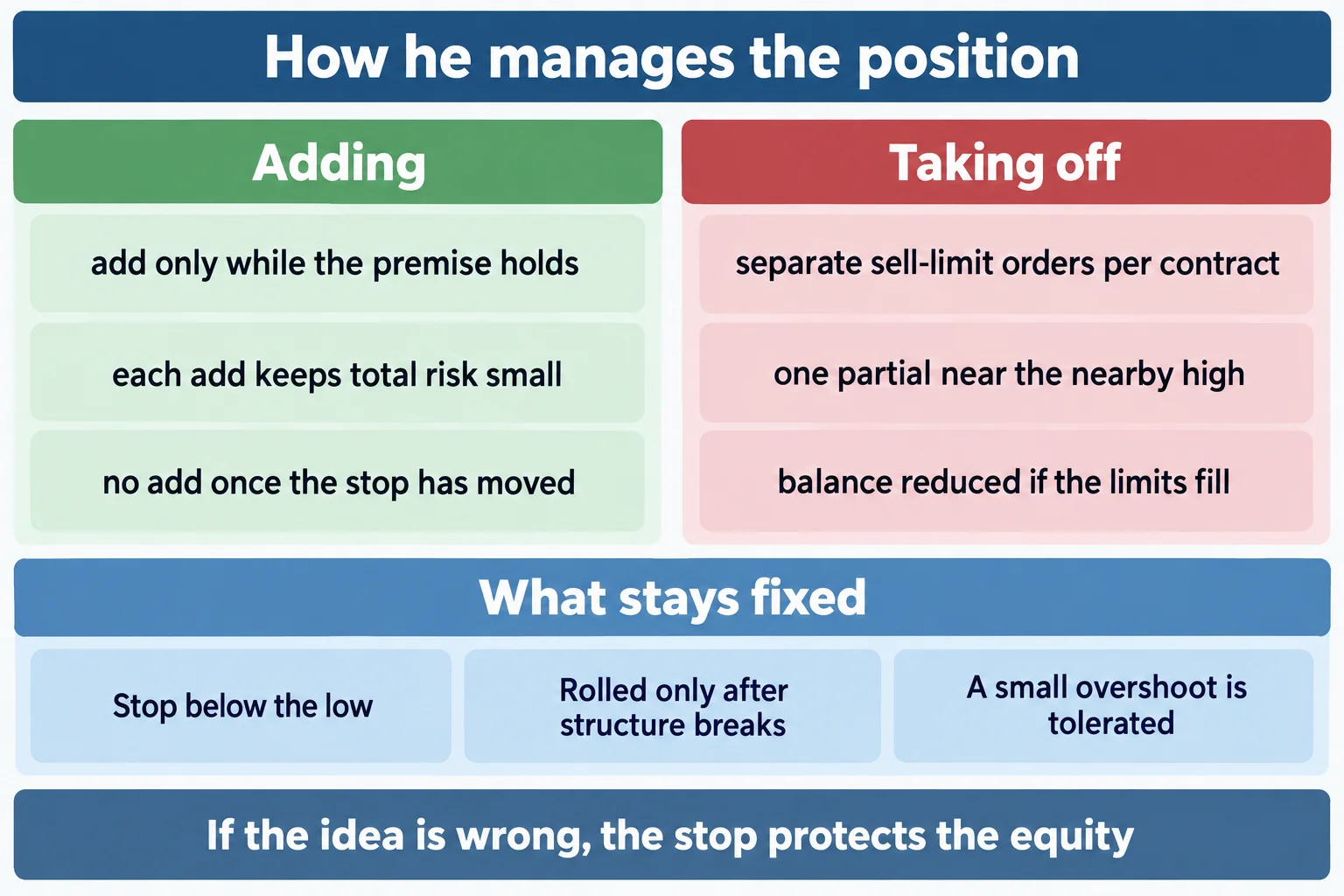
He narrates the position building contract by contract, reading his platform’s risk figure each time. At 2:52 he describes three contracts with a risk reading of 3-10, and at 4:29 he adds again and reads the risk as 575. Near the start, at 1:14, he mentions a figure of $170 without the captions making clear what it measures, so this article does not treat it as a risk statement. The pattern he describes is consistent: each add is made while the original structural premise is intact, and each is accompanied by a reading of the total exposure.
Where the stop goes is stated as a rule, not a preference. At 4:35 he says that once the nearby high is cleared he will take the stop and move it up underneath the newer low, because there should be no reason for price to go back below the breaker after that structure breaks. He repeats the same rule with the mechanics at 8:01: the stop rolls below that low only once the high is taken out, and only then. Later, at 9:15, he confirms the roll happened and reads the risk down to 300, and at 10:43 he reports six contracts with a risk reading of 365.
Exits: separate limits per contract
At 5:21 he points to a high that could be used for a partial and says he currently has five contracts on. He explains the mechanics at 7:40, placing a separate sell-limit order for one contract at one level and another at a higher level, and at 7:51 he describes the balance adjusting automatically from five contracts to three if both limits fill.
His stated rationale is about what a trader is allowed to need. At 5:46 he says this leaves him in a position where the whole scenario does not have to come to fruition and simply moving the right way is enough. The trade-off is real and worth naming: taking partials at intermediate levels gives up part of the position if the farther objective is eventually reached, in exchange for a smaller remaining exposure if it is not.
Context, tolerance and the stated invalidation
At 8:33 he says it is almost eight o’clock in the morning New York time and notes that it is a Friday. At 11:30 he adds that the market is underneath what he calls a buy program, then adds one more contract at 11:24 to demonstrate that the basis for the idea is unchanged.
He then states the invalidation and the tolerance in the same breath. At 11:54 he shows that the stop sits under the low, and explains that price is allowed to touch the breaker again by one small tick below it — his “mohawk” — without cancelling the idea. At 12:11 he asks what happens if he is wrong and answers that the stop will do its job and protect the underlying equity. He closes at 12:20 by pointing at the expansion away from the mean threshold. That closing sequence is the most transferable part of the recording: a defined invalidation, a stated tolerance for a small overshoot, and an explicit acceptance that the stop may be the outcome.
What the recording does not contain matters as much. It never names the instrument, never gives the account type, never states a balance or an account size, and shows no statement or confirmed fills. The risk figures and contract counts are readings he speaks aloud from his own platform. This is a narrated discretionary example, not evidence of profitability, reliability or predictive power, and there is no testing data in the source.
Educational takeaway
- Ask what a label actually means: a 15-second chart is not high-frequency trading, and a narrated session is not a tested algorithm.
- Write the definition of the entry structure down in one sentence, as he does for the breaker, so it can be checked against other sessions.
- Tie the stop’s movement to a specific structural event rather than to how the position feels.
- Decide in advance how much overshoot outside the entry structure you will tolerate, and be consistent about it.
- Spread exits rather than depending on one distant target, and accept the trade-off that comes with it.
- Measure risk as it changes with each add, and stop adding when the premise or the stop has been altered.
Primary source
The timestamp links above point at the passages being described. The chart detail behind his annotations is only visible in the recording itself, which is the sole source for everything said about the session.
Resources
These are the sources checked for this article. The CFTC and Investor.gov material is regulator background on futures and leverage and on how trading-system results are presented and marketed. None of it is an assessment of ICT, of this recording or of anything said in it, and no claim is made here about whether any method described in the recording works.
- [1] ICT Mentorship 2023 – September 22, 2023 – High Frequency Trading Algorithmic Entries – The Inner Circle Trader (primary source; watch page read 15 September 2026, 12M41S)
- [2] Investor.gov – Futures glossary (regulator description of futures contracts and leverage; read 15 September 2026)
- [3] CFTC – Commodity trading systems sold on the internet (fraud advisory describing how hypothetical and simulated results are presented; read 15 September 2026)
- [4] Investor.gov – Economic indicators glossary entry (context for scheduled data releases that move index futures; read 15 September 2026)
This is independent educational commentary on one recorded session. It is not official ICT material, it is not a tested or backtested trading system, and it is not investment advice. The contract counts and risk figures are platform readings the speaker states aloud, the instrument and account type are never identified in the recording, and no fill, statement or result is verified here. Leveraged futures trading involves substantial risk and is not suitable for everyone.