Key takeaways
ICT Mentorship 2023 Institutional Order Flow Made Simple is an approximately one hour 50 minute recording published by The Inner Circle Trader on YouTube on 16 July 2023 that presents ICT’s unverified price action model for Nasdaq.
Read the full summary
ICT Mentorship 2023 Institutional Order Flow Made Simple is an approximately one hour 50 minute recording published by The Inner Circle Trader on YouTube on 16 July 2023 that presents ICT’s unverified price action model for Nasdaq. ICT argues that DOM, Level II, order books and footprints show resting orders or completed transactions rather than where price will move next, so he instead starts with weekly and daily liquidity objectives before carrying mitigation blocks, propulsion blocks, breakers, candle bodies, premium and discount levels and fair value gaps onto hourly, 15 minute and five minute charts. His weekly case study targets buy-side liquidity and a mitigation block, while the daily propulsion block remains valid when price wicks through its 50 percent mean threshold without closing below it. He defines breakaway gaps as inefficiencies expected to remain open, measuring gaps as forming roughly halfway toward the liquidity target and inversion fair value gaps as old imbalances later respected from the opposite side. Intraday analysis incorporates an 8 thirty news release, a New York lunch stop run and a Friday bearish reversal with a TGIF retracement objective of roughly 20 to 30 percent of the weekly range. ICT acknowledges that directional calls can fail, and the article stresses that the charts, forecasts, fills and outcomes are visible or described only in the recording, are not independently verified or backtested and do not establish reliable or profitable prediction.
How we researched this article
BestProps used document-based research from primary firm sources, checked September 24, 2026. The complete source list, scope, limitations, and commercial-state record appear near the end of this article.
What ICT Mentorship 2023 Order Flow Covers
In ICT Mentorship 2023 – Detailed Analysis of Institutional Order Flow, published on the The Inner Circle Trader channel on 16 July 2023, ICT contrasts conventional order-flow displays with his own price-action framework. The lesson first discusses depth of market (DOM), Level II data, footprints and order books. It then develops a multi-timeframe Nasdaq case study using concepts such as liquidity draws, mitigation and propulsion blocks, candle bodies, fair value gaps, breakers, premium and discount, and time-of-day macros. Throughout, the upload date and the date spoken in the recording are the same day: he says at 20:52 that it is 16 July 2023.
The central distinction is terminological. What many traders call order flow is transaction or resting-order data. ICT uses “institutional order flow” to describe his interpretation of how price moves among liquidity and inefficiency objectives on time-based charts. That is ICT’s market model and terminology, not independently established proof that institutional activity can be identified from candles alone.
Why ICT Institutional Order Flow Skips DOM and Footprints
At 2:43, ICT gives his short answer: he does not believe DOM and footprint tools are necessary for his method. He is careful not to tell traders who find them useful to abandon them. His narrower objection is to presenting these displays as a complete or uniquely “institutional” way to determine direction. In the same opening section he says his aim is to draw a stark contrast with how he uses the phrase institutional order flow (10:54).
His argument has three parts:
- A directional judgment remains necessary. A trader still must decide whether price is more likely to move higher or lower, regardless of how many orders appear on either side of the market. At 5:28 he groups DOM and level II data under that same challenge.
- Displayed orders can disappear. From 3:19, ICT discusses orders being placed above or below the marketplace and pulled away before the market prints, which he describes as spoofing. His broader point is that a visible order is not the same thing as a completed transaction or a dependable destination for price.
- Footprints describe completed activity. At 13:31, he emphasizes that footprint data reports what has already happened within a bar: “how many orders were in this part of the candle”. He prefers to begin with an anticipated liquidity objective and then observe whether price delivery supports that thesis.
ICT repeatedly acknowledges that his own directional opinion can be wrong. He also says supplementary tools may help someone remain focused or trust a defined model. The practical lesson is therefore not that order-flow software is inherently useless, but that ICT does not treat it as a substitute for context and directional analysis.
ICT Institutional Order Flow Nasdaq Case Study
The chart-based portion begins at 19:09, where he moves into what he calls a case study on Nasdaq and says he will spare the audience level II data because it is not required. He reviews a bullish Nasdaq expectation he had discussed the prior Sunday, and notes at 16:20 that he had already stated a view before the market opened. Because the transcript cannot show the charts, and does not contain any verified fills or statement, his earlier forecasts and the results he recounts remain his retrospective descriptions rather than independently verified outcomes.
Find the Higher Timeframe Institutional Draw
On the weekly chart, ICT identifies what he calls a mitigation block and treats it primarily as a target rather than an entry area. At 21:30 he defines the structure as a high, a low and a higher high without a lower high, and explains that mitigation blocks can be traded through, whereas he regards breakers as potentially stronger obstacles: “bearish breakers are much more stronger in terms of resistance than a mitigation block” (22:20). He combines that proposed target with buy-side liquidity above prior highs to form a bullish weekly objective.
The daily chart then supplies context through a “propulsion block”: in ICT’s description, a down-close candle that digs into an earlier down-close order block (27:51). He monitors the midpoint, or “mean threshold”, which he places at the 50 level of the block, and considers the structure valid when candles wick through that midpoint but do not close below it. He uses that condition to explain why the weekly target remained relevant.
Apply Institutional Order Flow to Lower Timeframes
At 32:59, the analysis moves to an hourly chart. ICT describes sell-side liquidity being taken, a short-term high being exceeded and price retracing toward the propulsion block’s mean threshold. In his framework, taking out the short-term high marks a shift in market structure; he adds that price does not need to close above it for that reading to apply (33:21). The higher-timeframe liquidity objective remains above.
He stresses that higher-timeframe reference points must remain visible or recorded when studying lower-timeframe movement. Otherwise, an isolated one- or five-minute pattern lacks the weekly and daily context that gives it meaning within his model.
Read Institutional Liquidity and Order Flow Inefficiencies
ICT gives candle bodies more narrative weight than wicks. Around 33:58, he argues that the bodies tell the story while “the wicks do all the damage”, because they are where traders are stopped out. This is an interpretive rule within his methodology, not a guarantee about subsequent price.
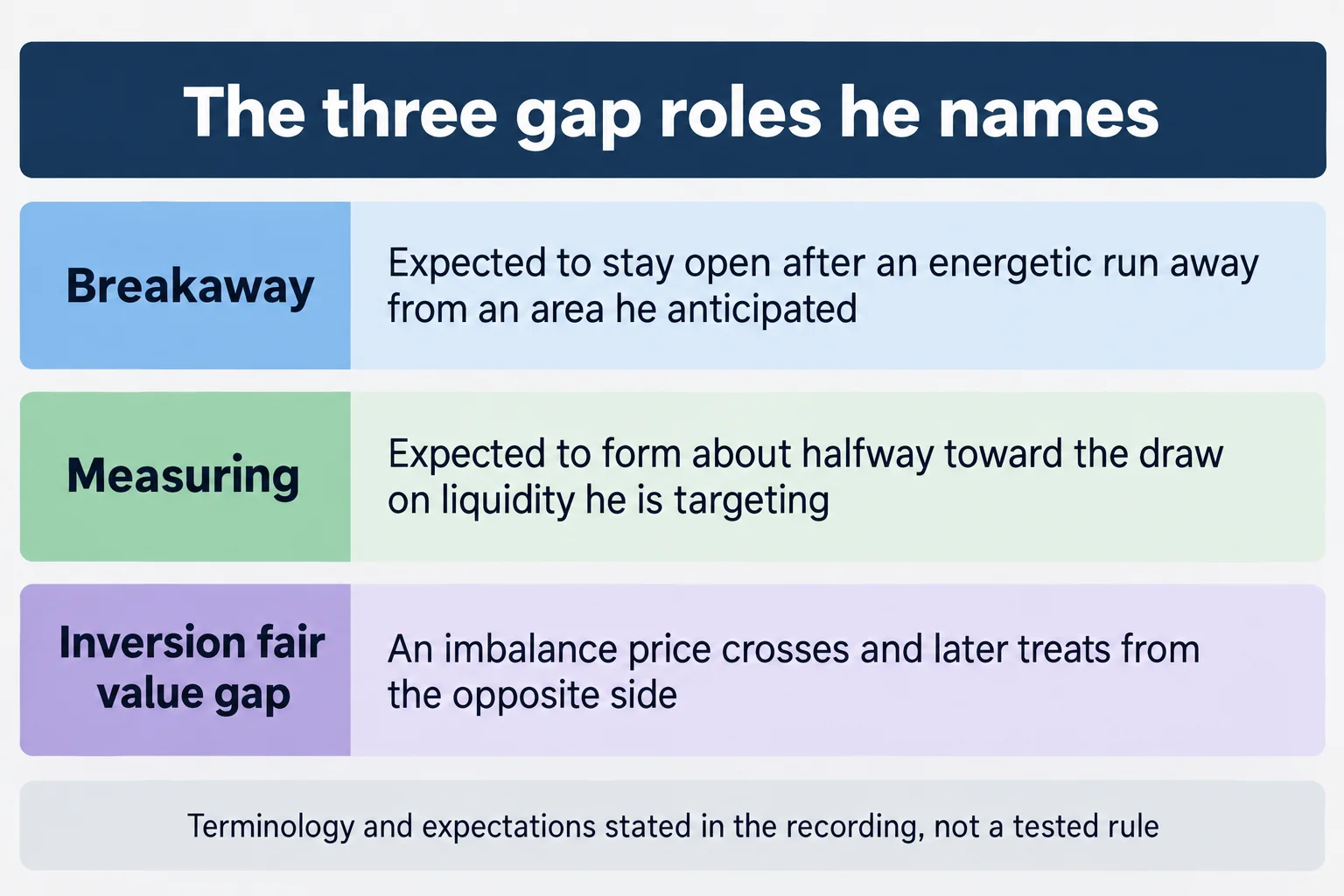
He also classifies gaps by the role he expects them to play. A breakaway gap is an inefficiency he expects to remain open after an energetic run away from an area he anticipated beforehand (57:12). A measuring gap is the one he expects to form roughly halfway toward the draw on liquidity he is targeting (106:09). An inversion fair value gap is an old imbalance that price crosses and later treats from the opposite side; he compares those levels to footholds a climber uses going up a face (87:06).
The captions for this recording are auto-generated and render a number of the speaker’s abbreviations inconsistently. “buy-side imbalance / sell-side inefficiency” appears several times in mangled forms. The concepts are identifiable from context, but the exact wording he uses for one of them is genuinely ambiguous in the caption file and is not asserted here.
ICT Order Flow Timing and Friday Reversals
From approximately 1:08:23, ICT steps down through 15-minute and five-minute charts. He relates the intraday structure to an 8:30 news release, a New York lunch macro and continued movement toward the higher-timeframe objective. Describing the lunch window at 1:10:20, he says that time of day is when he expects price to run the stops resting below the lows made after the news driver hit.
Later, from 1:37:38, he examines what he describes as a Friday blow-off move followed by a bearish shift. His analysis combines an inversion fair value gap, a bearish order block he reads from consecutive up-close candles (1:39:54), afternoon timing and a “TGIF” retracement objective he describes as roughly 20 to 30 percent of the weekly range (1:40:18). He explicitly notes that this interpretation could have been wrong if price had continued higher.
ICT Institutional Order Flow Takeaways
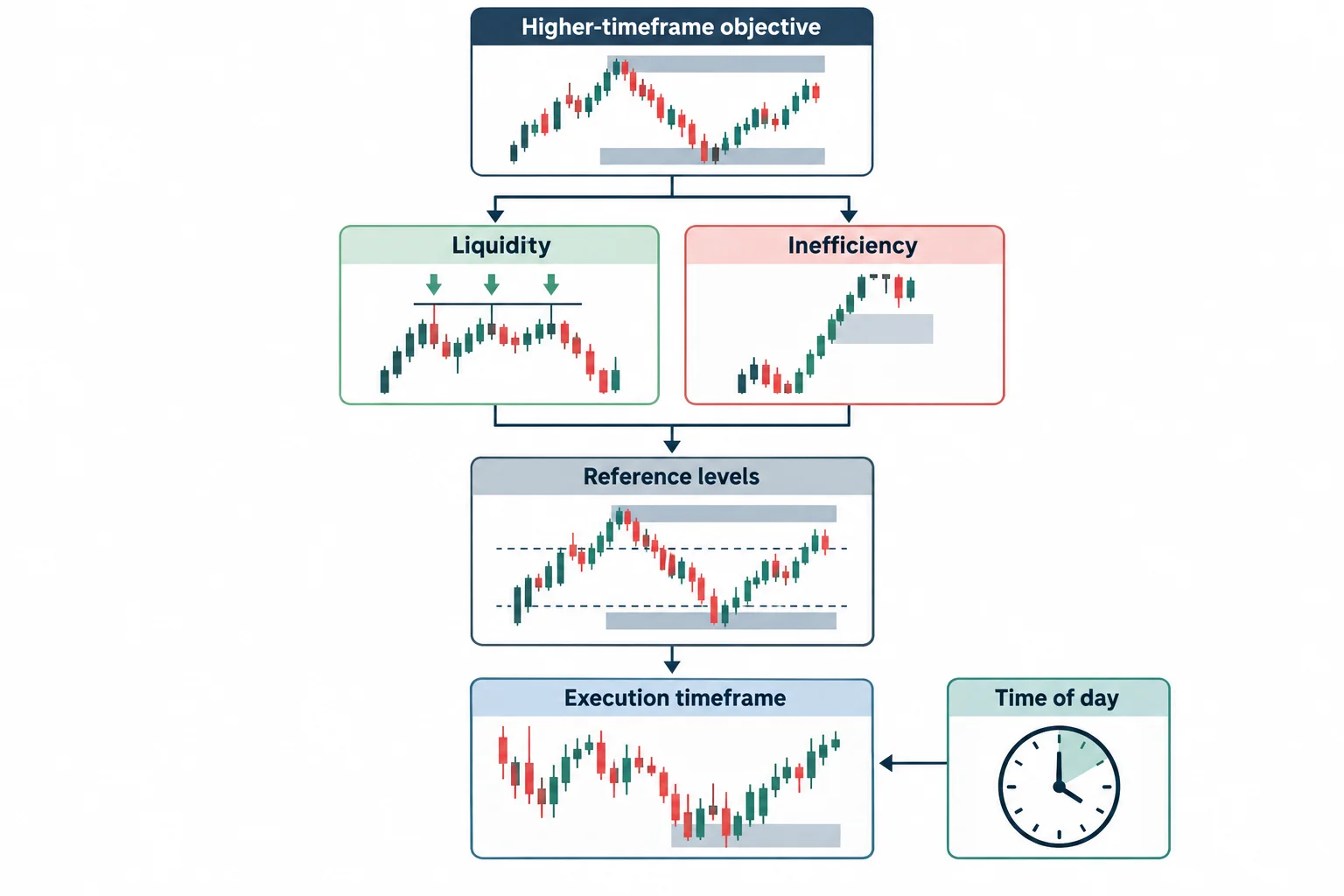
- Begin with a higher-timeframe hypothesis about the likely liquidity objective before examining entries.
- Carry weekly and daily reference levels onto the execution timeframe.
- Separate resting-order displays from completed transactions and from directional interpretation.
- Study whether price respects or invalidates predefined levels instead of adding every available concept to one chart.
- Use replay or screen recordings for observation and journaling without assuming a historical pattern will repeat.
ICT closes at 1:47:42 by summarizing the lesson as an integration of liquidity, inefficiency, gaps, time of day and anticipated price behavior, and repeats his objection to ladders, depth of market and footprints. The video is educational commentary, not investment advice, and it does not establish that the framework predicts markets reliably or profitably.
Watch the original recording on YouTube
This video cannot be played inside another website. Its embedded player was loaded and clicked from a BestProps page on 15 September 2026 and reported “Video unavailable. Playback on other websites has been disabled by the video owner.”, staying on a “Watch on YouTube” prompt with no playback progress, while the public watch page plays normally. That is why there is no inline player here.
Watch ICT Mentorship 2023 – Detailed Analysis of Institutional Order Flow on YouTube ↗
The timestamp links above point at the passages being described. Annotations, candles and levels are visible only in the recording, which is the sole source for everything said here about the session.
ICT Mentorship 2023 Order Flow Resources
These are the sources checked for this article. The CFTC and Investor.gov pages are regulator background on futures, leverage and how trading-system results are presented. None of them assesses ICT, this recording or anything said in it, and no claim is made here about whether the method described works.
- [1] ICT Mentorship 2023 – Detailed Analysis of Institutional Order Flow – The Inner Circle Trader (primary source; watch page read 15 September 2026, 1H50M31S)
- [2] Investor.gov – Futures glossary (regulator description of futures contracts and leverage; read 15 September 2026)
- [3] CFTC – Commodity trading systems sold on the internet (fraud advisory describing how hypothetical and simulated results are presented; read 15 September 2026)
- [4] Investor.gov – Economic indicators glossary entry (context for scheduled data releases that move index futures; read 15 September 2026)
This is independent educational commentary on one recorded session. It is not official ICT material, it is not a tested or backtested trading system, and it is not investment advice. The forecasts, fills and outcomes discussed are the speaker’s own account of the session and are not independently verified here. Leveraged futures trading involves substantial risk and is not suitable for everyone.