Key takeaways
Futures prop firm contract caps vary by firm, program, account phase, instrument, drawdown status, and scaling level.
Read the full summary
Futures prop firm contract caps vary by firm, program, account phase, instrument, drawdown status, and scaling level. In Topstep’s simulated Trading Combine parameters checked August 25, 2026, the published maximum position sizes are 5 minis or 50 micros for $50K, 10 minis or 100 micros for $100K, and 15 minis or 150 micros for $150K, with micros and minis counted at a 10:1 ratio. Treat those figures as a dated Topstep Trading Combine example, not a market-wide schedule or a position-sizing recommendation. ES and MES tick values are $12.50 and $1.25, making a 12-tick stop $150 per ES or $15 per MES, while NQ and MNQ tick values are $5 and $0.50, making a 20-tick stop $100 per NQ or $10 per MNQ before costs and slippage. Compare separate evaluation and funded caps, scaling milestones, account-wide aggregation, pending-order treatment, session restrictions, eligible instruments, and usable drawdown rather than relying on advertised account size.
How we researched this article
BestProps used document-based research from primary firm sources, checked September 12, 2026. The complete source list, scope, limitations, and commercial-state record appear near the end of this article.
Quick answer: There is no universal schedule for futures prop firms’ maximum contracts per account size. A $50K account at one firm may have a different cap from a similarly advertised account elsewhere. Limits can also vary by program, evaluation or funded phase, instrument, drawdown status, and scaling level.
That makes a simple account-size comparison potentially misleading. Before trading, confirm the current limit in the firm’s official rules and determine exactly how minis and micros are counted. The advertised account balance alone does not show how much risk capacity a trader actually has.
Research scope: BestProps checked current official Topstep Trading Combine parameters and CME contract specifications on August 25, 2026. This is document-based research, not first-hand account purchase, platform, execution, support, payout, or live-capital testing. Recheck the official rule page and agreement for the exact firm, program, phase, account size, and instrument before placing an order.
Maximum Futures Contracts by Prop Firm and Account Size
A useful comparison should identify more than a firm name and headline account size. For every account, traders need to know the program, phase, mini limit, micro limit, scaling conditions, effective date, and whether the cap covers the entire account or an individual market.
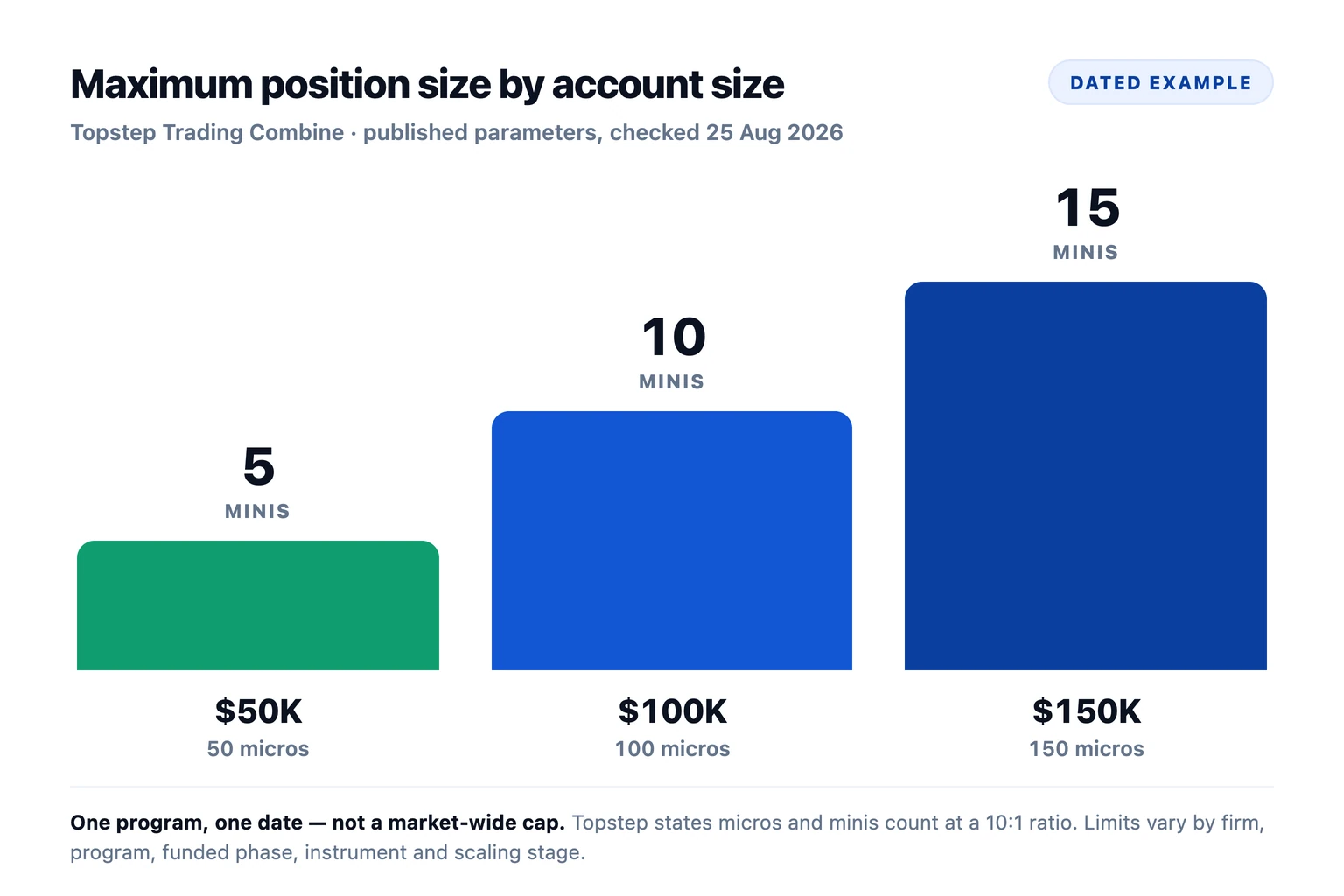
Current Topstep Trading Combine example (checked August 25, 2026): Topstep describes the Trading Combine as a simulated evaluation. Its official parameters list maximum position sizes of 5 minis or 50 micros for $50K, 10 minis or 100 micros for $100K, and 15 minis or 150 micros for $150K. The same page says micros and minis count at a 10:1 ratio. These limits apply to the named Topstep program and checked date; they do not establish another firm’s limits or Topstep rules for every account phase.
| Account size | Maximum minis | Maximum micros | What the figure covers |
|---|---|---|---|
| $50K | 5 | 50 | Topstep Trading Combine, checked August 25, 2026 |
| $100K | 10 | 100 | Topstep Trading Combine, checked August 25, 2026 |
| $150K | 15 | 150 | Topstep Trading Combine, checked August 25, 2026 |
| $25K | not verified | not verified | The account label does not determine the contract cap |
If an official source does not clearly state a limit, record “not verified” rather than extrapolating from another account tier, program, search snippet, or third-party summary.
Futures Contract Limits by Account Size
Contract Limits for $25K Accounts
Smaller advertised accounts often attract traders looking for a lower-cost evaluation, but the account label does not determine the contract cap. A firm may impose a relatively low maximum, apply an initial restriction, or allow scaling only after an account reaches a defined milestone.
Compare the position limit with the account’s actual drawdown allowance. A $25K label does not mean that $25,000 can be lost. In a simulated funded-trading program, the operative risk boundary is usually defined by the program’s loss and drawdown rules.
Contract Limits for $50K Accounts
There is no dependable market-wide maximum for a $50K account. In the dated Topstep Trading Combine example above, the published limit is 5 minis or 50 micros, but a different firm, program, funded phase, or scaling stage can use another number.
Traders should verify whether a published cap applies during the evaluation, after funding, or only after a safety threshold is met. They should also check whether the stated number means E-minis, total contracts of any type, or an exposure formula that treats micros differently.
Contract Limits for $75K to $100K Accounts
Medium-sized tiers may offer higher nominal caps, but increased account size does not guarantee proportionally greater usable risk. Drawdown mechanics, consistency conditions, and phase-specific restrictions can matter more than the headline maximum.
When comparing the maximum contracts on a $100K funded account, record the evaluation and funded limits separately. Do not infer a $100K limit by doubling a verified $50K figure.
Contract Limits for $150K and Larger Accounts
Larger plans can publish higher contract allowances, but the maximum may still depend on program phase, scaling stage, account threshold, or temporary risk controls. In the dated Topstep Trading Combine example above, the $150K maximum is 15 minis or 150 micros. Do not apply that figure to another firm or account phase without current official confirmation.
How Futures Prop Firms Count Mini and Micro Contracts
Futures prop firm mini and micro limits are not always expressed in the same way. A firm may publish separate caps, count every open contract individually, or convert micro contracts into mini-equivalent exposure.
Micros commonly represent one-tenth of the corresponding E-mini contract’s exposure, but that market relationship does not prove that a prop firm uses a 10:1 position-limit formula. Its risk system may count contracts differently.
Before combining products, ask:
- Are mini and micro limits listed separately?
- Does the firm define an explicit conversion ratio?
- Is the cap calculated across the whole account or per symbol?
- Are correlated markets combined for limit purposes?
- Do pending orders count, or only filled positions?
- Does an overnight session have a different cap?
For example, a trader should not assume that one ES and ten MES contracts consume identical capacity under a firm’s rules, even though their approximate market exposure is comparable. The official rulebook must define how the platform’s risk controls count them.
Futures Prop Firm Contract Limits by Account Phase
The evaluation limit may not carry over to a funded account. Some programs can introduce a lower initial cap, a safety-net restriction, or a scaling schedule after the evaluation. Conversely, other programs may keep the same cap throughout. No single pattern applies to every provider.
For each phase, confirm:
- The maximum simultaneous open position.
- Whether the cap is account-wide, per instrument, per direction, or per order.
- Whether scaling is automatic or requires approval.
- What account metric unlocks a higher limit.
- Whether a drawdown threshold can reduce the permitted size.
- What happens when an order would exceed the cap.
An order might be rejected by a risk system, but traders should not assume rejection is guaranteed. Depending on the documented rules and platform controls, an attempted or filled excess position could have other consequences. Confirm the firm’s current breach handling directly.
Maximum Futures Contract Size and Sensible Position Size
A contract cap is a ceiling, not a position-sizing recommendation. Practical size depends on stop distance, contract tick value, current drawdown room, slippage assumptions, and the trader’s predefined loss limit.

For illustration, ES has a tick value of $12.50 per contract, while MES has a tick value of $1.25. A 12-tick stop therefore represents $150 per ES contract or $15 per MES contract before commissions, fees, or slippage. Five ES contracts would represent $750 at that stop distance, even if a firm permitted a larger position.
NQ has a tick value of $5, while MNQ has a tick value of $0.50. At a 20-tick stop, the corresponding amounts are $100 per NQ contract and $10 per MNQ contract before trading costs and slippage.
These examples are educational arithmetic, not individualized financial advice. Realized losses can exceed the planned amount when orders fill at worse prices, particularly during fast markets or gaps.
Futures Prop Firm Contract Rules to Check
- Drawdown model: Determine whether it is static, end-of-day trailing, or intraday trailing and what balance or equity measure drives it.
- Total open exposure: Confirm how simultaneous positions in ES, NQ, MES, MNQ, and other contracts are aggregated.
- Instrument eligibility: Not every product available on a platform is necessarily permitted by a program.
- Session restrictions: Check whether positions must be closed before a specified time or may remain open overnight.
- News rules: Verify whether opening, closing, or holding positions around scheduled events is restricted.
- Order handling: Understand whether pending orders reserve contract capacity and how partial fills are counted.
- Scaling: Record the exact milestone, new limit, and conditions for retaining the higher allowance.
See BestProps’ guides to futures prop firm rules, trailing drawdown, and micro versus E-mini futures for related comparison factors.
Futures Prop Firm Contract Update Method
A defensible contract-limit comparison should prioritize official program rules over affiliate pages, glossaries, snippets, or community posts. Each entry should include a direct source and the date it was manually checked.
Search-result snippets can identify a claim that needs investigation, but they should not be used to publish a limit. Future-dated pages also require review because their publication date may not match the rule’s effective date.
Automated monitoring can flag an altered or missing rule page. It should not automatically publish a changed number, infer missing limits, or convert minis to micros without an explicit firm definition. A human review remains necessary whenever a program changes.
Futures Prop Firm Contract FAQs
How Many Contracts Can I Trade on a $50K Funded Account?
There is no standard answer. The limit depends on the firm, program, funded phase, instrument type, scaling status, and counting method. Verify the current official rule for the exact account.
Do Ten Micros Always Equal One Mini?
No. That exposure relationship should not be assumed to be the firm’s risk-control formula. Use only the conversion method stated in the official rules.
Can I Trade the Maximum Across Several Instruments?
Only if the rules explicitly permit it. Some limits may be account-wide, while others may be defined per instrument or through an exposure calculation.
Does Passing an Evaluation Increase the Contract Limit?
Not necessarily. A funded phase can have the same cap, a lower initial cap, or a scaling structure. Compare both phases separately.
What Matters Most Besides the Contract Cap?
The usable drawdown allowance is essential because it defines the practical loss boundary more directly than the advertised account size. Position size should be evaluated against that boundary rather than against the maximum alone.