Key takeaways
Apex Trader Funding and Tradeify offer futures prop-trading pathways, but neither is universally better and the right choice depends on the exact program, purchase date, drawdown mechanics, consistency rules, total costs, payout eligibility, platform support, session restrictions and multi-account policies.
Read the full summary
Apex Trader Funding and Tradeify offer futures prop-trading pathways, but neither is universally better and the right choice depends on the exact program, purchase date, drawdown mechanics, consistency rules, total costs, payout eligibility, platform support, session restrictions and multi-account policies. Compare Apex plans directly with Tradeify Growth, Select or Lightning rather than at brand level, and verify whether each stage uses intraday trailing, end-of-day trailing, locked or another drawdown method. Calculate initial evaluation, recurring billing, resets, activation, market data, platform, multiple-account, tax and processing costs across 3 scenarios covering a pass in 1 billing cycle, an additional cycle and 1 restart. Separately confirm evaluation and payout consistency formulas, qualifying and winning days, safety-net balances, request limits, profit splits, approval procedures and processing times because public sources conflict and request frequency does not equal payout speed. Also verify simulated versus live status, maximum accounts, trade copying, scaling, supported platforms, overnight and weekend rules, news trading, liquidation deadlines, permitted futures products, contract limits and automation policies. Apex may fit traders whose verified drawdown, account structure and scaling rules support their workflow, while Tradeify may fit traders whose preferred named path better matches their trading frequency, payout schedule and daily profit distribution. Save dated official rules before purchase, model the first payout requirements and recheck policies monthly and immediately before paying.
How we researched this article
BestProps used document-based research from primary firm sources, checked September 12, 2026. The complete source list, scope, limitations, and commercial-state record appear near the end of this article.
Choosing between Apex Trader Funding and Tradeify is less about finding a universal winner and more about matching a specific program to your trading habits. Both companies offer futures prop-trading pathways, but their available plans, drawdown mechanics, consistency requirements, costs and payout conditions may differ by account type and stage.
This Apex Trader Funding vs Tradeify comparison focuses on the questions funded traders should ask before purchasing an evaluation. It does not present volatile prices or payout terms as settled facts because current search results conflict on several important details. Verify every material rule on the firms’ official websites immediately before paying.
Quick verdict: Compare named programs, not just the two brands. Apex may be worth investigating if its current account structure and drawdown model suit your multi-account or evaluation workflow. Tradeify may be worth investigating if one of its distinct program paths offers rules better aligned with your payout schedule and daily profit distribution. Neither is automatically better for every trader.
Apex Trader Funding vs Tradeify Quick Comparison
The most useful comparison starts with the exact account size, program and purchase date. Public comparison pages frequently mix different Apex paths with Tradeify Growth, Select or Lightning programs. That can make a low advertised entry price look comparable to a plan with a different activation cost, drawdown method or funded-stage rule set.
| Comparison point | What to check |
|---|---|
| Programs | Both firms may offer more than one route, so firm-wide conclusions can be misleading. |
| Costs | Evaluation prices, promotions, renewals, resets and activation charges are time-sensitive. |
| Drawdown | Confirm whether the selected plan uses intraday trailing, end-of-day trailing or another mechanism. |
| Consistency | Check evaluation and payout-related consistency conditions separately. |
| Payouts | Eligibility, request frequency, approval and payment processing are different concepts. |
| Account status | An account described as funded may still be simulated rather than a live brokerage account. |
Because these details change, this article provides a decision framework rather than repeating disputed figures from third-party pages.
Apex and Tradeify Total Costs
A headline discount is only one component of the possible cost of reaching payout eligibility. A proper Apex vs Tradeify cost comparison should account for every charge that could apply to the selected path.
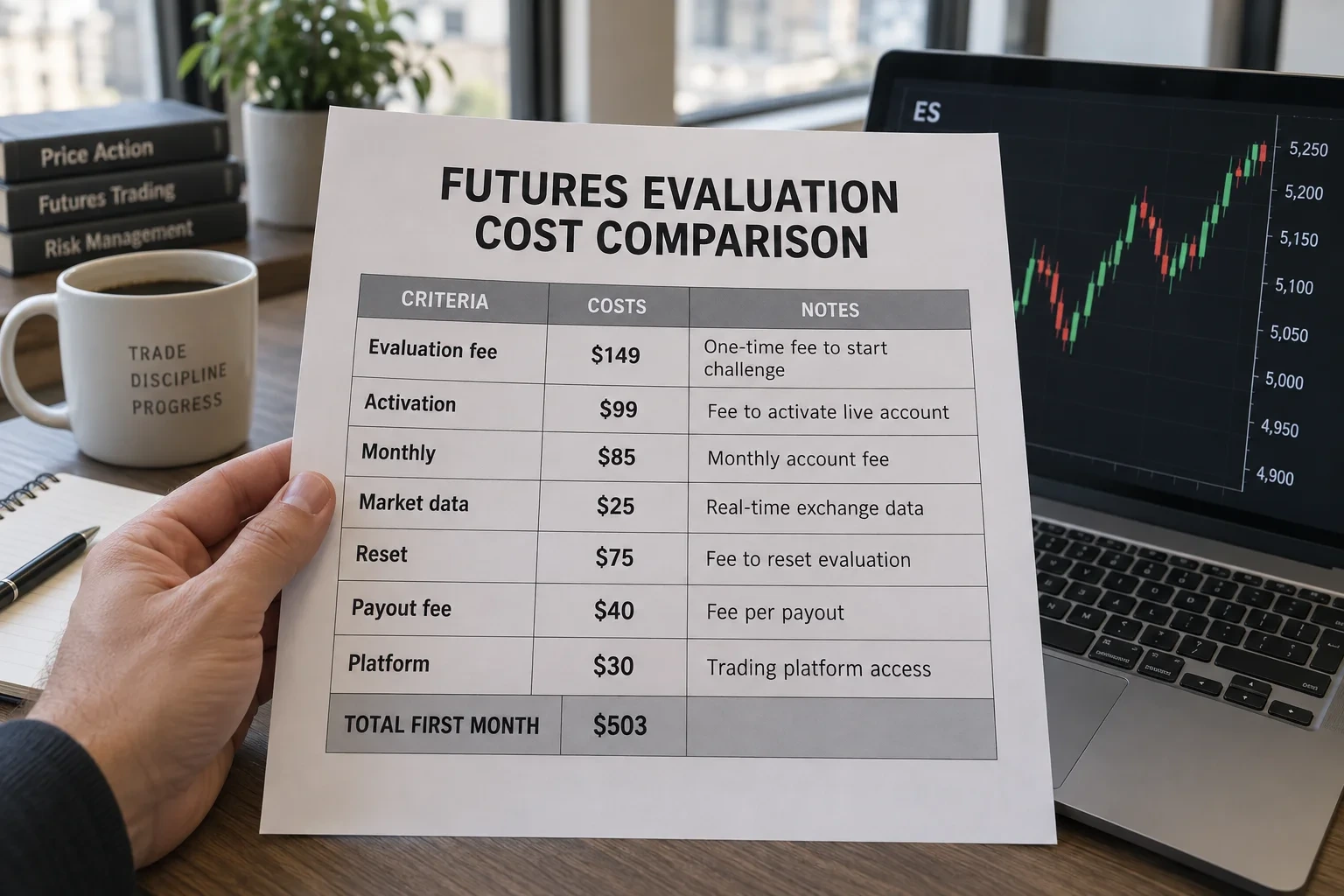
Build a personal cost worksheet containing:
- The initial evaluation price after any promotion
- Recurring evaluation charges and the billing date
- Reset charges, if resets are available
- Any funded-stage or activation charge
- Required market-data or platform costs
- The cost of maintaining multiple accounts
- Taxes or payment-processing costs that may apply to you
Calculate at least three scenarios: passing in one billing cycle, requiring an additional cycle and restarting once. This avoids selecting a firm solely because its temporary promotion has the smallest upfront number.
Do not assume a coupon remains valid or that a historical fee applies to a current account. Even firm-published promotional content can become stale. A Tradeify article discussing affordable firms, for example, contains promotional language and should not replace the checkout page and current program agreement.
Apex and Tradeify Drawdown Rules
Drawdown is often more consequential than the profit target. The label alone is insufficient: traders need to know when the threshold moves, which balance or equity value causes it to move, and whether it eventually stops trailing.

Apex Drawdown Example
Suppose two hypothetical accounts begin with the same balance and drawdown allowance. During a trade, open profit pushes equity higher before much of that profit disappears prior to the close.
- Under an intraday trailing model, the threshold may rise with the high-water mark while the trade is open.
- Under an end-of-day model, the threshold may be recalculated using an end-of-session value rather than every intraday fluctuation.
- Under a locked or non-trailing phase, the threshold may stop moving after a defined condition is met.
Those structures can produce different results from the same trade path. A trader who regularly lets open profits fluctuate may prefer a different model from someone who uses tight stops and closes positions quickly.
Search results describe Apex drawdown as intraday trailing, end-of-day trailing or plan-dependent. That conflict is a reason to check the exact Apex program rather than generalize. Tradeify’s official explanation, checked August 26, 2026, states that Growth, Select and Lightning accounts use an end-of-day trailing drawdown that updates from the closing balance rather than intraday unrealized profit peaks. Record the threshold behavior for both the evaluation and simulated-funded stage before choosing.
Apex and Tradeify Consistency Rules
A consistency rule generally limits how much one trading day can contribute relative to a broader profit measure. Its practical effect depends on the formula, percentage, calculation window and stage where it applies.
Third-party sources report conflicting consistency percentages for both firms. Some may refer to an evaluation, while others may describe payout eligibility or older account cohorts. Instead of relying on a single percentage from a comparison site, ask:
- Does a consistency rule apply during the evaluation?
- Is there a separate rule for requesting a payout?
- What values appear in the numerator and denominator?
- Can additional trading bring an account back into compliance?
- Did the rule depend on when the account was purchased?
This matters especially to traders whose profits are uneven. A strategy that produces one large day followed by several small days could meet a profit target but remain ineligible under a consistency formula. Learn more about prop firm consistency rules before comparing percentages.
Apex and Tradeify Payout Terms
Statements such as “daily payouts,” “same-hour payouts” or “fast processing” can refer to different parts of the process. One phrase may describe how often requests are permitted, while another describes processing after approval. Neither proves that every request will be approved or paid within that period.
For each Apex or Tradeify plan, verify:
- The minimum trading or qualifying days before a request
- Any winning-day definition
- The consistency condition at request time
- Minimum and maximum request amounts
- Account-balance or safety-net requirements
- Limits on early payouts or individual requests
- The stated profit split for the relevant stage
- Approval procedures and estimated processing times
Public pages currently conflict over Apex’s profit split and both firms’ payout timing. Avoid using a third-party summary as the final authority. Read the current payout policy and save a dated copy of the rules governing your account.
Apex and Tradeify Account Limits and Scaling
Traders interested in multiple accounts should compare more than the maximum advertised account count. Confirm whether the limit varies by program, whether accounts can be traded simultaneously and what trade-copying behavior is allowed.
Also distinguish account balances from actual capital allocation. A collection of simulated accounts with large notional balances should not automatically be described as equivalent live funding. Review the conditions under which either firm may transition a trader from simulated trading to another account type.
Search results report materially different maximum-account and allocation figures for Apex and Tradeify. Those numbers should be considered unverified until checked against current official policies. Traders should also review prohibited conduct, device or location policies and rules involving coordinated or copied trades.
Apex and Tradeify Platforms Sessions and Trade Rules
Platform support can determine whether a program fits your workflow. Before purchasing, verify that your intended platform, operating system, data connection and order-entry tools are supported by the exact program.
Session rules deserve similar attention. Third-party pages sometimes state that both firms require positions to be closed near the end of the futures session, but this should not be assumed across every plan. Check current rules covering:
- Overnight and weekend positions
- Economic news and high-impact events
- Session-close liquidation deadlines
- Permitted futures products and contract months
- Maximum position size and scaling
- Automated systems, trade copiers and third-party tools
A technically compatible platform does not necessarily mean every feature or strategy is permitted.
Apex and Tradeify Reviews on Reddit and Third-Party Sites
Community discussion ranks prominently for this comparison because traders want practical context about rule interpretation and account management. A Reddit discussion comparing several firms can reveal questions that deserve further investigation, but individual comments are qualitative audience evidence, not verified proof of payout reliability or firm policy.
The same caution applies to comparison publishers. PropScorer, Phidias Propfirm and The Prop Firm Guide emphasize useful comparison categories, but their figures may reflect different plans, dates or commercial relationships. Use them to create a checklist, then verify the answers directly.
When Apex Fits Your Trading Style
Apex may belong on your shortlist if you are prepared to identify the exact program, understand its drawdown behavior and verify current multi-account policies. It may be less suitable if your strategy conflicts with the selected plan’s trailing threshold, payout conditions or session restrictions.
Do not choose Apex based only on a discount or an advertised account balance. Model the full cost and read the rules that apply after passing.
When Tradeify Fits Your Trading Style
Tradeify may deserve closer review if one of its named programs offers a drawdown and payout structure aligned with your trading frequency. Its multiple program labels make plan-level comparison particularly important.
Tradeify may be less suitable when a selected path’s consistency formula, total cost or qualifying-day requirements conflict with your normal profit distribution. Confirm that promotional descriptions match the checkout selection and governing terms.
Choosing Apex or Tradeify for Your Trading Style
Choose the program whose rules your existing strategy can follow without forced changes. Apex may be the better fit when its current account structure, drawdown mechanics and scaling policies match your workflow. Tradeify may be preferable when a specific Tradeify path provides a more suitable combination of cost, drawdown and payout eligibility.
Before purchasing either evaluation, save the current rules, calculate total cost under multiple scenarios and write down the conditions for the first payout. If you cannot clearly explain when drawdown moves or why a payout request becomes eligible, postpone the purchase and continue comparing.
Prop evaluations and funded accounts involve fees and a risk of account failure. Passing an evaluation, receiving a payout or transitioning to a live account is not guaranteed. This comparison is general educational information, not individualized financial advice.