Buyer-first forex comparison · reviewed July 25, 2026
FTMO vs Instant Funding Buyer’s Scorecard
Compare the same account size and the same evaluation type. Then compare total attempt cost, how daily and maximum loss are calculated, whether drawdown is static or trailing, the funded-account rules, platform fit, and evidence of trust. Branded challenge names identify products; they are not decision criteria by themselves.
| Decision point | Instant Funding | FTMO |
|---|---|---|
| Profit target to get funded | None | 10% (Challenge); 5% (Verification, 2-Step) |
| Daily drawdown | No daily drawdown rule; uses “Smart Drawdown” | 5% (2-Step); 3% trailing (1-Step) |
| Consistency rule | None | Best Day Rule on 1-Step / FTMO Account |
| Profit split | Up to 90% | Up to 90% of simulated profits |
| Payout cadence | First payout 14 days after first trade, then every 7 days; on-demand | On-demand after eligibility |
Advanced checks before paying
- Calculate all-in attempt cost: evaluation or subscription fee, resets, activation, data or platform fees, and payout charges.
- Convert drawdown into a per-trade loss budget and model your normal losing streak.
- Audit funded-stage consistency, qualifying days, minimum balance, payout cap, number of payouts, scaling, and live-account transition.
- Check the contracting entity, recent complaint themes, support answer for your strategy, and a smaller first payout before scaling purchases.
This scorecard surfaces only decision rows without unresolved verification placeholders. Keep each row tied to the exact account size and program described; verify current checkout and official rules before purchasing.
This comparison is about Instant Funding (instantfunding.com), the no-evaluation prop firm, versus FTMO (ftmo.com), not “instant funding” as a generic category.
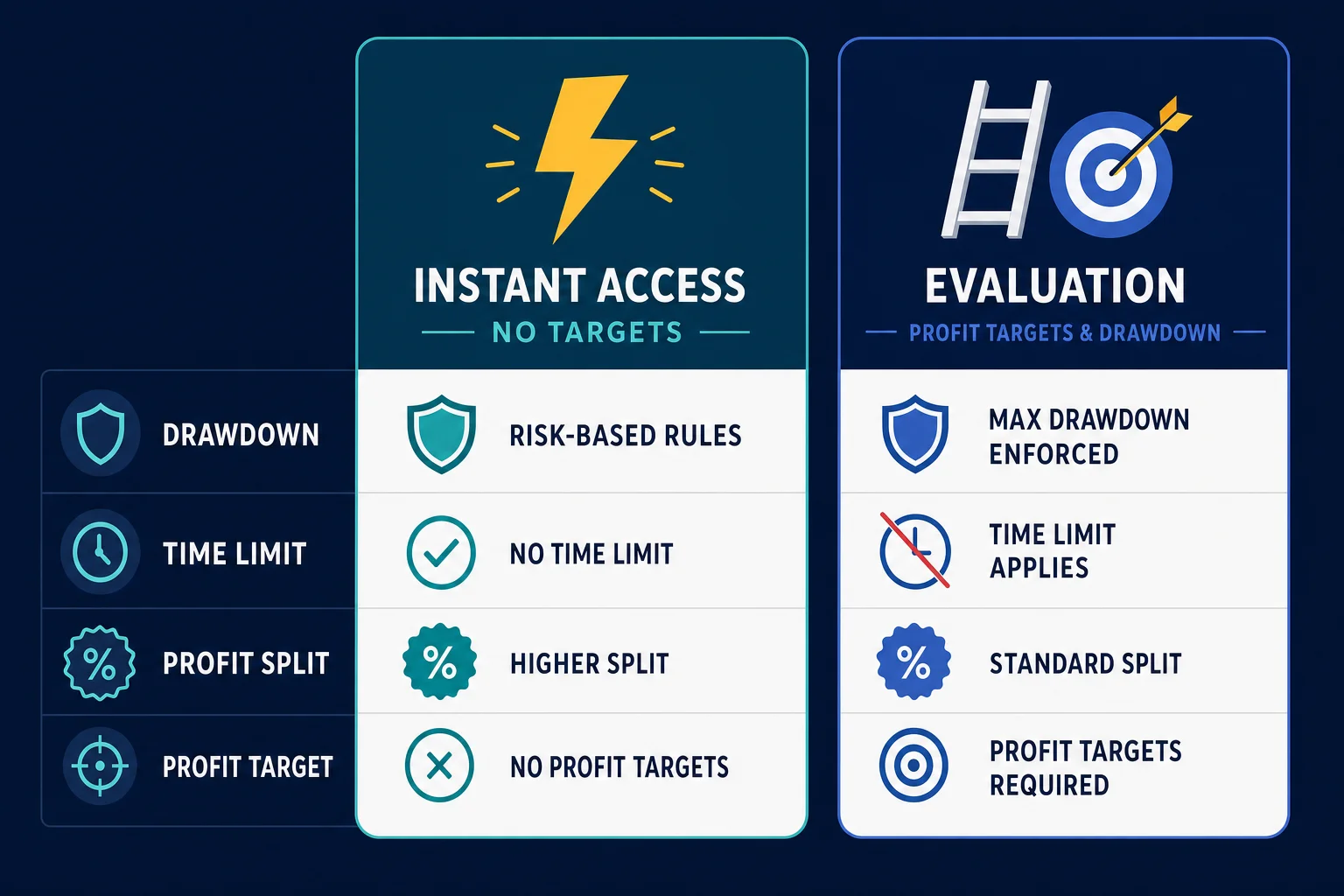
Choosing between Instant Funding and FTMO comes down to one core question: do you want to skip the evaluation and get access to a funded-style account immediately, or do you want the structure and track record of a multi-step challenge? These two firms sit at almost opposite ends of the prop-trading spectrum. Instant Funding gives you a funded (simulated) account the moment you pay, with no profit targets and no time limits. FTMO asks you to prove yourself through a challenge first, then provides a funded account that, per ftmo.com, has been operating since 2015. As with most modern prop firms, both operate on simulated/demo capital and pay rewards based on simulated trading performance. This guide breaks down the rules, payouts, costs, and trade-offs so you can decide which model actually fits the way you trade.
Instant Funding vs FTMO at a Glance
| Feature | Instant Funding | FTMO |
|---|---|---|
| Model | Instant / no-evaluation funding | Evaluation (1-Step and 2-Step Challenge) |
| Profit target to get funded | None | 10% (Challenge); 5% (Verification, 2-Step) |
| Time limit | None | None |
| Daily drawdown | No daily drawdown rule; uses “Smart Drawdown” | 5% (2-Step); 3% trailing (1-Step) |
| Maximum loss | 10% Smart Drawdown at the start; after a 5% closed-balance gain, the breach floor makes a one-time move to 5% below the starting balance and then stays fixed (official explanation) | 10% of initial capital |
| Consistency rule | None | Best Day Rule on 1-Step / FTMO Account |
| Profit split | Up to 90% | Up to 90% of simulated profits |
| Account sizes | $1,250 up to $80,000 base, with the current page advertising scaling toward $2.5M | Up to $200,000 |
| Payout cadence | First payout 14 days after first trade, then every 7 days; on-demand | On-demand after eligibility |
| Established | Newer instant-funding firm | Operating since 2015 |
Firm-specific figures are drawn from each company’s official pages where available; always confirm current rules on the firm’s own site before purchasing.
How Instant Funding Works
Instant Funding is built around a single idea: skip the test. Instead of passing a challenge, you choose an account size, pay a one-time fee, and receive a funded (simulated) account right away. According to the firm’s own site, accounts come with no profit targets, no time limits, no daily drawdown, and no consistency rules, which removes most of the structural pressure that trips traders up during evaluations.
Risk is managed through what the firm calls Smart Drawdown. Rather than a separate daily limit, you simply trade within your maximum drawdown, and “locking in” your Smart Drawdown is how you advance toward payouts. Leverage runs up to 1:100 and varies by asset type.
A word of caution here: “no daily drawdown” does not mean “no risk rule.” Smart Drawdown still governs how much you can lose before the account is gone, and depending on whether it trails your balance or equity it can be more or less forgiving than a static limit. Read the exact mechanics (and the precise maximum-drawdown percentage, shown as 10% Smart Drawdown at the start; after a 5% closed-balance gain, the breach floor makes a one-time move to 5% below the starting balance and then stays fixed (official explanation) here) on the firm’s own rules page before you assume it gives you more room than a traditional evaluation account.
Account sizes start small, at $1,250, and run up through $80,000 on the standard tiers, with larger plans available. The firm advertises scaling all the way up to $2.5 million in advertised scaled account size for traders who keep growing. The scaling logic is straightforward: your account grows by 25% every 90 days when you reach a 10% profit target, up to double your starting size.

On payouts, Instant Funding offers on-demand withdrawals. Your first profit withdrawal becomes available 14 days after your first trade, and after that first payout you can withdraw every 7 days following a new trade. Profit split goes up to 90%. If you want to dig into the exact one-time pricing per account tier, check the firm’s current pricing page, since the official Instant Funding price table reviewed July 25, 2026 listed $79 for $1,250, $120 for $2,500, $225 for $5,000, $440 for $10,000, $870 for $20,000, $1,735 for $40,000, and $3,460 for $80,000 (official price table) fees vary by account size and change with promotions.
The appeal is obvious for traders who hate evaluations: no exam, no clock, and immediate access to capital. The trade-off is that the upfront cost for instant access is typically higher than a comparable evaluation fee, because you’re paying for the account itself rather than a test.
How FTMO Works
FTMO is one of the longest-running and most reviewed firms in the space, operating since 2015 with millions of customers worldwide. It uses an evaluation model, and as of 2026 it offers two paths.
The 2-Step Challenge is the classic route. In Phase 1 (the FTMO Challenge) you need to hit a 10% profit target. In Phase 2 (Verification) the target drops to 5%. Both phases enforce a 5% Maximum Daily Loss and a 10% Maximum Loss, plus a minimum of 4 trading days. There is no time limit on either phase.
The 1-Step Challenge compresses everything into a single phase with a 10% profit target. Its risk rules are tighter in some respects: the Maximum Daily Loss is 3% (recalculated daily), the Maximum Loss is a 10% trailing limit, and a Best Day Rule requires that your single best day not exceed 50% of your total positive-day profit, discouraging one-lucky-trade passes.
Once you pass, you receive an FTMO Account with no profit target, and your reward is an advertised up to 90% of your simulated profits. FTMO accounts scale up to $200,000, with a published Scaling Plan that increases your balance over time as you stay profitable. Payouts are made on demand once you’re eligible, with multiple withdrawal methods supported.
FTMO’s evaluation fees scale with account size. Many programs advertise that the evaluation fee is returned with your first reward (FTMO’s 2-Step fee is refunded with the first reward withdrawal after passing; the 1-Step fee is not refunded (official fee policy)), but confirm both the refund terms and the exact starting fee on the FTMO pricing page, as for a comparable $100K 2-Step configuration, FTMO displayed €439 promotional / €540 reference when checked July 25, 2026 (official pricing) amounts depend on account size and the 1-Step vs 2-Step path.
The strength of FTMO is its track record: a long operating history (since 2015 per ftmo.com), transparent published rules, and an enormous review base. The cost is time and discipline, you have to pass the challenge before you see a cent of profit.
Rules and Risk Where Instant Funding and FTMO Differ
The clearest way to understand these two firms is to look at how they treat risk and structure.
Instant Funding removes structure on purpose. No profit target means you can take payouts on smaller, steadier gains. No time limit and no consistency rule means you can trade at your own pace and let one strong week carry you. The “Smart Drawdown” concept replaces the typical daily-loss tripwire, so a single volatile session is less likely to end your account on a technicality. This suits discretionary traders, swing traders, and anyone who has blown evaluations on daily-drawdown rules rather than on actual strategy.
FTMO keeps structure because structure is the product. The profit targets, daily loss limits, and (on the 1-Step) the Best Day Rule are designed to filter for consistent, risk-aware traders. If you trade a defined system with controlled position sizing, those rules are rarely a problem, and passing them gives you access to a firm with a deep payout history. If you’re an aggressive, all-in trader, those same rules will feel like a straitjacket.
For a closer look at how FTMO’s profit split and drawdown rules compare against another popular firm, see our Funding Pips vs FTMO breakdown.
Cost and Value of Each Prop Firm
These two models price differently because you’re buying different things.
With Instant Funding, you’re buying the account. The fee is higher up front, but there’s no risk of “failing” and having to repurchase a challenge. If you value certainty of access and your edge is real, paying once for live capital can be efficient.
With FTMO, you’re buying a test. Evaluation fees are lower, and they’re refundable with your first reward on eligible programs, so a successful trader effectively gets the evaluation for free. The risk is repeat purchases: traders who fail challenges end up paying multiple fees before (or instead of) reaching a funded account.
The math depends entirely on your pass rate. A trader confident in a consistent edge often comes out ahead with FTMO’s refundable model. A trader who finds evaluation rules counterproductive may pay less in the long run by going straight to funded capital with Instant Funding, even at a higher sticker price. If fast access to withdrawals is your priority, compare both against our roundup of the best prop firms for fast payouts.

Which One Fits Your Trading Style?
Choose Instant Funding if: you don’t want to take an evaluation, you trade discretionary or swing setups that don’t fit neatly into daily-drawdown rules, you want flexibility on timing and consistency, and you’d rather pay once for immediate capital than risk repeat challenge fees.
Choose FTMO if: you want a firm with a long track record and massive review base, you trade a consistent, rule-friendly system, you’re comfortable passing a 1-Step or 2-Step challenge, and you like the idea of a refundable evaluation fee and a published scaling plan.
New to the category and not sure either fits? Start with our guide to the best prop firms for beginners, and if you’re comparing FTMO against other challenge firms, our E8 Markets vs FTMO and GOAT Funded Trader vs FTMO comparisons cover adjacent options.
Frequently Asked Questions
Is FTMO instant funding?
No. FTMO uses an evaluation model. You pass a 1-Step or 2-Step Challenge first, then receive a funded (simulated) FTMO Account. Instant Funding, by contrast, gives you a funded account immediately with no challenge.
Does instant funding actually pay?
Instant Funding advertises on-demand payouts, with the first withdrawal available 14 days after your first trade and withdrawals every 7 days thereafter, subject to its withdrawal conditions. As with any prop firm, payout reliability is something to verify through current user reports and the firm’s own published terms before committing.
Which has the better profit split, Instant Funding or FTMO?
Both advertise up to 90%. Instant Funding’s split scales up to 90% on its accounts, and FTMO pays up to 90% of simulated profits on a funded FTMO Account. The practical difference is in how and when you reach the top tier, not the headline number.
What are the drawdown rules for each?
FTMO uses a 5% Maximum Daily Loss and 10% Maximum Loss on the 2-Step, and a tighter 3% daily / 10% trailing setup on the 1-Step. Instant Funding has no separate daily drawdown rule and instead uses its “Smart Drawdown” system within a maximum drawdown limit.
Is Instant Funding or FTMO cheaper?
FTMO’s evaluation fees are lower up front and refundable with your first reward, while Instant Funding charges a higher one-time fee for immediate access. Which is cheaper overall depends on how many challenges you’d need to pass with FTMO versus paying once with Instant Funding.
What account sizes can I get?
Instant Funding offers tiers from around $625 up to $80,000 on its standard plans, scaling toward $3.84M in buying power over time. FTMO funds accounts up to $200,000, with a scaling plan that grows your balance as you stay profitable.
Can I trade my own style on either firm?
Instant Funding is the more flexible of the two, with no consistency rule and no time limit. FTMO allows most strategies but enforces its trading objectives and forbidden-practices rules, and its 1-Step Best Day Rule discourages relying on a single outsized trade.
Page-one comparison check · US desktop results reviewed August 6, 2026
What to verify before choosing FTMO or Instant Funding
Decision summary: The headline account size and profit split do not identify the better fit on their own. Compare the complete cost, loss calculation, first-payout path, platform route, and restrictions for two specific programs before paying.
| Decision point | How to compare it |
|---|---|
| Strategy restrictions | Check news, weekend holding, copy trading, automated systems, scalping, HFT, hedging, and account-sharing rules for both the evaluation and funded stage. |
| Country and identity access | Confirm eligibility for your residence and citizenship, accepted identity documents, payment method, platform availability, and payout provider before checkout. |
| Support and dispute path | Save the applicable rule version and confirm the support, appeal, and dispute route before buying, especially when your strategy needs written clarification. |
| Drawdown calculation | Identify whether each limit is static or trailing, whether it updates intraday or at the end of the day, what equity or balance it follows, and when daily limits reset. |
| Simulated versus live status | Read the agreement for each stage and distinguish a simulated funded account from any later live-capital route; the word funded does not settle that question. |
Promotions and program rules can change independently. Use this page to narrow the choice, then confirm every decision-critical term in each firm’s current official program document, checkout, and trader agreement. Screenshots or saved copies help if a rule changes after purchase.
The Bottom Line
Instant Funding and FTMO solve the same problem, getting you access to trading capital, in fundamentally different ways. Instant Funding is for traders who want to skip the test, trade flexibly, and pay once for immediate access. FTMO is for traders who want a proven firm with transparent rules and don’t mind earning their funded account through a challenge. Neither is universally “better”; the right choice depends on your pass rate, your trading style, and how much you value structure versus speed.
A practical next step: list the three rules that have cost you accounts in the past (daily drawdown, consistency, time limits, etc.). If those rules are your nemesis, Instant Funding’s no-rules model is worth the higher fee. If you pass challenges comfortably, FTMO’s refundable, well-established program is hard to beat.
Disclaimer: This article is for educational and informational purposes only and is not financial, investment, or trading advice. Prop firm rules, pricing, and payout terms change frequently, verify all details on each firm’s official website before making a decision. Trading involves substantial risk of loss.
Research and disclosure
How this comparison was reviewed
- Basis
- Document-based comparison of official product pages, trading objectives, and help-center material cited in this page.
- Scope
- FTMO and Instant Funding programs and the exact account comparisons stated on this page. Other firms and changing checkout promotions are outside this comparison.
- Limitations
- BestProps did not purchase an account or perform first-hand trading, support, identity-check, or payout testing for this comparison. Recheck current terms before purchase.
- Commercial state
- BestProps currently has no active affiliate or sponsor relationship with FTMO, Instant Funding, or any firm named on this page. Any future relationship will be disclosed next to affected links and in this record.