Matched-account buyer comparison · prices and rules checked July 25, 2026
Goat Funded Trader vs FTMO: Matched 100K Two-Step Scorecard
This compares the current 100K 2-Step GOAT configuration with FTMO 100K 2-Step. GFT is cheaper and asks for a lower first target, while FTMO offers more daily-loss room and fewer funded profit-cap complications.
| 100K decision point | Goat Funded Trader | FTMO |
|---|---|---|
| Current price | $275 promotional · $458 reference for the selected 100K 2-Step GOAT configuration | €439 promotional · €540 reference |
| Profit targets | 8% phase 1 · 6% phase 2 | 10% Challenge · 5% Verification |
| Daily / maximum loss | 4% daily drawdown · 10% static maximum loss | 5% maximum daily loss · 10% maximum loss |
| Minimum days | 3 valid days per phase at 0.5% each | 4 trading days per phase |
| Funded reward | 80% · bi-weekly; optional on-demand first reward pays only 40% | 80% standard, potentially 90%; request from day 14 |
| Funded caps | $3,000 daily profit cap; first two payouts capped at 6% of account or $10,000, whichever is lower | No comparable daily profit cap on the standard 2-Step objectives |
| Reset / review | Phase-preserving resets are priced from the original fee; post-phase review can take up to 2 business days | Repeat purchase/free-trial preparation and standard account review apply |
| Best fit | Trader prioritizing price and lower first target who can work within valid-day and funded-cap rules | Trader needing more daily loss room and a simpler funded profit profile |
Advanced way to shop this comparison
- Calculate cost to first eligible payout: use total path cost, likely attempts, resets, activation, add-ons, and refund timing—not the entry price alone.
- Translate drawdown into trades: account for spread, commission, swap, slippage, correlated positions, and whether the floor is static or trails balance/equity.
- Replay the funded stage: test your daily P&L against consistency, profitable days, risk-per-idea, news, buffers, minimums, caps, and payout timing together.
- Verify trust operationally: identify the contracting entity, review rule-change history and complaint themes, get written strategy approval, and complete a small payout before buying multiple accounts.
Official sources used for this snapshot
Prices and terms change. Reconfirm the exact product, add-ons, platform, country eligibility, and agreement at checkout.
This comparison breaks down the evaluation models, drawdown rules, profit splits, payouts, and account sizes for both firms so you can match the firm to your trading style instead of the marketing.
Goat Funded Trader vs FTMO at a Glance
| Feature | Goat Funded Trader | FTMO |
|---|---|---|
| Headquarters | Hong Kong | Czech Republic (Prague) |
| Evaluation models | One-step, two-step (GOAT/PRO), three-step, instant funding, pay-later, $1 plan | One-step and two-step (Challenge + Verification) |
| Two-step profit target | 6% (2-Step GOAT model) | 10% (Challenge) + 5% (Verification) |
| One-step profit target | 10% | 10% |
| Maximum daily loss | 3% of initial balance | 5% (two-step) / 3% (one-step) |
| Maximum total drawdown | Balance must stay above 92% (~8%); $1 plan uses a 6% trailing drawdown | 10% |
| Profit split | 80% standard | 80% standard, up to 90% through the scaling plan |
| Payouts | Bi-weekly (every 14 days); on-demand available as an add-on | Regular profit-split payouts; on-demand option (check current schedule) |
| Account sizes | From $1,000 (via the $1 entry plan) up to large simulated accounts | $10,000 to $200,000 |
| Maximum time limit | None | None |
| Minimum trading days | Varies by model | Minimum 4 trading days |
| News trading | Permitted | Check FTMO’s current news-trading policy |
| Entry price | $275 promotional / $458 reference for the $100K 2-Step GOAT configuration shown July 25, 2026. The selected model showed 8% and 6% targets, 4% daily loss, and 10% maximum loss. Check GFT’s live configurator. | €439 promotional / €540 reference for the $100K FTMO 2-Step configuration shown July 25, 2026. Check FTMO pricing. |
Pricing and core figures rechecked against each firm’s official materials on July 25, 2026. Prop firm rules and pricing change frequently, so always confirm the latest figures on each firm’s official site before you buy.
FTMO Overview
FTMO is one of the most recognized proprietary trading firms in the industry. It runs a structured evaluation built around clearly published trading objectives, and it has a long, well-documented history of paying out its funded traders.
FTMO offers simulated account sizes of $10,000, $25,000, $50,000, $100,000, and $200,000. Traders can choose between a two-step path (the FTMO Challenge followed by Verification) or a streamlined one-step Challenge.
On the two-step path, you need to hit a 10% profit target in the Challenge and a 5% target in Verification, while staying inside a 5% maximum daily loss and a 10% maximum overall loss. The one-step Challenge asks for a 10% profit target with a tighter 3% maximum daily loss. The evaluation requires a minimum of four trading days, with at least one position opened on each (note this is a minimum activity requirement, not a deadline). FTMO does not impose a maximum time limit on completing the evaluation.
Once funded, traders earn an 80% profit split as standard. FTMO’s scaling plan can raise both the account balance (by 25% when requirements are met) and the reward share, up to 90%. FTMO also refunds 100% of the evaluation fee with your first reward withdrawal, which effectively makes a successful evaluation free.
The trade-off: FTMO’s structure is rigid by design. If you want maximum flexibility in account models or evaluation pace, the framework can feel restrictive.
Goat Funded Trader Overview
Goat Funded Trader is a newer firm based in Hong Kong that has built its reputation on flexibility and a low barrier to entry. Where FTMO gives you essentially two paths, Goat Funded Trader gives you a menu: one-step, two-step (in both a standard “GOAT” and a “PRO” variant), three-step, instant funding, a pay-later model, and a $1 entry plan designed to let new traders test the waters cheaply.
Profit targets depend on the model. The 2-Step GOAT model and the three-step model both use a 6% profit target, while the one-step model requires 10%. Across models, the maximum daily loss is 3% of your initial balance, and for most models your account equity or balance must never fall below 92% of starting capital (an 8% total drawdown buffer). The $1 plan uses a 6% trailing drawdown measured at the end of each trading day.
Goat Funded Trader pays an 80% profit split as standard with bi-weekly payouts (every 14 days), and traders can add on-demand payouts. The firm permits news trading and imposes no time limit on its evaluations, which removes the deadline pressure that trips up many traders.
The trade-off: Goat Funded Trader is younger than FTMO, so it has a shorter public track record. Because the firm runs several different models (each with its own targets, drawdown mechanics, and consistency rules), it’s important to read the fine print for the specific model you choose. Traders who put a lot of importance on long-term reliability may prefer an established name.
Evaluation Models and Trading Rules Compared
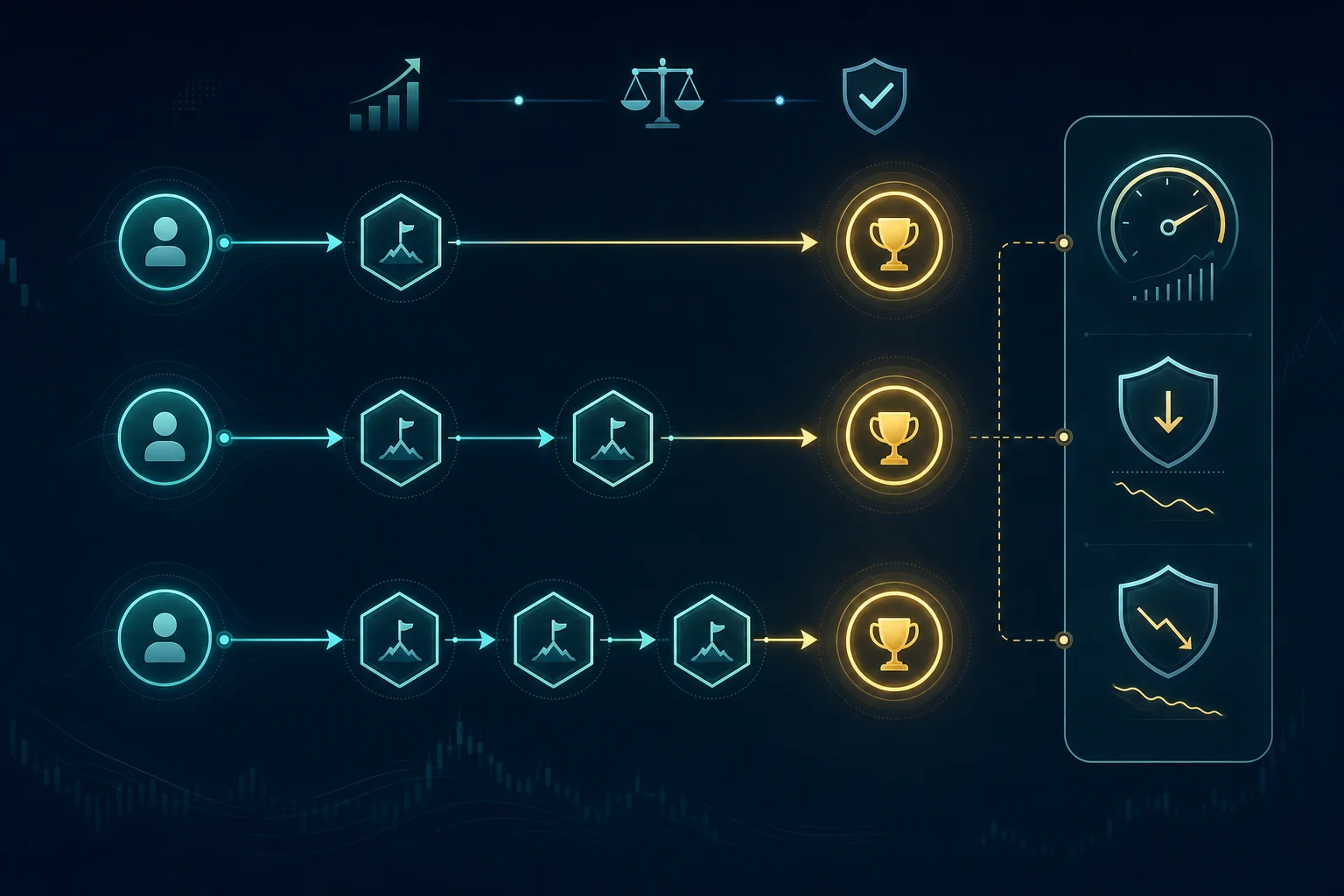
This is where the two firms diverge most. FTMO keeps it simple: pick an account size, pick one-step or two-step, and follow a fixed set of objectives. The rules are the same for everyone, which makes them easy to understand and plan around.
Goat Funded Trader trades simplicity for choice. If you prefer a single phase, the one-step model gets you funded faster but with a higher 10% target. If you want a lower target with more runway, the 2-Step GOAT model’s 6% target spreads the requirement across two phases. The instant funding and pay-later options exist for traders who want to skip or defer the evaluation entirely.
For daily risk, Goat Funded Trader’s flat 3% daily loss limit is tighter than FTMO’s 5% on the two-step but matches FTMO’s 3% on the one-step. On total drawdown, FTMO’s 10% is more generous than Goat Funded Trader’s ~8% buffer on most models. If you take larger intraday swings, FTMO’s wider total drawdown may suit you; if you trade conservatively day to day, the difference matters less.
Payouts, Profit Split, and Scaling

Both firms share the same headline number: an 80% profit split as standard. Goat Funded Trader runs a bi-weekly payout cycle (every 14 days) with an on-demand add-on; FTMO also offers regular profit-split payouts and an on-demand option, so confirm the current schedule on FTMO’s site before you plan around it.
The difference is in the upside. FTMO’s scaling plan rewards consistency with a higher profit share (up to 90%) and balance increases over time, and it refunds your evaluation fee on the first withdrawal. Goat Funded Trader’s flexibility shows up earlier in the funnel (a cheaper start and faster, lower-target paths) rather than in long-term scaling perks.
If fast, reliable payouts are your priority, see our guide to the best prop firm for fast payout preference.
Platforms, Markets, and Flexibility
Both firms support active retail trading across major instruments and popular platforms. Goat Funded Trader leans into flexibility (permitting news trading and removing time limits), which appeals to event-driven and slower-paced traders alike. FTMO’s framework is more standardized, which is part of why it’s a common benchmark for the whole industry.
If you’re still comparing the evaluation route itself, our breakdown of instant funding vs the challenge model is worth a read before you commit.
Which Firm Fits Your Trading Style?

Choose FTMO if you:
- Want an established firm with a long, public payout history
- Prefer a simple, structured set of rules over a menu of options
- Take larger intraday positions and value the 10% total drawdown buffer
- Like the idea of a fully refunded evaluation fee on your first withdrawal
Choose Goat Funded Trader if you:
- Want flexibility in how you get funded (one-step, multi-step, instant, or pay-later)
- Prefer no time limits and the freedom to trade the news
- Want a low-cost or even $1 entry to test the process
- Are comfortable with a 3% daily loss discipline and a tighter total drawdown
New traders deciding between firms may also want to read our guide to the best prop firm for beginners who want simple rules, and traders starting small should see the best prop firm for traders with small starting capital. For a deeper look at FTMO on its own, read our FTMO review for funded traders.
Frequently Asked Questions
Is Goat Funded Trader better than FTMO?
Neither is universally better. FTMO wins on reputation, structure, and a proven payout history. Goat Funded Trader wins on flexibility, lower entry cost, and no time limits. The better choice depends on whether you value structure or flexibility more.
What is the profit split at Goat Funded Trader vs FTMO?
Both pay an 80% profit split as standard. FTMO’s scaling plan can raise that to 90% over time for consistent traders.
What are the drawdown rules for each firm?
Goat Funded Trader uses a 3% maximum daily loss and requires most accounts to stay above 92% of starting capital. FTMO’s two-step uses a 5% maximum daily loss and a 10% maximum overall loss; its one-step uses a 3% daily loss and a 10% maximum loss.
Does FTMO refund the evaluation fee?
Yes. FTMO refunds 100% of the evaluation fee with your first reward withdrawal.
Does Goat Funded Trader have a time limit?
No. Goat Funded Trader does not impose a time limit on its evaluations, so you can trade at your own pace.
Which firm is cheaper to start with?
Goat Funded Trader generally offers a lower barrier to entry, including a $1 entry plan. Exact pricing for both firms changes with promotions, so confirm current prices on each official site before buying.
Can I trade the news at both firms?
Goat Funded Trader permits news trading. FTMO’s news-trading policy can vary by phase and changes over time, so check FTMO’s current rules before trading around high-impact events.
Is FTMO available in the United States?
Prop firm availability for US-based traders changes frequently and depends on each firm’s current terms and your location. Before signing up with either FTMO or Goat Funded Trader, verify directly on the firm’s official site whether it accepts traders from your country. This is informational only and not legal advice.
What is the 3% rule?
“The 3% rule” usually refers to a maximum daily loss limit of 3%. Goat Funded Trader applies a 3% maximum daily loss across its models, and FTMO’s one-step Challenge also uses a 3% maximum daily loss (its two-step uses 5%). It means your account cannot lose more than 3% of the relevant balance in a single trading day without breaching the rule.
Page-one comparison check · US desktop results reviewed August 6, 2026
What to verify before choosing Goat Funded Trader or FTMO
Decision summary: The headline account size and profit split do not identify the better fit on their own. Compare the complete cost, loss calculation, first-payout path, platform route, and restrictions for two specific programs before paying.
| Decision point | How to compare it |
|---|---|
| Support and dispute path | Save the applicable rule version and confirm the support, appeal, and dispute route before buying, especially when your strategy needs written clarification. |
Promotions and program rules can change independently. Use this page to narrow the choice, then confirm every decision-critical term in each firm’s current official program document, checkout, and trader agreement. Screenshots or saved copies help if a rule changes after purchase.
What are the key differences between FTMO and Goat Funded Trader?
A reliable answer depends on the two named account paths, not the firm names alone. Compare the current official rules on the decision points above, save the terms shown at checkout, and give extra weight to any rule that directly affects your normal trading method.
The Bottom Line
If you want a structured, battle-tested firm with a long payout history and a generous total drawdown buffer, FTMO is the safer, more conventional pick. If you want flexibility (multiple funding paths, no time limits, news trading, and a cheap way to start), Goat Funded Trader is built for you.
The smartest next step is to match the rules to your real trading behavior: look at your typical daily risk, how fast you like to trade, and how much you want to spend to get started. Then pick the firm whose structure you’d actually follow under pressure.
To compare costs across the industry first, see how much funded trading programs cost in 2026.
This article is for educational and informational purposes only and is not financial, investment, or trading advice. Proprietary trading involves significant risk, and most traders do not pass evaluations or earn consistent payouts. Prop firm rules, pricing, and account terms change frequently, so always verify the latest details on each firm’s official website before making a decision.
Research and disclosure
How this comparison was reviewed
- Basis
- Document-based comparison of official product pages, trading objectives, and help-center material cited in this page.
- Scope
- Goat Funded Trader and FTMO programs and the exact account comparisons stated on this page. Other firms and changing checkout promotions are outside this comparison.
- Limitations
- BestProps did not purchase an account or perform first-hand trading, support, identity-check, or payout testing for this comparison. Recheck current terms before purchase.
- Commercial state
- BestProps currently has no active affiliate or sponsor relationship with Goat Funded Trader, FTMO, or any firm named on this page. Any future relationship will be disclosed next to affected links and in this record.