
Key takeaways
Bulenox is a futures prop evaluation company at bulenox.com with monthly Qualification Account plans from $145 to $535 before any active discounts shown on its public signup flow.
Read the full summary
Bulenox is a futures prop evaluation company at bulenox.com with monthly Qualification Account plans from $145 to $535 before any active discounts shown on its public signup flow. As listed on Bulenox’s signup and help pages on June 1, 2026, official pages show $25K, $50K, $100K, $150K, and $250K account tiers, profit targets from $1,500 to $15,000, maximum drawdown from $1,500 to $5,500, Option 1 trailing drawdown accounts, and Option 2 EOD accounts with daily loss limits from $500 to $4,500. Bulenox says Master Account payouts can be requested after at least 10 individual trading days, payouts are processed weekly on Wednesdays, the first $10,000 earned is withdrawn without company commission, later profits are split 90% to the trader and 10% to the company, and the 40% consistency rule applies to every Master payout.
How we researched this article
BestProps used document-based research from primary firm sources, checked September 26, 2026. The complete source list, scope, limitations, and commercial-state record appear near the end of this article.
Bulenox review searches usually come from futures traders who are deciding whether the account rules are worth the subscription cost. The practical answer is mixed. Bulenox has clear public rules, a futures-specific account structure, and several account sizes, but the details around trailing drawdown, EOD scaling, daily loss limits, activation fees, and payout caps matter more than the headline account size.
This review uses Bulenox’s own pages for rules, payouts, pricing, and risk language. Competitor reviews and Reddit threads are useful for understanding what traders ask about, but they are not treated as primary proof for Bulenox fees, payout policy, or account rules.

Bulenox Review Verdict
Bulenox is best suited for futures traders who already understand drawdown math and want to choose between a real-time trailing drawdown model and an end-of-day drawdown model. It is not ideal for someone who only wants the cheapest monthly price or who has not modeled how a trailing threshold behaves during open trades.
The strongest part of Bulenox is transparency around the core account mechanics. Its public signup page lists account sizes, monthly prices, profit targets, maximum contract limits, and drawdown amounts. Its help center explains Qualification Accounts, Master Accounts, payout limits, consistency rules, resets, platform connection, and risk disclosures.
The main tradeoff is complexity. Bulenox uses several account terms that can be easy to confuse: Qualification Account, Master Account, Funded Account, Option 1, Option 2, trailing drawdown, EOD drawdown, daily loss limit, activation fee, payout cap, reserve threshold, and 40% consistency rule. A trader who buys before understanding those terms may be surprised later.
What Bulenox Is
Bulenox describes itself as a trader selection and training platform for futures traders. Traders start with a Qualification Account, follow the account rules, and aim to reach the profit target. After completing the qualification process, eligible traders can move to a Master Account where performance-based compensation rules apply.
Bulenox’s public site presents five main account sizes: $25,000, $50,000, $100,000, $150,000, and $250,000. The accounts are tied to futures trading, Rithmic connection, NinjaTrader setup, and other supported front-end platforms.
The site also uses risk language that traders should take seriously. Bulenox states that futures and options trading involves large potential reward and large potential risk, and that simulated performance results have inherent limitations. That matters because a prop evaluation is not a guaranteed income product. It is a rules-based trading evaluation with ongoing account terms.
Bulenox Fees and Account Sizes
Bulenox’s public signup page currently shows the same base monthly prices for Option 1 and Option 2 accounts. These are recurring Qualification Account subscription prices, not a promise that every checkout promotion or coupon will remain unchanged.
| Account size | Base monthly price | Profit target | Max contracts | Max drawdown |
|---|---|---|---|---|
| $25,000 | $145 | $1,500 | 3 | $1,500 |
| $50,000 | $175 | $3,000 | 7 | $2,500 |
| $100,000 | $215 | $6,000 | 12 | $3,000 |
| $150,000 | $325 | $9,000 | 15 | $4,500 |
| $250,000 | $535 | $15,000 | 25 | $5,500 |
Bulenox’s homepage displayed discounted monthly pricing for the $50,000 and $100,000 tiers at review time, but prop-firm discounts can change quickly. Treat base prices and live checkout as the source of truth before buying.
There are also other possible costs. Bulenox says professional traders are responsible for exchange data feed costs, while non-professional exchange data is included in the Qualification Account. The help center also lists a $78 reset fee when a trader resets outside the free reset timing on the billing date.
Payment methods listed by Bulenox include credit card, debit card, PayPal, and crypto. Its subscription page says Qualification Accounts renew every 30 days until canceled, and its return policy says refunds are not allowed after registering and using the service.
Bulenox Option 1 and Option 2 Rules
Bulenox offers two main Qualification Account styles.
Option 1 is the No Scaling Account with trailing drawdown. Bulenox’s Qualification Account rules say the trailing drawdown follows the current balance, including realized and unrealized gains. The drawdown is tracked in real time during the trading day and includes commission. If the trader violates the allowable drawdown, the account is blocked by the administrator.
Option 2 is the EOD Account with end-of-day drawdown, a scaling plan, and a daily loss limit. Bulenox’s Qualification Account rules say EOD drawdown updates at the end of the trading day when profit is made at the end of the session. Option 2 also uses a daily loss limit that includes commissions and real-time or unrealized trades.
| Rule area | Option 1 No Scaling | Option 2 EOD Scaling and DLL |
|---|---|---|
| Drawdown style | Real-time trailing drawdown | End-of-day drawdown |
| Scaling | No scaling account | Dynamic scaling based on cash on hand |
| Daily loss limit | Not the main rule | Applies by account size |
| Trader fit | Better for traders who want fixed maximum contracts | Better for traders who can trade inside scaling limits |
The easiest mistake is treating both options as the same account with different labels. They are materially different. A trader who trades large size from day one may prefer Option 1, while a trader who wants EOD drawdown behavior must be willing to follow the scaling plan and daily loss limits.
Bulenox Drawdown Rules That Matter Most
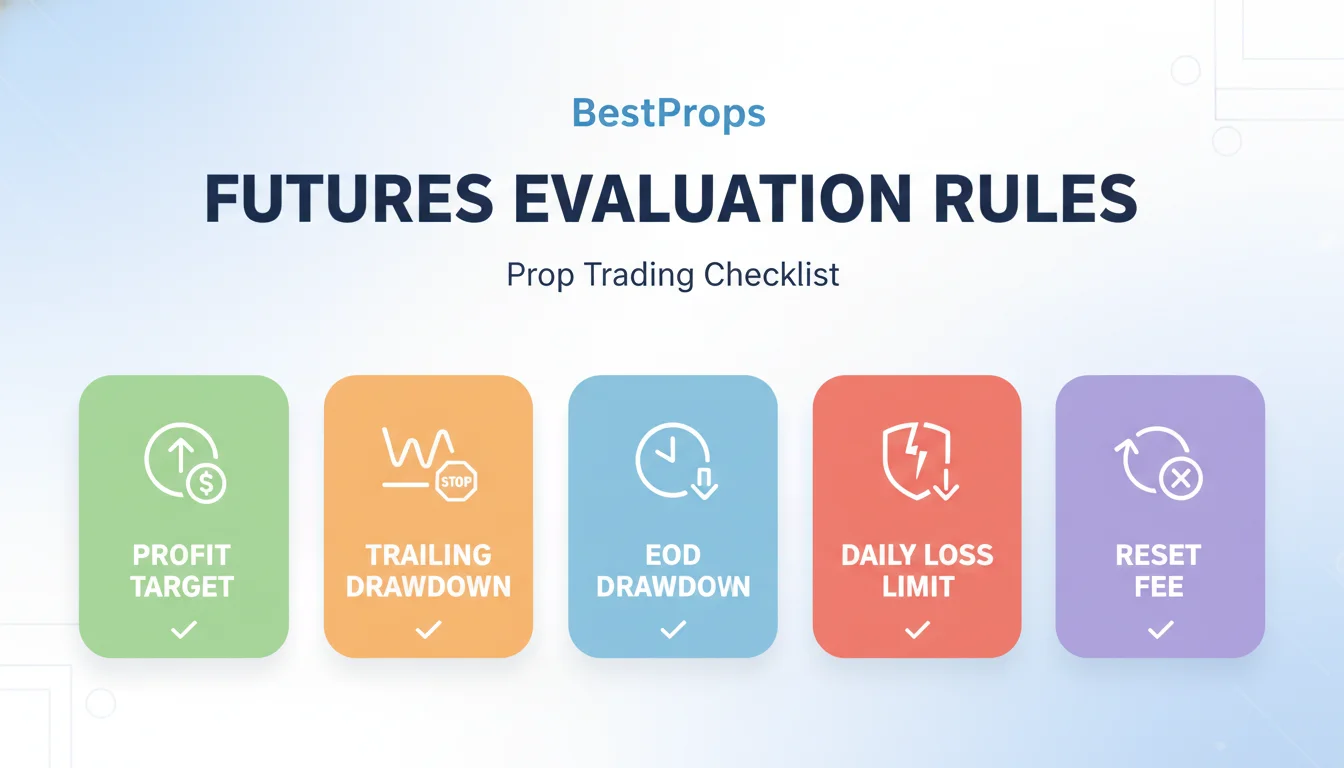
Drawdown is the main reason a trader can lose a prop evaluation even when the trade idea later works. Bulenox’s Option 1 trailing drawdown can move up with the account’s high-water mark. Bulenox gives an example of a $100,000 account with a $3,000 maximum trailing drawdown. If the account rises to $100,800, the threshold moves to $97,800. If the account later gives back open profit, the threshold does not move down.
Option 2 EOD drawdown behaves differently. Bulenox says it updates at the end of the trading day when the account ends with a new profit high. For a $100,000 account with a $3,000 max drawdown, an end-of-day balance of $101,000 would adjust the EOD balance to $98,000. If the next day ends at $100,500, the EOD threshold stays unchanged. If a later day ends at $102,500, the EOD threshold moves to $99,500.
The daily loss limit on Option 2 is separate from max drawdown. Bulenox lists the daily loss limits as $500 for $25K, $1,100 for $50K, $2,200 for $100K, $3,300 for $150K, and $4,500 for $250K. Bulenox says hitting the daily loss limit suspends the account for the rest of the trading day and does not count as a rule violation.
For traders comparing firms, the key question is not only “how large is the account?” It is “how much room does my strategy need during normal losing streaks, reversals, and commission drag?”
Bulenox Master Account Payouts
Bulenox’s Master Account page says the trader is paid directly for results achieved on the Master Account. The first $10,000 earned is withdrawn to the trader’s bank account without company commission. After the first $10,000, Bulenox says the company’s commission is 10% of profit and the trader receives the remaining 90%.
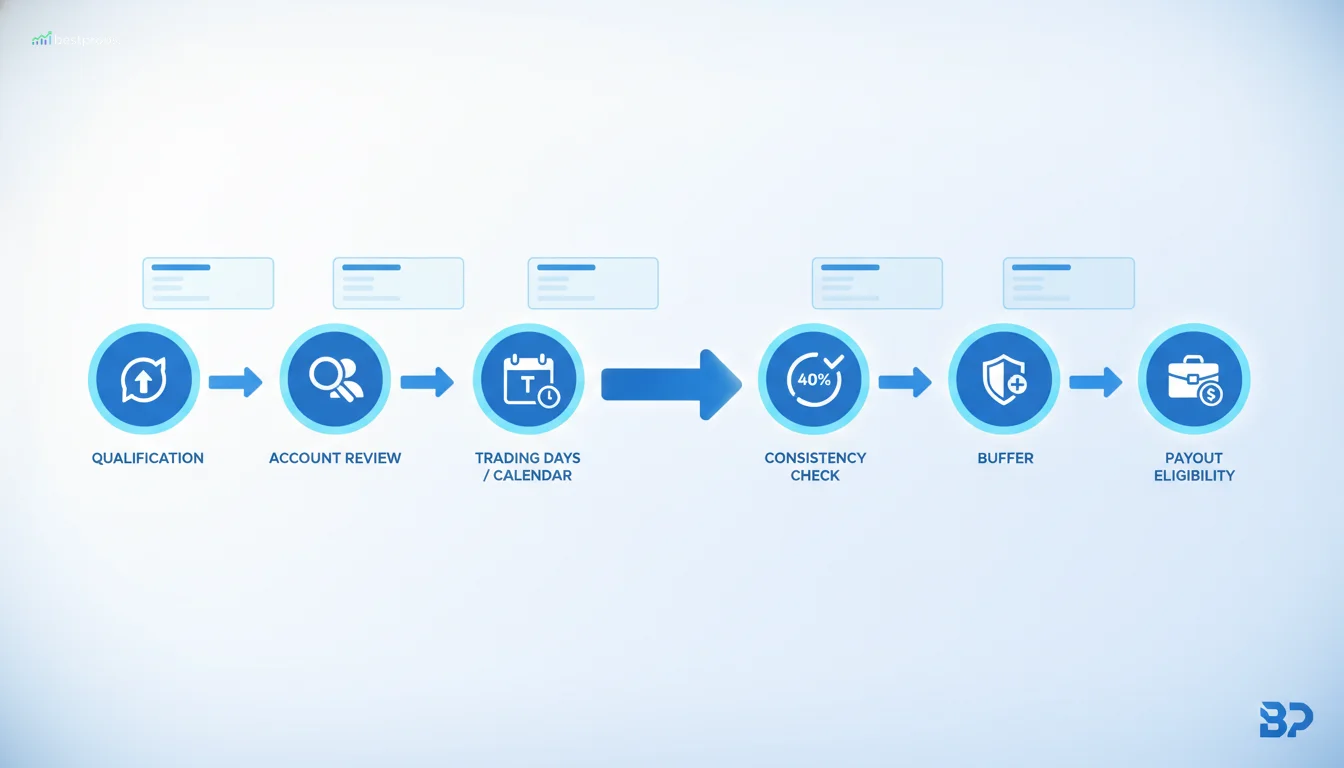
Payout timing is also specific. Bulenox says payout requests can be made anytime during the calendar month, all payouts are processed once a week on Wednesdays, and a payout request can be processed after the trader has completed at least 10 individual trading days.
Bulenox also lists first-three-payout maximum withdrawal amounts by account size:
| Account size | Maximum withdrawal for first three payouts | Reserve threshold |
|---|---|---|
| $25,000 | $1,000 | $1,600 |
| $50,000 | $1,500 | $2,600 |
| $100,000 | $1,750 | $3,100 |
| $150,000 | $2,000 | $4,600 |
| $250,000 | $2,500 | $5,600 |
After the third payout, Bulenox says there is no maximum withdrawal limit. The reserve threshold still matters because it defines the minimum amount required to remain in the Trader’s Account to be able to withdraw.
The Bulenox 40% Consistency Rule
The 40% consistency rule is one of the most important Bulenox payout checks because it applies to every Master Account payout. Bulenox says that when a trader submits a withdrawal request, the Master Account balance must not include more than 40% of total profit balance from one trading day.
In practical terms, if a trader has $20,000 in total profit, the best single profitable day should be at most $8,000. Bulenox gives the formula as best day profit and loss divided by total profit and loss, multiplied by 100.
If the consistency rule is not met, Bulenox says the payout cannot be processed, but the account is not violated. The trader can continue trading to generate more profit so the best-day percentage falls below 40%.
That distinction matters. A failed consistency check is not the same thing as a blown account, but it can delay payment. Traders who use occasional large winning days should model this before they request a payout.
Is Bulenox Trustworthy
Bulenox publishes a company address, account rules, signup pricing, connection instructions, payout mechanics, and risk disclosures on its own website. That gives traders more to inspect than a landing page alone, but it does not prove that every trader will have a good experience or that every payout request will be approved.
The best way to treat trust signals is to separate verified policies from user sentiment. Verified policies are the account rules and payout terms Bulenox publishes. User sentiment on sites such as Trustpilot or Reddit can flag themes to investigate, but it should not be treated as proof of a rule, fee, payout denial policy, or legal conclusion.
Before subscribing, check Bulenox’s current help pages, current checkout, recent third-party feedback, and your own platform setup. If any of those sources conflict, use the official rule page for mechanics and contact Bulenox support for account-specific clarification.
Does Bulenox Pay Out
Bulenox says eligible Master Account traders can request payouts after at least 10 individual trading days, with weekly Wednesday processing. That is the policy statement, not a guarantee that every request will be paid. Payouts can still depend on the Master Agreement, reserve threshold, first-three-payout limits, tax forms, account status, and the 40% consistency rule.
For payout due diligence, keep screenshots or exports of your trading days, total profit, best-day profit, reserve threshold, and payout request history. Also compare any public payout proof against basic verification standards instead of assuming a screenshot is enough. BestProps has a separate guide on prop firm payout proof verification for that process.
Platforms and Trading Setup
Bulenox’s connection guide is centered on Rithmic. It tells traders to connect through Rithmic Paper Trading and choose a gateway such as Chicago, Europe, Frankfurt, Tokyo, or Singapore depending on location. Bulenox also provides NinjaTrader connection instructions and notes that NinjaTrader Desktop and Rithmic are not supported on macOS.
That macOS point is not minor. A trader who uses a Mac may need a Windows machine, VPS, or a compatible front end. SERP results also show that platform compatibility is a common review concern for Bulenox.
Bulenox’s connection page lists other supported platforms visually, but the page text does not name every platform in a crawlable way. Because of that, this review does not claim a complete platform list beyond Rithmic and NinjaTrader instructions. Check the complete current supported platform set directly with Bulenox before buying, especially if your preferred setup is not named in the official text.
Bulenox Pros and Cons
| Pros | Cons |
|---|---|
| Public signup page lists account sizes, prices, targets, contracts, and drawdown amounts | Monthly subscription cost can add up if a trader takes longer to qualify |
| Choice between trailing drawdown and EOD drawdown account styles | Option 1 trailing drawdown can be unforgiving during open-profit reversals |
| Master Account payout terms, caps, reserve thresholds, and consistency rule are publicly described | First three payouts have maximum withdrawal caps |
| No minimum trading days are listed for reaching the Master Account from Qualification | Master payouts require at least 10 individual trading days before processing |
| Rithmic and NinjaTrader setup instructions are published | Rithmic and NinjaTrader Desktop are not supported on macOS |
The pros are strongest for disciplined futures traders who can read a rules page before paying and build a trading plan around those constraints. The cons are most important for traders with volatile strategies, large single-day wins, or platform requirements that do not match the Bulenox setup.
Bulenox Alternatives to Compare
When comparing Bulenox alternatives, start with the rule that affects your strategy most. A futures scalper, a swing trader, and a trader who relies on one or two large winning days will not value the same terms.
Compare Bulenox against alternatives on these points:
- Drawdown style, especially real-time trailing versus EOD drawdown.
- First payout timing and minimum trading days.
- First-three-payout caps and reserve threshold rules.
- Consistency rules, including whether a single big day can delay payout.
- Monthly fee, activation fee, reset fee, and data-feed costs.
- Platform fit for Windows, Mac, VPS, Rithmic, and NinjaTrader users.
- Whether the firm clearly separates evaluation accounts, simulated accounts, Master Accounts, and any live-capital path.
BestProps readers may also want to compare this review with the guides on futures trading leverage, prop firm payout proof verification, and what to do when a prop firm denies a payout.
Who Bulenox Fits Best
Bulenox is a better fit if you trade futures, understand contract sizing, can work with Rithmic or NinjaTrader, and can keep daily risk small enough to stay inside either trailing drawdown or EOD drawdown rules. It is also a better fit if you are comfortable planning payouts around the 40% consistency rule and first-three-payout caps.
Bulenox is a weaker fit if you need a Mac-native setup, want no monthly billing, rely on rare outsized winning days, or dislike man