
Key takeaways
We priced 23 prop firms on what a $100 budget actually buys: how many full attempts, how much loss room those attempts add up to, and the profit needed before the first withdrawal, all checked October 7, 2026.
Read the full summary
We priced 23 prop firms on what a $100 budget actually buys: how many full attempts, how much loss room those attempts add up to, and the profit needed before the first withdrawal, all checked October 7, 2026. Eighteen are ranked on that test (ThinkCapital also fits but carries a firm-level caution). Blue Guardian’s 2 Step Nano $25K buys the most loss room ($2,500 for $66.66, one attempt), Topstep’s No Activation Fee Combine 50K is the best futures fit ($2,000 for $95 a month), and The5ers’ High Stakes $2,500 buys the most tries (five at $19). Cheap stickers mislead: Topstep’s $49 Combine needs $149 more after passing, Apex Trader Funding’s cheapest 25K route needs $256, and Earn2Trade’s TCP25 needs $289 before funded trading. Ten of the 23 firms have their Trustpilot rating hidden.

Freshness: prices, fees and rules checked October 7, 2026; each Trustpilot figure carries the date it was read. Firms change terms without notice, so re-check the checkout before you pay. Euro prices are converted at the ECB rate of 1.1225 for October 2, 2026.
Editorial disclosure. As of the July 31, 2026 entry on our affiliate disclosure page, BestProps has no affiliate or sponsor relationship with any firm in this post (Blue Guardian, Topstep, Maven Trading, AquaFunded, FundingPips, The5ers, E8 Markets, FundedNext, Alpha Capital Group, For Traders, Goat Funded Trader, Hola Prime, Lucid Trading, FTMO, FXIFY, Tradeify, Funded Trading Plus, FunderPro, ThinkCapital, Earn2Trade, MyFundedFutures, FundedNext Futures or Apex Trader Funding) and has received no money from any of them. Codes shown are firm-published and uncompensated. No firm paid for placement or saw this post before publication.
Quick picks for traders with small starting capital
- Most loss room for $100: Blue Guardian 2 Step Nano $25K, $66.66 for $2,500 of static room, one attempt.
- Futures pick: Topstep Trading Combine 50K, No Activation Fee Path, $95 for one month and $2,000 of room.
- Most attempts for $100: The5ers High Stakes $2,500, five tries at $19 with a $250 static floor each.
- Least profit before a first payout: FTMO 1-Step $10K, $20 of closed profit, one attempt at $88.68.
Each pick is the firm’s best product on one number: the loss room a $100 budget buys once every fee before funded trading and the price of each retry are counted. The full ranking, the first-withdrawal table and the same arithmetic at $50 and $200 follow.
What a prop firm sells a trader with small capital
A prop firm sells a trial account, usually called an evaluation or challenge. You pay a fee, trade a simulated account under the firm’s rules, and if you reach the profit target without breaking a loss limit, the firm gives you a funded account and pays you a share of the profit you make there. The money you put at risk is the fee and any monthly or activation charge, not the account size: a $25,000 account bought for $66.66 cannot lose you more than $66.66. FTMO says it plainly: “Although FTMO Traders trade with simulated capital only, they are entitled to receive a Reward in the form of real money once they generate a profit on their demo FTMO Account”.
The models a small budget can buy fall into five groups. A 1-step evaluation has one target (E8 Pro, FTMO 1-Step, LucidFlex, Tradeify Growth); a 2-step has two (most forex products here); a 3-step spreads the target over three phases (ThinkCapital Nexus, Maven’s Standard 3-Step). An instant account skips the evaluation and starts funded, usually with a smaller floor for the price. And pay-later products charge a small entry fee now and the rest after you pass (Blue Guardian’s Buy Now Pay Later, For Traders’ Pay After Pass). Billing is the other split: most firms charge once, while Topstep and Earn2Trade charge every month until you pass or cancel.
How we ranked prop firms for a small budget
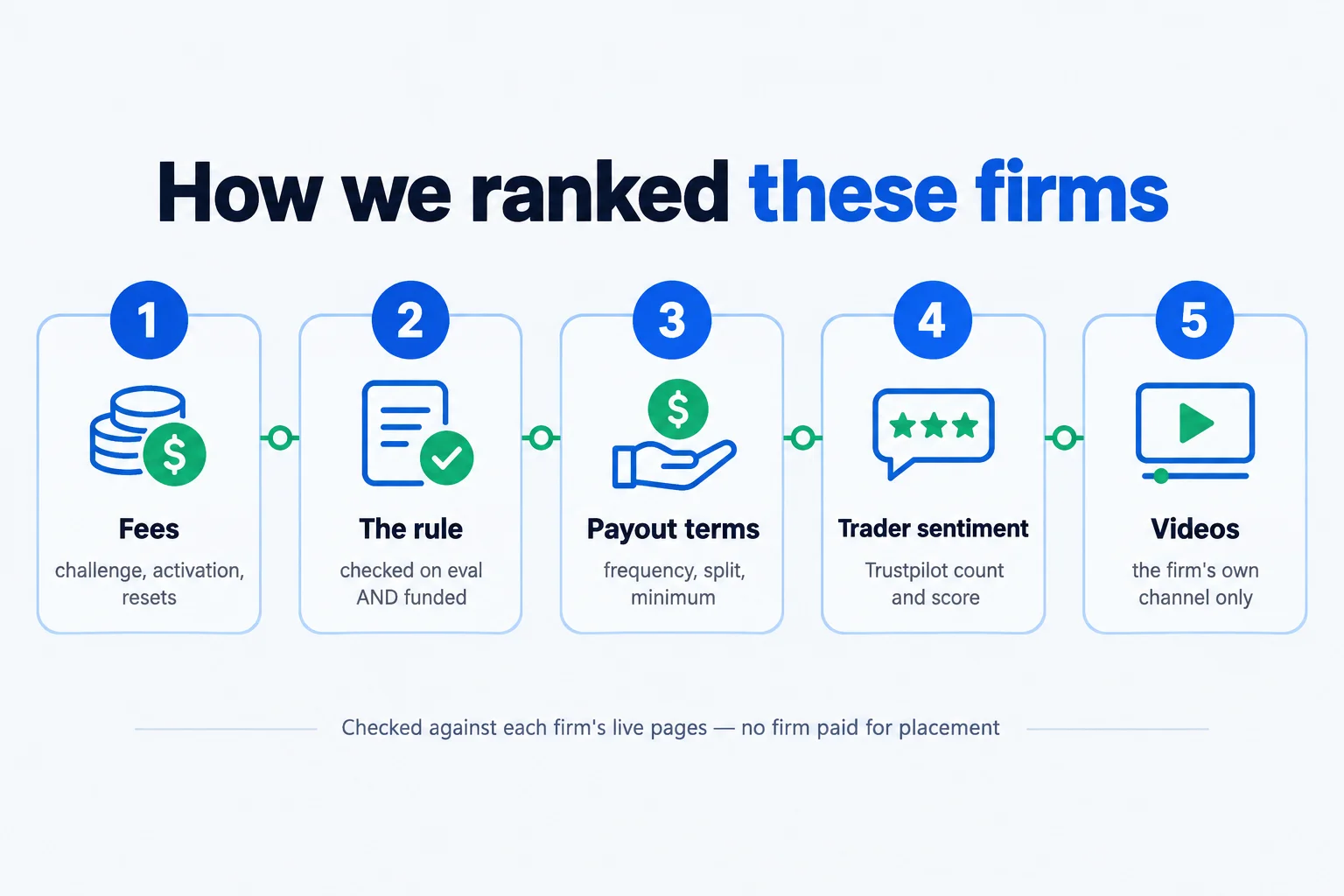
- Fit the budget: the first attempt plus every fee due before the funded account can trade (activation, or one month of a monthly fee) must be $100 or less, at list price on the firm’s own checkout.
- Count the attempts: after the first attempt, each retry is priced at the firm’s own cheapest restart of the same product and size: a paid reset, a discount with its time window, or a new purchase at list price. A fee due after passing is counted once.
- Measure the loss room: each attempt’s overall maximum loss in dollars at its tightest stage through the first payout, never a daily limit.
- Rank: attempts times loss room, the total loss room $100 buys. Ties go to the lower first-attempt cost, then the larger floor, then the lower profit needed before the first request.
- Report the payout side: for the same product, the minimum payout, split, earliest request and the smallest profit that allows a first request, so a cheap account with a steep first payout shows up.
One product is ranked per firm: its best on this test, not its cheapest sticker. Promo codes and limited-time prices never set a rank; they are listed with their dates further down. A product whose loss limit follows open profit during the day is never a firm’s ranked product, and a discretionary move to a live account is a watch-out, never a grade. Tradeify and every other firm are measured with the same tests and the same warning format. Where a firm does not publish an activation fee, the figure counts only what it publishes and carries a mark. Forex and futures arms of one brand are separate listings: FundedNext and FundedNext Futures are graded apart.
Small capital prop firms compared on a $100 budget
| Firm and product | First attempt all-in | Each retry | Loss room per try | Attempts $100 buys | Loss room $100 buys | Billing |
|---|---|---|---|---|---|---|
| 1. Blue Guardian 2 Step Nano $25K | $66.66 † | $66.66, a new purchase | $2,500 static | 1 | $2,500 | One-time |
| 2. Topstep Combine 50K, no-activation path | $95.00 ‡ | $95.00 reset | $2,000 end-of-day trailing | 1 | $2,000 | Monthly, rebills every 30 days |
| 3. Maven Trading Standard 2-Step $5K | $22.00 † | $22.00, a new purchase | $400 static | 4 | $1,600 | One-time |
| 4. AquaFunded 2 Step Elite $5K | $26.40 † | $26.40, a new purchase | $500 static | 3 | $1,500 | One-time |
| 5. FundingPips 2 Step Standard $5K, 3% daily | $36.00 † ¶ | $31.68, 12% off within 7 days | $500 static | 3 | $1,500 | One-time |
| 6. The5ers High Stakes New $2.5K | $19.00 | $19.00, a new purchase | $250 static | 5 | $1,250 | One-time |
| 7. E8 Markets E8 Pro $5K, 8% setting | $32.00 | $28.80, 10% off within 7 days | $400 static | 3 | $1,200 | One-time |
| 8. FundedNext Stellar Lite $5K | $32.99 † | $29.69 reset, until funded | $400 static | 3 | $1,200 | One-time |
| 9. Alpha Capital Group Alpha Pro 6% $10K, On-Demand | $47.00 # | $47.00, a new purchase | $600 static | 2 | $1,200 | One-time |
| 10. For Traders Classic $15K, 10/8/3 options | $91.00 ¶ | $91.00, a new purchase | $1,200 static | 1 | $1,200 | One-time |
| 11. Goat Funded Trader 2 Step GOAT $5K | $36.00 † | $33.48, 7% off, once per phase | $500 static | 2 | $1,000 | One-time |
| 12. Hola Prime 2-Step Prime $5K | $39.00 † | $39.00, a new purchase | $500 static | 2 | $1,000 | One-time |
| 13. Lucid Trading LucidFlex 25K | $79.00 ¶ | $55.00 reset within 30 days | $1,000 end-of-day trailing | 1 | $1,000 | One-time |
| 14. FTMO 1-Step $10K | $88.68 § | $88.68, a new purchase | $1,000 end-of-day trailing | 1 | $1,000 | One-time |
| 15. FXIFY Two Phase Classic $10K | $89.00 ◊ | $89.00, a new purchase | $1,000 static | 1 | $1,000 | One-time |
| 16. Tradeify Growth 25K | $99.00 | $60.00 reset | $1,000 end-of-day trailing | 1 | $1,000 | One-time |
| 17. Funded Trading Plus 2-Step Classic $10K | $89.00 | $71.20, 20% off | $800 static | 1 | $800 | One-time |
| 18. FunderPro Classic $5K | $69.00 | $69.00, a new purchase | $500 static | 1 | $500 | One-time |
| Caution: ThinkCapital Nexus $5K | $39.00 † | $39.00, a new purchase | $400 static | 2 | $800 | One-time |
| Caution: Earn2Trade TCP25 (monthly) | $289.00 ($150 + $139) ‡ | $100.00 reset | $1,500 end-of-day trailing | 0 | $0 | Monthly |
| Over $100: MyFundedFutures Builder 25K | $105.00 | $105.00, a new purchase | $1,000 end-of-day trailing | 0 | $0 | One-time |
| Over $100: FundedNext Futures Flex 50K | $133.99 | $77.99 reset | $1,500 end-of-day trailing | 0 | $0 | One-time |
| Over $100: Apex Trader Funding 25K EOD Trail | $599.00 ($490 + $109) | $490.00, a new purchase | $1,000 end-of-day trailing | 0 | $0 | One-time |
Marks. † Activation not published: Blue Guardian, Maven Trading, AquaFunded, FundingPips, FundedNext, Goat Funded Trader, Hola Prime and ThinkCapital do not name an activation fee for these products, so the figure counts only what they publish; if one charged a fee after passing, its all-in would rise by that amount and fewer attempts would fit. ‡ One month of a monthly fee: Topstep’s $95 and Earn2Trade’s $150 rebill every 30 days until you pass or cancel, so a slow pass costs another month each time; Earn2Trade’s $139 activation is taken from the first withdrawal and counted here. § Euro price: FTMO’s EUR 79 at the ECB rate of 1.1225 = $88.68; a stronger euro would raise it. ¶ Purchase-time options: FundingPips’ 3% daily option is $8 below the $44 default, on which $100 buys $1,000 of loss room instead of $1,500; For Traders’ 10% target and 3% daily options bring $117 down to $91, and the default does not fit $100; Lucid Trading’s price assumes the daily loss limit is on, and switching it off adds $10 to the price and the reset ($89 still buys one attempt, but $200 then buys two instead of three). # Payout schedule: Alpha Capital Group’s $47 is the On-Demand price; on Bi-Weekly payouts the same account is $55, so $100 buys one attempt and $600 of loss room. ◊ Exact tie: FXIFY’s Two Phase Classic and Two Phase Standard $10K match on every measure ($89, $1,000, $62.50); the Classic is named because its floor never moves.
Several firms tie on total loss room: AquaFunded and FundingPips at $1,500; E8 Markets, FundedNext, Alpha Capital Group and For Traders at $1,200; Goat Funded Trader, Hola Prime, Lucid Trading, FTMO, FXIFY and Tradeify at $1,000. Inside each tie the cheaper first attempt ranks higher.
First withdrawal on a small capital prop firm account
A small account is only worth its price if you can get paid from it. This table uses the same row order and shows, for the same product, how much profit the firm requires before the first payout request, and how soon.
| Firm | Profit split | Minimum payout | Profit needed first | Earliest first request | Fee refunded? | First watch-out |
|---|---|---|---|---|---|---|
| Blue Guardian | 80% | $100 crypto, $500 Rise | $125.00 | Every 14 days | Yes, after the 4th payout | 2% payout cap per cycle ($500); no reset |
| Topstep | 90% | $125 | $250.00 | 3 trading days (Consistency path) | No | Live call-up at the firm’s discretion |
| Maven Trading | 80% | Not published | $75.00 | Every 10 business days | Yes, on the 3rd withdrawal | No retry; 4% daily ($200) ends the account |
| AquaFunded | 90% | $100 | $111.11 | 14 days after first funded trade | Yes, with the 4th payout | No retry; 4% daily ($200) ends the account |
| FundingPips | 80% | 1% of the account ($50) | $50.00 | 14 days after the first trade | Yes, with the 4th reward | Live call-up at the firm’s discretion |
| The5ers | 80% | $150 of profit | $150.00 | 14 days after funding | 70% in cash with payout 1 | No reset; $150 minimum is 6% of the account |
| E8 Markets | 80% of the half you can request | 1% of the account ($50) | $50.00 | Any day | Not published | 2.5% daily limit ($125) ends the account |
| FundedNext | 80% | $20 by crypto or card | $25.00 | 21 days after funding | Yes, at the 3rd reward | First reward waits 21 days; no resets once funded |
| Alpha Capital Group | 80% | 2% of profit ($200) | $200.00 | On demand, after the Best Day Rule | Not published | Live call-up at the firm’s discretion |
| For Traders | 80% | $100 | $225.00 | Every 14 days, 3 profitable days | No | No reset; 3% daily ($450) ends the account |
| Goat Funded Trader | 80% | $100 | $125.00 | Every 14 days | Yes, timing not published | One reset per phase; first 2 payouts capped at $200 |
| Hola Prime | 80% | $50, excluding the firm’s share | $75.00 | Every 14 days | Yes, 25% with each of 4 payouts | No reset; 2% risk-per-idea cap checked at payout |
| Lucid Trading | 90% | $500 | $1,000.00 | After 5 days of $100 or more | Not published | Live call-up at the firm’s discretion |
| FTMO | 90% | No minimum; $20 profit by wire | $20.00 | 14th day after the first trade | No | No reset; every try is EUR 79 again |
| FXIFY | 80% | $50 | $62.50 | Every 14 days | Not on the Classic card | No reset; not sold to US residents |
| Tradeify | 90% | $250 | $1,500.00 | After 5 days of $100 or more | Not published | Live call-up at the firm’s discretion |
| Funded Trading Plus | 80% | 1% of the account ($100) | $100.00 | 10 days after account creation | Some accounts, at 10% profit | 3% per-symbol open-loss limit ($300) |
| FunderPro | 80% | $100 of profit | $100.00 | 14 days after funding | Yes, as a credit after reward 1 | 30%-off restart is a 24-hour promotion |
| ThinkCapital | 80% | Not published | Not published | Every 14 days | Not published | Pakistan accounts closed, payouts cancelled |
| Earn2Trade | 50% under $1,500, then 80% | $100 | $578.00 outside the US | After one trading day | Not published | Live call-up at the firm’s discretion |
| MyFundedFutures | 80% | $250 | $1,350.00 | 2 qualifying days; every 48 hours | Not published | Live call-up at the firm’s discretion |
| FundedNext Futures | 95% | Not confirmed on October 7 | $1,000.00 | After 5 days of $200 | Not published | Live call-up at the firm’s discretion |
| Apex Trader Funding | 100% | $500 | $1,600.00 | After 5 days of $100 or more | No | Live call-up at the firm’s discretion |
Two patterns stand out. The forex products need little profit before a first request, from $20 at FTMO to $225 at For Traders, while the futures products need $250 to $1,600 because of buffers, minimum balances or payout caps tied to profit. And a fee refund rarely arrives with the first payout: Maven Trading refunds on the third withdrawal, AquaFunded, FundingPips and Blue Guardian with the fourth, Hola Prime in four instalments, FundedNext with the third reward, and The5ers returns 70% in cash with the first. FunderPro is the exception that credits the whole fee, within 7 days of the first reward. Our prop firms with refundable challenge fees guide ranks the refund terms in detail.
What $50, $100 and $200 buy at small capital prop firms
The ranking budget is $100 because nearly every search for this question frames a low budget as under $100. Readers with less or more can read across: the same rules, at three budgets.
| Firm and product | $50 buys | $100 buys | $200 buys | Per $1,000 of room |
|---|---|---|---|---|
| Blue Guardian 2 Step Nano $25K | Does not fit | 1 try, $2,500 | 3 tries, $7,500 | $26.66 |
| Topstep Combine 50K, no-activation path | Does not fit | 1 try, $2,000 | 2 tries, $4,000 | $47.50 |
| Maven Trading Standard 2-Step $5K | 2 tries, $800 | 4 tries, $1,600 | 9 tries, $3,600 | $55.00 |
| AquaFunded 2 Step Elite $5K | 1 try, $500 | 3 tries, $1,500 | 7 tries, $3,500 | $52.80 |
| FundingPips 2 Step Standard $5K, 3% daily | 1 try, $500 | 3 tries, $1,500 | 6 tries, $3,000 | $72.00 |
| The5ers High Stakes New $2.5K | 2 tries, $500 | 5 tries, $1,250 | 10 tries, $2,500 | $76.00 |
| E8 Markets E8 Pro $5K, 8% setting | 1 try, $400 | 3 tries, $1,200 | 6 tries, $2,400 | $80.00 |
| FundedNext Stellar Lite $5K | 1 try, $400 | 3 tries, $1,200 | 6 tries, $2,400 | $82.48 |
| Alpha Capital Group Alpha Pro 6% $10K, On-Demand | 1 try, $600 | 2 tries, $1,200 | 4 tries, $2,400 | $78.33 |
| For Traders Classic $15K, 10/8/3 options | Does not fit | 1 try, $1,200 | 2 tries, $2,400 | $75.83 |
| Goat Funded Trader 2 Step GOAT $5K | 1 try, $500 | 2 tries, $1,000 | 5 tries, $2,500 | $72.00 |
| Hola Prime 2-Step Prime $5K | 1 try, $500 | 2 tries, $1,000 | 5 tries, $2,500 | $78.00 |
| Lucid Trading LucidFlex 25K | Does not fit | 1 try, $1,000 | 3 tries, $3,000 | $79.00 |
| FTMO 1-Step $10K | Does not fit | 1 try, $1,000 | 2 tries, $2,000 | $88.68 |
| FXIFY Two Phase Classic $10K | Does not fit | 1 try, $1,000 | 2 tries, $2,000 | $89.00 |
| Tradeify Growth 25K | Does not fit | 1 try, $1,000 | 2 tries, $2,000 | $99.00 |
| Funded Trading Plus 2-Step Classic $10K | Does not fit | 1 try, $800 | 2 tries, $1,600 | $111.25 |
| FunderPro Classic $5K | Does not fit | 1 try, $500 | 2 tries, $1,000 | $138.00 |
| ThinkCapital Nexus $5K | 1 try, $400 | 2 tries, $800 | 5 tries, $2,000 | $97.50 |
| Earn2Trade TCP25 (monthly) | Does not fit | Does not fit | Does not fit | $192.67 |
| MyFundedFutures Builder 25K | Does not fit | Does not fit | 1 try, $1,000 | $105.00 |
| FundedNext Futures Flex 50K | Does not fit | Does not fit | 1 try, $1,500 | $89.33 |
| Apex Trader Funding 25K EOD Trail | Does not fit | Does not fit | Does not fit | $599.00 |
At $50, 9 of the 18 ranked products still fit, and Maven Trading goes furthest: two $22 attempts and $800 of loss room. At $200 the order changes: Blue Guardian’s 2 Step Nano buys three attempts and $7,500, Topstep two attempts and $4,000, Maven nine attempts and $3,600, and Lucid Trading three attempts and $3,000. MyFundedFutures and FundedNext Futures fit $200 once; Earn2Trade and Apex Trader Funding do not fit even $200.
Why the cheapest sticker is not the best small capital pick
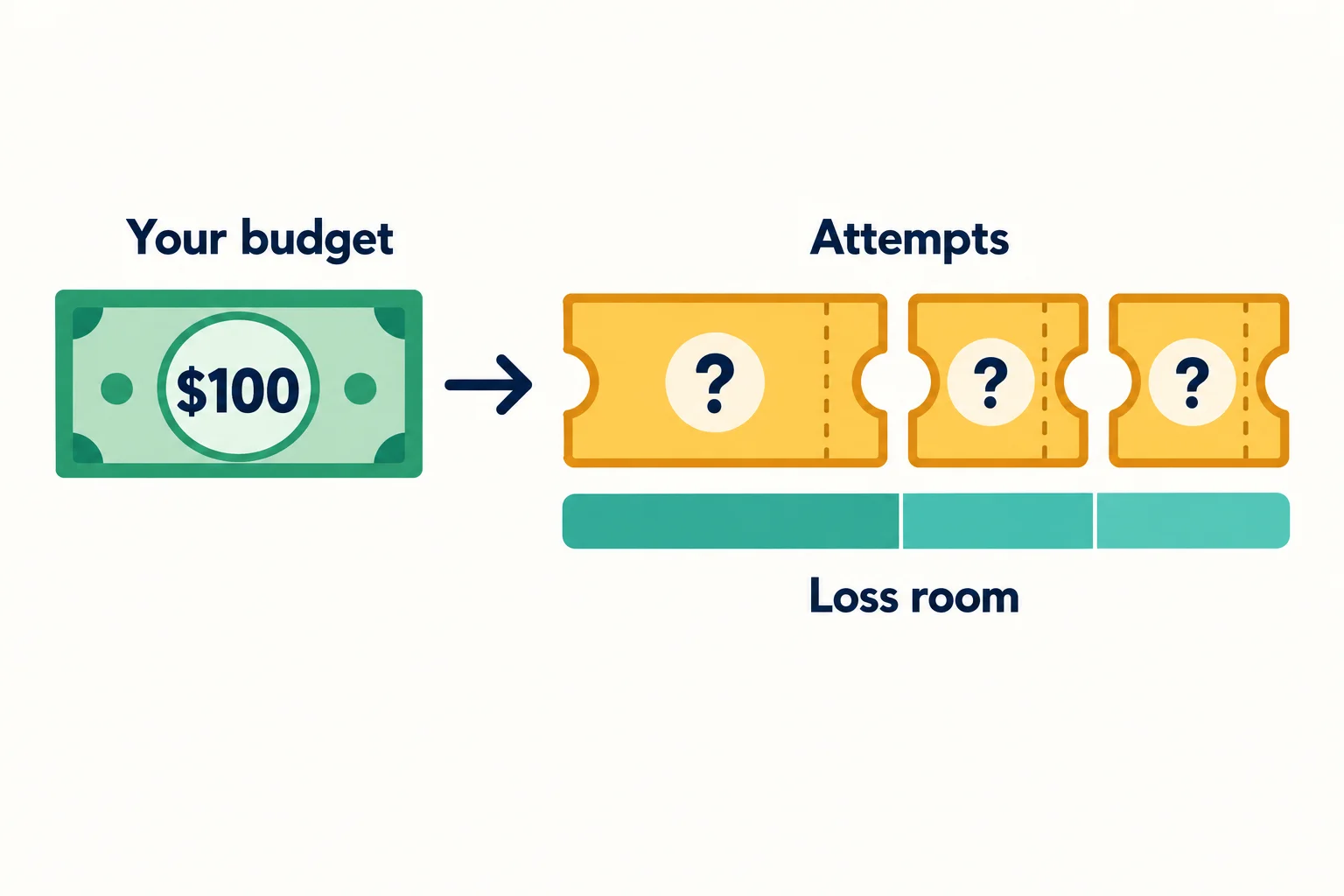
Five $19 attempts at The5ers add up to $1,250 of loss room. One $66.66 attempt at Blue Guardian’s 2 Step Nano gives $2,500. The cheaper sticker buys half the room, because a $2,500 account has a $250 floor and a $25,000 account has a $2,500 one. Cost per $1,000 of loss room shows the same thing in one number: $26.66 at Blue Guardian against $76.00 at The5ers and $138.00 at FunderPro.
Fees after the sticker change the answer more often than the sticker itself. Topstep’s Standard Path shows $49 a month, but passing adds a $149 activation, $198 in all. Apex Trader Funding’s 25K Intraday Trail is $167 plus $89, and the 25K EOD Trail is $490 plus $109. Earn2Trade’s $150 TCP25 carries a $139 LiveSim activation taken from the first withdrawal. Pay-later products work the other way: Blue Guardian’s Buy Now Pay Later $5K is $10 now and $52 after passing, which still fits $100, while Funded Trading Plus’s Activation Accounts ($4 now, $179 on passing) and Maven’s Buy Now, Pay Later have floors that follow open profit, so they are not ranked. Our cheapest prop firms guide prices one attempt to a first payout at larger sizes; this one prices how far a fixed budget goes.
Monthly and one-time billing on a small budget
Seventeen of the 18 ranked products are one-time purchases with no monthly rebill (Apex’s evaluations, in the over-budget group, expire after 30 days). Topstep is the ranked exception. Its $95 rebills every 30 days until you pass or cancel, so a two-month pass costs $190 and a three-month pass $285, with a Reset Credit banked at each rebill. Earn2Trade’s TCP25 works the same way at $150 a month. On a small budget, a monthly product suits a trader who expects to pass quickly; a one-time product suits one who needs time.
Activation fees are the other recurring surprise. Among the ranked firms, only Topstep publishes one, $149 on its Standard Path, which is why its No Activation Fee Path is the product ranked. Lucid Trading, Tradeify, E8 Markets, FTMO, FXIFY, Alpha Capital Group, For Traders, Funded Trading Plus, FunderPro and The5ers state they charge no activation fee, and the eight firms marked † in the budget table publish no figure either way. Our prop firms with no activation fee guide covers that question across larger accounts.
Drawdown rules on a small capital account, worked in dollars
The loss limit decides how much room each attempt really has, and at small sizes the type of limit matters as much as the size. Three types appear in this guide:
- Static: Maven Trading’s Standard 2-Step $5K fails if equity falls below $4,600 at any point. The line never moves, so a trader who first makes $300 has $700 of room above it. Fourteen of the 18 ranked products use a static floor.
- End-of-day trailing: Lucid Trading’s LucidFlex 25K keeps its $1,000 floor under the highest closing balance. Close a day at $25,600 and the floor moves up to $24,600; an intraday high given back before the close does not move it, and the floor stops once it locks. Topstep’s locks at the $50,000 start and Tradeify’s funded floor at $26,100.
- Follows open profit: some products move the floor up with the best open profit during the day, so a trade that is up $400 and then closes flat has used $400 of room. Apex Trader Funding’s 25K Intraday Trail and Maven’s 1-Step, Instant and Mini work this way. None of them is a ranked product here.
| Firm and product | How the floor moves | Daily loss limit | Profit target | Minimum days |
|---|---|---|---|---|
| Blue Guardian 2 Step Nano $25K | Static, open trades count | 3% ($750), ends the account | $2,000, then $1,250 | No minimum |
| Topstep Combine 50K, no-activation path | Trails end-of-day balance, locks at start | No default limit; optional pause | $3,000 | No minimum; can pass in 2 days |
| Maven Trading Standard 2-Step $5K | Static | 4% ($200), ends the account | $400, then $250 | 3 profitable days a phase |
| AquaFunded 2 Step Elite $5K | Static, open trades count | 4% ($200), ends the account | $400, then $250 | 3 trading days a step |
| FundingPips 2 Step Standard $5K, 3% daily | Static | 3% ($150), ends the account | $400, then $250 | No minimum |
| The5ers High Stakes New $2.5K | Static | 5% ($125), ends the account | $250, then $125 | 3 profitable days a step |
| E8 Markets E8 Pro $5K, 8% setting | Static until the first payout | 2.5% ($125), ends the account | $400 in one step | No minimum |
| FundedNext Stellar Lite $5K | Static | 4% ($200), ends the account | $400, then $200 | 5 a phase |
| Alpha Capital Group Alpha Pro 6% $10K, On-Demand | Static | 3% ($300), ends the account | $600, then $600 | 3 a phase |
| For Traders Classic $15K, 10/8/3 options | Static, balance-based | 3% ($450), ends the account | $1,500, then $750 | 3 profitable days a phase |
| Goat Funded Trader 2 Step GOAT $5K | Static | 4% ($200), ends the account | $400, then $300 | 3 profitable days a phase |
| Hola Prime 2-Step Prime $5K | Static | 5% ($250), ends the account | $400, then $250 | 3 trading days a phase |
| Lucid Trading LucidFlex 25K | Trails highest close, then locks | $600 if switched on; pauses the day | $1,250 | 1 day |
| FTMO 1-Step $10K | Trails end-of-day balance high | 3% ($300), ends the account | $1,000 in one step | No minimum |
| FXIFY Two Phase Classic $10K | Static | 4% ($400), ends the account | $500, then $1,000 | 4 days |
| Tradeify Growth 25K | Trails end-of-day, locks at $26,100 | $600, pauses the day | $1,500 | 1 day |
| Funded Trading Plus 2-Step Classic $10K | Static, balance-based | 4% ($400), ends the account | $700, then $700 | No minimum |
| FunderPro Classic $5K | Static | 5% ($250), ends the account | $500, then $250 | 4 a phase |
| ThinkCapital Nexus $5K | Static | 4% ($200), ends the account | $350, $300, then $250 | Not published |
| Earn2Trade TCP25 (monthly) | End-of-day trailing | $550, ends the evaluation | $1,750 | No minimum |
| MyFundedFutures Builder 25K | Trails end-of-day, locks at +$100 | $600, pauses the day | $1,500 | 1 day on the card, 2 elsewhere |
| FundedNext Futures Flex 50K | Trails end-of-day, locks at payout 1 | No daily limit | $2,500 | Not shown on the plan card |
| Apex Trader Funding 25K EOD Trail | Trails end-of-day, enforced live | $500, pauses the session | $1,500 | 1 day; 30-day expiry |